Louisiana
Here's When Louisiana Classrooms Will See Ten Commandments Posted


Louisiana won’t take official steps to implement a law requiring the Ten Commandments be placed in all of the state’s public school classrooms until at least November as a lawsuit makes its way through the courts, according to an agreement approved by a federal judge Friday.
The suit was filed in June by parents of Louisiana public school children with various religious backgrounds, who said the law violates First Amendment language forbidding government establishment of religion and guaranteeing religious liberty. Backers of the law argue that the Ten Commandments belong in classrooms because the commandments are historical and are part of the foundation of U.S. law.
The Louisiana law requires the commandments be posted no later than Jan. 1, a deadline unaffected by Friday’s agreement. The deal assures that the defendants in the lawsuit — state education officials and several local school boards — will not post the commandments in classrooms before Nov. 15, and won’t make rules governing the law’s implementation before then.
Lester Duhe, a spokesman for Louisiana Attorney General Liz Murrill, said the defendants “agreed to not take public-facing compliance measures until November 15” to provide time for briefs, arguments and a ruling.
In 1980, the U.S. Supreme Court ruled that a similar Kentucky law violated the establishment clause of the U.S. Constitution, which says Congress can “make no law respecting an establishment of religion.” The high court found that the law had no secular purpose but rather served a plainly religious purpose.
In 2005, the Supreme Court held that such displays in a pair of Kentucky courthouses violated the Constitution. At the same time, the court upheld a Ten Commandments marker on the grounds of the Texas state Capitol in Austin.
Louisiana’s new law does not require school systems to spend public money on Ten Commandments posters. It allows the systems to accept donated posters or money to pay for the displays.
The law also specifically authorizes but does not require other postings in public schools, including: The Mayflower Compact, which was signed by religious pilgrims aboard the Mayflower in 1620 and is often referred to as America’s “First Constitution”; the Declaration of Independence; and the Northwest Ordinance, which established a government in the Northwest Territory — in the present day Midwest — and created a pathway for admitting new states to the Union.
The legal challenge to the law came soon after it was signed by Republican Gov. Jeff Landry, a Republican who succeeded two-term Democratic Gov. John Bel Edwards in January. Landry’s inauguration marked a full takeover of state government by the GOP in a Bible Belt state where the party already held other every statewide elected position and a supermajority in the Legislature.
LOOK: Things from the year you were born that don’t exist anymore
Gallery Credit: Stacey Marcus



On Monday morning in New Orleans, 23-year-old Daniel Cressy rang a bell inside Manning Family Children’s hospital and stepped into what he calls “Life 2” — a life, for the first time, free of sickle cell disease.
His treatment using Casgevy’s CRISPR/Cas9, a gene-editing technology, makes him the first patient in Louisiana and the Gulf South to receive the therapy. It is a milestone that doctors say signals a turning point for a disease that has long devastated Black communities with too few answers and even fewer options.
“While many spend their lives searching for purpose, mine found me,” Cressy said after being found sickle cell free. “Now, instead of looking for meaning, I can spend my life fulfilling it.”
Cressy’s bell-ringing is the latest in a string of firsts reshaping the country’s approach to sickle cell. In 2024, 21-year-old Sebastien Beauzile became the first in New York to be treated. Declaring afterward, “I feel unstoppable.”
Earlier this year, 24-year-old Chantez Sanford Jr. became the first person in Michigan to receive Lyfgenia — the second FDA-approved gene therapy — at Children’s Hospital of Michigan in Detroit, reporting more energy and fewer pain episodes just months later.
Both treatments were approved by the FDA in December 2023, and are now itching toward being used more widely.
The stakes are high. Sickle cell disease affects approximately 100,000 people in the United States, with more than 90% being Black. Louisiana, the second-Blackest state in the U.S., carries one of the highest per-capita burdens of any state in the country.
The hospital’s chief executive officer, Lucio Fragoso, said Cressy’s cure provided a substantial reason to “hope” for the South.
“Curative gene therapy is restoring futures, and Daniel has paved the way for what is possible together with his care team,” Fragoso said. “This is a proud and transformational moment for all of us.”
Diagnosed as an infant, Cressy had long harbored a dream of becoming a commercial airline pilot — until the federal government told him his sickle cell diagnosis was disqualifying. He appealed, but the answer didn’t budge. A cure was his only option.
When Manning Family Children’s hospital received approval to offer the gene-editing treatment, Cressy began working with his doctors. In late 2025, his cells were sent to Scotland for genetic modification, returned to New Orleans this March, and infused back into his body on March 18.
Sickle cell disease causes red blood cells — normally round and flexible — to harden into a rigid, crescent shape that can’t move easily through blood vessels. Those misshapen cells block blood flow and oxygen delivery to organs and tissue, triggering episodes of excruciating pain, strokes, and over time, irreversible organ damage. The disease is most prevalent among people whose ancestors come from regions where malaria was historically endemic, namely sub-Saharan Africa. In the U.S., it was passed down at higher rates through generations of descendants of enslaved Africans.
But even as the science advances, access remains an open and urgent question. Cressy’s treatment carries a list price of $2.2 million; Lyfgenia, runs $3.1 million. The very communities most burdened by sickle cell disease are also, structurally, the least positioned to navigate a $3 million treatment pathway.
Studies show that those diagnosed with sickle cell disease are more likely to be poor and face challenges with access to stable housing and healthy food.
Between 50% and 60% of people living with sickle cell disease are enrolled in Medicaid, a program that has historically struggled to connect people with high-cost medical therapies. As of December 2025, only 33 states and two territories had opted into a model designed to standardize Medicaid access to sickle cell treatments — leaving significant gaps. Cressy, who joins about 100 other Americans who’ve received this treatment, was able to access care under Louisiana’s Medicaid program.
Cressy knows that weight, and says he feels a sense of obligation because of it.
“I feel like God chose me to be the first one in the state because my story, once I do finally become a commercial pilot, is going to be inspirational for a lot of people,” he said. “Overcoming what seemed impossible became my greatest blessing.”
Read More:
Medicaid Tries New Approach With Sickle Cell

SHREVEPORT, La. (KSLA) – Attack ads aimed at Louisiana Treasurer John Fleming and U.S. Rep. Julia Letlow have been running for weeks as the two Republicans compete in the race for Louisiana’s open U.S. Senate seat.
Fleming said political action committees have been “running dishonest attack ads for two weeks solid,” including ads he said connect him to the Sept. 11 attacks.
“I fully expect at some point they would connect me to the assassination of Lincoln,” Fleming said.
Letlow said she wants negative campaigning to stop.
“I’ve had $15 million dropped on my head in negative ads, and I understand that’s why people won’t run,” Letlow said.
Carbon capture has also been a major issue in the race. Carbon capture is described in the report as a process in which carbon dioxide from industrial installations or natural resources is separated before it is released into the atmosphere and then transported to a long-term storage location.
Fleming said he opposes carbon capture. Letlow said claims about her position have been misrepresented.
What Fleming, Letlow say on carbon capture
“I want a good economy for Louisiana, but there are things we have to do like lowering taxes, reducing insurance rates to get better business — not by a toxic dump of carbon dioxide,” Fleming said, referencing what he called “Julia Letlow and Jeff Landry’s method” of pursuing economic growth.
Letlow said she does not support projects that are not safe or lack community support.
“If the project is not safe, if it does not have community finance, I believe it should not move forward,” Letlow said. She also said she appreciates “the governor’s moratorium on the projects until they can be fully vetted,” and told voters not to believe what they read on social media.
Candidate backgrounds highlighted in the report
The report said Fleming previously served in Congress and was appointed to several positions in the Trump administration. Fleming is described as a Minden native, a Navy veteran, a physician and a businessman.
Fleming said he is mostly funding his own campaign.
“I can’t be bought,” Fleming said. “I stand for the individual people.”
The report said Letlow is a Monroe native. It said she ran in a 2021 special election for a vacant congressional seat previously held by her late husband, Luke Letlow, who died from COVID.
Letlow said her priorities include safe communities, border security and growing the economy.
“I want those safe communities for our kids,” Letlow said. “I will continue working with the president to make sure our border remains secure. I also want to grow our economy.”
Copyright 2026 KSLA. All rights reserved.
Louisiana
Q&A: Louisiana U.S. Senate candidates sound off on important issues ahead of primary runoff

Louisiana heads to the polls again on Saturday, June 27, as both Republicans and Democrats will hold party primary run-offs for Bill Cassidy’s U.S. Senate seat. Polls open at 7 a.m. and close at 8 p.m.
Republican voters will choose between Congresswoman Julia Letlow and state Treasurer John Fleming, while Democratic voters will choose between Jamie Davis, the state party’s endorsed candidate in the race, and Gary Crockett, who faces Davis after Nick Albares ended his campaign in late May.
Below is a list of questions WRKF sent to the four candidates and their responses. The responses have been edited and condensed for clarity.
Louisiana’s primary is this Saturday, May 16. See what’s on the ballot.
Gary Crockett (Democrat)
Photo courtesy of Gary Crockett
On abortion:
I am Moderate/pro-choice. I support legal abortion in some circumstances. I oppose total abortion bans. I absolutely support exceptions for rape, incest, and threats to the mother’s life. I am in favor of preserving access but totally against 3rd trimester abortions unless the woman’s life is in jeopardy.
On the death penalty:
I’m a moderate when it comes to the death penalty, and my view is to “keep it for the worst offenders” and allow for conclusive DNA testing for all who are sentenced to death.
On President Donald Trump:
I have strong opposition to Trump because his policies don’t work for the people who work.
The working-class people are suffering economically because Trump’s policies only benefit billionaires and large corporations.
Trump should spend more time focusing on economic and governance issues rather than filling the pockets of himself and his family.
On ‘The Epstein Files’
I call for the immediate release of non-sensitive records consistent with the law.
I support the investigation of wrongdoing regardless of political affiliation or person, including videos and files implicating the president.
I call for equal justice under the law with no actions or procedures to protect powerful individuals.
On carbon sequestration
I do not support research and deployment of carbon-capture technologies.
I reject the idea and any rhetoric that presents carbon sequestration as the only climate solution.
On DEI (Diversity, Equity, and Inclusion)
America has many mountains to climb in the areas of equal opportunity and anti-discrimination efforts.
Despite emphasizing merit, skills, and fairness, the current Secretary of Defense and this administration have discriminated against members of our own forces for promotions, even after passing several boards in which their counterparts took the same testing and were evaluated equally, but only minorities were refused promotions.
I want mandates ensuring everyone has a fair chance while maintaining standards.
What are your proudest accomplishments?
I am most proud of my 20+ years of military service and being a father of 4 great children.
What will be your top three priorities in office?
The economy, which includes increasing the minimum wage, creating opportunities, both economic and social, for our next generation of young people, and a better and more robust healthcare system for all — especially the rural areas of America.
Jamie Davis (Democrat)

Greg LaRose
/
Louisiana Illuminator
On abortion:
We flattened all of women’s healthcare into one issue, and it made many women less safe.
Politicians and laws shouldn’t be in the room with a woman and her doctor.
Since the Supreme Court struck down Roe, women have died on operating tables because doctors have been afraid to help.
We should restore women’s right to healthcare, trust them as the mothers to make important family and personal decisions, codify Roe, and keep the government out of their business.
On the death penalty:
It is not up to us to decide whether someone lives or dies. There is no moral justification. We are not the most high.
I agree with punishments that fit the crime, but when did we become the judges of whose lives we take vs. who we allow to live?
On President Donald Trump:
He’s the president for two more years, and here’s what I know.
A lot of Louisiana voters believed in him, and I think he’s let them down and left them with empty promises.
On ‘The Epstein Files’
They need to be released, and people should face consequences.
There are too many distractions flying around D.C., but if I’m elected, I’ll be another voice advocating for justice for the survivors.
On carbon sequestration
Decisions about our land, water, and future should not be made solely at the state or federal level without local consent.
Communities deserve the final say when projects threaten their property rights, safety, and quality of life.
I oppose CCS by way of eminent domain to seize private property for carbon pipelines.
No family should be forced to give up their land so corporations can profit from taxpayer-backed projects.
I also support repealing the federal 45Q tax credit, which has subsidized CCS projects while shifting the risks onto local communities.
Instead of spending taxpayer dollars on carbon capture schemes, we should invest in clean energy, infrastructure, and economic development that create good-paying jobs without putting Louisiana communities in harm’s way.
On DEI (Diversity, Equity, and Inclusion)
According to President Trump and the U.S. Supreme Court, DEI is over with.
We need to get serious and focus on ensuring everyone has a fair shot at making a living.
What are your proudest accomplishments?
I was the first person in my immediate family to graduate from high school, something that meant a great deal to my parents and opened doors for me that they never had.
In my early 20s, my father had to undergo back surgery during the farming season. Successfully managing the farm and bringing in the crop while he recovered gave me confidence and taught me the value of responsibility, hard work, and perseverance.
I am also proud of my service to my community. When I was elected to the Tensas Parish Police Jury, I unseated the longest-serving police juror in the State of Louisiana, proving that hard work, determination, and a willingness to listen to people can bring about meaningful change.
Through each of these experiences, my faith, family, and commitment to service have guided me and continue to shape the way I approach leadership today.
Above all, I am proud of my family. Becoming a husband, father, and grandfather has been the greatest blessing of my life.
What will be your top three priorities in office?
My top three priorities are affordability, healthcare, and opportunity.
First, I will work to lower the cost of living by addressing the rising costs of housing, insurance, utilities, and everyday necessities while supporting family farms, small businesses, and good-paying jobs.
Second, I will fight to protect healthcare by defending Medicaid, strengthening rural hospitals at risk of closing, lowering prescription drug costs, and protecting Social Security and Medicare and the subsidies that keep premiums affordable.
I will address opportunity in a few ways:
- First, invest in education, higher federal minimum wages, and workforce development, so that every Louisianan has the opportunity to succeed and build a future here at home.
- I will also push for a national ban on partisan gerrymandering so that we get elected officials away from drawing maps and back to solving problems and working together. Every American deserves fair representation and a voice that matters. They also deserve to know their elected official is accountable to them, not scheming to draw voters they don’t like into another district.
- Lastly, I will fight for a strong Farm Bill that supports family farmers, improves and expands SNAP benefits, strengthens rural communities, improves crop insurance and safety nets, and ensures that those who feed our country can continue to make a living on the land.
My goal is simple: to help create a Louisiana we can all afford and an economy that works for everyone.
State Treasurer John Fleming (Republican)

Photo courtesy of John Fleming
On abortion:
100% opposed to abortion. I have a 100% voting record in opposition to abortion.
On the death penalty:
I support the death penalty, especially in capital cases.
On President Donald Trump:
I fully support President Trump
On ‘The Epstein Files’
I support full release and disclosure
On carbon sequestration
I am totally opposed and never voted for Carbon Sequestration
On DEI (Diversity, Equity, and Inclusion)
Totally opposed and never voted for DEI.
Legislation you are most proud of and why?
- Amtrak Secure Transportation of Firearms Act of 2009. The bill required Amtrak to permit passengers to safely transport unloaded firearms and ammunition in declared, locked, hard-sided containers within checked baggage
- Federal Duck Stamp Act of 2014, which increased the price of the federal Migratory Bird Hunting and Conservation Stamp (Duck Stamp) from $15 to $25 to generate critical funding for wetland conservation
- Passed an amendment to the annual NDAA to prevent atheists from being hired in the military as chaplains.
How do you feel your record is viewed in Congress?
- The most conservative of any congressman in Louisiana, according to voting scorecards.
- One of the nine original founders of the House Freedom Caucus.
- Led the fight against the Affordable Care Act, which has driven healthcare costs to twice the rate of inflation.
What are your proudest accomplishments?
Fighting against abortion and ultimately reducing the rates of abortion as well as getting the right justices to make abortion a state issue, not a federal right.
What will be your top three priorities in office?
- Repeal the 45Q tax credits to end Carbon Sequestration.
- Reform healthcare to bring back competition and price transparency so that costs go down while quality of care improves.
- Serve on the Senate Armed Services Committee to support our national defense and defend our two major military bases in Louisiana.
Congresswoman Julia Letlow (Republican)
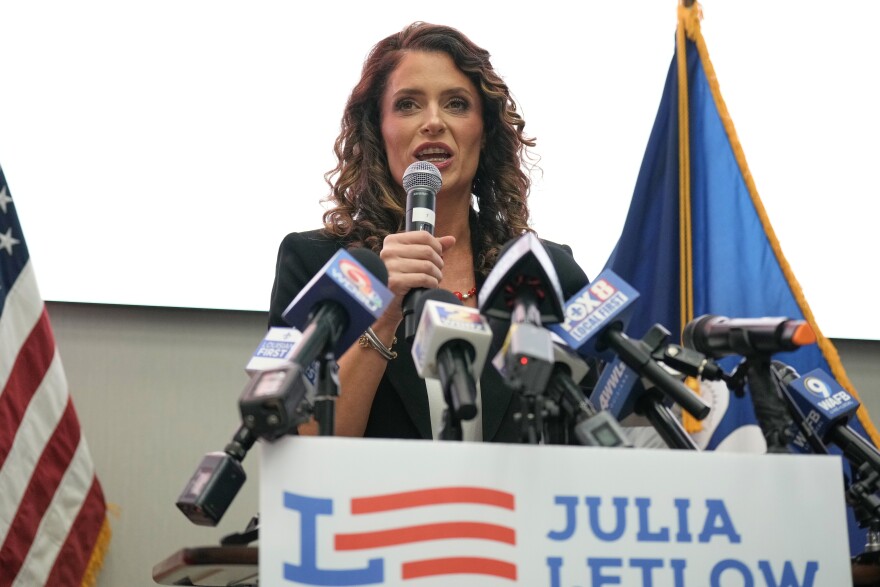
Matthew Hinton
/
AP Photo
On abortion:
I am unapologetically pro-life. As a mother, I believe every life is precious and worth protecting.
In Congress, I have consistently opposed taxpayer funding for abortion and supported legislation that defends the unborn.
In the Senate, I will continue to be a strong, unwavering pro-life voice for Louisiana families.
On the death penalty:
I support the death penalty for the most heinous crimes. There are evil acts so horrific that the ultimate punishment is justified.
I also believe victims and their families deserve justice, and I will always stand with law enforcement and those who work to keep our communities safe.
On President Donald Trump:
President Trump called on me to run for this Senate seat because he knows I’m conservative to my core and will always have his back.
I was honored to earn his complete and total endorsement, and I look forward to being his partner in the Senate to secure the border, unleash American energy, protect our values and finish the America First agenda.
On ‘The Epstein Files’
The American people deserve transparency and accountability. Anyone who committed crimes should be prosecuted to the fullest extent of the law.
The Department of Justice should follow the facts wherever they lead and ensure justice is served.
On carbon sequestration
I support Gov. Landry’s moratorium on new CCS permits.
My position is simple: if a project is not safe, not transparent, and does not have local buy-in, it should not move forward.
This is a state issue, and I trust Gov. Landry and our legislature to put the right protections in place for Louisiana communities.
On DEI (Diversity, Equity, and Inclusion)
Like many Americans, I initially saw DEI being presented as a way for students to achieve the American dream. But the radical left turned it into a system of division, indoctrination, and holding people down.
In Congress, I have fought against it every single day by authoring the Parents’ Bill of Rights to strip DEI from our K-12 programs, supporting the End Woke in Higher Education Act, and voting to remove DEI programs from the military.
I will continue to fight against DEI in the U.S. Senate.
Legislation You Are Most Proud Of and Why?
The legislation I’m most proud of is the Parents’ Bill of Rights.
As a mother and former educator, I believe parents should have a seat at the table when it comes to their children’s education.
The bill gives parents greater transparency into curriculum, school budgets, and what is happening in their children’s classrooms. It puts families back in charge and protects children from political agendas that don’t belong in schools.
How Do You Feel Your Record Is Viewed in Congress?
I think my record is viewed as one of someone who shows up, does the work and delivers results.
I’ve served on the Appropriations Committee, brought hundreds of millions of dollars back to Louisiana communities, fought for parents, supported our farmers and law enforcement officers and stood with President Trump.
I’ve earned a reputation as a conservative who gets things done and listens to the people whom I serve.
What Are Your Proudest Accomplishments?
I’m proud of the Parents’ Bill of Rights.
I’m proud of the work we’ve done to support Louisiana agriculture, including getting legislation I authored included in the Farm Bill.
I’m proud of the resources I’ve helped deliver to Louisiana communities for infrastructure, healthcare, and public safety.
And most importantly, I’m proud to have earned the trust of the people of Louisiana and President Trump.
What Will Be Your Top Three Priorities in Office?
First, border security and public safety. We must make President Trump’s border policies permanent, deport criminal illegal aliens, stop fentanyl and support law enforcement.
Second, growing Louisiana’s economy. That means unleashing American energy, cutting wasteful spending, lowering costs, supporting our farmers and fishermen and creating more good-paying jobs.
Third, education and families. I’ll continue fighting for school choice, parents’ rights, transparency in education and protecting girls’ sports and opportunities for the next generation.
Those three priorities all come back to one goal: making Louisiana safer, stronger, and more prosperous for our children and grandchildren.
-

 Wyoming3 minutes ago
Colorado And Oregon Lift Fishing Restrictions, Drought Will Kill Fish Anyway
-

 Crypto6 minutes ago
Bitcoin Slides Nearly 20% in June as $715M in Crypto Long Bets Collapse
-

 Finance11 minutes ago
Anne Arundel County Launches New Finance and Procurement Platform
-

 Fitness18 minutes ago
How Kaye Adams’ varied exercise routine keeps her fit at 63 – and why she swapped HIIT for walking
-

 Movie Reviews26 minutes ago
8News Reel Talk: ‘Toy Story 5’ movie review
-

 World36 minutes ago
Strong Earthquake Rocks Venezuela Capital
-

 Health1 hour ago
Does Berberine Aid Weight Loss? The Best Time To Take It To Boost Results
-
 Lifestyle1 hour ago
John Cena wanted to step away from the WWE ring before he became ‘too slow for the show’ : Wild Card with Rachel Martin

