Kentucky
How Mark Pope’s First Year at Kentucky Stacks Up Against His Coaching Peers


The dust has settled on Mark Pope’s first season at Kentucky, and although it ended in disappointing fashion, I think most fans would agree it was a success. As hungry as Big Blue Nation is for the program to return to glory, Pope’s first squad provided some major highs, including an NCAA record eight wins over AP Top 15 teams and a return to the second weekend of the NCAA Tournament.
The Cats also became beloved by fans, a ragtag group assembled in a matter of weeks from mostly smaller schools through the transfer portal. They battled injuries and played with a chip on their shoulder and a genuine appreciation for the Kentucky jersey, guided by Pope, a former team captain and national champion. There were some lows (the loss to Tennessee in the Sweet 16, the loss to Arkansas in John Calipari’s return to Rupp Arena); however, Pope and the Cats infused the program and fanbase with some needed joy and hope for the future.
Work is underway on year two. While we wait to see what that looks like, I thought it’d be good to compare Pope’s first season to some of his coaching counterparts. Obviously, Kentucky’s reputation as a blueblood, the current state of the sport with the transfer portal and NIL, and the SEC’s strength this season are important variables, but Pope’s record stacks up pretty well.
Mark Pope, Kentucky (2024-25)
Final Record: 24-12 (.667)
Regular Season Record: 21-10
SEC Record: 10-8 (6th)
SEC Tournament: 1-1 (Quarterfinals)
NCAA Tournament: 2-1 (Sweet 16)
As mentioned, the Cats tallied an NCAA record eight wins over AP Top 15 teams and made it to the Sweet 16 for the first time since 2019, all while dealing with injuries to several starters. Pope’s offense ranked in the top ten nationally throughout the year, and the Cats’ 341 three-pointers broke the school record for most in a season.
Nate Oats, Alabama (2019-20)
Final Record: 16-15 (.516)
Regular Season Record: 16-15
SEC Record/Finish: 8-10 (9th)
SEC Tournament: N/A (Canceled due to COVID)
NCAA Tournament: N/A (Canceled due to COVID)
A former math teacher, Nate Oats came to Alabama after four seasons at Buffalo, where he led the Bulls to the NCAA Tournament in three seasons, losing to Kentucky in the second round in 2018. His fast-paced, five-out offense has become one of the most successful in the sport (as evidenced by the Crimson Tide’s record 25 threes in the vs. BYU in the Sweet 16), but it took him at least one season to get his system in place.
Alabama went 16-15 in Oats’ first year in Tuscaloosa, losing four of its last six games. The NCAA Tournament was canceled that season due to COVID, but the Crimson Tide would have been on the outside looking in, barring a strong run in the SEC Tournament. Since then, Alabama has made the NCAA Tournament each season, reaching the Final Four in 2024 and the Elite Eight in 2025.
Bruce Pearl, Auburn (2014-15)
Final Record: 15-20 (.428)
Regular Season Record: 12-19
SEC Record/Finish: 4-14 (13th)
SEC Tournament: 3-1 (Semifinals)
NCAA Tournament: Didn’t make field
Pearl inherited an Auburn team that went 14-16 under Tony Barbee. He still had five months left on his show-cause order from his NCAA violations at Tennessee, so he wasn’t able to contact recruits during the summer recruiting period. The Tigers went 15-20 that season, losing to Kentucky in the SEC Tournament semifinals. In the decade since, Pearl has steadily built Auburn into a perennial power, leading the Tigers to two Final Fours (2019, 2025). The Tigers are the No. 1 overall seed in this year’s tournament and will face Florida for a spot in the national championship game on Saturday.
Todd Golden, Florida (2022-23)
Final Record: 16-17 (.484)
Regular Season Record: 16-15
SEC Record/Finish: 9-9 (8th)
SEC Tournament: 0-1
NCAA Tournament: Didn’t make field (NIT First Round)
Golden succeeded Mike White, who left Florida for Georgia. It was a big step up for Golden, who had just led San Francisco to the NCAA Tournament for the first time since 1998. The Gators did not make the NCAA Tournament in Golden’s first season, finishing the season 16-17 with a loss in the first round of the NIT, but there were bright spots, including a win over No. 2 Tennessee.
Obviously, Florida’s been on the rise since then, winning 24 games in Golden’s second season and now reaching the Final Four in his third. A young coach with a very modern offense, Golden is a success story in the new age of college basketball.
Rick Barnes, Tennessee (2015-16)
Final Record: 15-19 (.441)
Regular Season Record: 13-18
SEC Record/Finish: 6-12 (12th)
SEC Tournament: 2-1 (Quarterfinals)
NCAA Tournament: Didn’t make field
Barnes came to Tennessee after being fired by Texas, where he spent 17 seasons. He replaced Cuonzo Martin, becoming the third coach in as many seasons for the Vols. It took a few seasons for Barnes to get rolling in Knoxville, but in his third year, he had Tennessee back in the NCAA Tournament, and the Vols have made it every year since (omitting 2020, when the tournament was canceled due to COVID). As we know, they’ve still never made it past the Elite Eight.
John Calipari, Arkansas (2024-25)
Final Record: 22-14 (.611)
Regular Season Record: 19-12
SEC Record/Finish: 8-10 (9th)
SEC Tournament: 1-1 (2nd Round)
NCAA Tournament: 2-1 (Sweet 16)
You know all about John Calipari’s history before taking the Arkansas job. After leaving Kentucky for Fayetteville, Calipari assembled a roster with one of the biggest NIL budgets in college basketball. The Razorbacks struggled to start SEC play, losing six of their first seven conference games, but the win over Kentucky in Rupp lit a fire under the squad, which made it to the Sweet 16, the furthest Calipari had gone since 2019. The turnaround was commendable, but given the resources, the jury is still out on whether the Cal era at Arkansas will be deemed a success.

Pat Kelsey, Louisville (2024-25)
Final Record: 27-8 (.771)
Regular Season Record: 25-6
ACC Record/Finish: 18-2 (2nd)
ACC Tournament: 2-1 (Finals)
NCAA Tournament: 0-1 (1st Round)
There was nowhere for Louisville to go but up in Pat Kelsey’s first season. The Cards went from finishing last in the ACC in the previous two seasons under Kenny Payne to finishing second with an 18-2 conference record. They lost to Duke in the ACC Tournament championship and finished No. 10 in the AP Poll, even though they drew a No. 8 seed in the NCAA Tournament, where they lost to Creighton in the first round. Kelsey took home ACC Coach of the Year honors. The ACC was very weak this season, but there’s no doubt that Kelsey has the Cards on the right track — even if he lost his first game against Kentucky, 93-85 at Rupp Arena.
Mike Woodson, Indiana (2021-22)
Final Record: 21-14 (.600)
Regular Season Record: 18-12
Big Ten Record/Finish: 9-11 (9th)
Big Ten Tournament: 2-1 (Semifinals)
NCAA Tournament: 1-1 (First Round – Started in the First Four)
How about another blueblood that kept it in the family? In 2021, Mike Woodson returned to Indiana, where he played for Bobby Knight from 1976 to 80. In his first season, he led the Hoosiers back to the NCAA Tournament for the first time since 2016, where they lost to Saint Mary’s in the first round after beating Wyoming in the First Four. The Hoosiers went 2-6 against AP Top 25 opponents during the regular season but made it to the semifinals of the Big Ten tournament, knocking off No. 1 seed Illinois in the process. A decent first year, but, as we know, Woodson’s run at Indiana ended in February 2025, when he stepped down after four seasons.
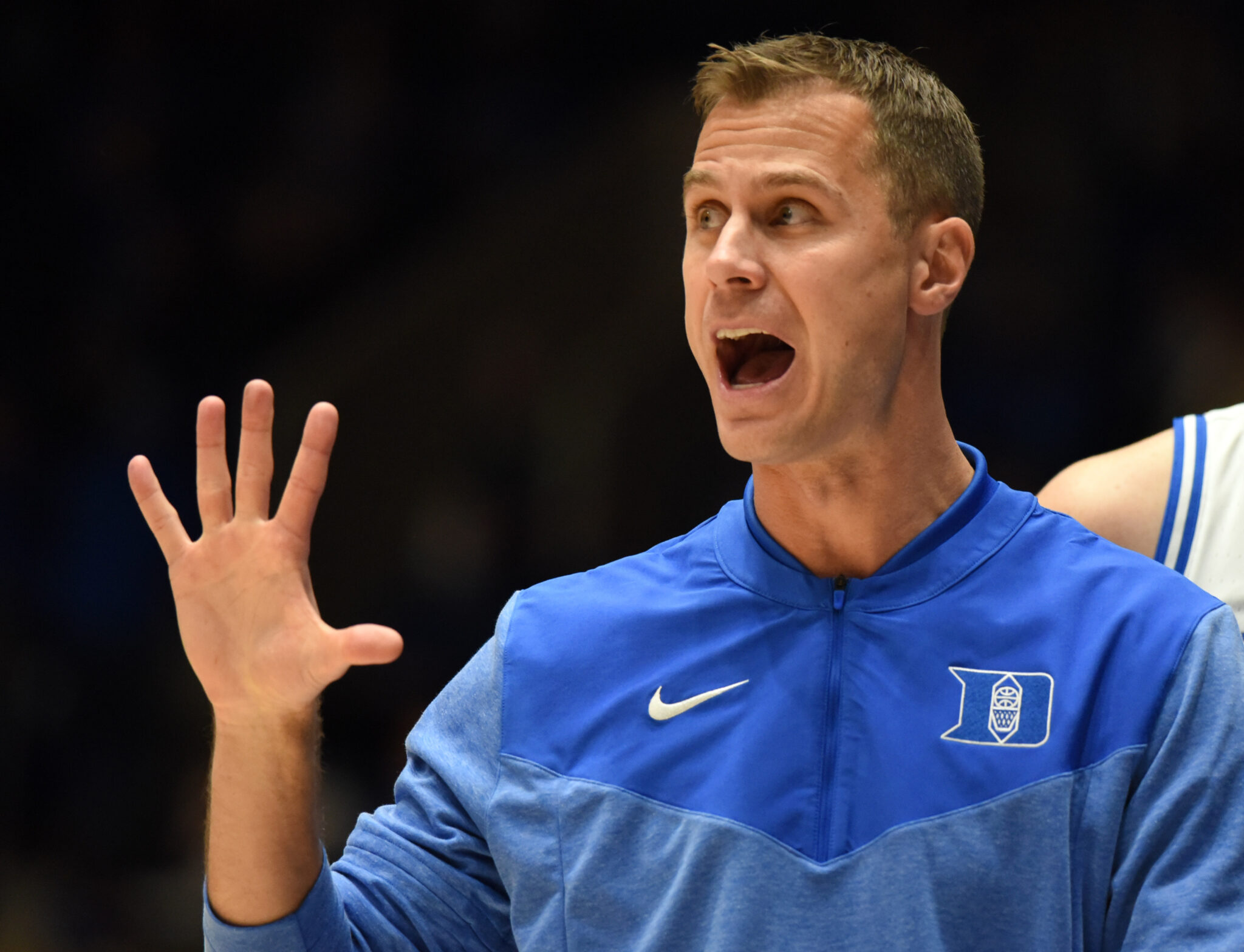
Jon Scheyer, Duke (2022-23)
Final Record: 27-9 (.750)
Regular Season Record: 23-8
ACC Record/Finish: 14-6 (3rd)
ACC Tournament: 3-0 (ACC Title)
NCAA Tournament: 1-1 (2nd Round)
Scheyer was tasked with the impossible: replacing Mike Krzyzewski. Obviously, three seasons in, he’s doing pretty well, leading the Blue Devils back to the Final Four, but even his first season could be considered a success. Scheyer brought in a top recruiting class and won the ACC Tournament, ultimately losing in the second round of the NCAA Tournament to Tennessee.
In terms of a blueblood program with a lot of resources, Scheyer’s success is enviable, although he is still leaning on elite freshmen talent while the rest of college basketball is focusing on the transfer portal.
Bill Self, Kansas (2003-04)
Final Record: 24-9 (.727)
Regular Season Record: 20-7
Big 12 Record/Finish: 12-4 (2nd)
Big 12 Tournament: 1-1 (Semifinals)
NCAA Tournament: 3-1 (Elite Eight)
So much has changed in college basketball since 2003 that it seems silly to include Self’s first year at Kansas in this exercise, but we’ve gotten this far, so why not? Self replaced Roy Williams, who left for North Carolina after the Jayhawks lost in the 2003 national championship game to Syracuse. In just his first season, Self led Kansas to a second-place finish in the Big 12 and the Elite Eight, where the Jayhawks lost to Georgia Tech.
Since then, Kansas has won two national championships and has been the picture of sustained success — until recently. The Jayhawks, who were ranked No. 1 in the AP Preseason Poll, are coming off their second straight 10+ loss season, losing to Arkansas in the first round of the NCAA Tournament, their first first-round exit since Self’s third season.
Mark Pope’s 1st season at Kentucky compared to other coaches
| Coach | School | Season | Final Record | Conference Record/Finish | NCAA Tournament |
| Mark Pope | Kentucky | 2024-25 | 24-12 (.667) | SEC 10-8 (6th) | 2-1 (Sweet 16) |
| Nate Oats | Alabama | 2019-20 | 16-15 (.516) | SEC 8-10 (9th) | N/A (Canceled due to COVID) |
| Bruce Pearl | Auburn | 2014-15 | 15-20 (.429) | SEC 4-14 (13th) | Didn’t make field |
| Todd Golden | Florida | 2022-23 | 16-17 (.484) | SEC 9-9 (8th) | Didn’t make field |
| Rick Barnes | Tennessee | 2015-16 | 15-19 (.441) | SEC 6-12 (12th) | Didn’t make field |
| John Calipari | Arkansas | 2024-25 | 22-14 (.611) | SEC 8-10 (9th) | 2-1 (Sweet 16) |
| Pat Kelsey | Louisville | 2024-25 | 27-8 (.771) | ACC 18-2 (2nd) | 0-1 (1st Round) |
| Mike Woodson | Indiana | 2021-22 | 21-14 (.600) | Big Ten 9-11 (9th) | 1-1 (1st Round – Started in the First Four) |
| Jon Scheyer | Duke | 2022-23 | 27-9 (.750) | ACC 14-6 (3rd) | 1-1 (2nd Round) |
| Bill Self | Kansas | 2003-04 | 24-9 (.727) | Big 12 12-4 (2nd) | 3-1 (Elite Eight) |


GRAYSON, Ky. (WSAZ) – New information has been released in the search for a missing woman at Grayson Lake.
According to game wardens with the Kentucky Department of Fish and Wildlife Resources, Marly Kinney, 19, of Ashland, was last seen at Grayson Lake on Wednesday afternoon.
They say search efforts are focused on the water at this time and include Kentucky State Police aerial support, drones, boats, and K9 assistance.
Crews suspend search for missing teen for the night
The search is now into its third day, with officials saying on and off rain has hindered their search and that a group of 50 volunteers are walking the banks of the lake to help in the search.
Search and rescue boats have been seen at the lake as well.
Officials say there are still many questions, including if Kinney is still alive and where exactly she went missing.
They also say they’ve been using a variety of equipment, including sonar and thermal detectors, as well as helicopters and underwater drones.
WSAZ received a statement from Kinney’s family Friday afternoon:
“We are very appreciative of the absolute surplus of support from law enforcement, search and rescue, 1st responders, and all of the community and its volunteers that are here with us and for us searching for Marly. We do not even know how to express our absolute gratitude to you all. We continue to have faith she will be found and brought back to us. We know we have the very best people doing all they can to bring her home.”
Anyone with information is asked to call 911.
We are still working to get more information.
Previous coverage can be found here.
Copyright 2026 WSAZ. All rights reserved.


13 things more likely to happen than winning the Powerball jackpot
Hoping to win the Powerball jackpot? Here are 13 things more likely to happen than becoming an instant millionaire.
The Kentucky Lottery offers multiple draw games for those aiming to win big.
Here’s a look at Thursday, June 25, 2026 winning numbers for each game.
Cash Ball
02-08-24-32, Cash Ball: 09
Check Cash Ball payouts and previous drawings here.
Pick 3
Evening: 6-3-0
Midday: 9-6-0
Check Pick 3 payouts and previous drawings here.
Pick 4
Evening: 5-7-6-0
Midday: 5-2-6-6
Check Pick 4 payouts and previous drawings here.
Millionaire for Life
03-13-14-34-45, Bonus: 01
Check Millionaire for Life payouts and previous drawings here.
Feeling lucky? Explore the latest lottery news & results
This results page was generated automatically using information from TinBu and a template written and reviewed by a Courier Journal digital producer. You can send feedback using this form.

On Thursday, Kentucky’s home and away SEC opponents for the 2026-27 season were revealed and on top of learning the three opponents who they will play twice, there are some very intriguing matchups. In conference play, Kentucky will face six teams who are among the top 25 in many preseason rankings.
In SEC play, Kentucky will play Tennessee, Vandy and Ole Miss all both home and away. The home matchups include Alabama, Arkansas, Auburn, LSU, Ole Miss, South Carolina, Tennessee, Texas A&M and Vandy. As for the road tilts, the Wildcats will face Florida, Georgia, Mississippi State, Missouri, Ole Miss, Oklahoma, Texas, Tennessee and Vandy. Let’s take a look at some interesting developments from the schedule release.
John Calipari returns to Rupp Arena (again)
In Calipari’s first year with Arkansas, he got the best of Kentucky when he came into Rupp Arena and left with a 10-point victory, a game where you could really feel the tension all game long in the building from Kentucky fans, which translated onto the court with the players. Last season, it was Kentucky who shocked everyone when they stole one on the road against a top 20 Arkansas team after a rough up-and-down season up to that point. Now, the two will face off again as Kentucky will look to get the win in Rupp and make sure Calipari doesn’t get two in a row in the building. It’ll be another highly-anticipated showdown.
Kentucky hits the road at Texas
This is shaping up to be a major challenge for Kentucky next season and may even end up being one of the biggest games of the season. Texas is seen by many as a clear top 10 team, with some even having them within the top five and when you combine that with the fact that the game is on the road, the Wildcats will have their hands full. The Wildcats fell to the longhorns in the 2024-25 season, and it’ll be a much stiffer challenge this time.
Which game could be a trap?
We don’t have the game-by-game dates yet, so it’s hard to say with a lot of confidence, but opponent-wise, Georgia could really give Kentucky fits. In Pope’s first year, his team struggled handling the physicality of the Bulldogs and now, they’ve retained one of their best guards for another year and have added physicality through the portal. Mike White’s teams love to make opponents uncomfortable and they could do that once again down in Athens. Another sneaky team to watch is Oklahoma, who will have very good guard play. Kentucky will face both teams on the road.
Overall, it’s a pretty fair SEC schedule for a Kentucky team who has the capability of a return to being atop the conference once again. Mark Pope has such a system-fit squad and he can do some damage in the SEC.
Sign up to our free newsletter and follow us on Facebook and YouTube for the latest news.
Add us as a preferred source on GoogleFollow
-

 Technology11 minutes ago
Prime Day’s final hours bring rare discounts on Philips Hue smart lights
-

 World14 minutes ago
Video shows gaping hole after small plane crashes into towering skyscraper
-

 Politics19 minutes ago
Warren tells Trump to ‘sign the damn bill’ as bipartisan housing package remains stalled in Washington
-

 Health26 minutes ago
Common food preservatives may raise blood pressure and heart risks, study suggests
-

 Sports29 minutes ago
Who is Alyssa Thomas? WNBA star suspended for punching Caitlin Clark in the throat
-

 Technology34 minutes ago
Fox News AI Newsletter: Waymo’s robotaxi recall
-
Business41 minutes ago
Cisco to lay off more than 400 workers in California
-
 Entertainment44 minutes ago
Tom Sandoval’s girlfriend Victoria Robinson arrested after patio fire pit altercation


