Kentucky
Federal crackdown on silica dust begins as mining experts highlight impact to Kentucky workers

After a years-long rule-making process at the Mine Safety and Health Administration (MSHA), coal mines will have to keep workers safe from toxic silica dust by lowering the legal exposure limit from 100 micrograms to 50 micrograms over an 8-hour work shift.
Experts have long-known that silica dust is causing a surge in the incurable black lung disease among central Appalachian coal miners. It’s caused as miners inhale bits of the rock that’s being pulverized to get to harder-to-reach coal seams.
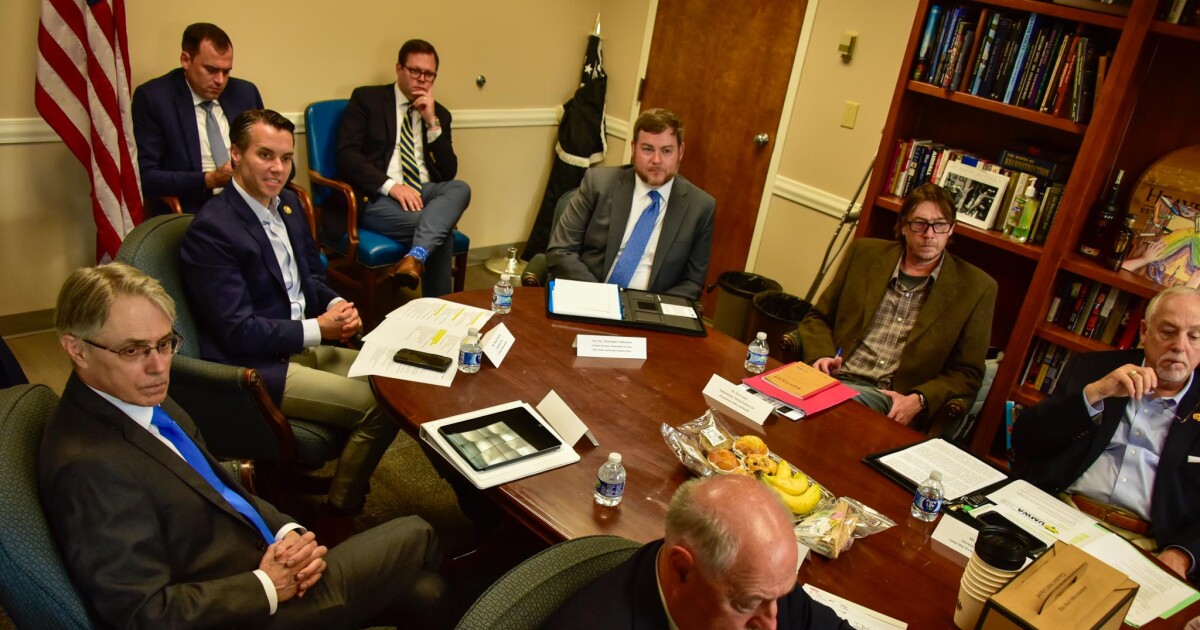
“You want to know what it’s like to have black lung?” John Robinson, a former miner battling the disease asked at a roundtable discussion in Louisville on Monday. “Grab your pillow off your bed, go outside, and get your push mower going in your yard.”
Other industries who extract things like metal, sand and gravel will also need to comply with the silica standards. For the first time ever, they’ll also be required to X-ray workers’ lungs. Those X-rays will be stored in a database managed by the National Institute of Occupational Safety and Health (NIOSH).
Those industries have said they don’t see the same epidemic coal has with black lung, but regulators hypothesize that’s because they don’t look.
“My guess is, that when we go looking for a problem, when we go looking at these miners and their chest films, we’re probably going to see silica in those lungs,” NIOSH researcher Scott Laney said.
U.S. Representative Morgan McGarvey hosted Monday’s roundtable in Louisville with federal experts discussing the impact of the rule. There are no active coal mines in his district, but he is the only Democrat in Kentucky’s congressional delegation.
Officials have lauded the Biden administration for the measure, which was promised but undelivered in multiple previous administrations.
“I’ve always considered myself, yes, representing my district, but also being a representative of our state,” McGarvey said. “When you talk about the safety of our workers, to me, that’s never been a political issue.”
McGarvey’s office said the lawmaker wanted to learn from federal experts about what is needed “to ensure effective implementation and enforcement of this rule.”
One thing that might make it difficult to implement and enforce? A flat budget at the federal mine agency. Congress recently denied a $50 million budget increase for more mine inspections and more silica dust sampling.
“We just need to help get MSHA more money to help enforce this,” National Black Lung Association Vice President Vonda Robinson said. “They need more guys to go out and help, to be able to enforce this.”
“MSHA has had flat budgets for, I don’t know how many years now,” MSHA Assistant Secretary Chris Williamson said at a panel earlier in June. “You’re talking about people because in almost every federal agency, the cost driver is personnel. We will do the best we can with what we’re given to work with, but it will remain a priority.”
Appalachian advocacy groups have criticized the measure for largely relying on companies to accurately self-report high silica dust samples. They say it gives companies “every incentive to continue cheating and hiding dangers” and compared it to letting a “fox guard the hen house.”
Williamson has repeatedly promised that any companies caught cheating on the silica testing and reporting requirements will be dealt with severely.
Meanwhile, the silica rule is facing two separate legal challenges from mining industry associations. They’re asking federal judges to analyze the rule for its legality.
“Worker safety and health is a core value of our association, but unfortunately, this rule has missed the mark,” National Stone, Sand and Gravel Association CEO & President Michael Johnson said in a written statement. “MSHA’s crystalline silica rule includes provisions that were not included in the proposed rule, for which we were not provided the opportunity to comment, as required by law.”
Although companies are expected to begin lower silica dust levels now, enforcement will begin in April 2025 for coal companies and 2026 for non-coal.
State government and politics reporting is supported in part by the Corporation for Public Broadcasting.



Mark Pope and the Kentucky Wildcats will be looking to replace a lot in the transfer portal, and one thing that Pope will need a ton of is three-point shooting. The three-point shooting this season for Kentucky outside of Collin Chandler was rough. Otega Oweh, Kam Williams, and Denzel Aberdeen all had a solid shooting season, but Chandler was the only true, reliable three-point shooter.
Williams is a player that fans expect to get much better from three next season if he is back in Lexington, but Pope is still going to need a lot of shooting.
When Pope took the job at Kentucky, he wanted to shoot over 30, perhaps even 35 threes per game, but in his two seasons, this has not happened. Coach Pope needs to get back to this for his offense to work at a high level, but he will need the roster to get it done.
While the portal is not technically open yet, some players have announced that they plan to enter the portal when it does open on April 7th. Some Kentucky fans have already started to list players whom Pope should reach out to in the portal. Many of the guard’s BBN wants look good on paper, but don’t have elite three-point shooting percentages.
The point of this article is to make the case that Coach Pope can’t gamble with the players he brings in via the portal to be shooters. A great example of this is Jaland Lowe, as he came over from Pitt with a bad three-point shooting percentage. He didn’t play enough this year to really judge him as a shooter, but Pope doesn’t need projects like this.
He shouldn’t take guards who shot 31% from three. Pope needs to take players who are true knockdown shooters from deep, so the Wildcats offense next season will have a handful of players who are all capable of making threes.
There are some guards and forwards in the portal right now who had great seasons shooting the ball from deep and more will enter when it officially opens on the 7th. Coach Pope needs a bunch of players who shot 35% or better from deep, so the Wildcats are an elite team from beyond the arc.
If Kentucky isn’t a good shooting team, we will see a season similar to this one next year, so shooting is a top priority for the staff when the portal opens here in about a week.

Even in the era of the transfer portal and NIL, fans of a team will still focus on and care about recruiting. That’s especially the case with the Kentucky Wildcats. Fans are already up in arms about Kentucky’s recruiting for the class of 2026, or, in their case, lack thereof.
Only one player is signed for the class of 2026, after 4-star point guard Mason Williams announced his commitment to play for the Cats on Friday. On the board. Still work to do.
Chris Washington Jr., an Alabama decommit and top-35 senior prospect, is a new target for Mark Pope and UK ahead of the spring signing period in mid-April. The staff reached out to his AAU coach, Bobby Maze, to gauge the athletic wing’s potential interest. This is all according to Kentucky Sports Radio.
Washington is a 6-9, 195-pound forward who originally committed to Alabama, but decommitted in November. Kentucky is now included among the likes of Tennessee, Oregon, Oklahoma State, USC, and SMU that are interested in Washington.
“It’s a good program,” Washington said of Kentucky while adding, “Honestly, I just want to go where I’m wanted — and the play style. I got to go where I fit in and where the coaches really want me. (My recruitment is) open. Whenever the time is right.”
Only four players ranked ahead of him remain available in 2026, including No. 1 Tyran Stokes. That tells you just how big of a prospect Washington will be in the spring signing period.
Kentucky has swung and missed in recruiting a lot recently. But there is still time to get things moving in the right direction this spring on both the high school front and in the transfer portal.

BOWLING GREEN, Ky. (WKRC) — A Kentucky man was arrested Thursday after police said he was riding a horse while intoxicated, reports WBKO.
Bowling Green police said they found 48-year-old Jorge Luis Hernandez on a horse, partially slumped over, as it walked along a road. He and the horse then began traveling on a sidewalk, according to an arrest record.
Police said Hernandez had a “strong odor of alcoholic beverage” and had bloodshot eyes, slurred speech and delayed movements. Hernandez said he had just left the liquor store and had a liquor store bag tied to the horse’s saddle.
Hernandez was arrested and charged with operating a non-motor vehicle under the influence of intoxicants.

Nearly 1,000 customers without power in Western Montana

Nebraska completes sweep over Indiana with 12-4 Sunday victory

Problem gambling orgs join Nevada legal fight against prediction markets

Meet Garret, Your Newest Morning Show Host on 97.5 WOKQ

Power Players: FIFA World Cup 2026 — New York / New Jersey World Cup Host Committee

Florida High School Football Rankings: Top 25 teams – Oct. 21

How old is Bo Nix? What to know about Oregon quarterback ahead of 2024 NFL Draft

Cleary's 21 help Le Moyne down Central Connecticut State 69-64 in OT

99th annual Pony Swim held in Virginia

Indiana Members Credit Union announced as new anchor tenant at Bottleworks District

Video: Iran to Allow More Oil Ships Through Strait of Hormuz, Trump Says

Dem senator warns deportation could let Virginia woman’s illegal immigrant killer ‘escape accountability’

Newsletter: G7 ministers to hold talks on war’s economic fallout
ICE officers could remain at airports after TSA workers are paid

Scathing report claims nation’s oldest labor union ‘betrayed’ MAGA members through ‘shocking’ spending
-

 Sports1 week ago
IOC addresses execution of 19-year-old Iranian wrestler Saleh Mohammadi
-

 Miami, FL4 days ago
Jannik Sinner’s Girlfriend Laila Hasanovic Stuns in Ab-Revealing Post Amid Miami Open
-

 New Mexico1 week ago
Clovis shooting leaves one dead, four injured
-

 Politics1 week ago
Schumer gambit fails as DHS shutdown hits 36 days and airport lines grow
-

 Tennessee7 days ago
Tennessee Police Investigating Alleged Assault Involving ‘Reacher’ Star Alan Ritchson
-

 Minneapolis, MN4 days ago
Boy who shielded classmate during school shooting receives Medal of Honor
-

 Science1 week ago
Record Heat Meets a Major Snow Drought Across the West
-

 Technology1 week ago
YouTube job scam text: How to spot it fast