Science
2024 Brought the World to a Dangerous Warming Threshold. Now What?


Source: Copernicus/ECMWF
Note: Temperature anomalies relative to 1850-1900 averages.
At the stroke of midnight on Dec. 31, Earth finished up its hottest year in recorded history, scientists said on Friday. The previous hottest year was 2023. And the next one will be upon us before long: By continuing to burn huge amounts of coal, oil and gas, humankind has all but guaranteed it.
The planet’s record-high average temperature last year reflected the weekslong, 104-degree-Fahrenheit spring heat waves that shuttered schools in Bangladesh and India. It reflected the effects of the bathtub-warm ocean waters that supercharged hurricanes in the Gulf of Mexico and cyclones in the Philippines. And it reflected the roasting summer and fall conditions that primed Los Angeles this week for the most destructive wildfires in its history.
“We are facing a very new climate and new challenges, challenges that our society is not prepared for,” said Carlo Buontempo, director of the Copernicus Climate Change Service, the European Union monitoring agency.
But even within this progression of warmer years and ever-intensifying risks to homes, communities and the environment, 2024 stood out in another unwelcome way. According to Copernicus, it was the first year in which global temperatures averaged more than 1.5 degrees Celsius, or 2.7 degrees Fahrenheit, above those the planet experienced at the start of the industrial age.
For the past decade, the world has sought to avoid crossing this dangerous threshold. Nations enshrined the goal in the 2015 Paris agreement to fight climate change. “Keep 1.5 alive” was the mantra at United Nations summits.
Yet here we are. Global temperatures will fluctuate somewhat, as they always do, which is why scientists often look at warming averaged over longer periods, not just a single year.
But even by that standard, staying below 1.5 degrees looks increasingly unattainable, according to researchers who have run the numbers. Globally, despite hundreds of billions of dollars invested in clean-energy technologies, carbon dioxide emissions hit a record in 2024 and show no signs of dropping.
One recent study published in the journal Nature concluded that the absolute best humanity can now hope for is around 1.6 degrees of warming. To achieve it, nations would need to start slashing emissions at a pace that would strain political, social and economic feasibility.
But what if we’d started earlier?
By spewing heat-trapping gases into the atmosphere, humankind has lifted global temperatures to record highs.
If nations had started reducing emissions in 2005, they could have made gradual cuts to limit warming to 1.5 degrees.
Starting in 2015, when the Paris agreement was adopted, would have required steeper cuts.
Starting today would require cuts so drastic as to appear essentially impossible.
“It was guaranteed we’d get to this point where the gap between reality and the trajectory we needed for 1.5 degrees was so big it was ridiculous,” said David Victor, a professor of public policy at the University of California, San Diego.
The question now is what, if anything, should replace 1.5 as a lodestar for nations’ climate aspirations.
“These top-level goals are at best a compass,” Dr. Victor said. “They’re a reminder that if we don’t do more, we’re in for significant climate impacts.”
The 1.5-degree threshold was never the difference between safety and ruin, between hope and despair. It was a number negotiated by governments trying to answer a big question: What’s the highest global temperature increase — and the associated level of dangers, whether heat waves or wildfires or melting glaciers — that our societies should strive to avoid?
The result, as codified in the Paris agreement, was that nations would aspire to hold warming to “well below” 2 degrees Celsius while “pursuing efforts” to limit it to 1.5 degrees.
Even at the time, some experts called the latter goal unrealistic, because it required such deep and rapid emissions cuts. Still, the United States, the European Union and other governments adopted it as a guidepost for climate policy.
Christoph Bertram, an associate research professor at the University of Maryland’s Center for Global Sustainability, said the urgency of the 1.5 target spurred companies of all kinds — automakers, cement manufacturers, electric utilities — to start thinking hard about what it would mean to zero out their emissions by midcentury. “I do think that has led to some serious action,” Dr. Bertram said.
But the high aspiration of the 1.5 target also exposed deep fault lines among nations.
China and India never backed the goal, since it required them to curb their use of coal, gas and oil at a pace they said would hamstring their development. Rich countries that were struggling to cut their own emissions began choking off funding in the developing world for fossil-fuel projects that were economically beneficial. Some low-income countries felt it was deeply unfair to ask them to sacrifice for the climate given that it was wealthy nations — and not them — that had produced most of the greenhouse gases now warming the world.
“The 1.5-degree target has created a lot of tension between rich and poor countries,” said Vijaya Ramachandran, director for energy and development at the Breakthrough Institute, an environmental research organization.
Costa Samaras, an environmental-engineering professor at Carnegie Mellon University, compared the warming goals to health officials’ guidelines on, say, cholesterol. “We don’t set health targets on what’s realistic or what’s possible,” Dr. Samaras said. “We say, ‘This is what’s good for you. This is how you’re going to not get sick.’”
“If we were going to say, ‘Well, 1.5 is likely out of the question, let’s put it to 1.75,’ it gives people a false sense of assurance that 1.5 was not that important,” said Dr. Samaras, who helped shape U.S. climate policy from 2021 to 2024 in the White House Office of Science and Technology Policy. “It’s hugely important.”
Scientists convened by the United Nations have concluded that restricting warming to 1.5 degrees instead of 2 would spare tens of millions of people from being exposed to life-threatening heat waves, water shortages and coastal flooding. It might mean the difference between a world that has coral reefs and Arctic sea ice in the summer, and one that doesn’t.
Each tiny increment of additional warming, whether it’s 1.6 degrees versus 1.5, or 1.7 versus 1.6, increases the risks. “Even if the world overshoots 1.5 degrees, and the chances of this happening are increasing every day, we must keep striving” to bring emissions to zero as soon as possible, said Inger Anderson, the executive director of the United Nations Environment Program.
Officially, the sun has not yet set on the 1.5 target. The Paris agreement remains in force, even as President-elect Donald J. Trump vows to withdraw the United States from it for a second time. At U.N. climate negotiations, talk of 1.5 has become more muted compared with years past. But it has hardly gone away.
“With appropriate measures, 1.5 Celsius is still achievable,” Cedric Schuster, the minister of natural resources and environment for the Pacific island nation of Samoa, said at last year’s summit in Azerbaijan. Countries should “rise to the occasion with new, highly ambitious” policies, he said.
To Dr. Victor of U.C. San Diego, it is strange but all too predictable that governments keep speaking this way about what appears to be an unachievable aim. “No major political leader who wants to be taken seriously on climate wants to stick their neck out and say, ‘1.5 degrees isn’t feasible. Let’s talk about more realistic goals,’” he said.
Still, the world will eventually need to have that discussion, Dr. Victor said. And it’s unclear how it will go.
“It could be constructive, where we start asking, ‘How much warming are we really in for? And how do we deal with that?’” he said. “Or it could look very toxic, with a bunch of political finger pointing.”
Methodology
The second chart shows pathways for reducing carbon emissions that would have a 66 percent chance of limiting global warming this century to 1.5 degrees Celsius above the preindustrial average.



It was after 3 a.m. Thursday when Joe Swann got word from someone at a bar perched on the banks of the Guadalupe River in Ingram, Texas, that rising floodwaters had triggered a new flood warning device. The alarm was flashing a bright light and blaring orders.
“Move away from the tower,” the device warned, alerting a nearby campground. By the time Mr. Swann arrived to see it for himself, campers were already leaving for higher ground.
Mr. Swann and his company, River Sentry, had installed 100 of the eight-foot-tall devices along the Guadalupe in the year since a deluge surged down the river and shocked the Hill Country region last July 4, killing dozens of people, many of them children at summer camp. Government money and philanthropic investment have also funded other flood siren systems that kicked in when Hill Country flooded again this week, devastating many of the same areas as last summer’s tragedy.
This time, the systems worked, though they could not prevent at least two deaths. In Kerrville, where floods wrecked areas still in the process of recovering from last summer’s deluge, Mayor Joe Herring Jr. said all residents were accounted for as of Thursday night.
“We had better warning,” he said in a phone interview.
“I’m thankful to the state of Texas and the Upper Guadalupe River Authority for working to install an automated, data-driven warning system,” he added. “And that helped save lives today.”
But the latest disaster also underscored a need to continue investing in improved forecasting and warning systems, said Phil Bedient, a professor at Rice University working on such a project.
“It’s wonderful to have that warning going off,” Dr. Bedient said of the new siren systems. “You’ve got to have more than that to have a bona fide early flood warning system.”
Texas made significant investments in flood warning systems after the tragedy last July. The state legislature and Gov. Greg Abbott, a Republican, approved $50 million for warning systems, rain and river gauges and other flood infrastructure.
Much of that was in place before this week’s storms, including sirens that blared across Kerr County, home to the worst of the flooding last summer.
Other work is still ongoing.
The Upper Guadalupe River Authority, a group responsible for guarding the health of the river, installed new sirens in May. It plans to install more river and rain gauges and develop software to help predict flooding, according to its website. An authority official could not be reached for comment.
Dr. Bedient and colleagues at the University of Texas, Arlington, are using $4 million from the state to develop a system to monitor rainfall on radar and use computer models to compare that data with a range of flooding scenarios. The goal is to increase the lead time for warning systems like flood sirens, he said.
“They will then know to turn sirens on even before the flood gets there,” Dr. Bedient said.
Researchers at Texas Tech University are using another $24 million in state funds to increase radar coverage and capability for meteorological analysis across Hill Country and other parts of rural Texas where flood risks are high but forecasting can be spotty.
River Sentry installed devices, including the ones that alerted campers in Ingram, using private fund-raising led by the owners of Camp Mystic, where 28 children and counselors died in last July’s floods. Each device cost $8,000, said Ian Cunningham, the company’s CEO.
The company, based in the Austin area, plans to add more capabilities, including connecting the network of devices wirelessly and adding small, portable sensors that people can keep with them to receive flood alerts and call for help when needed, Mr. Cunningham said.
Mr. Cunningham also works as an American Airlines pilot, but because he has two daughters who attend summer camp, he used his background in the U.S. Navy to lead River Sentry’s quick work to build the flood warning system.
“We can’t have what occurred last summer occur here again,” Mr. Cunningham said.
Pooja Salhotra contributed reporting.
Science
After wildfires destroyed 95% of this California tribe’s forests, members uncovered 1,200 ancestral sites
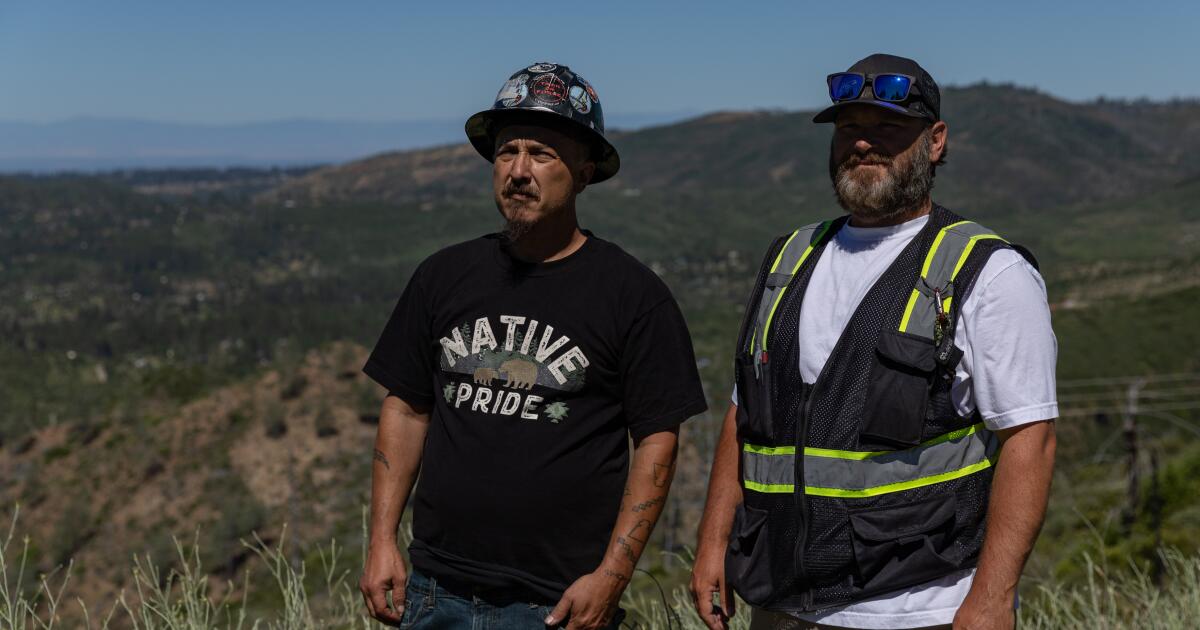
CONCOW, Calif. — Until recently, when members of the Konkow Valley Band of Maidu pulled up a map of their ancestral land in the foothills of the Sierra Nevada, only about two dozen of their historic sites appeared.
Disease, violence and forced labor had separated California tribe members from their history. Without routine Indigenous fire to clear out the foothills, the landscape — much of it now managed by the U.S. Forest Service — grew dense with conifers, obscuring the signs of their enduring presence.
As a result, archaeologists’ picture of the tribe’s past was spare. No more than 500 people. Going back about 3,000 years — a fraction of the time other tribes are known to have lived in the state.
Then the forests burned.
In less than a decade, wildfires destroyed forests across 95% of the tribe’s homelands. The Forest Service turned to the tribe for help healing the land. As members walked the wide-open moonscape, they found evidence of their vibrant history everywhere.
Now just a few years later, their map shows more than 1,200 sites.
Each one is itself a collection: Arrowheads. Rock art. Milling stations where ancestors used cups carved into rock faces to grind salmon, manzanita berries and bay leaves. The circular pits of winter houses, where they sat around a fire under a cedar roof.
A milling station found by the Konkow Valley Band of Maidu in their tribal homelands.
(Sara Nevis / For The Times)
Now, as Tribal Chairperson Matthew Williford Sr. walks these lands, he imagines a much more vibrant past than the one traditionally portrayed by archeologists.
For millennia, upward of 5,000 ancestors living in the basin, many trekking to higher elevation to gather food in the summertime. Husbands venting about domestic life as they shaped their arrowheads on one side of the hill; wives doing the same at the milling stations on the other side.

Matthew Williford Sr., Konkow Valley Band of Maidu tribal chairperson, stands in Plumas National Forest.
(Sara Nevis / For The Times)
Now, to better understand the tribe’s past, the Konkow Valley Band of Maidu is teaming up with a new generation of archaeologists. On a recent day in the Plumas National Forest, Matthew O’Brien, an anthropology professor at Chico State University, worked alongside a handful of students and tribal members.
The team excavated a house pit, carefully carrying artifacts to a rudimentary lab of folding tables and camp chairs, where students weighed them, measured them with calipers and assessed their chemical makeup with an expensive tool called an XRF analyzer. People offered explanations for how their ancestors used the artifacts.
For O’Brien, this form of archeology is worlds apart from the practice of the past. Tribal people are not voiceless historical subjects to study but active collaborators helping to understand and protect the past.
In the 20th century, “the government put archaeologists in charge of stewarding the past. In places like the United States, that leads to some serious ethical issues because what we’re in charge of protecting is not our own culture,” O’Brien said. Now, “it’s our job to help repair that relationship.”
It’s an irony lost on no one that the same policies that disconnected tribal members from their history also enabled the fires that then allowed them to rediscover it.
Even before California gained statehood, Gold Rush lawmakers banned tribes from lighting fire to rejuvenate and thin out forests. That same law also allowed white Californians to force Indigenous adults and children into labor, which separated “at least a generation of children and adults from their families, languages, and cultures,” the state later acknowledged.
Meanwhile, the federal government refused to ratify treaties to establish reservations for tribes whose homelands lay within newly created California, leaving tribes like the Konkow Valley Band of Maidu landless. By the early 1900s, Forest Service officials were working aggressively to squash lingering sentiment among white ranchers that intentional fire was productive. Any fire that started on Forest Service land, the policy became, ought to be contained by 10 a.m. the next morning.
The Konkow Valley Band of Maidu did what they could. Tribal members drove around in a beat-up Buick flinging matches out the window. Eventually those efforts landed one elder in jail for arson.
The open forests of oak, dogwood and a few pines, once routinely thinned and maintained with low-intensity “good” fire, became thick with conifers, to the delight of the Forest Service. Now five to six times denser, the trees formed yet another barrier between the tribe and its history — yet a fragile one. When fire inevitably ignites within so much wood in such a tight space — through lightning or human error — it does not burn gently.

A statue stands in a lot charred by the Camp fire, which tore through Paradise, Calif., in 2018.
(Noah Berger / Associated Press)
In 2018, the Camp fire ripped through Butte County, burning 150,000 acres and killing 85 people. Three years later, the Dixie fire ravaged nearly a million acres. In its wake, a world covered in ash. Waterways turned into black sludge. A foul smell of sulfur lingered in the air.
“It was sickening,” Williford said. “Just disgusting.”

Material to be burned is piled in an area of Plumas National Forest that the Konkow Valley Band of Maidu helps manage.
(Sara Nevis / For The Times)
“The land used to repay us, or acknowledge us, by giving us what we needed,” Williford said, standing on a dirt road overlooking the valley. “There were Native generations that were disconnected, unplugged. … We feel lucky that it’s our opportunity to reconnect, to let the land know that ‘Hey! We’re still here!’”
Restoration work with the Forest Service — surveying sites, planting trees and bringing back good fire — continues to unearth long-lost artifacts. And the most exciting data from O’Brien’s team is yet to come:
The team plans to carbon-date a piece of charcoal from the house pit it excavated to see just how long ago tribal ancestors sat around its hearth.
It was an ancient fire, not the recent ones, that preserved some dead wood, and with it, a lasting elemental fingerprint saying, “We were here.”

Mayor Karen Bass’ adminstration quietly appointed a new chief heat officer over a month ago, The Times has confirmed.
Daniela Simunovic took on the role May 31 after the administration discreetly fired Marta Segura, the first person to hold the position. Simunovic previously served as Bass’ senior director of climate and sustainability for three years.
The chief heat officer is responsible for overseeing the city’s response to extreme heat, one of the deadliest climate risks facing California. Like her predecessor, Simunovic will also head the city’s Climate Emergency Mobilization Office.
The move comes after Bass proposed eliminating the office entirely when facing a $1-billion budget shortfall. The L.A. City Council rejected the move, and the final budget ultimately moved the office from Public Works to the Emergency Management Department.
Los Angeles created the office in early 2021 to coordinate city efforts to reduce greenhouse gas emissions and protect Angelenos from climate disasters worsened by global warming. Then-Mayor Eric Garcetti appointed Segura as its director.
The following year, L.A. moved to also name the office’s director as the city’s chief heat officer, making it the third city in the country — after Phoenix and Miami — to create such a position.
On the hottest days, heat-related illness can account for nearly 1 in every 100 emergency department visits in L.A. County. In 2025, the County recorded 10 heat-related deaths, according to a new dashboard.
Segura was paid about $222,0000 in 2025 according to payroll data from the city controller. Simunovic, while in her role as senior director of climate and sustainability, was paid about $161,000 last year.
Before joining L.A. City government, Simunovic was a senior advisor for the California Air Resources Board, which is responsible for protecting the public from air pollution.
The Substack Climate Colored Goggles first reported Simunovic’s appointment Thursday. A spokesperson with Mayor Bass’s office confirmed it in a statement to The Times.
“Many stakeholders and City partners have been working closely with her and are excited to have her lead the office, including during the current Extreme Heat Warning in effect for the City of L.A.,” the statement said.
The Climate Emergency Mobilization Office has been “working with community partners on the development of the City’s Heat Action and Resilience Plan,” it read, “which should be completed by early 2027.”
Despite Bass’ proposal to cut the office last year, the mayor has reaffirmed and advanced several L.A. climate goals, including reaching 100% renewable energy by 2035.
Bass’s Climate Action Plan, released in April, called for doubling local solar power by 2030, reducing the use of fossil fuels in buildings and city buses, and addressing heat risk by planting more trees to increase shade, establishing “cooling centers” to provide relief during hot days and developing the Heat Action and Resilience Plan.
-
 Alaska2 minutes ago
EPA waives Clean Air Act restrictions on high-sulfur diesel for the North Slope
-

 Arizona8 minutes ago
Arizona lacrosse leaders believe sport is poised to grow
-

 Arkansas14 minutes ago
Two Narratives, One Ballot Box: Trump’s Concerns and Arkansas’ Response
-

 California20 minutes ago
Forest Service workers held hostage at gunpoint by father, son in CA forest for hours: Authorities
-

 Colorado26 minutes ago
The presiding judge of Colorado Springs Municipal Court will retire
-

 Connecticut32 minutes ago
Wethersfield woman accused of sexually coercing minor from New York after meeting him online
-

 Delaware38 minutes ago
Canadian Wildfire Smoke Pushes Delaware Air Quality to Code Red | Delaware LIVE News
-

 Florida44 minutes ago
Will Florida see its next named storm this weekend?

