Kentucky
Federal crackdown on silica dust begins as mining experts highlight impact to Kentucky workers

After a years-long rule-making process at the Mine Safety and Health Administration (MSHA), coal mines will have to keep workers safe from toxic silica dust by lowering the legal exposure limit from 100 micrograms to 50 micrograms over an 8-hour work shift.
Experts have long-known that silica dust is causing a surge in the incurable black lung disease among central Appalachian coal miners. It’s caused as miners inhale bits of the rock that’s being pulverized to get to harder-to-reach coal seams.
“You want to know what it’s like to have black lung?” John Robinson, a former miner battling the disease asked at a roundtable discussion in Louisville on Monday. “Grab your pillow off your bed, go outside, and get your push mower going in your yard.”
Other industries who extract things like metal, sand and gravel will also need to comply with the silica standards. For the first time ever, they’ll also be required to X-ray workers’ lungs. Those X-rays will be stored in a database managed by the National Institute of Occupational Safety and Health (NIOSH).
Those industries have said they don’t see the same epidemic coal has with black lung, but regulators hypothesize that’s because they don’t look.
“My guess is, that when we go looking for a problem, when we go looking at these miners and their chest films, we’re probably going to see silica in those lungs,” NIOSH researcher Scott Laney said.
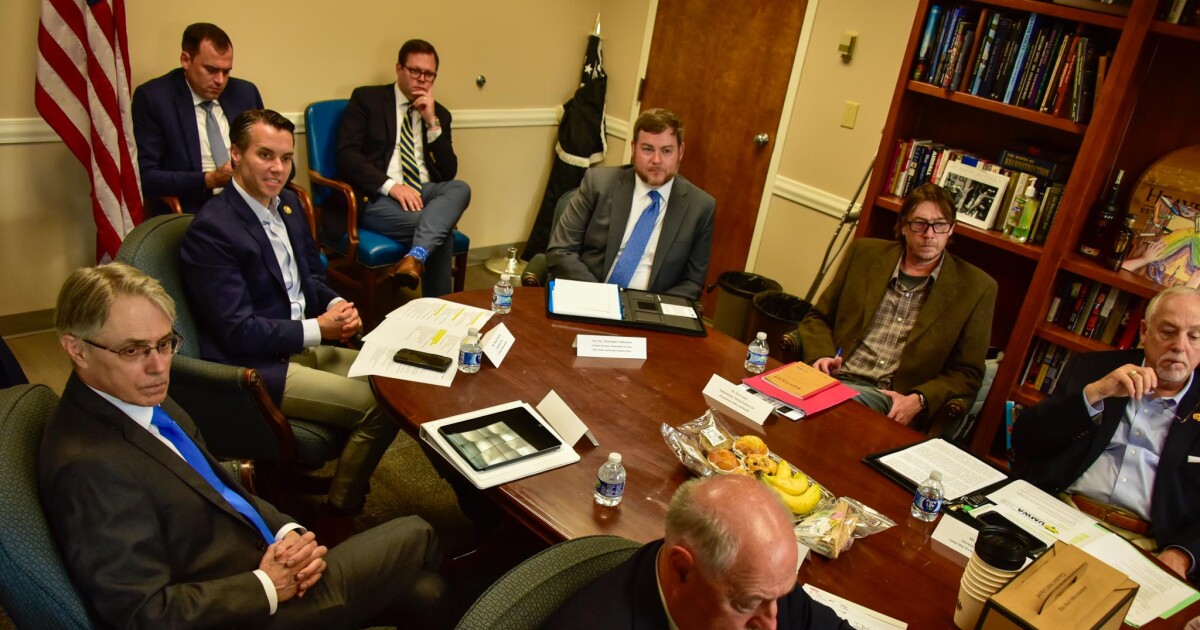
U.S. Representative Morgan McGarvey hosted Monday’s roundtable in Louisville with federal experts discussing the impact of the rule. There are no active coal mines in his district, but he is the only Democrat in Kentucky’s congressional delegation.
Officials have lauded the Biden administration for the measure, which was promised but undelivered in multiple previous administrations.
“I’ve always considered myself, yes, representing my district, but also being a representative of our state,” McGarvey said. “When you talk about the safety of our workers, to me, that’s never been a political issue.”
McGarvey’s office said the lawmaker wanted to learn from federal experts about what is needed “to ensure effective implementation and enforcement of this rule.”
One thing that might make it difficult to implement and enforce? A flat budget at the federal mine agency. Congress recently denied a $50 million budget increase for more mine inspections and more silica dust sampling.
“We just need to help get MSHA more money to help enforce this,” National Black Lung Association Vice President Vonda Robinson said. “They need more guys to go out and help, to be able to enforce this.”
“MSHA has had flat budgets for, I don’t know how many years now,” MSHA Assistant Secretary Chris Williamson said at a panel earlier in June. “You’re talking about people because in almost every federal agency, the cost driver is personnel. We will do the best we can with what we’re given to work with, but it will remain a priority.”
Appalachian advocacy groups have criticized the measure for largely relying on companies to accurately self-report high silica dust samples. They say it gives companies “every incentive to continue cheating and hiding dangers” and compared it to letting a “fox guard the hen house.”
Williamson has repeatedly promised that any companies caught cheating on the silica testing and reporting requirements will be dealt with severely.
Meanwhile, the silica rule is facing two separate legal challenges from mining industry associations. They’re asking federal judges to analyze the rule for its legality.
“Worker safety and health is a core value of our association, but unfortunately, this rule has missed the mark,” National Stone, Sand and Gravel Association CEO & President Michael Johnson said in a written statement. “MSHA’s crystalline silica rule includes provisions that were not included in the proposed rule, for which we were not provided the opportunity to comment, as required by law.”
Although companies are expected to begin lower silica dust levels now, enforcement will begin in April 2025 for coal companies and 2026 for non-coal.
State government and politics reporting is supported in part by the Corporation for Public Broadcasting.


LEXINGTON, Ky. (WKYT) – Recent heavy rainfall has left soil across the state completely soaked, contributing to localized flooding in some areas.
When rain falls, some water soaks into the ground through a process called percolation.
Soil can only hold a limited amount of water. Once the small air spaces within the soil fill with water, the ground becomes saturated and additional rainfall has nowhere to go.
Soil type plays a role in how quickly water drains.
Much of Kentucky has clay-heavy soil, which is made up of very small, flat particles packed tightly together.
That composition makes it harder for water to move through. In clay soil, water may drain at a rate of only 0.02 to 0.17 inches per hour.
When rainfall comes down faster than the ground can absorb it and water cannot drain into a stream or storm drain quickly enough, it begins to build up.
That buildup is what leads to localized flooding.
Copyright 2026 WKYT. All rights reserved.

BOWLING GREEN, Ky. (WBKO) – Cyclosporiasis is a microscopic parasite that can contaminate food and water — is making people sick across several states, including Kentucky.
Dr. Patricia Tellez-Watson said, the illness is caused by Cyclospora cayetanensis and spreads when someone ingests contaminated food or water. “It is an intestinal infection caused by this water-borne, food-borne microscopic parasite,” she said.
Symptoms can include diarrhea, nausea and vomiting.
Tellez-Watson said, cases are often sporadic, but outbreaks can happen — especially during hot, wet months, when the parasite can survive in the environment long enough to become infectious.
Health experts recommend taking extra precautions with food and water. Washing hands and thoroughly rinsing produce before eating or cooking can reduce risk.
Watson also urged people to be cautious with fresh produce, particularly pre-packaged items, and to consider using bottled water.
Officials have confirmed cases in Bowling Green, though it’s unclear how many.
Copyright 2026 WBKO. All rights reserved.


What will Moeller’s Matt Ponatoski bring to Kentucky football, baseball?
Hear what Moeller senior had to say about signing to play football and baseball at the University of Kentucky.
Dual-sport star and Moeller alum Matt Ponatoski’s final decision still awaits, but signs are pointing towards Lexington, KY.
After committing to the University of Kentucky as both a quarterback and pitcher, Ponatoski was selected in the 18th round (No. 542 overall) of the 2026 MLB Draft by the hometown Cincinnati Reds. While Ponatoski was ranked No. 208 on the MLB’s draft board and expected to be selected higher, doubts around whether he intended to go pro this year caused his stock to fall.
Ponatoksi has until the MLB’s signing deadline on July 27 to make a final decision, but the Moeller product has seemingly signaled his intention to stick with the University of Kentucky. He enrolled at the University of Kentucky on Wednesday, July 15, per a Kentucky Sports Radio report, indicating he will join the Wildcats football team in the fall.
The Man of Moeller was just the third player in the history of the Gatorade Player of the Year award to win for two different sports in the same season. Doing so in his junior year, he joined Pro Football Hall of Fame receiver Randy Moss and National Baseball Hall of Fame catcher Joe Mauer.
For Wildcats football, Ponatoski would come in as a four-star quarterback prospect and helped give new head coach Will Stein a top-25 recruiting class in the nation. He threw just one interception in his senior season for the Moeller Crusaders, completing 66% of his passes for 2,395 yards and 28 touchdowns.
For Kentucky baseball, Ponatoski would join up with fellow freshman and former Louisville Trinity pitcher Grayson Willoughby, who won Kentucky Mr. Baseball and withdrew his name from the draft. Willoughby, a top-rated pitching prospect, felt MLB teams were attempting to low-ball him and thus chose to stick with the Wildcats. Ponatoski is fresh from a season leading Moeller to the state championship game, recording a 1.37 ERA on the year.
-

 Los Angeles, Ca59 minutes ago
Arrest made in deadly shooting at 4th of July gathering in Compton; search for 2nd suspect continues
-

 Detroit, MI1 hour ago
Detroit crime hits decades-low as Michigan governor candidates debate how to keep progress going
-

 San Francisco, CA2 hours ago
Operator of boat that capsized near Alcatraz mourns brother as search continues
-

 Dallas, TX2 hours ago
Mavericks vs Thunder Game Preview and Injury Update
-

 Miami, FL2 hours ago
Miami Dolphins Fans Vs. The Media
-

 Boston, MA2 hours ago
Man who allegedly shot at Boston Police officers arrested after foot chase in Dorchester
-

 Denver, CO2 hours ago
Swan, dragon and duck boats are back pedaling around City Park
-

 Seattle, WA2 hours ago
Ticket Alert: Thundercat, Michelle Branch, and More Seattle Events Going On Sale This Week – The Stranger

