South
Hegseth declares ‘new era' under Trump in visit to southern border in Texas

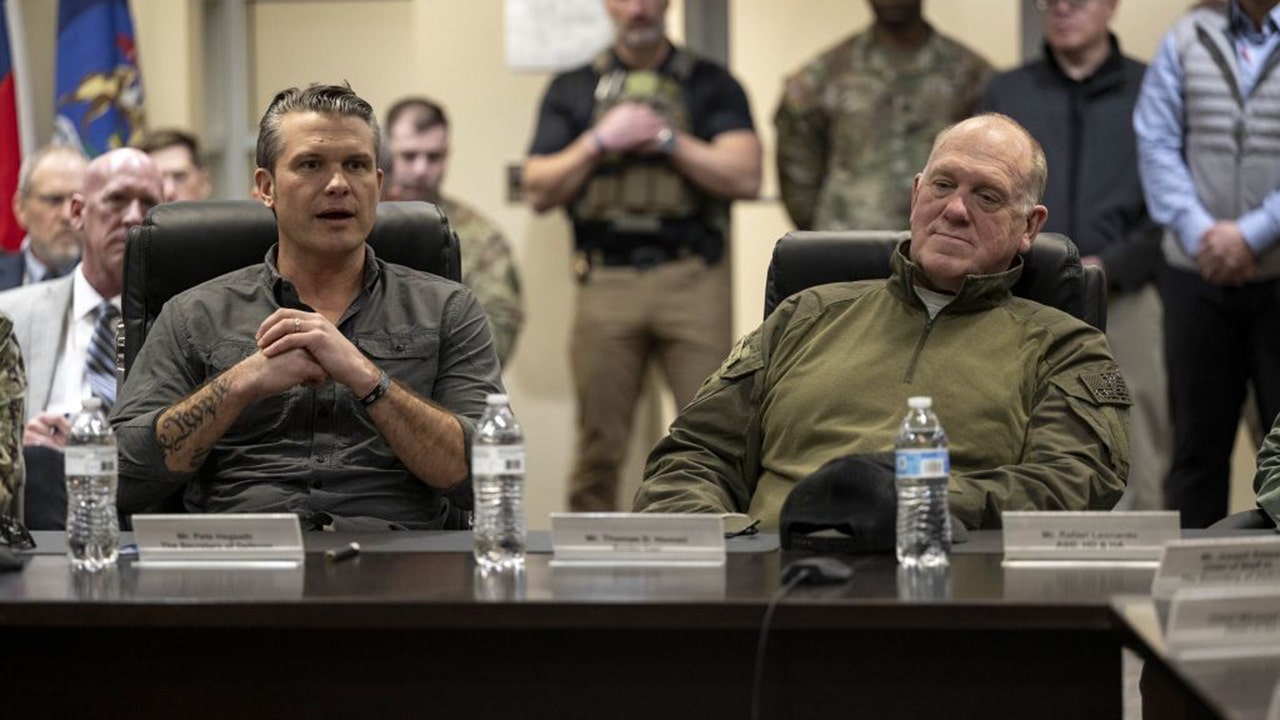
Defense Secretary Pete Hegseth on Monday visited the southern border, declaring a “new era of determination” as the Trump administration doubles down on its efforts to secure the border and stop illegal immigration.
“Because of President Donald Trump, this is a new era at the southern border, a new era of determination, a new era of cooperation. And at the Defense Department, we are proud to be a part of it,” Hegseth told reporters at a press conference in El Paso, Texas after Hegseth had toured the border.
Hegseth emphasized that, rather than focusing on foreign territory, the administration wanted to focus first on U.S. sovereignty.
HOMAN, LAWMAKERS SIGNAL COOPERATION ON ‘OVERLOOKED’ NORTHERN BORDER AMID MIGRANT SPIKE: ‘SAME VISION’
Secretary of Defense Pete Hegseth visits Texas border to inspect the efforts against irregular migrants with Tom Homan, who is in charge of border security in Texas, United States on February 03, 2025. ((Photo by Secretary of Defense Pete Hegseth/Anadolu via Getty Images))
“Guys and gals of my generation have spent decades in foreign countries guarding other people’s borders. It’s about time we secure our own border,” he said.
Trump deployed the U.S. military to the border on his first day in office, with over 1,500 troops joining forces already there. It’s part of a blitz that has correlated with a sharp drop in encounters at the southern border.
Hegseth said the men and women dispatched to the border are excited to be there.
“They’re motivated to be here because they’re defending their friends, their family, their communities, their church, their schools, their loved ones from an invasion of people whose intentions we don’t know,” he said. “We are going to get control of this border.”
NEW SECRETARY OF STATE MARCO RUBIO PAUSES REFUGEE OPERATIONS, RAMPS UP VISA VETTING
A group of people cross the US-Mexico border from Ciudad Juarez, Chihuahua state, Mexico, into Sunland Park, New Mexico, US, on Friday, Jan. 24, 2025. (Justin Hamel/Bloomberg via Getty Images)
Hegseth’s visit to the southern border is the latest migration-focused trip by a Trump Cabinet official.
His trip comes after DHS Secretary Kristi Noem was at the southern border in Del Rio, Texas on Saturday. She said she was there to see “firsthand what’s happening and how we can best support our Border Patrol agents.”
“Under President [Trump] the days of open borders are over,” she said.
CLICK HERE FOR MORE IMMIGRATION COVERAGE
Meanwhile, Secretary of State Marco Rubio, who had a migration-packed first week in office, left Saturday for his first overseas trip to Latin America.
His visit includes trips to Panama, El Salvador, Costa Rica, Guatemala and the Dominican Republic. He is expected to return Thursday, and issues including migration, drug trafficking and gang violence are expected to be at the top of his agenda.
CLICK HERE TO GET THE FOX NEWS APP
Hegseth spoke alongside border czar Tom Homan, who said what was occurring with the use of the military and other government agencies to facilitate security and deportations is a “game changer.”
“We will finally succeed and have an operational control of our southern border with this president in charge,” he said.

West Virginia
Morrisey signs Baylea’s Law, increasing criminal penalties in W.Va. for DUI causing death

CHARLESTON, W.Va. (WCHS) — West Virginia Gov. Patrick Morrisey officially signed House Bill 4712 into law on Friday.
The bill, better known as Baylea’s Law, increases criminal penalties against those who are convicted of driving under the influence resulting in death. The bill is named after Baylea Bower, a 24-year-old woman from Boone County who was killed in a car crash on Easter in 2025 caused by a drunk driver.
The bill passed the House in February, with several of Bower’s family and friends gathered at the West Virginia Capitol in support of the bill.
“Obviously we’re going to be heartbroken,” Bower’s friend India Henderson said. “We have the lifetime sentence of not having Baylea. But if this does help save a life in the future and cause someone to not want to go out and cause this tragedy, then that is a win.”
In accordance with the passage of the bill, Baylea’s Law will take effect on June 12.
“West Virginia will no longer allow those who drive while impaired to escape the full weight of justice,” Morrisey said Friday in a press release. “Baylea’s Law gives our legal system the teeth to demand absolute accountability for the most heartbreaking crimes. Today, our laws stand firmly on the side of victims and their families.”
Specifically, Baylea’s Law introduces the offense of aggravated DUI resulting in death, which will carry the following mandatory sentences, according to a release from Morrisey’s office:
- Five to 30 years in prison
- Fine of $2,000 to $10,000
- Lifetime revocation of the offender’s driver’s license

DALLAS – Thunderstorms will roll through parts of North Texas on Friday. Thankfully, none should be severe. Mother’s Day could be a different story.
Friday Forecast

According to FOX 4 Weather Meteorologist Berkeley Taylor, a cluster of thunderstorms will work their way east across the Dallas-Fort Worth Metroplex on Friday morning.
Everything is well below severe limits, just with lots of lightning!
Scattered showers and thunderstorms will move in and out through the day on Friday. Coverage is about 20%.
An isolated strong storm or two can’t be ruled out, but the overall threat is low.
Temperatures will be in the 50s and 60s for the morning, before climbing into the 80s by the afternoon.
Weekend Forecast
Saturday will look similar, with even lower coverage expected.
Sunday presents the best chance to find rain and storms – about 50% as a cold front moves through North Texas.
North Texas is under a Level 2 out of 5 risk for severe weather. The biggest concerns will be with wind and hail.
Timing-wise, the front looks to move through in the afternoon/evening.
7-Day Forecast
Once the front is south of North Texas on Mother’s Day, the rain should come to an end, and it will stay dry into next week.
Temperatures will start to warm into the upper 80s and low 90s by midweek next week.
The Source: The information in this story is from the FOX 4 Weather team and National Weather Service.

The search for missing 16-year-old Benjamin Braithwaite is over. Atlanta police announced just before midnight Thursday that he had been located, more than a week after he vanished from his Regency Trace home.
The department shared the update on social media but did not release additional details about where he was found or the circumstances surrounding his recovery.
Braithwaite had been missing since the night of April 27, when he was last seen around 9 p.m. at his home in Atlanta. His family said they had no contact with him during the entire time he was gone.
The disappearance of the KIPP Atlanta Collegiate High School sophomore and basketball team member had galvanized the Atlanta community. His family, teammates, Atlanta police officers and neighbors gathered at the school last week to raise awareness about his disappearance. Hartsfield-Jackson Atlanta International Airport, where his mother works, joined the search effort — asking the public to watch for him at MARTA stops and fast food restaurants.
A $10,000 reward had been offered for credible information leading to his safe return.
“Even small details matter. Your awareness could make the difference,” the airport wrote in an Instagram post earlier this week.
-

 Wisconsin2 minutes ago
‘Song Sung Blue’ subject Claire Sardina playing Wisconsin State Fair
-

 West Virginia8 minutes ago
Morrisey signs Baylea’s Law, increasing criminal penalties in W.Va. for DUI causing death
-

 Wyoming14 minutes ago
Obituaries: Mothersbaugh Jr.
-

 Crypto20 minutes ago
Tucker Carlson Calls Markets ‘Fake’ After 60 Days of Middle East Conflict
-

 Finance26 minutes ago
UK watchdog says car finance legal challenge hearing unlikely before October
-

 Fitness33 minutes ago
“No Pain No Gain” May Be Wrong: Science Says Slow Eccentric Exercise Builds Stronger Muscles
-

 Movie Reviews44 minutes ago
8News Reel Talk: ‘The Devil Wears Prada 2’ movie review
-

 World56 minutes ago
‘Grey’s Anatomy’ Boss on the Season 22 Finale: How Teddy and Owen Say Goodbye and That Surprising Meredith Twist