Entertainment
Are men OK? Actor Jena Malone genuinely hopes so on a beguiling new album

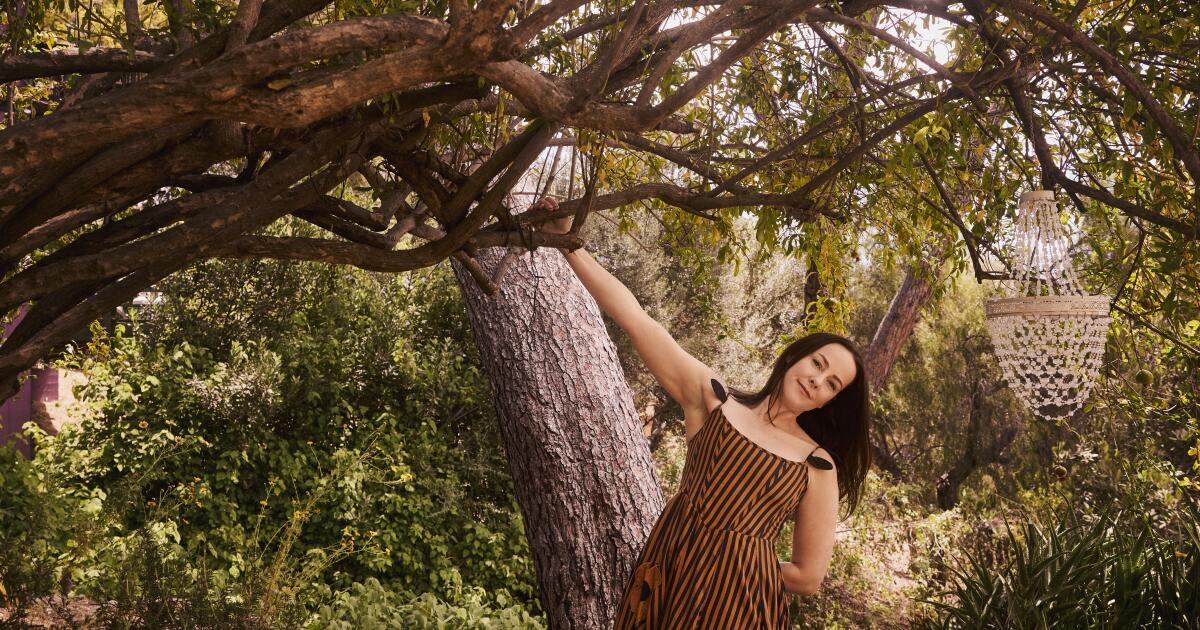
If, god forbid, there’s a natural disaster in L.A. in the near future, Jena Malone might be one of your first responders.
“I’ve been studying Community Emergency Response Team training,” the actor-musician, 41, said, drinking coffee in the living room of her home overlooking pomegranate trees and a canyon in northeast L.A. “Whether it’s fire management or building a neighborhood tool shed, it’s less important for me to hit career milestones now than to transform how I live on this planet. Let’s build something where we’re all taking care of each other’s needs through mutual aid.”
Those are galvanizing priorities from Malone, who’s led generationally beloved films like the sci-fi noir “Donnie Darko,” played the axe-chucking Johanna Mason in two “Hunger Games” tentpoles and recently co-starred in the lesbian bodybuilding revenge flick “Love Lies Bleeding.” For almost as long, she’s also made experimental folk and electronic records that toy with avant-garde noise and quietly poignant songwriting.
This is a wild time in L.A. for anyone concerned about the city and its culture industries, and Malone is deeply invested in both. Just before the release of her new Netflix series, the Duffer Brothers-produced “The Boroughs,” she’s released her first album in nearly a decade. “Flowers For Men” is an effects-shredded, future-primitive record, written after the birth of her son upended her obligations — and expectations — toward the men in her life and the world they’ll inherit.
“It changed everything,” Malone said, about raising a son. “I grew up learning to thrive and mask in masculine spaces. Grind culture is a masculine toxicity that I inherited and indoctrinated myself in. But parenthood offers you this opportunity to burn your entire life down in sacrifice to finding out what’s real. I had no idea what it was to be a man. All of my ideas burned down and not much was being raised back up.”
For millennial film fans, Malone’s been a consistently compelling, trust-anything-she’s-in actor since her child-star turn in 1997’s “Contact.” Few embody a tortured, beguiling Americana quite like her.
“The Boroughs” — a high-profile follow-up to “Stranger Things” from the masters of unreality, created by Jeffrey Addiss and Will Matthews — has a stacked cast that includes Alfred Molina, Geena Davis and Bill Pullman, set amid a bucolic retirement community under supernatural threat. A ragtag group of Duffer Brothers misfits teaming up to fight off eldritch horror might be the last safe bet in television.
Yet that’s also how Malone feels about the current climate of Hollywood — a once-stable neighborhood fending off malign forces. Institutional consolidation and retreat, spiraling costs, technological upheaval — they all add to a creeping sense that an era is over, and worse is coming.
“Film is in such a delicate transition. I think that where music was 20 years ago, film is now,” she said. “It’s like being on an elevator where every floor is on fire. A lot of the things that I loved about it no longer exist, even if what I love about it is still wildly potent. My stress levels go down and my creativity goes up when I’m building a world that does not rely on the film industry, even though it’s my main love.”
That feeling called her back to music on “Flowers For Men,” arriving nine years after her last LP. The ego-shattering experience of giving birth in 2016 and raising a son prompted reflections about what men’s inner lives were really like, and she wanted to write about them.
“I was raised by two moms, and I had this strange aspiration to become the dad,” Malone said, laughing. “I was the breadwinner of my family then. But being a parent was all brand-new to me. I kept seeing my father in him, my grandfather, these older relationships with men. It was asking me to look at him with curious, childlike eyes.”
“Flowers For Men” was written from a sincere curiosity about mens’ strictures, bad influences and better aspirations. To inhabit someone else’s life, she had to sound different, too.
“Film is in such a delicate transition. I think that where music was 20 years ago, film is now,” Malone said. “It’s like being on an elevator where every floor is on fire. A lot of the things that I loved about it no longer exist, even if what I love about it is still wildly potent.
(Evan Mulling/For The Times)
The most prominent instrument on the album is its layers of vocal treatments. Malone has a lovely natural voice — intimately whispered, with hints of ‘70s country rock. But here she douses it in pitch-shifted digital acid, like a late 2000s R&B record dropped in the pool at the Joshua Tree Inn.
It’s an uncanny combo, but its lends modern melancholy to “Barstow,” which has the narrative structure of a Townes Van Zandt banger but is corroded with bleary effects. “Create In Your Name” has a Billie Eilish-worthy late-night murk, with lyrics so devotional they almost sound consumptive. “Disaster Zones” is all blown-out ambience, and the LP closes on a showstopping cover of John Prine’s classic “Angel From Montgomery.”
“I just love that a man wrote a song where the first line is ‘I’m an old woman,’” Malone said. “As a female songwriter, it gives me so much permission. Now all the doors are open. If I was to give flowers to all of the different men that have touched or changed things that deserve celebration, John Prine would be one of them.”
That idea — celebrating men for the good they’re capable of — felt transgressive enough today that it cohered the album for her. But it also came with questions about how romantic partnership fit into her life. Settling into motherhood, she read up on relationship anarchy — which she sees as not abiding by tiers of connection. She bought books on ethical nonmonogamy (“Sex at Dawn” was a big one) to learn how other lives were not just possible, but maybe even more fulfilling.
(Perhaps this was not a stretch from an actor who played the wild child Lydia Bennet in “Pride and Prejudice.”)
“I had been under this societal understanding that hierarchical love, placing one partner above everything else, was the ultimate romantic expression. I could name hundreds of movies that brought that up,” she said. “But while I’m learning to take care of this child, I’m realizing that self-love is one of the most important parts of this equation. I need to have expression, some work in life that felt like another love. And then my family, and how important friends were. And all of a sudden there’s no world where I would just have one love, not even just romantic love.”
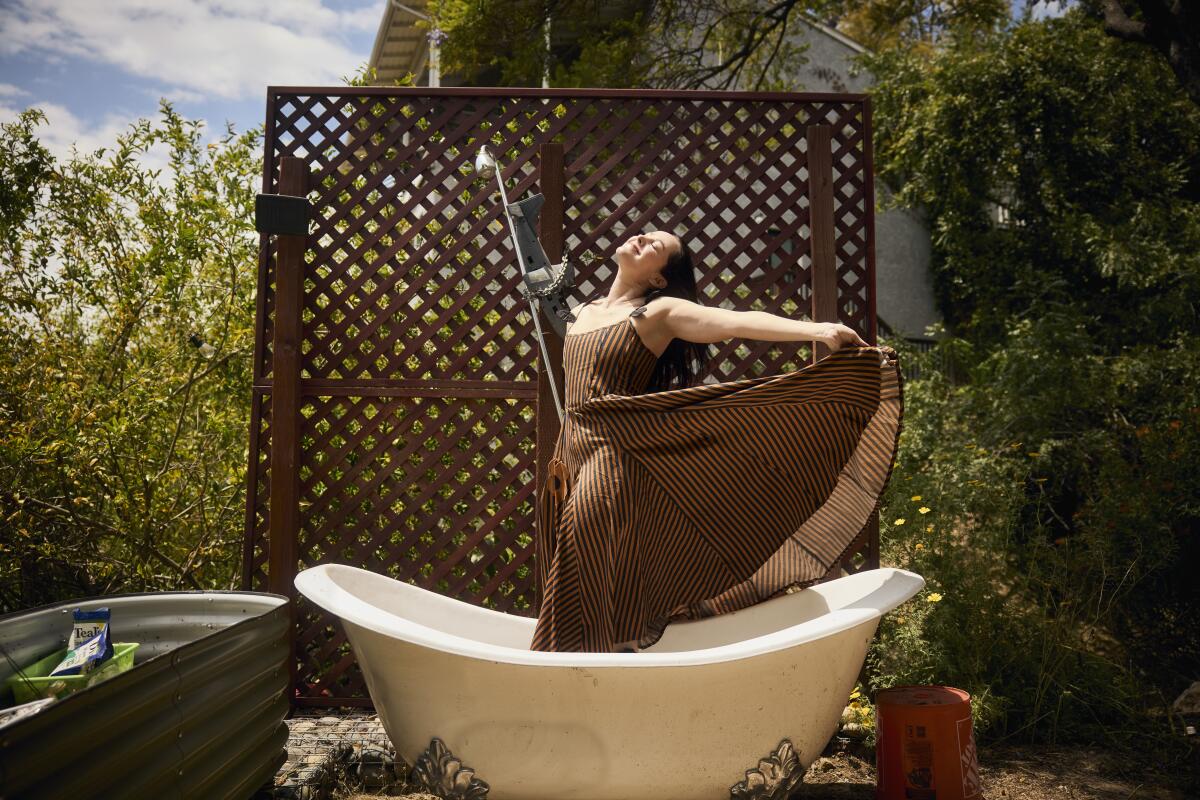
“I had been under this societal understanding that hierarchical love, placing one partner above everything else, was the ultimate romantic expression. I could name hundreds of movies that brought that up,” Malone said. “But while I’m learning to take care of this child, I’m realizing that self-love is one of the most important parts of this equation. I need to have expression, some work in life that felt like another love.
(Evan Mulling/For The Times)
“Flowers For Men” is, in her way, a bargain with that contradiction — to love men deeply, but never put them above all else, even as she got engaged to her partner, actor Jack Buckley, earlier this year.
She’s still sorting out how to present this album live. She said she’s a fan of the Dead City Punx model of renegade shows in forgotten corners of L.A. Maybe as the city seems to fall apart, she’ll find a leafy park or the back of a dingy bar that’s the right home for these strange, lonely yet hopeful songs.
“I want someone to walk into the bathroom and be like, ‘Whoa, why is there a woman singing to me?’” Malone said. “I like the idea that art makes you a little uncomfortable and you don’t have the previously held expectations to know how to hold it.”


Photo: 1-2 Special/Everett Collection
The English director Mark Jenkin works a bit like a local artisan from another era. Filming in and around his native Cornwall, he shoots his pictures himself on a 16mm Bolex, the kind of camera that might have been used by film students decades ago and that produces tactile, slightly grainy images. He also edits the movies himself, and records his sound later, layering in dialogue and effects and music (sometimes composed by himself) with an austere, handcrafted precision. This gives Jenkin’s work a certain timelessness, as if it belongs to the past but not to any specific period of the past. True, such an old-fashioned approach could feel performative, like an unusually well executed Instagram filter. But Jenkin’s style ties directly to his subjects and his expressive philosophy. His latest, Rose of Nevada — which stars two name actors, Callum Turner and George MacKay, and opens in New York today after doing the festival rounds — has the beguiling simplicity of a fable and the captivating textures of a dream. It stays with you like an unexpected and unanswerable question.
Jenkin privileges atmosphere through the collection of minute, sometimes abstract details. Set in a sparsely populated and depressed fishing village, Rose of Nevada opens with the unexpected return of the empty boat of the title, thought lost decades ago. Its arrival is announced by close-ups of barnacles, of rusty edges on ancient metal, of curious plant growth and moldy, tangled coils of black rope, as if its return was just part of a broader natural order. The Rose of Nevada clearly has a tragic history, which perhaps explains the psychological paralysis of the few remaining townsfolk. But it’s here, and so it must set off on a new fishing voyage.
Joining the journey, almost as if they were pulled towards it, are Nick (MacKay), a downcast man who needs money and seems incapable of meeting his young family’s most basic needs, and a drifter, Liam (Turner), whom we first see running down a road as if he were fleeing something. Both men are alienated from their environs, though for different reasons: MacKay conveys Nick’s quiet awkwardness well, and Turner has a charming, freewheeling energy that suggests he’s up for anything. When they return from the fishing expedition, however, the two men find that they’ve transported back several decades in time, and they’re mistaken for — or rather, they appear to be inhabiting the bodies of — two young deckhands who died long ago. Now that it’s the 1990s again, the fishing village is thriving, its local pub crowded with people and blaring pop. Nick and Liam see the younger, happy versions of the broken townspeople they’d left behind. Liam (now known as Alan) suddenly has a family, and Nick (now known as Luke) suddenly has parents. It’s almost as if the young men have been offered to the harvest gods as a sacrifice. And it’s worked.
So, it’s a ghost story, and a time travel story, and a folk tale, and something of a kitchen sink drama, but it’s also none of these things, really, and that’s where Jenkin’s formal gambits come in. His filmmaking has a lovely, homespun directness. We can feel scenes and moments being constructed, which fixes our attention on seemingly simple exchanges. An example: Early on, we see Nick hand his daughter a candy. Other filmmakers might shoot such a scene in a quick, offhand manner to mask its emotional weight, but Jenkin goes in the opposite direction, shooting everything in relative close-up and cutting the action to both extend and clarify it: We see Nick pull the candy out of its box, we cut to the girl receiving the candy, we see his wife see the girl, we cut to the wife taking the candy, we cut to a close-up of her unwrapping it, we cut to the girl getting the candy back, and we see Nick’s response. On some level, this could be an introductory filmmaking exercise: a whole series of extremely deliberate shots and edits designed to show this man’s feeling of inadequacy. But within the general precision of Jenkin’s style, the moment doesn’t stand out. Instead, it’s one in a long line of specific, human moments through which he builds his narrative and conjures a mood.
Such straightforwardness give Rose of Nevada a fable-like quality: There’s no narration, but we feel the deliberate rhythms of the storytelling, the telling emphasis on certain details over others. But weirdly, it also has something of the opposite effect: The film’s intimacy and Jenkin’s attention to the elements (along with his fondness for elliptical, well-timed flash frames) lends everything an otherworldly aura. Despite the time travel premise, nobody’s running around looking for a time machine to take them back, nor are they wasting much time trying to figure out how the dynamics of time travel work. The writer-director lets the unexplainable remain unexplained, because he’s interested more in our emotional response to it. We watch how people interact with these transformed versions of Nick and Liam, and we watch Nick and Liam’s own disparate responses to this new world, to the competing philosophies of life that emerge from this bewitching film. Rose of Nevada’s power lies in its peculiarities.
See All

SANTA BARBARA — Sixty-one years and a day after he laid down the epochal “Like a Rolling Stone” in a recording studio on Seventh Avenue in New York City, Bob Dylan shuffled onstage on the other side of the country dressed so fine in a dark jacket with the hood pulled over his head.
The hood, which Dylan has been wearing even for shows without the cool coastal breeze that blew through the Santa Barbara Bowl on Wednesday night, has lately become an object of online fascination; one guy on X last year wrote that he was obsessed with the rock legend’s “new dripped out look,” and I have to agree: Though there are great hooded-Dylan photos going back decades, his current wardrobe — as seen nightly against a velvety curtain lighted from below — is a vibe through and through. (His Bobness forbade photographers from shooting Wednesday’s show, which means you’ll have to consult social media for a glimpse.)
Dylan’s drip isn’t the only thing putting him into the viral bloodstream of the internet. In March, he launched a Patreon, where he’s posting short stories and apparently AI-assisted installments in an audio series called “Lectures From the Grave”; this week, he contributed his thoughts on aging to a widely shared New York Times op-ed pegged to President Trump’s 80th birthday. In my social feeds, at least, quotes from Dylan’s piece — “You’re an old king from some vanished country,” he wrote — kept turning up next to clips of Timothée Chalamet celebrating the New York Knicks’ NBA Finals win — an oddly poetic interleaving given their history.
All this stuff is cool; I admire veteran culture-shapers who figure out how to adapt to a new information environment. Yet one of the reasons it’s fun to encounter Dylan on Instagram is because you can still encounter him in the flesh. And at 85, he’s absolutely cooking on the road right now.
Wednesday’s show was the first in a handful he’s playing around Southern California this week, including a gig scheduled for Saturday night at Palm Desert’s Acrisure Arena. For years after the release of 2020’s pulpy “Rough and Rowdy Ways,” Dylan said he was on the Rough and Rowdy Ways tour; this month, though, he started selling T-shirts that describe his latest run of dates as the Long Hot Summer tour — precisely the sort of taxonomical quirk to get Bobheads going in the comments.
The concert, which ran about 80 minutes, mixed four cuts from “Rough and Rowdy Ways” with older Dylan songs like “All Along the Watchtower” and “To Be Alone With You” and covers such as Bo Diddley’s “I Can Tell” and Eddie Cochran’s “Nervous Breakdown.” But the whole thing felt like one continuous dream state, as Dylan — accompanied by a four-piece band dressed in dark colors to match the boss — croaked, gasped and crooned from behind an electric piano he played like somebody knocking the keys with his arm as he reaches for a drink.
“False Prophet” was a raunchy blues while “When I Paint My Masterpiece” rode a luscious rumba groove; “Crossing the Rubicon” and “I’ve Made Up My Mind to Give Myself to You,” both from “Rough and Rowdy Ways,” got arrangements completely different from those on the album.
To the astonishment of many a Bobhead, Dylan’s guitarist Doug Lancio was replaced in Santa Barbara by Julian Lage, the youngish jazz star known for his work with Gary Burton and John Zorn. (Dylan said nothing about the change, nor about anything else, from the stage; a spokesman for the singer said he had no word on whether Lage was a permanent addition to the band.) Lage’s playing was tender and spooky, not least in “Tryin’ to Get to Heaven,” where every 30 seconds or so the chords would go in some direction I could never have predicted.
The result was a spectacle of emotion — you’d have to have tried not to get swept away by “I Shall Be Released,” which closed the show — but also of belief in one’s craft. Onstage as on your phone, Dylan was searching for new limits Wednesday — a lifer grinding toward the sublime.

Movie: Maa Inti Bangaaram
Rating: 2.5/5
Banner: Tralala Moving Pictures
Cast: Samantha, Gulshan Devaiah, Srinivas Gavireddy, Manjusha Mukkavilli, Diganth, Sreemukhi, Gautami, Anand, Lakshmi, Rachana, and others
Music Director: Santhosh Narayanan
DOP: Om Prakash
Editor: Dharmendra Kakarala
Producers: Raj Nidimoru, Samantha, Himank Reddy Duvvuru
Written by: Raj Nidimoru, Vasanth Maringanti
Directed by: BV Nandini Reddy
Release Date: June 19, 2026
Nearly three years after her last lead-role outing, Samantha returns to the big screen with “Maa Inti Bangaaram.” The film marks an important milestone in her career, serving as a comeback vehicle and also her first collaboration with husband Raj Nidimoru, who has co-produced the film and penned the story for this family action drama.
The big question is: has Samantha delivered a strong comeback with “Maa Inti Bangaaram”? Let’s find out.
Story
Swarna (Samantha) arrives with her husband at her in-laws’ village home to attend a family wedding. It is their first visit after marriage, as her husband had married her against his parents’ wishes.
Hoping to win over the family, Swarna settles into the household and tries to impress everyone, even seeking help from a friend for her cooking.
Just when she begins to feel accepted, trouble arrives. A group of men starts searching for her, determined to find out whether she is really Swarna or someone named Jhansi.
As the story unfolds, her hidden past comes to light. Years ago, she escaped from her mentor Karuna (Gulshan Devaiah) after discovering his true intentions. Since then, she has been living under different identities before eventually finding love and marrying her husband. Now, Karuna, who has completed a prison sentence, is back and determined to reclaim her at any cost.
Can Swarna protect herself and her newfound family from Karuna?
Performances
Samantha slips comfortably into the role. Despite returning to a lead role after nearly three years and overcoming health challenges, she retains her star presence and carries much of the film on her shoulders. While this may not rank among her best, she convincingly handles both the emotional and action-heavy portions, particularly in the second half.
Diganth plays her husband and delivers a decent performance, though the role offers him little scope. Gulshan Devaiah initially makes an impact as the antagonist, but the character gradually becomes routine, limiting his effectiveness.
Manjusha Mukkavilli gets a well-written supporting role and leaves a positive impression. Sreemukhi is adequate in her brief part.
Vennela Kishore appears in a cameo, while the rest of the cast performs within the requirements of their conventional roles.
Technical Aspects
Santosh Narayanan’s background score works reasonably well and elevates several scenes, especially in the latter half.
Cinematography is functional without offering any standout visuals. Production design serves the narrative adequately.
The film’s biggest technical shortcomings lie in its writing and editing. The dialogues rarely stand out, and the screenplay unfolds without enough surprises or dramatic highs.
A tighter edit and shorter runtime could have significantly improved the film’s overall impact.
Highlights
Samantha’s screen presence and performance
A few engaging moments in both halves
Some clever references
Drawbacks
Predictable screenplay
Unconvincing backstory
Lack of strong dramatic moments
Analysis
“Maa Inti Bangaram” is neither the emotional family drama audiences typically associate with Nandini Reddy nor the stylish action-driven narrative one expects from Raj Nidimoru’s storytelling sensibilities. Instead, it attempts to blend family drama with action, placing Samantha in a role usually reserved for a male commercial hero.
The basic premise feels familiar. Like many mainstream action films, it revolves around a protagonist whose troubled past threatens the peaceful life they have built. The difference here is that Samantha occupies the center of that narrative, taking on responsibilities and action beats traditionally assigned to male stars.
The first half unfolds largely as a family drama. Nandini Reddy focuses on the dynamics between the new daughter-in-law and her in-laws, presenting a series of domestic situations and emotional tests. The portions involving Samantha seeking help from her friend to impress the family with her cooking generate some humor and provide the film with a few enjoyable moments. Apart from these stretches, however, the narrative progresses at a measured pace.
The film gradually reveals why Jhansi became Swarna and why Karuna remains obsessed with finding her. While the backstory involving Naxalism provides the necessary motivation for the conflict, it never feels entirely convincing or emotionally compelling.
Once the central conflict is fully revealed by the interval, the film shifts gears. The second half becomes a straightforward battle between Swarna and the force threatening her family. While this creates a clear objective, it also reduces the scope for surprises.
A couple of scenes work reasonably well, and the climax action sequence inside the house provides some excitement, but the overall narrative goes on expected manner.
The film deserves credit for attempting something different within the commercial framework. Giving a female protagonist the kind of role usually written for male stars is a refreshing idea. Unfortunately, the execution lacks the emotional depth and dramatic strength needed to make the concept truly resonate.
Even the husband’s character feels somewhat artificial, functioning largely as a gender-reversed version of the supportive spouse often seen in hero-centric films.
Interestingly, some of the film’s most enjoyable moments come not from the action but from its lighter touches. References to older films, the creative use of the song “Mutyamantha Muddu,” and Samantha’s largely saree-clad appearance throughout the film, including during action sequences, add a distinctive flavor.
Ultimately, “Maa Inti Bangaram” attempts to merge family drama with female-led action. However, predictable storytelling and underdeveloped drama prevent it from reaching its full potential. The film remains watchable largely because of Samantha’s star appeal, but it never evolves into the engaging and emotionally satisfying experience it aspires to be. It makes an okay watch.
Bottomline: Not Pure Gold
-

 South-Carolina2 minutes ago
Sickle Cell Day gathers advocates at South Carolina State House
-

 South Dakota9 minutes ago
Communities across South Dakota celebrate America 250 with fireworks, parades, and exhibits
-

 Tennessee12 minutes ago
Shooting Hunger event aims to prevent childhood hunger in West Tennessee
-

 Texas17 minutes ago
New screwworm portal aims to protect Texas livestock, wildlife and rural economy
-

 Utah24 minutes ago
Utah Athletics making Huntsman Center seating changes – KSL Sports
-

 Vermont27 minutes ago
New owners of Vermont Packinghouse plan for local growth – The Vermont Journal & The Shopper
-

 Virginia32 minutes ago
Predicting Virginia Tech’s 2026 Statistical Leaders
-

 Washington38 minutes ago
Washington Nationals vs. Tampa Bay Rays prediction, pick for Friday 6/19/26

