Lifestyle
Primm was a cheap, beloved Vegas alternative. Then new California casinos killed it

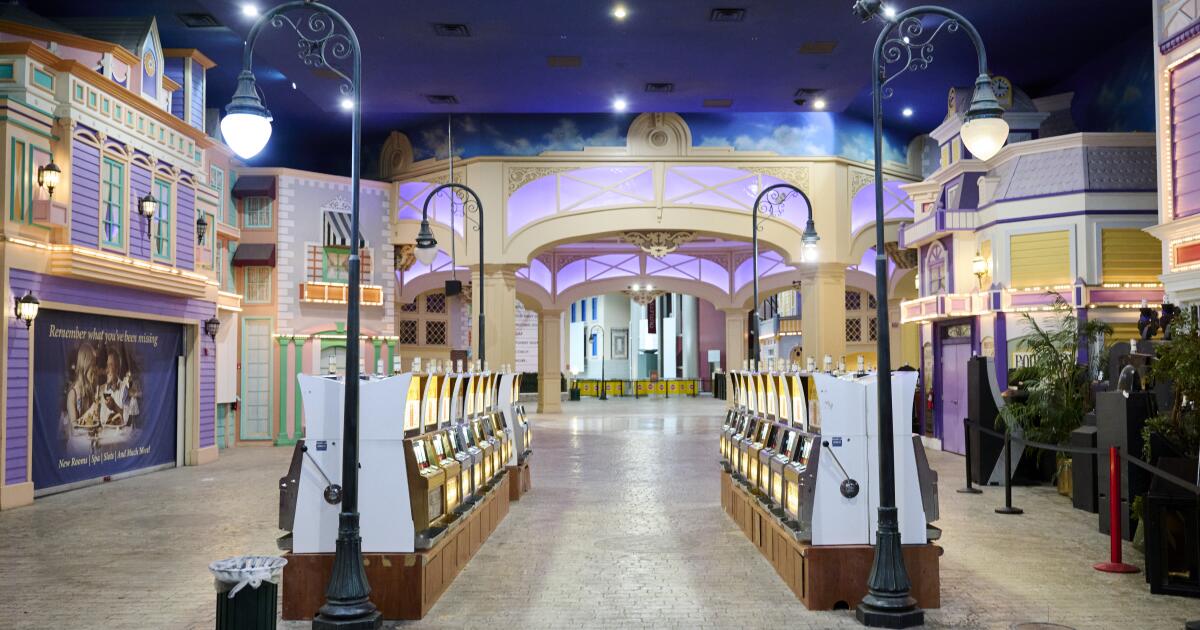
Once upon a time, Primm, Nev., had three bustling casino resorts, shiny gas stations, a roller coaster and Bonnie and Clyde’s “death car.”
It was a bit surreal, said former visitor John Honell of West Covina: “You had this whole complex in the middle of the desert.”
Southern Californians traveling the arid stretches of the I-15 would see Primm pop up. As he drove to Sin City for bowling tournaments, Honell would stop and “drop a few coins” into the slot machines. It was a gambling oasis — a little less flashy and a little more affordable than Vegas and 45 minutes closer.
“I guess it worked for a while,” said Honell, 85.
But it works no longer. The last of the three casino resorts will close on July 4, owner Affinity Gaming confirmed to The Times this week.
Honell, a regular in the 1970s, saw the growth of a desert gamble: the expansion of the Primm property, in the dusty town once known as State Line, from Whiskey Pete’s gas station, bar and slot machines into three busy resorts.
The Nevada gambling hub south of Las Vegas along the 15 Freeway appears finished, though. Southern Californians who appreciated that it was a shorter drive now can find gambling much closer, at tribal casinos.
Las Vegas insider publication Las Vegas Locally posted a termination letter from Affinity Gaming’s affiliate, Primadonna Co. LLC, to employees who worked at Primm Valley.
With the casino closing down July 4, all employment will end that day too.
Affinity Gaming declined to make an official comment.
The castle-shaped Whiskey Pete’s opened in 1977, followed by Primm Valley in 1990 and Buffalo Bill’s in 1994. Whiskey Pete’s was the first casino to close, in December 2024. Buffalo Bill’s Resort ended 24-7 operations on July 6, only opening when the casino’s concert venue, the Star of the Desert Arena, hosted special events.
David G. Schwartz, a gaming historian and professor at the University of Nevada, Las Vegas, said Primm’s casinos were “built for an entirely different world.”
“Southern California is a huge market for Las Vegas and, in particular, it was once very attractive for those in the Inland Empire,” Schwartz said. “It was a way to trim 45 minutes off the drive — it was a 2-hour drive. It’s different math.”
Lights still glow on the Buffalo Bill’s Resort and Casino sign on Sunday, July 6, 2025 in Primm, NV. (Bridget Bennett / For The Times)
(Bridget Bennett/For The Times)
Primm was once one of Nevada’s more popular gambling resorts, a less expensive, slightly more kitschy alternative to Las Vegas that benefited from being closer than Sin City.
Primm Valley, Whiskey Pete’s and Buffalo Bill’s all hosted at one time the famed Bonnie and Clyde V-8 Ford riddled with more than 100 bullets in 1934.
Whiskey Pete’s offered a quick and affordable 24-hour IHOP, in comparison to Vegas’ pricier buffets, and Californians and Nevadans visited Primm Valley’s 100-store outlet mall, supported by shoppers who were brought by bus to the mall for free.
The three resorts enjoyed expansion and growth throughout the 2010s by utilizing low prices, gimmicks and attractions to lure guests.
Buffalo Bill’s was the biggest of the trio, boasting a buffalo-shaped pool and 592 rooms at its opening (the Bellagio has nearly 4,000 rooms) and eventually expanding to 1,242 rooms.
Buffalo Bill’s and its sister resorts closed in March 2020 when the pandemic hit, reopening between December 2022 and 2023. But they struggled to attract customers.
Although the COVID-19 pandemic hurt all Nevada casinos, that was only part of the reason for Primm’s decline. Schwartz said tribal casinos in Southern California saw their prospects soar as Primm’s hotels teeter-tottered.
California voters passed Proposition 1-A in 2000, which allowed tribal casinos to operate slot machines and erased limits on card games.
“Many of those people Primm was drawing from began to stay in Southern California, where the drives are just much shorter and the amenities much closer,” Schwartz said. “You see the same issue playing out at Laughlin along the Arizona border and Reno and Tahoe in Northern California.”
Shortly after Proposition 1-A’s passage, San Manuel was one of several tribal casinos in San Bernardino and Riverside counties that declared an arms race with Nevada.
Fantasy Springs Resort Casino in Indio, run by the Cabazon Band of Mission Indians, opened in December 2004. The tribe was the fourth between 2002 and 2004 to open or expand its operations, including Agua Caliente in Palm Springs, Morongo in Cabazon and the Pechanga Band of Luiseno Mission Indians in Temecula.
Most of these casinos have continued to build and expand their operations as revenue has continued to flow.
The Southern California tribal resorts are classified by the National Indian Gaming Commission, a gaming regulatory body, to be in the Sacramento region, which includes all resorts in California and Northern Nevada.
In 2014, the combined casinos contributed $7.9 billion in gross gaming revenue.
Ten years later, 87 tribal operations throughout two states combined for $12.1 billion, marking a modest 1.4% increase from 2023.
Yaamava’ Resort & Casino, run by the San Manuel Band of Mission Indians, sits in Highland, about 200 miles from Primm but less than half that distance from downtown L.A.
Yaamava’ completed a $760-million expansion in 2021, which added a 17-floor tower, three bars and about 1,700 new slots.
The 7,400 slot machines at Yaamava’ make the casino the West Coast’s largest, with 4,000 more slots than its Vegas peers. By square footage of gaming space, Yaamava is No. 4 in the nation and still the biggest on the West Coast.
“The decline has been part of a larger trend,” Schwartz said of Primm. “People are choosing options that most appeal to them.”


Stacy Clausen and Joe Bird in Leviticus.
NEON
hide caption
toggle caption
NEON
Summer movies aimed at high-schoolers — comedies, romances, horror flicks — have been a tradition for ages. Think Fast Times at Ridgemont High, Dirty Dancing and the original Friday the 13th, which all drew hot-weather crowds back in the 1980s.
This summer, the movies are queer — not just in casting, but in method and purpose. These three teen flicks transform familiar movie styles by bringing them an LGBTQ sensibility.
A raunchy comedy: She’s the He
YouTube
You know the drill: a bonkers lose-my-virginity plan is hatched by inseparable high-school best buds who are so eager to get girls to notice them, they can hardly think straight.
So, they don’t think … straight. For reasons that could only make sense to horny 17-year-olds, Ethan and Alex decide the way to catch the attention of the school’s hottest girls is to pretend to be trans.
Filmmaker Siobhan McCarthy uses that premise to tell a sweet story about Ethan (who realizes mid-scam that she really is trans), while also mocking some of the more ridiculous transphobic notions — “bathroom scare,” anyone? — that have been politically weaponized recently.
When the whole football team decides that donning women’s attire is a small price to pay to get access to the girls’ locker room, McCarthy prompts boisterous laughs while also establishing how idiotic and unlikely this scenario would be in real life. Casting trans men — say, team captain played by Emmett Preciado — as the cis male characters allows McCarthy to further poke at conservative anxieties.
As leads Alex and Ethan, Nico Carney (a sharp trans comic whose read on toxic masculinity proves hilarious), and Misha Osherovich (sweetly affecting as Ethan discovers her true self) head a terrific, mostly trans and non-binary cast. And a similarly queer team behind the camera helps make She’s the He a raucous, touching, seriously fun charmer — think Some Like It Hot meets American Pie with a Heartstopper vibe.
The romance: Girls Like Girls
YouTube
This gentle teen love story sprang from a hit song Hayley Kiyoko released in 2015. The music video that accompanied the song pictured a budding lesbian romance and has since racked up over 160 million YouTube views. In 2023, Kiyoko penned a young adult book version, which debuted at the top of bestseller lists. Now, she’s brought all of those elements together in a movie about Coley (Maya da Costa) and Sonya (Myra Molloy), two 17-year-old girls navigating a summer romance that takes both of them by surprise.
First-time filmmaker Kiyoko seems content to honor teen romance conventions in a more or less by-the-book tale of first love that has been through enough permutations to feel vaguely workshopped. Still, she’s gotten engaging performances from her leads, as well as from a supporting cast that includes Zach Braff as a loving dad, and Levon Hawke (son of Ethan Hawke and Uma Thurman) as Sonya’s jealous boyfriend.
The horror thriller: Leviticus
YouTube
First-time feature writer/director Adrian Chiarella uses horror conventions in this Australian thriller to explore the trauma caused by a particularly callous strain of homophobic cruelty. The story is centered in a small mill town where high school boys Naim (Joe Bird) and Ryan (Stacy Clausen) fall for each other, only to run afoul of the conservative teachings of their religious community.
Chiarella imagines a Christian sect that has put conversion therapy on steroids, curbing queer desire with a scare-away-the-gay ritual that conjures supernatural demons. The boys smirk as church leaders conduct the ritual, but later discover that when they’re left alone, they’re attacked by murderous entities that take the form of the person they love — each other. Soon, reaching out to — even just seeing each other in school hallways fills them with anxiety. This is, of course, the design: the church leaders want them to be scared. And it will never end.
It’s a conversion therapy metaphor as apt for gay kids as the metaphor in Jordan Peele’s thriller Get Out was for victims of racial bigotry.
Breathtakingly well-crafted, Leviticus clearly has queer teen audiences in mind — all three of these films do — but not exclusively. Yes, Leviticus fills a representation gap. It’s also freakin’ scary.


Lifestyle
L.A. Affairs: Would taking a trip with this new guy finally push us out of the ‘polite’ phase?

Sometimes compatibility unfolds over long conversations at coffee shops or even on the dance floor. Mine and Fernando’s became apparent on our seventh date, standing on a dark corner in downtown L.A. After a short flight, a day at Venice Beach and the fastest glow-up ever for a mom of three, my date opened his hands, sighed and canceled the glorious evening I’d planned. It was supposed to start with a jazz club and end with a tour of late-night sushi bars, until Fernando said, “I feel like a bummer.”
I hooked my arm through the crook of his, turning back toward the empty streets and our stuffy Airbnb.
A few weeks before, on one of our first dates, I’d told Fernando I was presenting at a conference in L.A. “You should join me,” I said, half joking.
“Really?” he asked. “You don’t know me at all.”
He was right. We were in the polite phase. We bonded over being transplants to Seattle — him from the Dominican Republic, me from Florida, but we were still figuring out the basics. I hadn’t learned yet that he never touches coffee but totally loves cake, my least favorite treat. And for me, espresso is a daily requirement.
Fernando didn’t say yes to my invitation right away. We continued to date, playing the questions game. “What’s your favorite snack?” he asked me.
“Mole tacos,” I said. “What’s your biggest flaw?”
“Follow through,” he said. “Yours?”
“I’m annoyingly persistent.”
“Perfect match,” he said.
The more we talked, the more we realized that our shortcomings, which made us look like exact opposites, came from the same root. His father had been barely present during childhood, and my father had died when I was a teenager. We both wrestled with trying to find agency inside of moments in our adult lives that felt like abandonment. Although we’d each been in therapy for years before we met, we also struggled to deal with disappointment.
“Maybe we should go on this wild trip together,” he said.
“Make-it-or-break-it style,” I said.
When we stepped through the door of our downtown L.A. Airbnb after a long, hot day walking the boardwalk, we had our first chance to manage a letdown, together.
“I think people actually live here,” he said.
“Like it’s 2015,” I said.
We’d made a commitment before we flew out to keep things light. If one of us complained, the other was supposed to say something fun. But the apartment was muggy, the surfaces covered in dust. We made exaggerated, positive comments about the vintage decor as I waited for the water to warm in a huge, clawfoot tub.
Fernando said something about getting in while the shower was still cold, so we could preserve water for the good people of California. I noted the fatherly tone — and realized I probably seemed wasteful for resisting the chilly stream during a drought.
While I bathed, he shaved. Then we switched. “I feel shy but not shy,” Fernando said, and I agreed. I wondered if this would be the first of many small, sweet moments — or if it was the only time we’d ever share this kind of intimacy.
We were finally ready for our night on the town, but we only walked six blocks before Fernando turned to me and told me that he was too tired to keep going.
“I owe you,” he said, as we walked back, but I was wiped too and relieved he said it first.
“What if we do something different and call it exciting?” I asked.
We talked about the absolute thrill of ordering takeout in a city that was 30 degrees warmer than the one where we both lived, listing every little thing that was totally amazing around us. All those closed-down garages that would open in the morning selling fabric? Gorgeous.
The dark streetlights on one side of the road that made the shadows look like a modern noir film? Fabulous.
The fact that we were about to fall asleep in the same city as dozens of celebrities we both adored? Relatively meaningless but still badass.
As we ate our to-go sushi in downtown L.A., I realized I wasn’t disappointed at all. My drive to follow through was all about the mission, and our mission had changed. Instead of wooing my new date with a super swanky night on the town, I had the opportunity to connect with him in a real way.
Our trip to L.A. had become a kind of test, way more intense than agreeing on a sofa or building an IKEA shelf. We were stuck spending time with each other without performing, in a strange city, for days.
After I presented at the conference the next morning, Fernando and I moved to a new rental in the Hollywood Hills, where we found our way to endless taco stands and two speakeasies, Good Times at Davey Wayne’s and Adults Only. The only landmark we saw was Muscle Beach, and the only quintessential L.A. thing we did was accidentally find ourselves in front of the Last Bookstore an hour before we needed to head to the airport, so we spent that hour walking around inside.
“Let’s keep traveling,” we said to each other on the way home.
Seven years and dozens of trips later, I engraved “I will travel with you” on the inside of our wedding rings. The night before our wedding, we stood together in a tiny bathroom in his sister’s house in the Dominican Republic, washing our faces. I looked at him in the mirror. He turned and looked at me. “I’m really glad you invited me to Los Angeles,” he said.
“It was a risk,” I said, “and the best trip ever.”
The city isn’t ours, but it made us who we are, together.
The author is a journalist and illustrator working on a memoir about Florida. She splits her time between her Seattle, L.A. and the Deep South. Her Instagram is @adjsbb and website is AshaDore.net.
L.A. Affairs chronicles the search for romantic love in all its glorious expressions in the L.A. area, and we want to hear your true story. We pay $400 for a published essay. Email LAAffairs@latimes.com. You can find submission guidelines here. You can find past columns here.

What freedom looks like today.
Getty Images/Viktoriia Miroshnikova/Photo illustration by NPR
hide caption
toggle caption
Getty Images/Viktoriia Miroshnikova/Photo illustration by NPR
What does freedom mean today?
Happy Juneteenth! For those not in the know, today commemorates when U.S. federal troops arrived in Galveston, Texas in 1865 to take control of the state and ensure that all enslaved people were freed – a full two and a half years after the signing of the Emancipation Proclamation. Since then, Juneteenth has been celebrated all over the country, especially in Texas and across the South, where Juneteenth parades, cookouts, festivals and pageants happen every year. Two weeks from now, the country will celebrate the Fourth of July – and its 250th anniversary. For many Black Americans, there’s always been a tension between these holidays – and their two different ideals for what it means to be free. As voting rights protections are rolled back and Black history is being scrubbed from government websites, what does freedom look like for Black Americans today?
To get into it, Brittany is joined by Dr. Kellie Carter Jackson, chair of Africana Studies at Wellesley College.
For more episodes about the quality of Black life in America, check out:
Jesse Jackson & the end of the civil rights superhero
Is the economy slowing? Ask Black women.
What to expect when you’re expecting racism
Support Public Media. Join NPR Plus.
Follow Brittany on Instagram: @bmluse
For handpicked podcast recommendations every week, subscribe to NPR’s Pod Club newsletter at npr.org/podclub.
This episode was produced by Corey Antonio Rose and Liam McBain. It was edited by Neena Pathak. We had engineering support from Josephine Nyounai. Our Supervising Producer is Cher Vincent. Our Executive Producer is Barton Girdwood. Our VP of Programming is Yolanda Sangweni.
-

 Georgia45 seconds ago
Georgia farmers on alert as New World Screwworm confirmed in Texas, New Mexico
-

 Hawaii4 minutes ago
Principal honors Obama as ‘Child of Hawaii’ at library opening – AsAmNews
-
 Idaho9 minutes ago
Mountain Home neighbors kickoff Juneteenth celebrations as Idaho marks 25 years of recognition
-

 Illinois16 minutes ago
Illinois has already broken the record for number of tornadoes in a year — and it’s only June
-

 Indiana18 minutes ago
Hamilton County teen is youngest delegate at Indiana Republican convention
-

 Iowa24 minutes ago
Reynolds orders flags lowered for funeral of Iowa Sen. Julian Garrett
-
Kentucky34 minutes ago
Louisville celebrates Juneteenth with parade honoring history and culture
-

 Louisiana39 minutes ago
From ‘not pageant people’ to Miss Louisiana stage: Addison J…


