Austin, TX
Austin creative collective pushes past funding loss with summer events


This month, Austin’s art scene is exploring how history, identity, and relationships shape creative expression. At the Blanton Museum, A Family Affair: Artistic Dynasties of Europe (Part I, 1500-1700) showcases intricate woodcuts and etchings by European printmaking families, revealing an evolution over generations. Similarly, In Creative Harmony: Three Artistic Partnerships examines collaboration and legacy.
Other exhibitions delve into individual experiences and their intersections with the environment. Aisha Imdad’s The Allegorical Gardens at Women & Their Work combines miniature painting with sensory elements to evoke the garden as a space of healing and cultural memory. Meanwhile, Relational Earth at the Doughtery Art Center explores the connections between ecology and human experience through textured, site-specific works.
Whether focused on familial bonds, cultural roots, or the natural world, these exhibitions highlight the diverse ways artists engage with themes of legacy and belonging.
A piece from Lance Myers: “Frequencies in the Static Bloom.”Image courtesy of Lance Myers via Wally Workman Gallery
Blanton Museum
Group Exhibition: A Family Affair: Artistic Dynasties of Europe (Part I, 1500-1700) — Now through June 15
Woodcuts, etchings, and engravings across a nearly 200-year span are on display in this group exhibition. Together, the pieces tell the story of 16 European printmaking families. A Family Affair looks at the striking similarities and drastic differences families make in their creative work over generations. Incredibly detailed and intricate work, these etchings show both high fantasy scenes and realistic renderings. Persian ambassadors, dragons, drinkers, and sorcery all find their way into these works.
Group Exhibition: In Creative Harmony: Three Artistic Partnerships— Now through July 20
Featuring six artists, this group exhibition looks at how artists are inspired through intergenerational connections, friendships, and family. Mexican printmakers José Guadalupe Posada and Artemio Rodríguez use dark humor in their works to interrogate social injustices. Arshile Gorky and Isamu Noguchi’s works reunite collaborative drawings the pair made in 1939. Mother-daughter pair Nora Naranjo Morse and Eliza Naranjo Morse work together for the first time at this scale to create an immersive artistic environment.
Doughtery Art Center
London Farris: Swammer — Now through June 21
This mixed media series was inspired by Farris’ experience as a swimmer, exploring body image, identity, and the challenges of competitive swimming. The artist uses shifting colors and tones to reflect the different phases of her journey, depicting the toll of competition and joy of celebration. Through rich textures, Farris highlights the resilience and beauty of athletes, offering a glimpse into their everyday realities.
Lindsey Millikan: Tides and Time — Now through June 21
Millikan blends celestial and aquatic elements, bold patterns, and surreal landscapes to explore the past, present, and future. Central figures transcend reality, inviting the viewer closer. Rooted in fine art and mural traditions, the work offers perspectives on the human psyche and our evolving world.
Melinda Barsales and Rachel Long: Relational Earth — Now through June 21
Relation Earth is a collaborative exhibition between Barsales and Long, looking at the connections between place, ecology, and the human experience. Melding visual, performing, and healing arts, the artists reconnect with the natural world through collage, texture, and site-inspired works, exploring reflection and belonging.
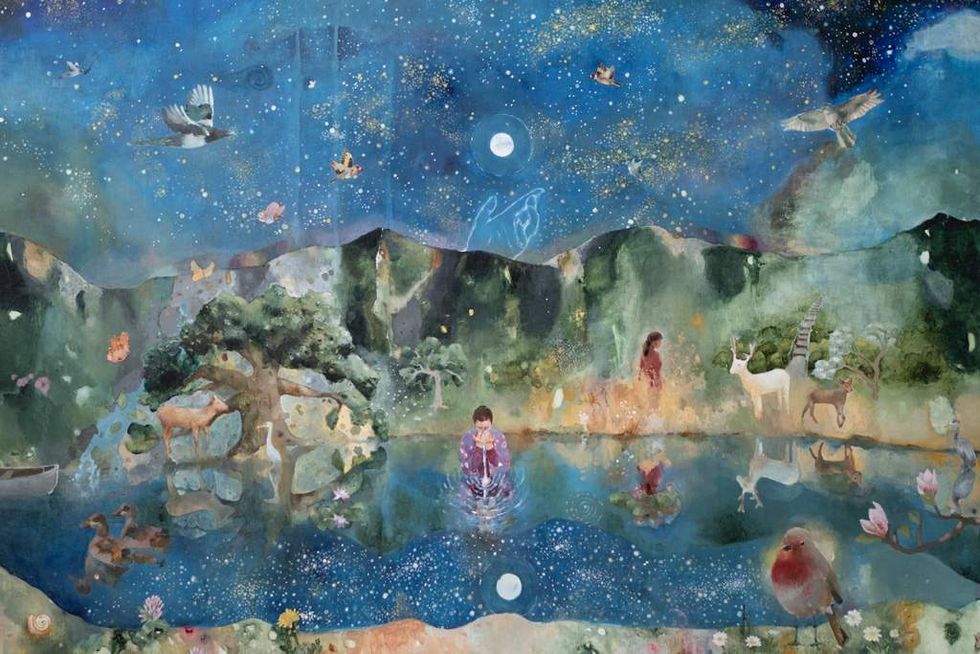 “Home” by Rachel Long.Image courtesy of Rachel Long via the Dougherty Arts Center
Lora Reynolds Gallery
Ewan Gibbs: TX/NY— Now through June 28
Gibbs’ intricate grayscale drawings celebrate the gallery’s 20th anniversary. Known for his meticulous “pin-pointillism,” Gibbs translates iconic landmarks like New York’s Empire State Building and symbolic Texas imagery into delicate, grid-based compositions. His works reflect a lifelong dedication to precision and capturing the passage of time. A highlight is Gibbs’ portrait of Lora Reynolds, created over seven months with 20 pencil grades, symbolizing their decades-long friendship and shared artistic journey.
Women & Their Work
Aisha Imdad: The Allegorical Garden — Now through July 3
Imdad draws inspiration from Indian, Mughal, and Persian miniatures and frescos, reflecting the artistic traditions of her birthplace, Pakistan. Her work blends traditional painting techniques with a contemporary approach. Imdad’s latest series, The Allegorical Gardens, explores the garden as a symbol of paradise, healing, and cultural memory. Through intricate large-scale paintings paired with sensory elements such as floral scents and birdsong, she creates immersive sanctuaries that celebrate the garden’s significance.
Austin Central Library
Group Exhibition: Roots Unveiled: Exploring the Chinese Experience — Now through August 31
This interdisciplinary project mixes traditional visual art with modern video storytelling to explore the Chinese American experience in Texas. Michael Wei, a prominent vlog artist, presents a video series highlighting the stories of Austin’s ten legendary Chinese Americans. Through curated still-life compositions and narratives of Chinese immigrants since the 1800s, the project offers a dynamic multimedia perspective on their journey and contributions.
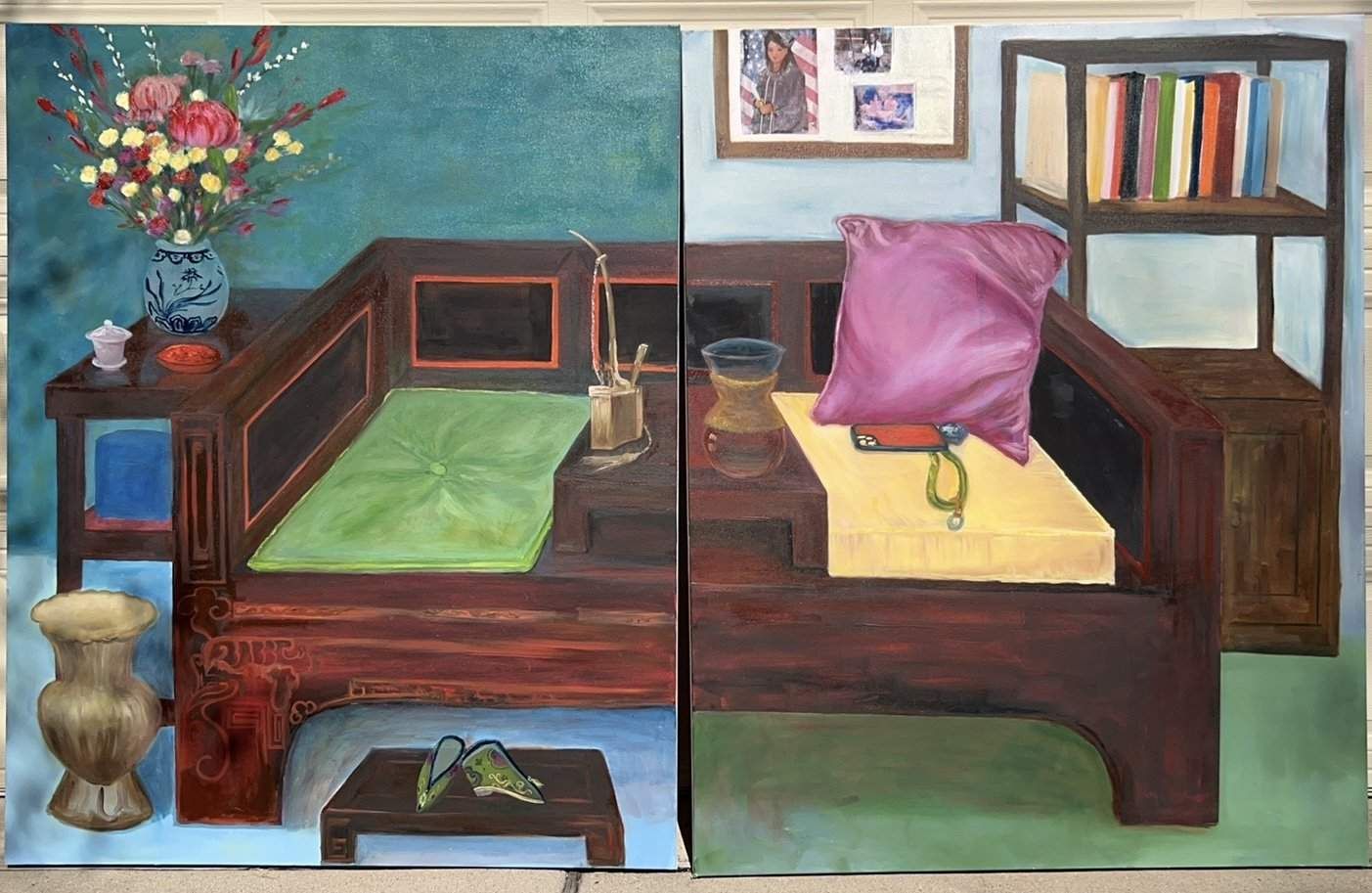 Untitled painting by June Xu.Image courtesy of June Xu via the Austin Public Library
Wally Workman Gallery
Lance Myers: Frequencies in Static Bloom— June 7 through July 6
Myers’ oil paintings capture surreal scenes rendered in fine detail. From large beetles feasting on oranges to despondent artists sitting before their work, Myers bounces between painting still life and figurative pieces. Many of the pieces capture people in private moments of reflection, creating an intimate, almost voyeuristic connection with the viewer. Bursting across the canvas, Myers’ work showcases vivid, dynamic imagery.



AUSTIN, Texas — Austin city leaders gathered on East 11th Street on Juneteenth to celebrate the “Black Artists Matter” mural before it must be removed under an order from the Texas Department of Transportation. The mural and the city’s rainbow crosswalk are slated for removal in compliance with a Texas Department of Transportation directive requiring cities to remove political ideologies from roadways. Last October, Gov. Greg Abbott directed TxDOT to enforce the policy.
Austin Mayor Kirk Watson stood on the blocked-off street where the yellow letters spelling “Black Artists Matter” are painted on the roadway’s surface. “We will never forget that when the state decided to target our murals, the community stood together to celebrate our city’s diversity, spirit, and creativity,” Watson said.
Watson criticized the state’s actions, saying, “The state government engages in negative rhetoric and threats, it targets communities that it disagrees with and seeks retribution.”
In response to the order, Watson formed the Public Spaces Task Force to identify other ways to celebrate diversity in Austin.
ALSO| Screwworm medications straining animal shelter budgets across Texas
KEYE
Daphne McDole, chief executive officer of the African American Cultural Heritage District and a member of the task force, said she wanted the event held on Juneteenth because of its significance. “I wanted to do it on Juneteenth, it was significant to me because I knew that that was the day my community would be in the district. We will be celebrating over here all day, so it was appropriate,” McDole said.
Task force members said they are exploring alternatives to honor East Austin’s history and diversity. They noted that city leaders in San Antonio created rainbow sidewalks after removing rainbow crosswalks, but said Austin will pursue its own approach.
Task force chair Steven Rivas said the community is focused on preserving the meaning behind the markings. “We chose to come together as a community and find a way to respect what these markings mean and build upon them. If we can’t have them in the street, we’re going to put them off the street,” Rivas said.

AUSTIN, Texas — The screwworm outbreak is having a major impact on animal shelter budgets across Texas. Instant kill and preventative medications for dogs and cats are an unprecedented expense.
Paul is a rescue dog from South Texas, where he was living on the streets and starving. He is now at Austin Pets Alive! getting Screwworm prevention medication and the treatment he needs to get healthy.
“Any dog that enters our shelter period, but especially if they look like this, we are going over them with a fine-tooth comb and looking for anything that might be a wound where a screwworm might have been able to gain access,” said Dr. Ellen Jefferson, CEO and President of Austin Pets Alive!
RELATED| FDA authorizes generic over-the-counter drug to treat New World screwworm in pets
Dr. Jefferson says dogs and cats need regular checks of their eyes, noses, ears, and underneath their fur. But Austin Pets Alive! says the best protection is a combination of Capstar, which is an instant-kill medication for existing active screwworm larvae, and prescription preventatives that provide ongoing protection when administered every 30 days.
“Just to buy the initial Capstar for our program, it was close to $10,000,” said Rebecca Giamona, Asst. Medical Care Director at Austin Pets Alive!
Giamona says preventative meds are also putting a heavy financial strain on the nonprofit’s budget at a cost of around $70,000.
“We need about 5,000 doses of the monthly preventative, and they are roughly $14 to $15 per dose,” said Giamona.
Products with the active ingredients ending in l, a, n, e, r are highly effective at preventing and treating infestations. But keeping Paul and every shelter animal up to date will take help from the public.
“Donations, and hopefully some more donations,” said Giamona.
An infestation of New World Screwworm can be painful, disfiguring, and potentially deadly for animals. Most cases involve livestock, especially cattle, but dogs and cats can also get infestations.

AUSTIN, Texas – Central Texans gather to celebrate Juneteenth or “Freedom Day” on June 19 and commemorate the end of slavery.
What you can do:
The Greater East Austin Youth Association (GEAYA) is hosting the Central Texas Juneteenth Parade and Festival today (6/19).
It’s free and taking place at Rosewood Park in East Austin located at 2300 Rosewood Ave.
The schedule for the events is as follows:
- ACME Juneteenth FunRun – 8:30 AM – 9:30 AM
- Juneteenth Historical Parade – 10 AM – 12 PM
- Park Celebration and Fireworks – 12 PM – 9:45 PM
Other events
On June 20, the Carver Kickback: Juneteenth Edition will be taking place 11 a.m. to 4 p.m. at the George Washington Carver Museum, Cultural, and Genealogy Center located at 1165 Angelina Street.
It will be a day of celebration and remembrance and there will be BBQ plates and music as well as vendors and hands-on activations.
The backstory:
Juneteenth commemorates the end of formal slavery in Texas on June 19, 1865, two and a half years after President Abraham Lincoln signed the Emancipation Proclamation on January 1, 1863, and more than one month following the end of the American Civil War.
Colloquially known as “The Black 4th of July,” Juneteenth marks the beginning of an African American journey to carve a new place in society for free people to shape identities independent of racial caricature, eradicate slave culture, promote ethnic pride, and create economic prosperity.
The Source: Information from City of Austin and Greater East Austin Youth Association and reporting by Jessica Rivera.
-

 Mississippi3 minutes ago
Eight tornadoes confirmed in Louisiana and Mississippi from Post-Tropical Cyclone Arthur storms
-

 Missouri8 minutes ago
1 dead and 5 wounded in Kansas City shooting
-

 Montana15 minutes ago
Planning For Life After Coal Cost a Montana County Commissioner His Seat – Inside Climate News
-

 Nebraska18 minutes ago
Today in History – June 20: ‘Carhenge’ opens to public in Alliance, Nebraska
-

 Nevada30 minutes ago
Nevada’s First And Largest Military Outpost Is Now A Historic State Park To Camp, Paddle, And Hike – Islands
-
 New Hampshire33 minutes ago
New Hampshire faces child care crisis: Costs rise, options fall – Valley News
-

 New Jersey38 minutes ago
Parsippany Positioned for the Spotlight Through New Jersey’s Film Ready Program | Parsippany Focus
-

 New Mexico45 minutes ago
APD: Pedestrian hit and killed in early morning crash

