Science
Video: NASA Prepares for Artemis II’s Return to Earth


new video loaded: NASA Prepares for Artemis II’s Return to Earth
transcript
transcript
NASA Prepares for Artemis II’s Return to Earth
The Artemis II crew prepared for their return home and NASA inspected the exterior of the Orion spacecraft, which is scheduled to land in the Pacific Ocean off the coast of Southern California on Friday.
-
“We have seen just some extraordinary things and other things that I just had never even imagined.” “Canadians couldn’t be more proud of you personally. But this mission and our collaboration with the United States. And I just wonder, a lot of Canadians just want one point of reassurance that the preference is for maple syrup over Nutella on your pancakes in the morning.”

By Nailah Morgan
April 9, 2026



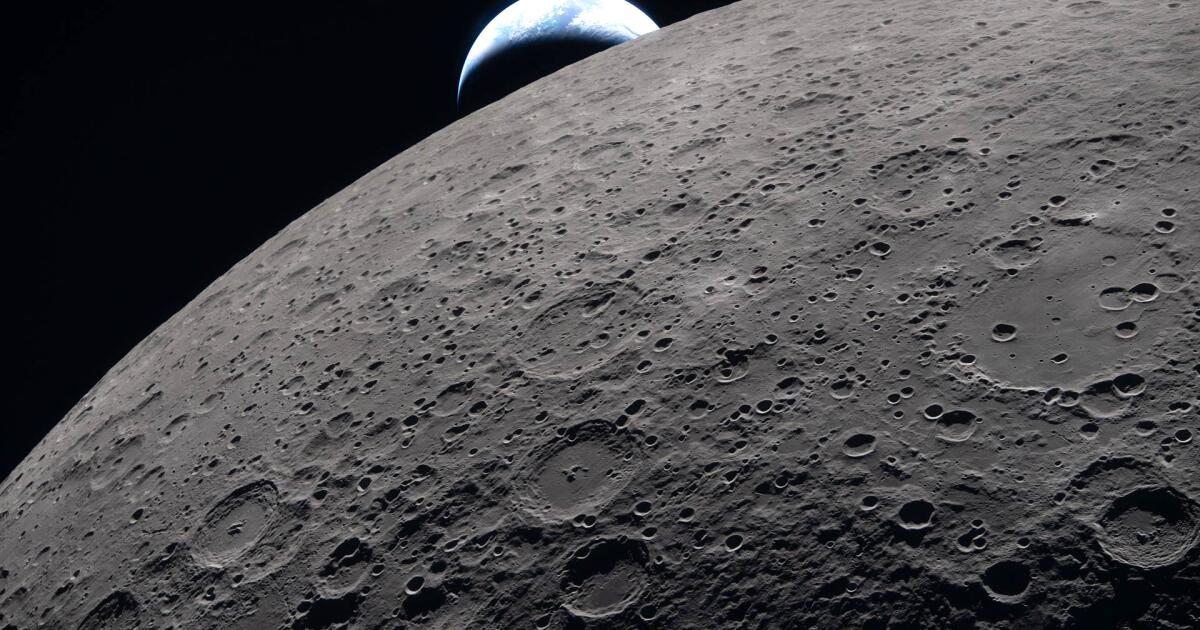
The crescent Earth — our oasis holding everything we cherish, now just a speck in the infinite blackness — seemed to kiss the jagged lunar surface. The moon’s thousands of scars projected themselves across the Earth as it slowly slipped out of sight.
“I’m actually getting chills right now just thinking about it,” said Artemis II Cmdr. Reid Wiseman, talking to The Times while still in space Wednesday evening (Earth time). “It was just an unbelievable sight, and then it was gone.”
The crew of four — in the dim green glow of their spacecraft, with no more elbow room than a Sprinter van — entered a profound solitude few have ever experienced. Farther from Earth than any humans in history, the crew could no longer reach Mission Control, their families or any other living member of our home planet.
For 40 minutes Monday, it was just them, their high-tech lifeboat and the moon.
Artemis II Cmdr. Reid Wiseman peers out the window of the Orion spacecraft as his first lunar observation period on Monday begins.
(NASA)
The crew members paused their rigorous scientific observations for just three or four minutes to let the surreal feeling settle. They shared some maple cookies brought by Canadian Space Agency and Artemis II mission specialist astronaut Jeremy Hansen.
We humans eat seven fishes on Christmas Eve, samosas on Eid al-Fitr and maple cookies behind the moon.
But the astronauts still had work to do. NASA wanted to observe the far side of the moon, eternally locked facing away from Earth, with a highly sophisticated instrument the agency has seldom had the opportunity to measure this landscape with: the human eye.
The moon, appearing about the size of a bowling ball at arm’s length to the crew, hung in the nothingness. In complete silence, it beckoned.

-
Share via
Artemis II pilot Victor Glover heard the call of the terminator: the border between the moon’s daytime and nighttime — the lunar dawn. Here, the sun cast stark, dramatic shadows across the moon’s steep cliffs, rugged ripples and seemingly bottomless craters.
Artemis II mission specialist Christina Koch described the scattering of tiny craters across the daytime side proudly reflecting sunlight, like pinpricks in a lampshade. Hansen was drawn to the beautiful shades of blues, greens and browns that the surface reveals if you’re patient enough.
Even though Earth was hidden behind the moon a quarter million miles away, the crew couldn’t help but think of our home.
For Koch, the desolation was only a reminder of how much Earth provides us: water, air, warmth, food. Glover could feel the love emanating from our pale blue dot, defying distance. Hansen thought of the Earth’s gravity, still working to pull the crew home.
And yet, the crew was in the moon’s gravitational arena, where its gravity dominates Earth’s. It was the lunar monolith in front of them that gently redirected their small vessel of life around the natural satellite and toward home.
Eventually, home peaked back out from behind the dark orb.

The moon fully eclipsing the sun, as seen by the Artemis II crew. From the crew’s perspective, the moon appears large enough to completely block the sun, creating nearly 54 minutes of totality.
(NASA)
As a final show, or perhaps a goodbye, the moon temporarily blocked out the sun: a lunar eclipse.
“We saw great simulations made by our lunar science team, but when that actually happened, it just blew us all away,” Glover said. “It was one of the greatest gifts.”

New shades of brown and green in the rings of impact craters. Rugged terrain and long shadows along their rims. Earth rising over the moon’s horizon and the glow of lofted dust.
These are observations the Artemis II astronauts made during their lunar flyby on April 6. While passing by the far side of the moon, they saw parts never observed with human eyes before.
The astronauts were able to catch a full view of the Mare Orientale, a dark, ringed 600-mile wide crater that straddles the near and the far sides of the moon. Human eyes had never seen the whole basin before. (The Apollo missions were timed so that the landings occurred as the crater was hidden in darkness.)
Everything to the left of the crater is the far side, the hemisphere we don’t get to see from Earth because the moon rotates on its axis at the same rate that it orbits around us.
Astronauts looked at the dark smooth plains on its concentric impact rings, noting that there was more brown near the center of the multi-ring crater. To the naked eye, the basin looked like a plain or a plateau, but through the camera lens the Artemis II crew members were able to distinguish colors from shadows.
This is a close-up view of the Vavilov crater on the rim of the larger and older Hertzsprung crater. Astronauts looked at terrain changes: smooth inside the inner rings of the crater and rugged around the rim.
Some 24 minutes into the flyby, the Artemis II crew began observing the South Pole-Aitken basin, seen in the photo below with the terminator line separating the sunlit side from the dark side.
With an immense width of about 1,600 miles, it is the largest known impact crater in the solar system. These observations will help scientists find clues to the moon’s geological history.
After Artemis II swung around the far side, the astronauts experienced a 53-minute solar eclipse.
They were able to observe the solar corona and get glimpses of a bright Venus, a reddish Mars far in the distance and a Saturn with hints of orange.
The crew described the corona as similar to “baby hair” as the sun’s light intensified.
Then, Earth came into view over the moon’s edge, an event described as Earthrise when humans first saw it in 1968.
Photos taken by Reid Wiseman, Victor Glover, Christina Koch and Jeremy Hansen from the Orion capsule on April 6 and provided by NASA. Time annotations are based on audio comments during NASA’s live transmission of the mission.

Hall of Fame defensive tackle Steve McMichael, a key member of the Super Bowl XX champion Chicago Bears, has been diagnosed posthumously with Stage 3 chronic traumatic encephalopathy, the Concussion & CTE Foundation said Tuesday.
McMichael died April 23, 2025, after a five-year battle with ALS, also known as Lou Gehrig’s disease. He was 67.
“By sharing Steve’s diagnosis, we want to raise awareness of the clear connection between CTE and ALS,” McMichael’s wife Misty said in a statement released by the Concussion & CTE Foundation.
“Too many NFL players are developing ALS during life and diagnosed with CTE after death. I donated Steve’s brain to inspire new research into the link between them.”
ALS — amyotrophic lateral sclerosis — is a neurological disorder that destroys motor neurons. CTE is a degenerative brain disease that has been found in people exposed to repetitive head trauma; it can be diagnosed only after death.
McMichael’s CTE diagnosis was made by researchers at the Boston University CTE Center, which has found that several other former NFL players suffered from both ALS and CTE. According to the center’s director, neurologist Dr. Ann McKee, about 6% of people with CTE also have ALS.
“There is strong evidence linking repetitive brain trauma and ALS,” McKee said.
Michael kept up with the research, according to the Concussion & CTE Foundation, and pledged to donate his brain to be studied after his death.
“Steve McMichael was known for his strength, toughness, and larger-than-life presence,” said Dr. Chris Nowinski, co-founder and chief executive of the Concussion & CTE Foundation, “but his final act was to give a piece of himself back to the sports community so we might have a chance to save ourselves.”
McMichael spent 13 of his 15 NFL seasons in Chicago, earning Pro Bowl honors in 1986 and 1987. He set a Bears record playing in 191 consecutive games from 1981 to 1993 and is second on the team’s all-time sacks list with 92.5 (he had 95 total in his career).
After football, McMichael spent several years as a professional wrestler with World Championship Wrestling.
Bedridden in the advanced stages of ALS, McMichael was inducted into the Pro Football Hall of Fame in a ceremony from his Homer Glen, Ill., home in 2024.
The Associated Press contributed to this report.

PORTAL TARGET BREAKDOWN: Oklahoma State guard Amari Whiting

Kotek signs sweeping immigrant justice package expanding school, healthcare protections in Oregon

Pennsylvania lawmakers face deadline to rewrite sentencing law for second-degree murder

Justice Maureen McKenna Goldberg reflects on 35 years on Rhode Island’s high court

South Carolina bill would help regulate puppy mills

Florida High School Football Rankings: Top 25 teams – Oct. 21

How old is Bo Nix? What to know about Oregon quarterback ahead of 2024 NFL Draft

Cleary's 21 help Le Moyne down Central Connecticut State 69-64 in OT

99th annual Pony Swim held in Virginia

Indiana Members Credit Union announced as new anchor tenant at Bottleworks District

Video: How Trump’s Advisers Felt About Going to War With Iran

Unearthed clip exposes shocking claim by Newsom’s wife about inmates at violent California prison

Gaza journalists mourn Al Jazeera’s Wishah, killed by Israel

Exclusive: Trump weighs pulling some US troops from Europe amid NATO strains, official says

Video: The Fragile Cease-Fire in Iran
-

 Atlanta, GA5 days ago
1 teenage girl killed, another injured in shooting at Piedmont Park, police say
-

 Education1 week ago
Video: We Put Dyson’s $600 Vacuum to the Test
-

 Movie Reviews1 week ago
Vaazha 2 first half review: Hashir anchors a lively, chaos-filled teen tale
-

 Georgia2 days ago
Georgia House Special Runoff Election 2026 Live Results
-

 Pennsylvania3 days ago
Parents charged after toddler injured by wolf at Pennsylvania zoo
-
 Milwaukee, WI3 days ago
Potawatomi Casino Hotel evacuated after fire breaks out in rooftop HVAC system
-

 Education1 week ago
Video: YouTube’s C.E.O. on the Rise of Video and the Decline of Reading
-
 Entertainment1 week ago
Inside Ye’s first comeback show at SoFi Stadium