Fitness
How are Artemis 2 astronauts staying fit? They exercise using this unique gym


Four astronauts are currently hurtling toward the Moon in a spacecraft no larger than two minivans. On the historic Artemis 2 mission, the secret to staying fit is a 13.6-kilogram device called the Flywheel Exercise Device, or FED.
As Commander Reid Wiseman, Pilot Victor Glover, Mission Specialists Christina Koch and Jeremy Hansen journey through deep space, they are using this miniaturised gym to combat the harsh effects of microgravity.
HOW DOES THE FLYWHEEL GYM WORK?
In the weightlessness of space, muscles and bones begin to weaken almost immediately because they no longer have to support the body against gravity.
To prevent this, the FED uses a cable-based system similar to a yo-yo.
When an astronaut pulls the cable, an internal wheel spins and stores energy.
As the user pulls back against the spin, the wheel creates a smooth and steady resistance.
This clever design allows the crew to perform heavy strength training without needing any actual weights, which would be impossible to use in the weightless environment of space.
The FED is a masterclass in space engineering. Unlike gyms on Earth that rely on heavy weights, the flywheel provides up to 180 kg of variable resistance using physics alone.
This allows the crew to perform squats, deadlifts, and rowing in an extremely cramped environment.
WHY IS EXERCISE VITAL FOR LUNAR MISSIONS?
Without a daily 30-minute workout, the crew would face rapid physical decline.
This mission is the first crewed flight beyond low-Earth orbit since Apollo 17 in 1972, meaning the stakes are incredibly high.
There is no quick way back to Earth for medical help, so keeping the heart and bones strong is a non-negotiable mission requirement.
WHAT IS DAILY LIFE LIKE INSIDE ORION?
Recent footage shows Victor Glover exercising while Jeremy Hansen prepares a chocolate pudding cake.
Life inside the Orion capsule is a constant act of multitasking. The crew sleeps in custom nooks to save space, and every movement is monitored by ground teams.
Even the act of breathing during a heavy workout affects the cabin air quality, as the life support system must work harder to scrub carbon dioxide and moisture.
This tiny gym is more than just fitness equipment.
It is a vital piece of technology that ensures humans can survive and thrive as they venture back to the Moon and eventually to Mars.
– Ends
Tune In



In January 2025, I attended my first bootcamp class.
I had spent the day hunched over my laptop, anxious and craving an intense workout that would dispel my worries. I booked the class at a nearby gym, and the five-star reviews promised the all-consuming exercise I wanted: “Militant style instructor, but very motivating,” read one. Another: “Hardest workout of my life; extremely rewarding.”
The gym was no-frills – just a room with a mirror. After a standard warm-up, we did four sets of lateral shuffle push-ups across the floor, interspersed with standing, weight-bearing exercises.
When my turn came, I dropped to plank position and started doing steady, shallow reps, focusing on my form.
But caution soon fell away. Upbeat music was booming and someone was always advancing beside me. When the instructor encouraged us to lower all the way down, I obeyed, even though my form suffered. I had rarely done more than a handful of pushups at a time, and in the final set, I was exhausted, collapsing on every rep and barely prying my torso off the floor.
The rest of class was a blur. I became nauseated, told the instructor I needed to pause, and stepped outside to suck cold winter air into my lungs.
Back in the studio, I sat on the sidelines and waited for the dizziness to recede before slinking to my spot for the core section and cooldown.
Later that night, I felt what I thought was typical post-workout muscle soreness. I was satisfied; the ache was proof of a successful workout.
But the next day, lifting my arms to wash my face was exhausting. Searing pain kept me awake that night. Two days after the class, my arms were so stiff I couldn’t raise them more than a few inches, even to brush my teeth.
When I Googled my symptoms – pain, weakness and a new one, dark urine – something frightening came up: exertional rhabdomyolysis, a condition wherein extreme exercise causes muscle cell contents to flood the bloodstream, potentially overwhelming the kidneys. One article warned that debilitating pain after a new, intense activity was a sign to visit the emergency room.
I went to the ER but suspected I was overreacting. After all, the internet always offers the worst possibility.
Doctors use bloodwork to test for exertional rhabdomyolysis; typically, they diagnose it if a patient has too much of a muscle enzyme called creatine kinase (CK) in their blood – at least 1,000 units per liter, or five times the normal range. However, there is little consensus on this number, says Dr Barry Boden, an orthopaedic surgeon at The Orthopaedic Center in Maryland, who specializes in sports medicine. Some recent guidelines suggest that only higher amounts – as much as 10,000 units – warrant diagnosis and inpatient treatment.
My CK count was so high the machine in the emergency room couldn’t measure it; a nurse had to do a second blood draw and send it to a more precise lab. They put me on an IV drip and eventually reported the exact number: 57,000.
Thus began my seven-day hospital stay. My mom and sister traded shifts, acting as my arms for the week – scrubbing my teeth, feeding me, washing my face. I had never felt so helpless and irresponsible. What had I done to myself?
What is exertional rhabdomyolysis?
Normally, during exercise, muscles tear a little and then rebuild. There may be a little extra CK in a person’s blood as a result, which healthy kidneys can filter out.
But excessive exercise can harm muscle cells so much that their contents – including CK and a protein called myoglobin – overload the system. “When the cell membrane starts to break down, the chemicals within the muscle cells start to get released, which can cause damage to other organs around the body,” said Boden. “ If there’s enough of those chemicals from the muscle that reach the kidney, it can cause damage to the kidney.”
The symptoms are muscle pain (even while at rest), weakness and dark urine, though few people experience all three. Treatment involves early and aggressive administration of IV fluids to help the kidneys filter the toxins. It’s possible to manage a mild case with at-home oral hydration, but it’s always important to consult a doctor because mild symptoms don’t always mean low CK elevation, said Dr Petr Schlegel, a CrossFit trainer and professor at the department of physical education and sports at the University of Hradec Králové in the Czech Republic.
Exertional rhabdomyolysis is dangerous and fatal in very rare cases; researchers estimate that 10% of patients develop acute kidney injury (AKI), and some suffer other serious complications.
How common is exertional rhabdomyolysis?
Before I had rhabdomyolysis, I had never heard of it; I thought the worst that could come from a workout was a broken bone or a regurgitated lunch. I now know it can happen to anyone, although people with certain conditions, such as sickle-cell trait and hypokalemia, are predisposed. Despite the common misconception that only unfit people can get it, even elite athletes are susceptible.
“Anybody can get it – anybody that’s pushed to an extreme, taking a big jump in their exercise level, or doing something they’re not used to doing,” said Boden. “Everybody has muscles, and if the muscles are damaged enough, you can develop rhabdomyolysis.”
Boden authored a study estimating there were over 40,000 exertional rhabdomyolysis cases in US hospitals from 2000 to 2019. But he said it’s impossible to get a precise count, as no organization collects the data.
This number is likely an underestimate, as the condition is probably under-reported, said Schlegel. Since the symptoms closely resemble those of delayed onset muscle soreness – the normal ache people expect after a workout – individuals may not seek care.
Data indicate exertional rhabdomyolysis is on the rise. In Norway, Australia and the US, researchers have observed an increase in hospital records between the 2000s and 2010s. This year, hospitals in a Canadian province reported a surge in cases.
Researchers suspect the popularity of high-intensity workouts is behind the rise. They are efficient and produce measurable progress, but are risky if misused, said Schlegel: “Evidence suggests that high-intensity exercise, especially when combining strength and endurance elements, carries the greatest potential to induce [exertional rhabdomyolysis].”
after newsletter promotion
Can you prevent exertional rhabdomyolysis?
Prevention guidance has been pretty consistent since the earliest studies from the 1960s: vary exercises to avoid overloading one muscle group, incorporate rest, and gradually build intensity when starting something new or after time off.
Starting low is especially important when targeting large muscle groups – such as biceps, triceps and quads. “It’s that hyperintense going from zero to 100, really intense workouts of large muscle groups, that puts people at risk,” said Dr Bryant Walrod, a sports medicine physician and the head team physician for the Ohio State Buckeyes. Weight matters, but so do reps; an outrageous number of low-weight exercises or calisthenics – hundreds of pushups or squats, for example – is the trigger in many cases. Walrod also advises doing a different kind of workout from one day to the next.
Eccentric exercises like push-ups – where muscles lengthen – are particularly likely to cause injury. In a 2024 article about how to prevent rhabdomyolysis in student athletes, the National Federation of State High School Associations called push-ups the “No 1 cause” of rhabdomyolysis. In April, Texas families filed a lawsuit against a charter school after 20 children were hospitalized after hundreds of pushups.
Walrod said collegiate sports professionals became more vigilant about prevention after University of Iowa football players were hospitalized with exertional rhabdomyolysis in 2011. “That case spurred better control of workouts, better monitoring, and better input from the trainers and strength coaches.”
“Where we see most of the cases is that athletes are being pushed or threatened or punished [contrary to industry standards],” said Dr Rebecca Stearns, COO at the Korey Stringer Institute for preventing sudden death in sports. Coaches are not exercise physiologists, and even when well-intentioned may not have adequate training to prevent overexertion, said Boden.
Similarly, there’s no guarantee fitness instructors understand the risk. “People may be going in unconditioned and doing too much too soon,” said Walrod of these classes. CrossFit incorporated prevention into its trainer curriculum after reports of severe cases among participants, but in general, class participants should self-monitor.
How do you identify overexertion?
I was discharged from the hospital with a firm instruction: no exercise except walking for a month. I had to learn what an appropriate challenge felt like – how to self-monitor, discern between safe discomfort and overexertion, and advocate for myself. But when is hard too hard?
Unfortunately, sensing that something is wrong is a subjective measure; there is no universal metric.
“I never have a very satisfying answer to that, but I do think it’s a line we need to be vigilant about always, and it changes from day to day,” said Dr Natalia Petrzela, author of Fit Nation: The Gains and Pains of America’s Exercise Obsession, longtime fitness instructor, and professor of history at The New School.
“You know your body the best, and if you feel like something isn’t right, it’s time to speak up,” said Walrod. Sports medicine physicians advise people to stop exercise immediately if unusual pain occurs; in the event that there is excessive muscle breakdown, it’s critical to stop the movement right away.
Speaking up in a class setting can be difficult. Many feel self-conscious about pausing or modifying activity, especially if an instructor is singling them out. Petrzela said that she motivates participants in her class but also expresses a key caveat: “Only you know what you can do today.” She said this language “helps [them] find that very important and difficult-to-discern line”, adding that this nuance might get lost in classes with less experienced instructors who give inflexible instructions.
During that fateful class, I ignored the alarm bells. Maybe I was desperately chasing endorphins or wanted to prove to myself that I wasn’t weak. Ironically, my arms atrophied to below baseline as a result.
Over a year later, I’m still building my strength back – but not at bootcamp. I opt for low-impact methods such as barre and pilates where I can modify if needed, and there is no need to keep pace with others.
Sometimes I tell instructors about my medical history, so they understand what’s happening if I pause. Verbalizing it also reminds me to be careful. Finally, I avoid anything new or especially difficult when I’m having a hard day.
Fitness culture taught me that pain is gain – but now I know that’s not always true.

10
Fitness Point gym has state of the art machines to help in health exercises.
KIGALI – There are 10,080 minutes in a week. Health experts recommend that adults spend at least 150 minutes of moderate-intensity physical activity each week in order to build a healthy body.
For those who prefer structured workouts, three one-hour gym sessions amount to just 180 minutes, less than two percent of the time available over seven days.
It is a surprisingly small investment for something associated with better heart health, stronger muscles, improved mental wellbeing and reduced risk of many chronic diseases.
That simple idea found an unlikely ambassador recently when Rwanda’s Minister of Health, Dr. Sabin Nsanzimana, reflected on a birthday gift he had given himself.
“Healthy habits are the best gifts we can give ourselves,” he wrote after completing a demanding hike to the summit of Karisimbi volcano.
Many people may admire the endurance behind the journey but perhaps the most powerful part is the reminder that good health is rarely built through one extraordinary achievement. It is built through habits repeated week after week.
The Growing Urban Philosophy
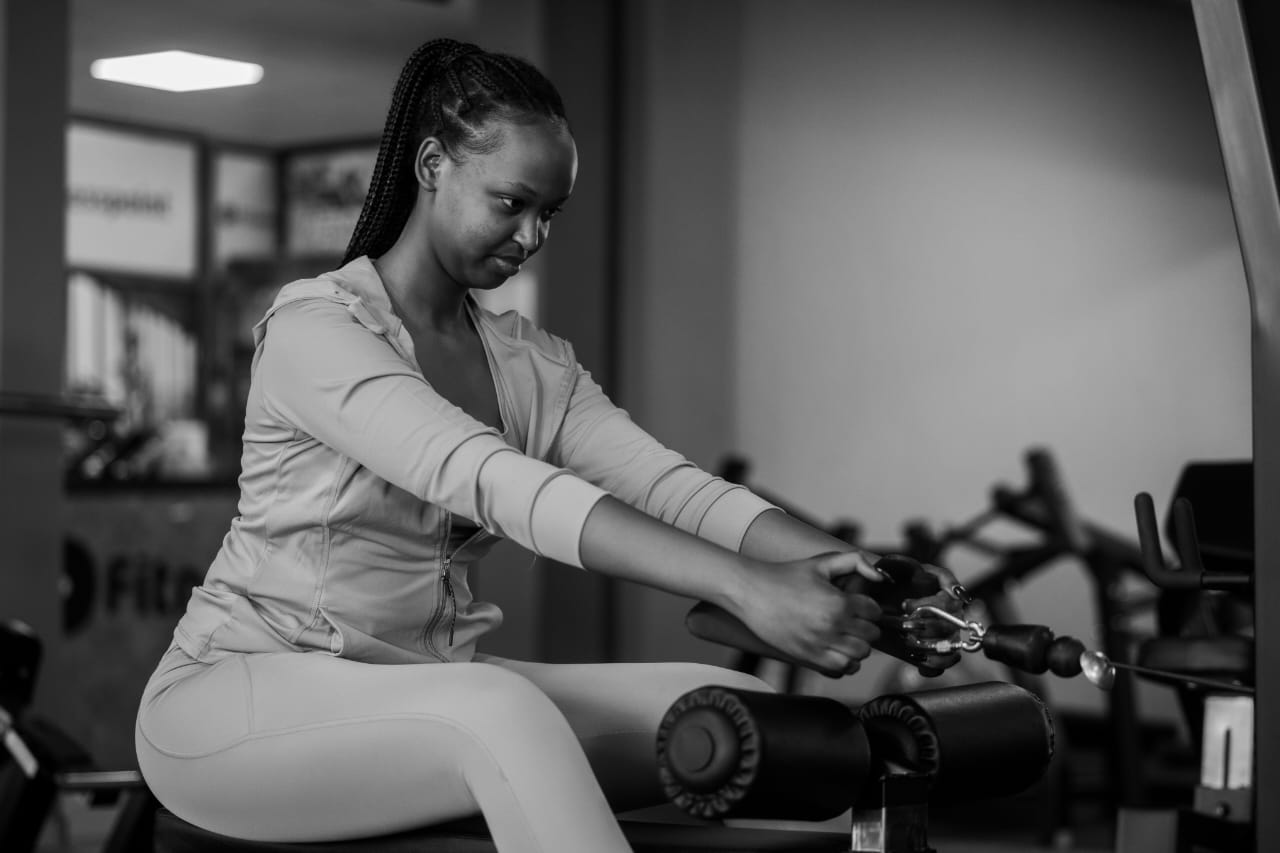
A lady working out at a Fitness Point gym located in Gacuriro.
Every evening across Kigali, people filter through the doors at various Fitness Point’s branches carrying laptops, gym bags and the fatigue of another workday to quietly bring that philosophy to life in a different setting.
In Remera, Gacuriro and Kimihurura, some arrive before sunrise, squeezing in a session before the office. Others come long after business hours, determined to honour a promise they made to themselves despite packed schedules.
They are not training to conquer volcanoes or prepare for competitions. Most are simply trying to become healthier than they were yesterday.
As work becomes increasingly desk-based and daily routines leave little room for movement, the challenge is not understanding that exercise is important. It is finding a way to make it part of ordinary life.
For many, that begins with putting just three appointments on the calendar each week.
Consistency Better Than Intensity

Jean Baptiste Muganza, a Kigali-based physiotherapist and frequent guest at Fitness point, says one of the biggest misconceptions he encounters even in his work is that meaningful health improvements require extreme effort.
“People often believe they have to exercise every day or spend several hours in the gym before they can see results. In reality, consistency matters much more than intensity,” he says.
A structured routine done regularly, he says, delivers far greater benefits than occasional bursts of very demanding exercise. And the benefits extend well beyond appearance.
“We see improvements in cardiovascular health, muscle strength, posture, flexibility and energy levels. Regular exercise also plays an important role in managing stress, improving sleep quality and reducing the physical effects of spending long hours sitting,” he explains.
Ironically, he says, the hardest exercise often happens before anyone touches a treadmill or lifts a weight.
“The biggest challenge isn’t completing the workout. It’s building the habit. Once exercise becomes part of your weekly routine, it stops feeling like an obligation and becomes part of your lifestyle,” Muganza says.
Leading by Example

Rwanda’s Minister of Health, Dr. Sabin Nsanzimana recently took a hike to the top of Karisimbi volcano as a birthday gift to himself.
That change is becoming increasingly visible at Fitness Point, where trainers say members are arriving with goals that seem less visible but perhaps more valuable than just chasing dramatic body transformations.
Many are seeking something lower stress, better mobility, freedom from persistent back pain, improved fitness and enough energy to keep pace with demanding jobs and family life.
The gym itself has gradually evolved into more than a room filled with equipment. Before work, it offers a fresh start. After work, it becomes a place where the pressures of the day give way to movement.
Between those moments, friendships are formed, routines are strengthened and small victories accumulate, one workout at a time.
That is perhaps why Minister Nsanzimana’s message resonated with so many people. Healthy habits are gifts not because they require extraordinary effort, but because they reward ordinary consistency.
A birthday hike or a workout at the gym may inspire thousands, but the habit that made it possible was almost certainly built long before that day.
For most people, good health may begin in a neighborhood gym, during an evening workout after work, or in the simple decision to dedicate less than two percent of an entire week to taking care of the one body they have.
Sometimes, the smallest investment of time turns out to be the one with the greatest returns.

Visited 25 times, 5 visit(s) today

Fitness, like anything else, is partial to trends, and at the moment, exercise is portrayed in extremes. “You’ve got to do HIIT training. You’ve got to run marathons. You’ve got to lift heavy.” The actual truth is much less snappy and attention-grabbing: fitness should be balanced and well-rounded. Slow and intentional is better than intense and sloppy.
There’s one functional exercise which is particularly good at challenging us in the ways we often forget, and most of us have never heard of it: the Turkish get-up.
But what is the Turkish get-up, and why is it so good for you?
What is functional movement?
Functional movement is any exercise which mimics and builds on the way we move in everyday life. Rather than aiming for aesthetic results or personal bests, the goal of functional exercise is to feel a little better all the time, in every movement you do, whether that be taking the stairs, lifting heavy boxes, or, if you’re a mum like me, bending down to pick a child up off the floor.
Functional movement incorporates multiple muscle groups, or the entire body, to build strength in a way you’ll actually use, multiple times a day, without even really thinking about it – the best type of exercise. But functional movements aren’t all about building muscle – they also crucially improve coordination, joint stability, shoulder strength, balance, hip mobility, and, perhaps most importantly, core stability and strength.
Over on Strong Like Mum, functional exercise is the name of the game. If you or someone you know is postnatal and ready to start rebuilding core strength, we’ve just released week three of the Strong Like Mum core challenge – all you need is 15 minutes, for a stronger core in just 6 weeks.
Start from week one to start building the vital foundations needed to rehabilitate a strong core. Join the Strong Like Mum core challenge:
What is the Turkish get-up?
See the step-by-step guide below for how to do a Turkish get-up.
The Turkish get-up is an incredibly beneficial, multi-step, multi-joint, full-body exercise targeting every major muscle, which has a simple goal: get from lying down on the floor to standing up, while holding a weight in one hand.
The whole movement is about being balanced, steady, and controlled. It takes an incredible amount of strength to move with intention, rather than trying to go as fast or hard as your body can take. High-impact exercise can be great, but slow and controlled movements can challenge your body in loads of ways, too.
In April of this year, strongman Mike Aidala broke the Guinness World Record for the heaviest Turkish get-up with a whopping 118.6kg
Record breaker
It’s ideal for hitting all the areas we often forget while we’re pushing for a heavier weight or racing to break a personal best. It’s about slow control, brain function, focus, and coordination.
The Turkish get-up is also really easy to replicate if you have children, as it seems more like a fun mobility challenge than an exercise routine. Maybe you could call it a teddy bear get-up: rather than holding a weight, they’ve got to balance their teddy bear in their hand.
How to do a Turkish get-up
Here’s a rundown on how to do a Turkish get-up.

Why is the Turkish get-up so good?
There’s a growing interest in longevity and healthy ageing at the moment. People are starting to think about the long game and what’s going to help create strong foundations for future exercise, in the immediate short-term and into older age.
This is where Strong Like Mum comes in. If you’re postnatal and want to be able to do high-intensity exercise, lift heavy weights, and run marathons, that’s great! But in order to get there, we need to start in the right way. We need to build those strong foundations in order to have longevity with our health. If you want to be able to get the maximum benefit out of this exercise, you’re going to have to do it with the right technique, and that’s where the six-week core program will really help.
For another great full-body workout, check out this video from Strong Like Mum:
If you do this exercise wrong, it can actually cause you all sorts of issues, like back pain or shoulder strain. You have to do it right, and doing it right comes with laying all the foundations that we learn over on Strong Like Mum.
For more evidence-based postnatal recovery advice, pelvic floor education and realistic fitness guidance for women navigating motherhood and midlife, subscribe to Strong Like Mum on YouTube.
-

 Alaska1 minute ago
Alaska moves to award $350M contract to replace 62-year-old Tustumena ferry
-

 Arizona4 minutes ago
What areas are affected by the Pocket Fire near Oak Creek Canyon?
-

 Arkansas9 minutes ago
Northwest Arkansas-based Community Clinic aims to acquire multiple Baptist Health-Fort Smith clinics | River Valley Democrat-Gazette
-

 California16 minutes ago
Billionaire tax measure heads to California’s November ballot, with Kern County watching
-

 Colorado19 minutes ago
Smokey skies and critical fire danger conditions continue in southern Colorado
-

 Connecticut24 minutes ago
US Supreme Court to consider challenge to Connecticut assault weapons ban
-

 Delaware31 minutes ago
Delaware Fire Marshal Urges Fireworks Caution Ahead of July 4th – 47abc
-

 Florida34 minutes ago
New details in deadly Florida alligator attack

