Science
Video: NASA Astronauts Finally Return to Earth, Almost 9 Months Delayed


new video loaded: NASA Astronauts Finally Return to Earth, Almost 9 Months Delayed
transcript
transcript
NASA Astronauts Finally Return to Earth, Almost 9 Months Delayed
A SpaceX capsule carrying two NASA astronauts, Butch Wilmore and Suni Williams, splashed down off Florida’s Gulf Coast on Tuesday, concluding their unexpectedly long stay in space.
-
You can see those, those parachutes continuing to slow the Dragon capsule down.” “And splashdown. Crew-9 back on Earth.” [cheers] “Some harnessing being placed around the capsule. This harnessing is what will be used to lift the Dragon capsule out of the water and onto the recovery vessel. Wow, we got a cute little pod of dolphins. It wasn’t just one or two. The capsule will be placed inside of what you can see there is basically a basket. We call it the nest.” “Now working to get that spacecraft situated in the nest. And there you have it. The side hatch is open for the first time since September.” “It looks like we’re getting our next crew member here. That is none other than Suni Williams. Big smile, big waves.” “And of course that leaves NASA astronaut Butch Wilmore.” “And undocking confirmed. Freedom is free of its moorings. The Dragon hatch was closed at 10:05 p.m. Central time.” “Deorbit burn complete. Performance nominal. Nose cone closure initiated.” “Now, there. There’s Butch coming in through the hatch. All right. So I’m going to lead you down through the PMA, PMA 2 into Starliner.”
Recent episodes in U.S.



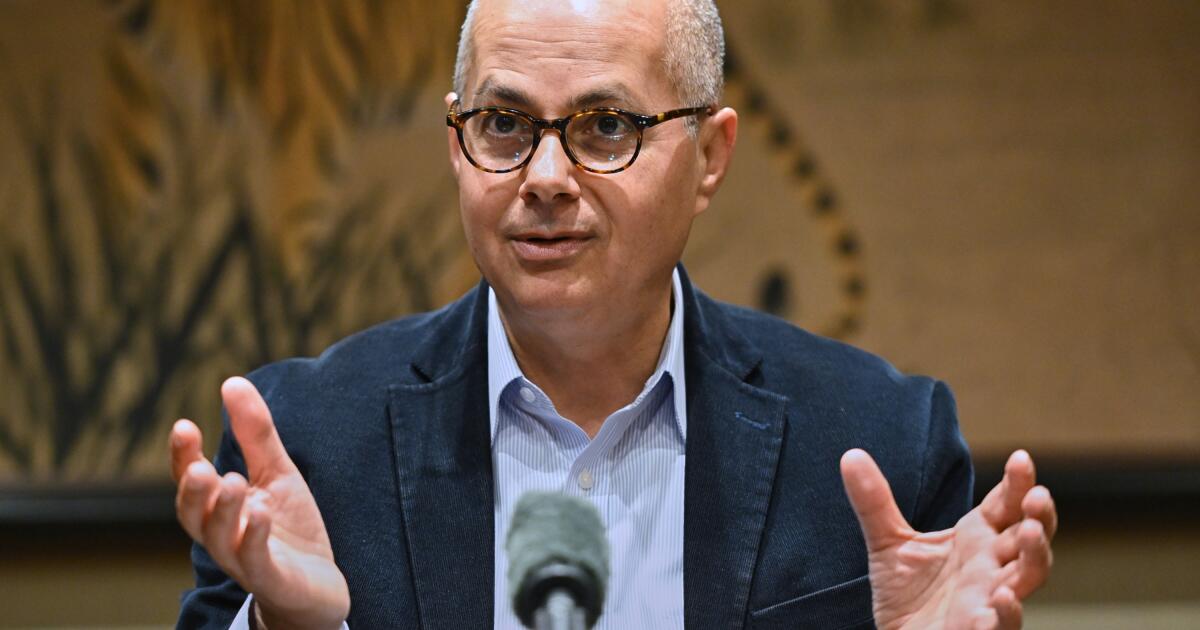
Nobel Prize recipient Omar Yaghi is leaving his role at UC Berkeley to lead the development of a new artificial intelligence institute at Tsinghua University in Beijing, the Chinese university announced.
Yaghi will head the AI Chemistry and Materials Research Institute at Tsinghua, where he was appointed an honorary professor in 2022. Known as AIMATRY (AI × Materials × Chemistry), the new center will focus on material design and synthesis through artificial intelligence, according to a statement from the university.
In 2025, Yaghi shared the Nobel Prize in chemistry with Susumu Kitagawa of Kyoto University and Richard Robson of the University of Melbourne for their development of metal-organic frameworks, a type of super-porous material in which metal ions and carbon-based molecules combine to form crystals with exceptionally large surface areas.
The material has the potential to combat climate change by capturing and storing carbon or other pollutants, and by extracting water from the atmosphere in water-scarce areas. Upon awarding the prize, a member of the Nobel committee likened the technology’s ability to store enormous amounts of stuff in seemingly compact spaces to Hermione Granger’s enchanted handbag in the Harry Potter series.
Yaghi’s Irvine-based company, Atoco, has said it will start taking orders later this year for its technology that harvests water from the air.
A representative for Yaghi said he was not yet available to respond to questions.
China is one of several countries that has been actively recruiting scientists from the U.S., where the Trump administration has slashed science funding, suspended research grants, fired science advisors and tightened immigration restrictions.
“For many, many years, our funding was very competitive; if you worked hard and you were doing good research, you would get funding,” Yaghi said of the U.S. in an interview with Scientific American earlier this year. “The current state is not so encouraging because of the cutting back on grants and support of science by the very agencies that many university researchers rely on.”
Yaghi was born in Jordan to Palestinian refugees, and immigrated to the U.S. when he was 15 to study.
“We’ve learned over and over in human civilization that scholars can move across borders,” Yaghi told the New York Times last year. “This is how knowledge spread and how vast regions of the world lifted themselves out of poverty.”
Science
Trump administration seeks to limit federal funding that doesn’t ‘advance’ presidential policies

A new rule proposed by the White House Office of Management and Budget would fundamentally overhaul the way federal grants are awarded and overseen — a sweeping change that one scientific society said “would all but end the use of scientific merit in the selection of grants and programs across the government.”
Proposed in late May, the rule would give political appointees unprecedented control over federal grants for research, education and infrastructure, and specifies that government funds can only be spent on projects “aligned with administration policies and priorities,” according to a copy of the proposed rule.
The rule would also restrict research topics, limit U.S. scientists’ ability to collaborate with colleagues in other countries and make it easier for the government to suspend or cancel grants at any time.
The changes are intended to improve “transparency, accountability, and oversight for Federal awards” while “ensuring that American tax dollars are not wasted or misused,” according to the White House office.
But critics say that if the rule is implemented, the final sign-off for grants will no longer be in the hands of subject-matter experts within individual agencies, but in those of political appointees.
“This touches all parts of American life,” said Dr. Eric Rafla-Yuan, a psychiatrist who practices at the Veterans Administration and San Diego County’s psychiatric hospital.
“Control of how all of the federal grants and programs are funded will fall under a small group of highly partisan individuals who would have very few limits on how they spend these billions of taxpayer dollars,” said Rafla-Yuan, who also chairs the Committee to Protect Public Mental Health advocacy group. “This touches everyone’s life, even if they don’t realize it.”
OMB published the proposed rule May 29, opening a 45-day comment period that closes July 13.
Opposition to the proposed rule has mobilized multiple sectors of society. Professional groups representing cancer researchers, civil engineers, county governments, medical schools, housing agencies, city and municipal governments, nonprofits and others have publicly expressed concerns about potential consequences.
By midday Thursday, the Federal Register logged nearly 100,000 comments about the proposal, many of them expressing concern.
“I understand the need for oversight, fiscal responsibility, and accountability. That is not the issue,” wrote Jack Feldman, a neuroscientist who holds the David Geffen School of Medicine Chair in Neuroscience at UCLA. “The issue is whether scientific research is to be judged by scientific merit, or whether it can be approved, denied, or terminated according to broad political criteria that may change from one administration to the next.”
Crucially, the rule converts policies governing federal grants from “guidance” into binding regulations that all agencies would be required to follow. It would give political appointees power to override federal agencies’ merit-based reviews and mandate that a political appointee review decisions to ensure that all awards “demonstrably advance the President’s policy priorities.”
The elevation of political appointees in what were previously merit-based decisions has alarmed many scientists.
“The proposed rule changes would all but end the use of scientific merit in the selection of grants and programs across the government,” read a statement from the Planetary Society, a nonprofit dedicated to space research.
Researchers and science groups have also expressed concern about a section of the rule prohibiting the promotion of “theories of disparate-impact liability” — a legal concept that refers to policies that appear neutral but cause disproportionate harm to certain groups.
The section’s vague language and many loopholes could have a chilling effect on any research that studies the effects of a disease, policy or public health intervention on any specific group of people, Rafla-Yuan said.
As an example, he said, “if there’s a specific age range that is at higher risk for suicide, and we want to figure out, well, what’s going on with people that are aged 14 to 19 … we can’t do that under the wording in this rule.”
New restrictions on collaborations with scientists in other countries would hinder opportunities for U.S. researchers and limit innovation, said Joanne Padrón Carney, chief government relations officer for the American Assn. for the Advancement of Science.
“Science is a global enterprise. Especially in biomedical and public health fields, diseases don’t care about borders or government policies,” she said.
California’s congressional delegation sent a letter Wednesday asking OMB to rescind the proposal, outlining concerns about its impact on scientific innovation, U.S. competitiveness and the fiscal stability of local governments, many of which rely on federal grants for local services.
The proposed rule grants the federal government broad powers to suspend or cancel grants for any reason, introducing “unprecedented unpredictability into local governance,” the lawmakers wrote, “leaving vital infrastructure projects unfinished and abandoning vulnerable populations who rely on these services.”
Republican Sen. Susan Collins has also asked the White House to withdraw certain parts of the letter and extend the public comment period, saying the proposed rule as written would “harm small and rural communities, undermine scientific and biomedical research, and conflict with Congress’ control over the federal funding process.”

Several states, primarily in the Midwest and on the East Coast, have reported thousands of cases of cyclosporiasis, a parasitic disease that can cause an extended bout of debilitating diarrhea.
There have been cases of cyclosporiasis infection in California this year, but none has been linked to the current outbreak. Public health officials, however, have advice for residents to stave off illness.
Cyclosporiasis is an intestinal illness caused by several species of the microscopic parasite Cyclospora cayetanensis and is spread through the feces from an infected person that has contaminated food or water, according to the federal Centers for Disease Control and Prevention.
People become infected with the illness by consuming food or water that has been contaminated with the parasite — the infection is not transmitted from person to person.
The epicenter of the current outbreak is in Michigan, which has reported more than 1,000 cases since June, including 44 people who were hospitalized. The state typically reports about 50 cases of cyclosporiasis annually. Now there may be hundreds more infected as 17 states have reported numerous cases.
Officials say the true number of infected people is likely higher because some people recover without medical care and are not tested for the parasite.
In the United States, food-borne outbreaks of cyclosporiasis have been linked to various types of fresh produce imported from Latin America, including raspberries, cilantro, basil, snow peas and mixed salad, according to the California Department of Public Health.
Officials say those who have fallen ill became sick after eating food in the United States and did not report travel during the 14 days before they got sick.
Those who have contracted cyclosporiasis have ranged in age from 5 to 86.
There is currently no evidence of a single, multi-state cyclospora outbreak, meaning there isn’t a common source linking all cases, according to the CDC and the U.S. Food and Drug Administration, which are working with local public health authorities to investigate the cases in each state.
At this time, there aren’t any local outbreaks in California, and current cases of cyclosporiasis infection are not linked to the multi-state outbreak, according to the California Department of Public Health.
“From January to June 2026, California has reported 41 provisional cases of cyclosporiasis, compared to 80 cases during the same period in 2025,” said Beth Deines, information officer for the state agency.
Most of these cases are associated with recent international travel, she said.
“With the significant increase in cases in the Eastern and Midwestern states, we will monitor for cases that may be associated with travel to areas of the country that are experiencing these increases,” Deines said.
Similarly, officials with the public health department will look for clusters of cases that may indicate transmission occurring in California.
There have been four domestic cases reported since May 1.
Two of those who were infected reported that they had traveled to the Midwest. Investigation of these cases is ongoing. To protect patient privacy, the state public health department does not disclose where in the state the patients reside.
Symptoms of cyclosporiasis
Cyclosporiasis cases are reported year-round; however, infections are most common when temperatures are warmer, in the summer and early fall.
Infected people experience symptoms from two days to two weeks after consuming food or drinking water containing the parasite.
Some people who are infected, particularly those from areas where cyclosporiasis is endemic, may not have any symptoms.
Those who do develop symptoms could experience:
- Watery diarrhea
- Loss of appetite
- Weight loss
- Cramping
- Bloating
- Increased gas
- Nausea
- Fatigue
Less common symptoms may include:
- Vomiting
- Body aches
- Headache
- Low-grade fever
- Other flu-like symptoms
Cyclospriasis can be treated with a combination of antibiotics. Without treatment, symptoms can last from a few days to a month or longer.
Some symptoms, such as diarrhea, may go away and then return.
How to protect yourself
When traveling to areas where cyclospriasis is endemic — including tropical or subtropical regions — avoid drinking tap water. Also make sure hot food is served piping hot, health officials say, and cold food should be kept thoroughly chilled. Germs that cause food poisoning can grow quickly in lukewarm food.
A complete list of food and drink considerations provided by the CDC can be found here.
Most food-borne outbreaks of cyclosporiasis in the U.S. have been linked to various types of imported fresh produce, so public health officials in California and in states reporting infection cases recommend:
- Wash your hands with soap and water before and after handling or preparing raw fruits and vegetables. Note that hand sanitizer does not kill the parasite that causes cyclosporiasis.
- Wash all fruits and vegetables thoroughly under running water before eating, cutting or cooking.
- Scrub firm fruits and vegetables, such as melons and cucumbers, with a clean produce brush.
- Cut away any damaged or bruised areas on fruits and vegetables before preparing and eating.
- Refrigerate cut, peeled or cooked fruits and vegetables as soon as possible.
-

 Technology4 minutes ago
No, Flock isn’t threatening people for debating surveillance
-

 World7 minutes ago
Israel signals readiness for another Iran strike as Trump declares ceasefire over
-

 Politics12 minutes ago
Kelley Paul: America’s Founders were the ‘first civil rights heroes’
-

 Health19 minutes ago
Your resting heart rate could reveal more about your health than you think, doctors say
-

 Sports22 minutes ago
Shohei Ohtani ruled out of MLB All-Star Game as Dodgers plan to manage nagging injury
-

 Technology34 minutes ago
Fake VA shoe offer targets veterans
-
 Business37 minutes ago
Los Angeles hotels saved by last-minute surge in World Cup bookings
-
 Entertainment42 minutes ago
Emily Ratajkowski’s viral essay on sex life as a single mom scores her a seven-figure book deal

