Science
Intuitive Machines’ Athena Lander Launches on Journey to the Moon


Intuitive Machines landed a robot on the moon last year. Can the Houston company do it again, but keep the spacecraft upright this time?
The company’s second lander, named Athena, launched on Wednesday evening on a SpaceX Falcon 9 rocket from NASA’s Kennedy Space Center in Florida. It is now on an arcing path to the moon.
The spacecraft turned itself on, but then several minutes of suspense followed when it was late to check in. Eventually, data from the probe arrived, accompanied by relief at Intuitive Machines’ mission control.
On March 6, the spacecraft will attempt to land in Mons Mouton, a region about 100 miles from the moon’s south pole. That will be closer to the south pole than any previous spacecraft has landed.
When Intuitive Machines’ first lander, Odysseus, set down on the moon in February last year, it managed to communicate with Earth even though it had toppled on its side. It was the first commercially operated lander to reach the moon’s surface, and the first American vehicle to land softly on the moon since Apollo 17 in 1972.
The main payload on Athena is a drill for NASA as part of its Commercial Lunar Payload Services program. Paying a commercial company like Intuitive Machines to take something to the moon is cheaper for NASA than designing and building its own spacecraft.
The drill is designed to dig about three feet below the surface, pulling up lunar soil about four inches at a time and dropping it onto a pile on the surface. An instrument known as a mass spectrometer will then sniff around the drilled material for compounds like frozen water that easily transform into gases.
The Athena lander is also carrying three robotic rovers and a small flying “hopper” that will be deployed after landing.
The largest rover, known as the Mobile Autonomous Prospecting Platform, or MAPP, is part of a NASA-financed test of the first cellphone network on the moon. Nokia won financing from the space agency to test the technology but then needed a way to move at least one antenna some distance from the lander. So Nokia hired a company called Lunar Outpost to build the rover, which is about the size of a small dog.
Lunar Outpost sold space on MAPP to other customers. One, the Massachusetts Institute of Technology, built a tiny rover called AstroAnt, which will crawl around on the top flat surface of MAPP.
Athena will also deploy a rover called Yaoki, built by a Japanese company, Dymon, that is a bit bigger than a Mac mini computer.
Intuitive Machines built the hopper as part of another NASA contract. The small rocket-powered craft could offer new opportunities to explore long distances, similar to the way NASA’s Ingenuity helicopter on Mars provided a different way to explore areas not easily reached on the ground.
On the airless moon, helicopters cannot fly, but thrusters will allow the hopper to fly long distances. It will also be carrying one of the Nokia cellphone antennas. The plan is to fly into one of the moon’s permanently shadowed craters.
Why did Intuitive Machines’ last lander topple over?
The Odysseus lander was supposed to use a laser altimeter to help guide it to the moon’s surface. But because of an oversight during the launch preparations, a safety switch for the device was never disabled, rendering that tool useless. Engineers at Intuitive Machines hurriedly rewrote their landing software to use similar measurements from an experimental NASA instrument on the spacecraft. But they missed updating one key parameter in the computer code, and the landing software ignored the data.
The spacecraft thus landed oblivious to its exact altitude, only guessing its distance above the surface based on horizontal speed calculated from camera images and measurements of accelerations in the spacecraft’s velocity. The guesses were close enough that it did not crash, although it was still moving horizontally. The landing gear broke, and the spacecraft tipped.
The Athena lander is almost identical to Odysseus — each is what the company calls its Nova-C design — and Intuitive Machines officials said they had tested the laser multiple times.
What other spacecraft are traveling with Athena?
Three more separate spacecraft are riding on the Falcon 9 rocket. They are essentially taking advantage of extra payload space in the rocket for a cheaper ride to space.
One, Lunar Trailblazer, is a lost-cost NASA mission — about $100 million — designed to measure the distribution of water on the moon from orbit.
While Athena will make a quick one-week trip to the moon, Lunar Trailblazer will take a more leisurely, fuel-efficient path. If launch occurs on Wednesday, it will take just over four months to reach the moon. (If the launch occurs on a different day, the trajectory changes, and the journey could be as long as seven months.)
A second spacecraft, Odin, is a microwave-size spacecraft built by the company AstroForge of California. It will head to a near-Earth asteroid to examine whether it might be full of valuable metals that could be mined in the future.
A third vehicle, CHIMERA GEO 1, is a spacecraft from Epic Aerospace of San Francisco designed to put small satellites in distant orbits.
An eclipse?!
The mission on the surface is scheduled to last for less than one lunar day, or about 10 Earth days, until the sun sets. With no solar energy, the spacecraft’s batteries will run out of power.
But in the middle of the lunar day, on March 14 at about 2 a.m. Eastern time, darkness will fall for a few minutes — an eclipse when the Earth passes between the sun and the moon.
The solar-powered lander will have to draw power from its batteries during the eclipse but should survive.
What else is landing on the moon soon?
Athena is the third commercial lander launched toward the moon this year, although it might be the second to arrive.
On Jan. 15, a Falcon 9 rocket launched carrying the other two landers — Blue Ghost from Firefly Aerospace of Austin, Texas, and Resilience by Ispace of Japan.
Blue Ghost, like Athena, is part of NASA’s CLPS program, and it is scheduled to land on March 2, ahead of Athena. It is headed toward Mare Crisium, a basin in the northeast quadrant of the near side of the moon.
Resilience, also known as the Hakuto-R Mission 2 lander, is taking an indirect route and is expected to arrive at the moon in May. Its landing site is near the center of Mare Frigoris, or the Sea of Cold, in the moon’s northern hemisphere. This will be Ispace’s second lunar landing attempt. Its first mission, in 2023, crashed.



Science
Did you feel it? As Artemis II nears reentry, scientists want to know how far the sonic boom travels

Southern Californians may hear a distinct “boom” around 5 p.m. Friday as NASA’s Artemis II moon flyby mission makes its energetic reentry off the coast of San Diego, the U.S. Geological Survey said.
USGS does not know how far up and down the coast — or how far inland — Californians will be able to hear this sonic boom, produced as the capsule breaks the sound barrier as it slows down, said John Bellini, a geophysicist with the agency.
For this reason, USGS is asking for the public’s help: Californians can report whether or not they heard the boom to the agency’s “Did You Feel It” survey.
This information, Bellini said, will help scientists better predict sonic booms in the future, which are dependent on a variety of atmospheric conditions.
“Since this is a known source with a relatively known location and time of occurrence, people reporting this can help us in the future to better characterize unknown sources of a similar type,” he said.
NASA astronaut and Artemis II Pilot Victor Glover in the Orion spacecraft during the Artemis II lunar flyby.
(NASA via Getty Images)
For example, meteorites and space debris piercing the atmosphere can produce sonic booms — as can supersonic tests from the military and private aerospace companies.
While Southern Californians might hear the intense reentry, NASA isn’t so confident they’ll be able to see it.
However, Aaron Rosengren, assistant professor of space systems at UC San Diego, is more optimistic.
“The weather is quite nice today,” he said. “If you have any view along the Southern Coast and you’re looking westward along the horizon, you should be able to see a faint light in the sky as it reenters.”
Rosengren expects that streak in the sky to last less than a minute.
The Artemis II crew, the first to reach the moon in a half-century, will slam into the atmosphere at 30 times the speed of sound, generating a fireball of nearly 5,000 degrees Fahrenheit around the capsule.
When Artemis II pilot and SoCal native Victor Glover was asked Wednesday evening about the moments from this mission he’ll carry with him for the rest of his life, he joked: “We’ve still got two more days, and riding a fireball through the atmosphere is profound as well.”

Between all the monitors, wires and keyboards are the normal trappings of a workplace: lunchboxes, water bottles, backpacks and smartphones.
A vase of roses brightens up the center of the room. Since the Challenger disaster in 1986, a couple in Houston has sent more than a hundred bouquets to mission control to commemorate NASA’s space launches and honor the lives of fallen astronauts.
Mission control is in a new room, and looks a little different than in the Apollo era. Wood desks have replaced green metal mainframes, and the ashtrays and rotary phones are gone.
But the bones of the operation have not changed, said Judd Frieling, one of the Artemis II flight directors, who spoke from mission control to reporters on Saturday. Every spacecraft needs similar systems — propulsion, navigation and the like — to succeed.
“We’re building upon the giants that started it back in the Apollo era,” Mr. Frieling said. “We continued our evolution during the space shuttle program, during the International Space Station program and now on to the Artemis program.”
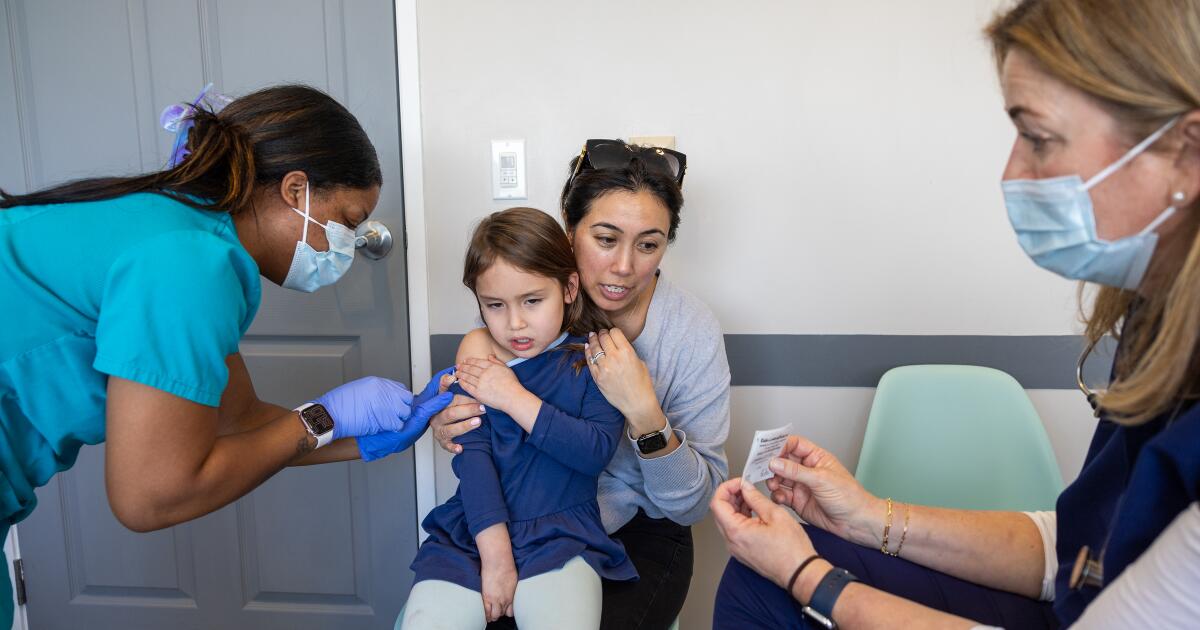
Measles is back in the United States. More than 1,500 cases have already been reported in the first months of 2026, putting the country on pace to surpass last year’s total of more than 2,200, the highest number in decades. Public health officials warn that the nation’s status as “measles free” is now at risk as childhood vaccination rates decline.
Measles may not be the only disease poised for a comeback. Another virus that once infected thousands of American children each year could be heading in the same direction.
A recent study my colleagues and I conducted using national electronic health record data found that hepatitis B vaccination rates among newborns declined by more than 10% between 2023 and August 2025.
At first glance, hepatitis B may seem like an unlikely threat to infants. The virus spreads through infected blood or bodily fluids, exposures many parents assume newborns would rarely encounter. But before routine vaccination began, hepatitis B infected roughly 18,000 children under the age of 10 in the United States every year.
About half of those infections were passed from mother to child during birth. The rest occurred through everyday household exposure, often through contact with a caregiver or family member who did not know they were infected.
The consequences can be lifelong. While acute infection is often mild or asymptomatic, as many as 90% of babies infected in their first year of life develop chronic hepatitis B. Over time, chronic infection can lead to cirrhosis, liver cancer and liver failure.
The first major step toward prevention was screening. In 1988, universal hepatitis B testing during pregnancy was recommended so that infants born to infected mothers could receive protection immediately after birth. The strategy helped identify many high-risk cases, but it did not prevent all infections. Each year between 50 and 100 infants still developed hepatitis B.
To close those remaining gaps, universal newborn vaccination was recommended in 1991. Over the following decades, hepatitis B infections in children fell to fewer than 20 annually.
That is why many physicians were surprised when, in December, the federal government’s Advisory Committee on Immunization Practices revised its recommendation for newborn hepatitis B vaccination. Under the new guidance, babies born to mothers who test negative for hepatitis B may receive the vaccine based on individual clinical decision making rather than a universal recommendation.
The idea behind this approach is straightforward. If a mother tests negative for the virus, the immediate risk to the newborn is extremely low.
But the history of hepatitis B prevention shows why universal protection became necessary in the first place.
Today, an estimated 660,000 Americans still live with chronic hepatitis B, and roughly half are unaware of their infection. Exposure risks have not disappeared. They have been controlled through vaccination and screening.
At the same time, the nation’s vaccine guidance is becoming increasingly confusing. Earlier this year, the Centers for Disease Control and Prevention revised its childhood immunization schedule, moving several vaccines from being universally recommended to being suggested as topics of discussion for parents and providers.
The changes were not supported by new evidence. In response, the American Academy of Pediatrics created its own immunization schedule that largely maintains the previous recommendations.
As a result of a lawsuit against the CDC and the Department of Health and Human Services, a federal judge has temporarily blocked the changes to the federal recommendations and invalidated actions taken by the advisory committee.
The result is growing confusion.
In my clinic, parents have begun asking questions I never heard before. Which vaccine schedule should we follow? Is this the schedule with all the vaccines or only some of them? Vaccination decisions are influenced by science but also by trust and consistency. When parents receive mixed messages, some begin to question whether vaccines are necessary at all. We have already seen the consequences of declining vaccination with measles.
For decades, hepatitis B vaccination protected American children from a virus that once infected thousands every year. Because the disease became rare, many parents and younger physicians have never seen its consequences firsthand.
If measles is a warning, hepatitis B could be next.
The lesson from the past is simple. When we stop using vaccines that work, the diseases they prevent come back.
Joshua Rothman is a pediatrician at UC San Diego Health and a clinical assistant professor of pediatrics at the UC San Diego School of Medicine.

“Moon tree” in Metro Detroit rediscovered following Artemis II mission

San Francisco store created and run by AI

Wembanyama drops 40 as Spurs beat Mavericks, reach award eligibility

Who is Rueben Bain Jr\ufeff? Miami Hurricanes draft prospect visits Bengals

Full-length Replay: Boston | FOX Sports

Florida High School Football Rankings: Top 25 teams – Oct. 21

How old is Bo Nix? What to know about Oregon quarterback ahead of 2024 NFL Draft

Cleary's 21 help Le Moyne down Central Connecticut State 69-64 in OT

99th annual Pony Swim held in Virginia

Indiana Members Credit Union announced as new anchor tenant at Bottleworks District

Swalwell’s former female staffer drops bombshell allegations of sexual assault, exposing himself: report

NASA’s Artemis II prepares for splashdown on Earth

Trump proposes painting executive office building white

Rep Randy Fine joins House Freedom Caucus: ‘Strongest group of conservative patriots in Congress’

Trump issues NATO ultimatum to reopen Strait of Hormuz ‘within days’
-

 Atlanta, GA6 days ago
1 teenage girl killed, another injured in shooting at Piedmont Park, police say
-

 Education1 week ago
Video: YouTube’s C.E.O. on the Rise of Video and the Decline of Reading
-

 Movie Reviews1 week ago
Vaazha 2 first half review: Hashir anchors a lively, chaos-filled teen tale
-

 Education1 week ago
Video: Toy Testing with a Discerning Bodega Cat
-

 Georgia4 days ago
Georgia House Special Runoff Election 2026 Live Results
-

 Pennsylvania4 days ago
Parents charged after toddler injured by wolf at Pennsylvania zoo
-

 Arkansas14 hours ago
Arkansas TV meteorologist Melinda Mayo retires after nearly four decades on air
-
 Milwaukee, WI5 days ago
Potawatomi Casino Hotel evacuated after fire breaks out in rooftop HVAC system