Politics
'Why do we need to rush?' California's Lake County may have the nation's slowest elections department

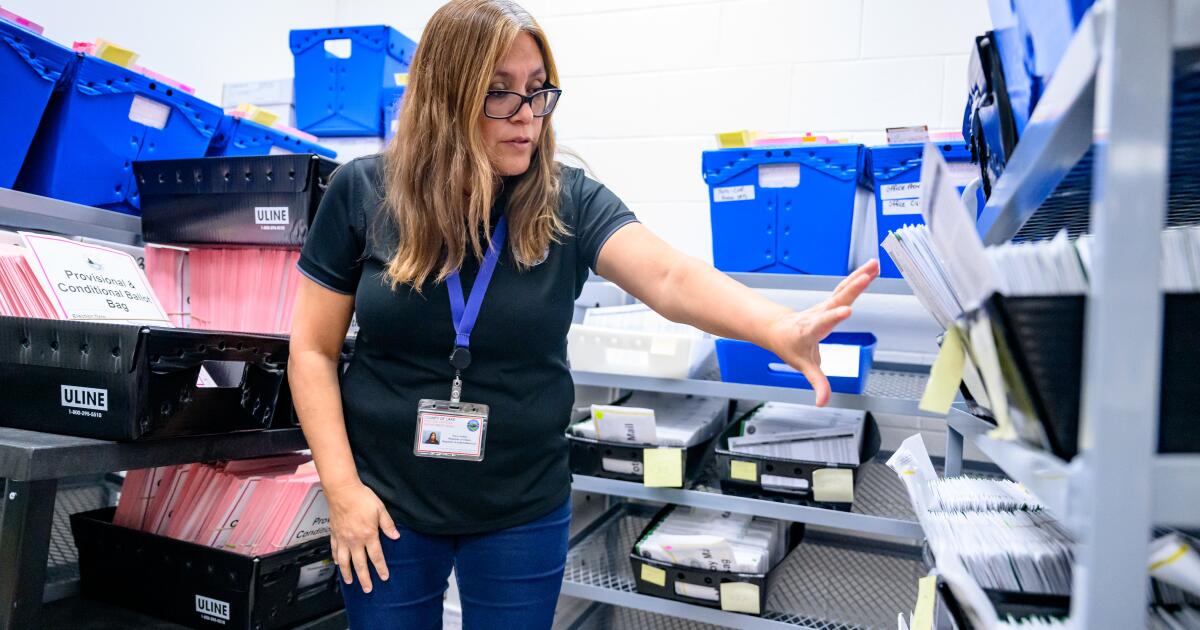
LAKEPORT, Calif. — Maria Valadez would like everyone to chill out.
Every election, the prickly Lake County registrar follows California’s litany of voting laws and certifies thousands of ballots by the time she is required to. And every year, people still complain.
“The state gave us a deadline, we meet the deadline,” an exasperated Valadez said from her small office in Lakeport as a handful of staffers sat at computers verifying signatures more than two weeks after election day, when they had tallied fewer than half of the votes. “I just don’t understand, why do we need to rush?”
In a state known for its slow processing of election results, Lake County, with only about 38,000 voters, is often the slowest of them all.
Ballots ready for processing at the Lake County registrar’s office in Lakeport.
For years, the rural Northern California county — known for local disputes over marijuana cultivation and several brutal wildfires — has been among the state’s last to announce votes after elections, often frustrating candidates and befuddling political pundits.
The reason appears to be a combination of factors, including an under-resourced elections budget in one of California’s smaller, lower-income counties and a desire to keep a meticulous, steady process that was instilled by trusted staff decades ago, even as technology advances.
“Elections are a lot of security, transparency and accountability. That’s what we do here. And it has been like this for all of the years I’ve worked here,” said Valadez, who was hired in 1995 and trained by the prior registrar, who was hired in 1977. “We have a lot of checks and balances. We do them as we go.”
She repeated: “We have a deadline, we meet the deadline.”
State law requires counties to finalize their official results 30 days after the election, this year by Dec. 5. Though Valadez is adamant that she’ll make it, the pace of progress is startling compared to most of the country. Shortly before midnight on election night, Lake County reported just 5,784 ballots. A few thousand more have been counted since. Yet by Thursday — 16 days after the election — Lake County still had more than 10,000 ballots left to count, according to the secretary of state.

Workers process ballots at the Lake County registrar’s office, which is slower than many others in submitting final election results.
“I’m not unsympathetic to the challenges that come with unfunded top-down mandates from Sacramento, but there is a pattern of sheer awfulness with Lake County in particular going back at least a decade and they’ve earned all the scorn coming their way,” Rob Pyers, who operates the election guide California Target Book, said on social media last week.
He said Lake County is “in the running for slowest election department worldwide.”
This year, that may not matter much. Unlike some other counties in California, where daily ballot counts are still changing results in tight races for the House of Representatives that will determine the size of Republicans’ majority in Washington, Lake County did not have many hot contests on the ballot.
Still, the slow count means residents are waiting to find out who will serve on local schools boards, the Clear Lake City Council and the county board of supervisors.
Lake County’s lag has delayed statewide outcomes before.
In the 2014 primary election, the race for state controller was razor thin. California voters had to wait a month to know who would compete in the general election as Lake County officials took their time with the final ballots even as they were barraged with phone calls from politicos feverishly refreshing their browsers for updates.

Lakeport is the county seat of Lake County, which is often the slowest of all California counties to report election results.
It was Lake County that declared Betty Yee had edged out fellow Democrat John Perez by fewer than 500 votes and would advance. The county met its deadline. Democracy lived on.
Now, it’s a different world than when Valadez first started working in elections 30 years ago, and her department’s speed — or lack thereof — has spurred conspiracy theories like those inflamed by Donald Trump when he lost the election in 2020.
As Valadez and her staff calmly processed ballots Wednesday, an angry man from North Dakota called to inquire about what’s taking so long.
Conservatives have singled out Lake County on social media as proof that deep blue California is aiming to rig elections. The man who lives 1,600 miles east and can’t vote in Lake County suggested something nefarious was going on.
Valadez invited him to visit her office off the shore of Clear Lake, to her tightknit community where the security guard at the courthouse next door calls entrants “kiddo.” She has nothing to hide, she said.
“We take our job very seriously,” Valadez said of her small staff. “The integrity of my work is very important to me.”

Lake County Registrar Maria Valadez at work in her office in Lakeport.
California is among the slowest states to call elections not only because of its huge population, but also because of voting laws designed to increase voter participation, including sending all registered voters a ballot by mail, which can prolong when some races are called.
“California deserves all the scorn it gets for holding up House election results,” screamed a headline last week in the New York Post. The article went on:
“Hey, bud, what’s the rush? seems to be Golden State officials’ work ethic.”
Derek Tisler, who focuses on elections as counsel for the Brennan Center for Justice, confirmed that Lake County is among the slowest to process ballots in the U.S. this year. But that’s OK, he said.
“We get impatient, but I think everyone would agree that at the end of the day, we want things to be accurate,” Tisler said. “That is what election officials are going to prioritize. It makes sense they’re doing things in a way that they feel confident in.”
As a wall of rain beat down this week on most of Lake County, a place that struggles with meth and opioid abuse, where 73% of public school students qualify for free and reduced-price meals, Valadez said she’s doing her best “within staffing and resource limitations.”

Jim Emenegger processes ballots at the Lake County Registrar of Voters office.
The Lake County registrar’s office has five full time-employees, and one is currently on leave. A few retirees have been added as temporary help. The county — population: 67,000 — does not have a machine to verify signatures, instead verifying them manually.
Kim Alexander, president of the nonpartisan California Voter Foundation, said places like Lake County don’t get the same resources as bigger tourism destinations with urban centers and higher property taxes. The state does not help counties pay for elections staff or voting equipment even as it issues more mandates, she said, making local officials’ jobs harder and uneven, depending on where they live.
“I get really frustrated when I hear lawmakers complaining about how long it takes to count, because they could actually do something about it,” Alexander said. “If elections were not a chronically underfunded government service, we could have faster results.”
Valadez also pointed to voting preferences as a potential reason for the timing of the county’s results. Unlike a growing number of counties, Lake County does not offer voting centers, a hybrid model that allows voters to drop off ballots several days before the election.
Voters here prefer to vote in person at their neighborhood polling precincts and some are still getting used to receiving a ballot in the mail, Valadez said.
But even if Lake County got a boost in funding, and more voters sent their ballots in by mail early, it’s unclear if elections officials would change much of their decades-old strategy.

Diane Fridley and Jim Emenegger process ballots at the Lake County registrar’s office.
Wearing a bright red pixie cut and a Carhartt flanel, Diane Fridley, 71, worked to verify votes this week at a computer in the registrar’s office in Lakeport, scrolling her mouse across the screen to identify any issues with ballots.
For more than 40 years, Fridley was the Lake County registrar. When she retired in 2019, she passed the torch to Valadez. But in between babysitting her grandchildren, Fridley comes in to help around election season.
A Lake County native, Fridley remembers when voters had to bring their birth certificates to their polling stations. She has lived through the days of hanging chads. As someone who likes to have the same breakfast every morning — a slice of apple pie — and is hypervigilant about counting ballots, all the changes have been hard, but exciting.
“Yeah, it takes us a little longer, but we dot our I’s and we cross our Ts,” she said. “We’re positive whatever totals we have are correct. I’m not saying other counties don’t do that, but we try to be perfect.”
Fridley and Valadez exchanged a knowing look.
“There’s a deadline for a reason,” Fridley said, echoing Valadez. “We always meet the deadline.”

Politics
Trump-aligned House holdouts accused of holding ‘life-saving’ veterans bill ‘hostage’ over SAVE America Act

NEWYou can now listen to Fox News articles!
A sweeping veterans package supporters describe as the largest expansion of veterans’ health care and benefits in more than a decade is expected to return to the House floor when lawmakers come back from the July recess, but backers warn the legislation could once again become collateral damage in the Republican standoff over the SAVE America Act.
The Take Care of America’s Veterans Act rolls roughly 60 veterans bills into a package that would dramatically expand veterans’ health care and benefits. At its core, the legislation would cement veterans’ access to community care outside the VA while increasing benefits for combat-wounded veterans, caregivers and Gold Star families, expanding mental health services and enacting dozens of additional reforms.
House Veterans’ Affairs Committee Chairman Mike Bost, R-Ill., told Fox News Digital he intends to bring the Take Care of America’s Veterans Act back for a vote as soon as the House reconvenes next week.
WASHINGTON, D.C. – MARCH 17: Eugene Simpson, 29, from Dale City, Virginia goes through physical therapy at the Veterans Affairs Medical Center in Washington, D.C. with Michael Minor, a kinesiotherapist with the United States Department of Veterans Affairs on March 17, 2006 in Washington, D.C., USA. (Photo by Jeff Hutchens/Getty Images) (Jeff Hutchens/Getty Images)
HOUSE CONSERVATIVES DERAIL GOP AGENDA IN SAVE AMERICA ACT SHOWDOWN
The legislation was held up last month after a group of House Republicans joined Democrats to defeat a procedural vote, stopping the House from taking up the bill.
“I’m feeling good as long as my members stay with us on the rule,” Bost said. “Right now, there’s some politics being played, not about this bill, but just in general.”
The bill became entangled in a broader House Republican fight over the SAVE America Act, legislation championed by President Donald Trump that would require proof of U.S. citizenship to register to vote in federal elections.
On June 30, the House voted on H. Res. 1398, the procedural rule governing floor consideration of several bills, including the National Defense Authorization Act and the Take Care of America’s Veterans Act. The rule failed after 14 Republicans joined Democrats in opposition, preventing the House from taking up the veterans package and bringing floor business to a standstill. Rep. Anna Paulina Luna, R-Fla., claimed to have voted against the rules vote in protest against House leadership’s handling of the SAVE America Act. As a result, Speaker of the House Mike Johnson sent the members home early.
Bost accused the holdouts of effectively putting veterans legislation on hold.
The US Department of Veterans Affairs building is seen in Washington, DC, on July 22, 2019. (Photo by Alastair Pike / AFP) (Photo credit should read ALASTAIR PIKE/AFP via Getty Images) (Photo credit should read ALASTAIR PIKE/AFP via Getty Image)
‘IT’S A MESS’: GOP TURNS ON HOUSE CONSERVATIVES AS VOTER ID BLOCKADE STALLS TRUMP’S AGENDA
“They’re holding all bills hostage,” Bost said. “They’re not voting for any rule. Any bill that has to pass a rule before it comes to the floor—which this bill does because of its size—can’t move.”
Although Bost said he supports the SAVE America Act and has voted for it three times, he argued the Senate’s failure to act should not stop the House from advancing unrelated legislation.
“I agree with that bill,” Bost said. “But the Senate still has to do their work. We don’t stop our work because the Senate isn’t doing it.”
With 23 legislative days left in the Congressional session, Concerned Veterans for America Strategic Director John Byrnes, a supporter of the bill, said time is of the essence.
“There are lots and lots of things that have to get done,” Byrnes told Fox News Digital. “There’s also the National Defense Authorization Act, which is a must pass every year, so these things eat up time. There’s requirements to have debate on these, which eat up session time.”
Byrnes argued that every procedural delay pushes other legislation further down the calendar.
“This bill will save lives in 2027,” Byrnes said. “If we lose veterans because they could have had faster, better access to health care, we’re never going to get those veterans back.”
Rep. Mike Bost, R-Ill. ( )
TRUMP’S SAVE AMERICA ACT SHOWS SIGNS OF LIFE IN THE SENATE DESPITE REPUBLICAN REVOLT
But Rep. Chip Roy, R-Texas, who also voted no on the procedural vote, told Fox News Digital that he has concerns about how the bill is financed.
“I appreciate what the chairman’s trying to do in some respects, but there’s a few issues,” Roy said.
Among them, Roy pointed to provisions offsetting new spending through changes affecting other veterans.
“You’re taxing certain veterans to provide some sort of benefits and changes to other veterans,” Roy said. “There are concerns about some of the pay-fors.”
Veterans of Foreign Wars has also taken issue with Section 108 of the bill, warning that it would codify changes to future disability ratings for tinnitus and sleep apnea to help finance other veterans priorities.
But Bost said this is inaccurate.
“No veteran is going to have their benefits reduced,” Bost said. “If you’re receiving a benefit right now, that’s not going to be reduced at all.”
Roy, who previously served two years on the House Veterans’ Affairs Committee, said he supported a lot of what the bill was seeking to accomplish; but said other pieces of legislation are priorities, too.
CLICK HERE TO DOWNLOAD THE FOX NEWS APP
“There is a block of us for whom border security, the SAVE Act and demonstrating our leadership on major issues is critical,” Roy said. “Some of these other bills may or may not get hung up based on a desire of many in the conference to see movement on other things.”
Fox News Digital reached out to Luna’s office and the White House for comment.

WASHINGTON — Shortly before President Trump ended a ceasefire with Iran this week, Israeli officials presented his team with intelligence indicating Tehran was hatching new plots to kill him.
It was not the first such warning. U.S. law enforcement and intelligence agencies have tracked evidence for years of Iranian efforts to target the president, with signals only increasing since the start of the war.
Their desire to target Trump and his top aides began six years ago, just outside Baghdad International Airport, when the president ordered a drone strike that killed Iran’s most powerful general. The assassination of Qassem Suleimani brought the two countries to the brink of war.
Yet even as full-scale war was averted, top Iranian officials vowed revenge for the strike, authorizing attempts on the lives not just of the president, but of his secretary of State and national security advisor, among others, even after they had left office.
Now, calls for revenge have reached a sharper pitch in Tehran, after a joint U.S.-Israeli operation killed Iran’s supreme leader, Ayatollah Ali Khamenei, at the start of the war in February.
At Khamenei’s funeral ceremonies this week, red flags of vengeance flew throughout the capital as protesters explicitly called on their government to “kill Trump.” His son, Mojtaba, the new supreme leader, was absent from the commemorations, fearing assassination himself.
Mourners hold an anti-President Trump banner at the Imam Khomeini Grand Mosque during mass funeral prayers for Iran’s late Supreme Leader Ayatollah Ali Khamenei and his family in Tehran on Sunday.
(Morteza Nikoubazl / NurPhoto via Getty Images)
The prospect of foreign assassination plots targeting U.S. leaders puts the United States in dangerous new territory, where its embrace of political killings could ultimately place its own officials at unprecedented risk. And experts fear the existential threat of assassination has pushed peace further out of reach: When both sides believe their survival is at stake, the trust required for diplomacy becomes far harder to achieve.
Israeli news organizations have reported that Israel’s prime minister, Benjamin Netanyahu, cited Iranian attempts to kill Trump in recent years as part of his case to go to war in the first place.
A U.S. official told The Times that a range of serious threats exist against the president, including from Iran, but that Israel’s intelligence pointed to a more specific plot. The official did not provide further details. Israeli officials did not respond to requests for comment.
Iran’s president, Masoud Pezeshkian, has said in recent months that the government sees vengeance against U.S. officials as “its legitimate duty and right,” and “will fulfill this great responsibility and duty with all its might.”
“The Suleimani killing accelerated a lifting of restraints on foreign assassinations — and the taboo on targeting and killing foreign leaders, with U.S. military assets, has been more or less lifted,” said Matt Dallek, a political professor at George Washington University.
“If the United States sets the example of how to conduct international relations, and it is using assassination of foreign leaders as a political weapon, it’s only logical that other countries will be more inclined to also engage in assassinations,” Dallek added. “It does seem likely that Trump will have a bigger target on his back.”
Returning from a NATO summit in Turkey on Wednesday, Trump was forced to switch back to an old model of Air Force One — equipped with specialized defensive technologies — from a new plane given as a gift by Qatar, after the Secret Service warned of potential threats to the aircraft from Iran.
“They want to take out the U.S. leader — me,” Trump told reporters aboard the plane. “I’m on whatever list. I saw this morning I’m on every single one of their lists. And so far, I guess I’ve been a bit lucky, but maybe that doesn’t last very long.”
The threat has remained on his mind in the days since. In an interview with the New York Post, Trump told the reporter, “I hope you’ll miss me,” adding that he has “been on their list for a long time.” And in a subsequent social media post Friday night, he warned of a catastrophic response he instructed the administration to pursue in the event Tehran succeeds.
“1000 Missiles are Locked and Loaded and aimed at the Islamic Republic of Iran,” he wrote, “with thousands of more to immediately follow, should the Iranian Government act on its threat, pronounced in many corners of the Globe, to assassinate, or attempt to assassinate, the sitting President of the United States of America, in this case, ME!”
The United States had a decades-old prohibition against assassinating foreign leaders before Trump’s presidency, codified in an executive order signed by President Ford in 1976 over concerns of a CIA plot to kill Fidel Castro.
The policy was only strengthened further by subsequent administrations, fearing a new international standard for targeted killings could result in unintended consequences in the halls of Washington.
Other administrations have been accused of targeting foreign leaders before. Under the Obama administration, an international coalition targeting the Libyan regime of Moammar Kadafi during the country’s 2011 civil war struck his fleeing convoy, leading to his capture and killing by rebel fighters.
But experts say Trump’s explicit targeting of Suleimani and Khamenei — and his public celebration of their deaths — marks a new paradigm.
“Through words and actions, President Trump has done more to normalize political violence than any other U.S. president, certainly in modern times,” said Robert Pape, a professor at the University of Chicago and author of “Our Own Worst Enemies: America in the Age of Violent Populism.”
“On the international front alone, the president routinely brags about killing Iranian leaders and seizing the leader of Venezuela, among others,” he added, “to the point that assassination is becoming the new normal in international politics.”
Politics
Trump takes unusual step, lets bipartisan housing bill become law unsigned amid SAVE pressure campaign

NEWYou can now listen to Fox News articles!
A bipartisan housing bill became law Saturday at midnight after President Donald Trump declined to sign it, capping a weeks-long saga over whether the president would veto the measure amid frustrations with Congress over his stalled agenda.
Trump refused to sign the 21st Century ROAD to Housing Act — legislation aimed at expanding the nation’s housing stock and lowering costs — in an attempt to pressure Congress to pass the SAVE America Act, despite the housing bill clearing both chambers with overwhelming majorities.
“I will not sign the Housing Bill, which has been fully approved by Congress and sent to the White House, in PROTEST over the fact that the United States Senate is not capable of passing THE SAVE AMERICA ACT, which is polling at 97% with the Republican Party, and very high with the non-politician Dumocrats,” he declared on Truth Social Friday morning.
The Trump-backed election measure, which would require proof of citizenship to vote in federal elections and impose voter ID requirements, has struggled to overcome the Senate’s 60-vote threshold.
Meanwhile, the House has not passed a version of the bill that includes the president’s proposed crackdown on mail-in voting and banning men from women’s sports.
President Donald Trump speaks in the Oval Office of the White House, Wednesday, June 3, 2026, in Washington. (Alex Brandon/AP)
HOUSE CONSERVATIVES DERAIL GOP AGENDA IN SAVE AMERICA ACT SHOWDOWN
Under the U.S. Constitution, Trump had 10 days, not including Sundays, to sign or veto the housing measure after the House formally transmitted the legislation to the White House in late June. The president ultimately chose neither option, allowing the measure to become law without his signature.
Though Trump declined to veto the legislation, he sharply criticized elements of the bill and argued it should not have been a legislative priority in recent weeks.
“It’s so unimportant … compared to the SAVE America Act,” Trump told reporters in the Oval Office in late June. “I think the SAVE America Act is exactly what it says. It’s saving America from crooked elections.”
Trump went on to call the housing bill “a yawn,” adding, “compared to the SAVE America Act, just about everything is a big yawn.”
It would have taken a two-thirds majority in both chambers to override a veto — a margin the House and Senate exceeded when they passed the legislation. However, it remains unclear whether so many Republicans would have defied the president had he vetoed the bill.
Trump also appeared to criticize the bill over a provision restricting Wall Street investors from purchasing single-family homes — a policy he first proposed during his January State of the Union address and later urged Congress to pass. Trump previously argued the investor ban would give individual homebuyers a leg up against private equity firms in the housing market.
“I don’t want to hurt people that own houses, too,” Trump later told reporters, appearing to reference the provision. “These people, for the first time in their lives, they have valuable houses. They’ve become rich. I don’t want to hurt them either. What you want to do is what’s good for everyone, get the interest rates down.”
The law also aims to boost housing supply by streamlining federal environmental reviews, loosening rules around the construction of factory-built homes, and incentivizing local governments to modify their zoning laws to allow more housing, among roughly 60 provisions.
Trump’s souring on the legislation created headaches for Republicans, who touted the bill as an affordability win as voters grapple with high housing costs.
“It’s irresponsible to postpone signing the Housing bill due to the SAVE Act,” Sen. Bill Cassidy, R-La., a retiring lawmaker who lost re-election to a Trump-backed challenger, wrote on social media. “We need to start delivering relief to people for the high cost of housing ASAP!!”
Construction workers stand on the roof of homes under construction at a new housing development on June 24, 2026, in Valencia, Calif. (Justin Sullivan/Getty Images)
WARREN TELLS TRUMP TO ‘SIGN THE DAMN BILL’ AS BIPARTISAN HOUSING PACKAGE REMAINS STALLED IN WASHINGTON
Trump abruptly canceled a signing ceremony for the legislation at the U.S. Capitol in June with GOP leaders. The stage had already been set, with at least one senior Republican arriving unaware the president had called off the event shortly before it was scheduled to begin.
The president then declared he would not sign the legislation until Congress passed the SAVE America Act, despite Senate GOP leaders insisting the votes do not exist to advance the measure.
Trump has also expressed frustration with the Republican-controlled Senate for declining to weaken the legislative filibuster, which requires 60 votes to advance most legislation in the upper chamber.
“GET SMART REPUBLICANS, IF YOU DON’T, YOU WON’T BE IN OFFICE FOR LONG!” Trump wrote in a Truth Social post on Sunday.
Before Trump came out against the bill, White House Press Secretary Karoline Leavitt called it “one of the most significant pieces of housing affordability legislation in American history” and said it included an array of policies “long championed” by Trump.
House Speaker Mike Johnson, a Republican from Louisiana, speaks during a news conference at the U.S. Capitol in Washington, D.C., on Oct. 15, 2025. (Eric Lee/Bloomberg via Getty Images)
Meanwhile, Trump political operative James Blair touted the legislation for including the president’s Wall Street investor ban, which he referred to as a “signature commitment.”
House Speaker Mike Johnson, R-La., has argued that Republicans will still promote the landmark housing bill ahead of November.
CLICK HERE TO DOWNLOAD THE FOX NEWS APP
“We’ll still celebrate it, but he’s trying to make a point, and I think he’s making it very effectively,” the speaker recently told reporters, referring to Trump. “And the fact that you all ask me every three steps down the hallway illustrates that he has achieved the desired objective, and that is to make SAVE America the number one thing, because if we don’t get that right, everybody’s concerned about what happens next.”
-

 World41 seconds ago
Sheikh Hamad bin Khalifa Al Thani, architect of modern Qatar
-
 News31 minutes ago
Messi and Argentina survive another close call to reach the World Cup semifinals
-

 Los Angeles, Ca2 hours ago
19-year-old arrested, accused of distributing marijuana to minors across Riverside County
-

 Detroit, MI2 hours ago
Phillies end the Tigers’ winning streak at 6 with a 4-2 victory
-

 San Francisco, CA2 hours ago
Giants select Barry Bonds’ nephew Peyton in third round
-

 Dallas, TX2 hours ago
Mark Cuban takes legal action against the Dallas Mavericks ownership over proposed arena deal
-

 Miami, FL3 hours ago
South Florida businesses report economic boom, as FIFA officials estimate a billion dollar economic impact
-

 Boston, MA3 hours ago
Forecast: Looking ahead to toasty temps next week

