Politics
We set a big chunk of California wilderness on fire. You're welcome


HOPLAND, Calif. — On a sun-kissed hillside in remote Northern California, I watched in awe as a crackling fire I’d helped ignite engulfed a hillside covered in tall, golden grass. Then the wind shifted slightly, and the dense gray smoke that had been billowing harmlessly up the slope turned and engulfed me.
Within seconds, I was blind and coughing. The most intense heat I’d ever felt seemed like it would sear the only exposed skin on my body: my face. As the flames inched closer, to within a few feet, I backed up until I was trapped against a tall fence with nowhere left to go.
Alone in that situation, I would have panicked. But I was with Len Nielson, chief of prescribed burns for the California Department of Forestry and Fire Protection, who stayed as cool as the other side of the pillow.
Like a pilot calmly instructing passengers to fasten their seat belts, Nielson suggested I wrap the fire-resistant “shroud” hanging from my bright yellow helmet around my face. Then he told me to take a few steps to the left.
And, just like that, we were out of the choking smoke and into the gentle morning sunlight. The temperature seemed to have dropped a few hundred degrees.
“It became uncomfortable, but it was tolerable, right?” Nielson asked with a reassuring grin. “Prescribed fires are a lot about trust.”
Dripping gasoline onto dry grass and deliberately setting it ablaze in the California countryside felt wildly reckless, especially for someone whose job involves interviewing survivors of the state’s all too frequent, catastrophic wildfires. But “good fire,” as Nielson called it, is essential for reducing the fuel available for bad fire, the kind that makes the headlines. The principle is as ancient as it is simple.
Before European settlers arrived in California and insisted on suppressing fire at every turn, the landscape burned regularly. Sometimes lightning ignited the flames; sometimes it was Indigenous people using fire as an obvious, and remarkably effective, tool to clear unwanted vegetation from their fields. Whatever the cause, it was common for much of the land in California to burn about once a decade.
“So it was relatively calm,” Nielson said, as the flames we’d set danced and swirled just a few feet behind him. “There wasn’t this big fuel load, so there wasn’t a chance of it becoming really intense.”
With that in mind, the state set an ambitious goal in the early 2020s to deliberately burn at least 400,000 acres of wilderness each year. The majority of that would have to be managed by the federal government, since agencies including the U.S. Forest Service, the Bureau of Land Management and the National Park Service own nearly half of the state’s total land. And they own more than half of the state’s forests.
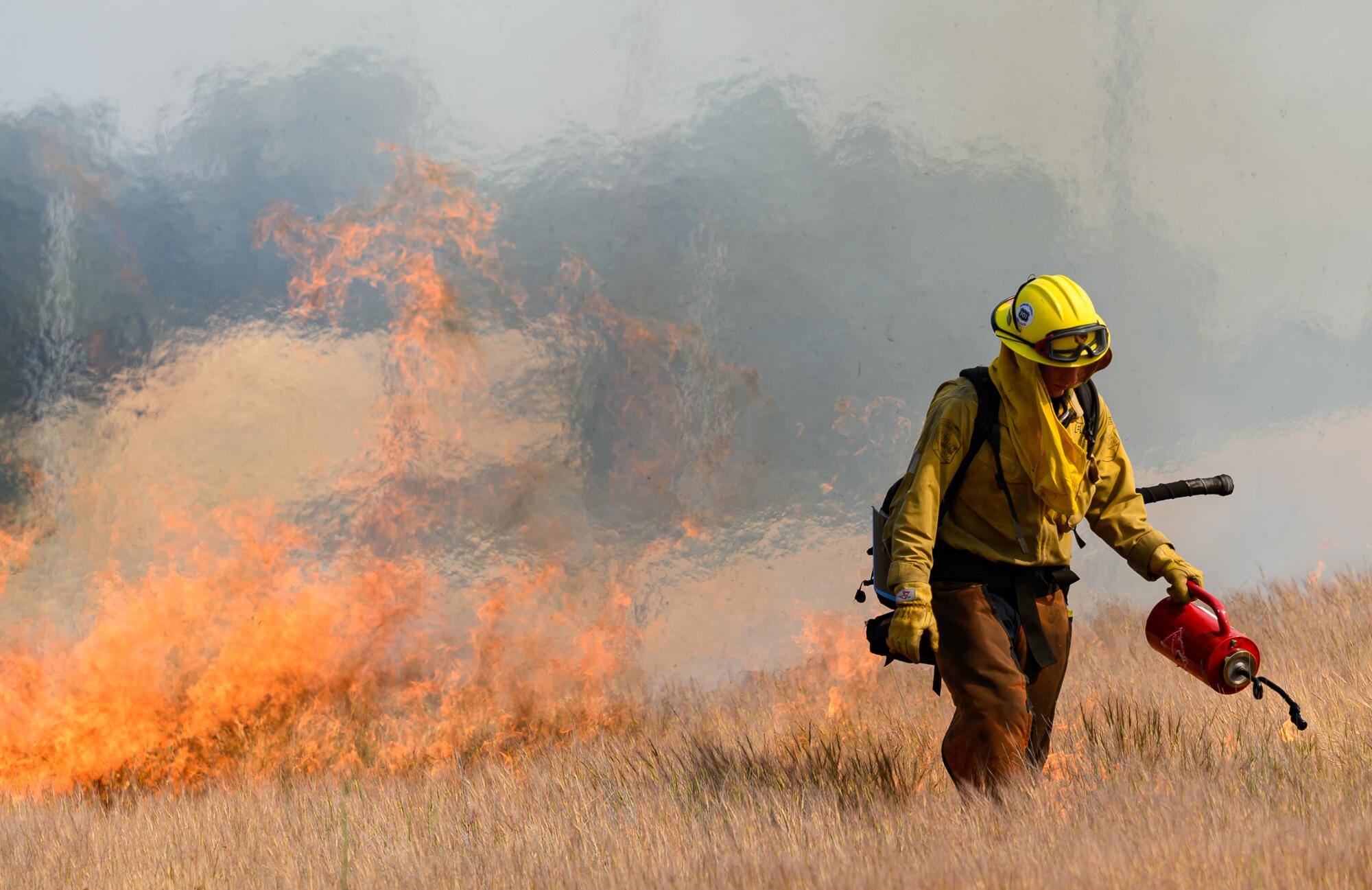
Cal Fire crew members set a prescribed burn near Hopland in Mendocino County.
(Josh Edelson / For The Times)
But California officials worry their ambitious goals are likely to be thwarted by deep cuts to those federal agencies by Elon Musk’s budget-whacking White House advisory team, dubbed the Department of Government Efficiency, or DOGE. In recent months, the Forest Service has lost about 10% of its workforce to mass layoffs and firings. While firefighters were exempt from the DOGE-ordered staffing cuts, employees who handle the logistics and clear the myriad regulatory hurdles to secure permission for prescribed burns were not.
“To me, it’s an objective fact that these cuts mean California will be less safe from wildfire,” said Wade Crowfoot, California’s secretary of natural resources. He recalled how President Trump, in his first term, erroneously blamed the state’s wildfires on state officials who, Trump said, had failed to adequately “rake” the forests.
“Fifty-seven percent of our forests are owned and managed by the federal government,” Crowfoot said. If anybody failed, it was the president, he argued.
Larry Moore, a spokesman for the U.S. Department of Agriculture, which oversees the Forest Service, said the job cuts won’t affect the agency’s fire prevention efforts.
The Forest Service “continues to ensure it has the strongest and most prepared wildland firefighting force in the world,” Moore wrote in an email. The agency’s leaders are “committed to preserving essential safety positions and will ensure that critical services remain uninterrupted.”
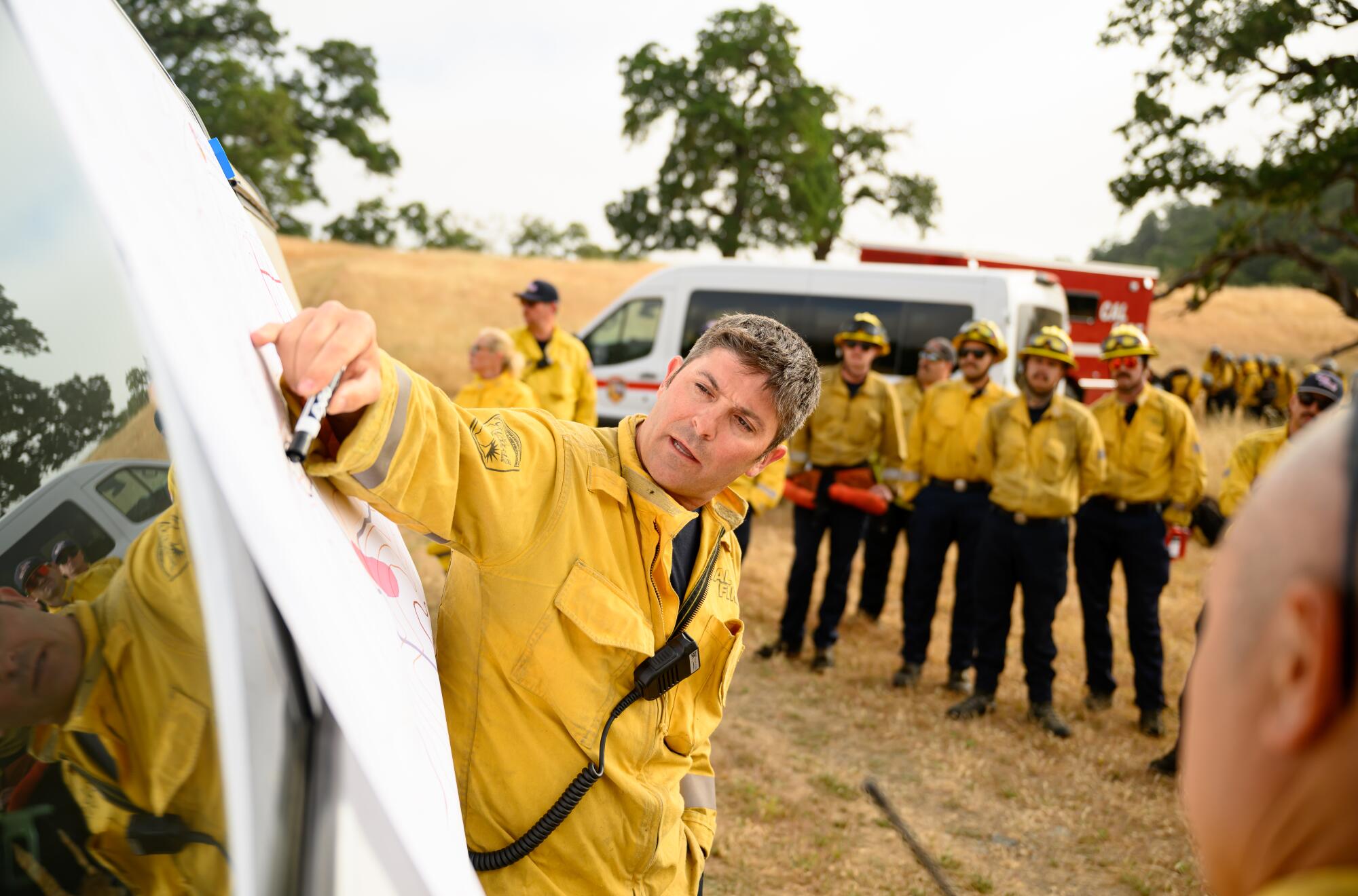
Cal Fire crew members plot out the direction and scope of a prescribed burn in Mendocino County.
(Josh Edelson / For The Times)
Nevertheless, last month, Gov. Gavin Newsom added $72 million to the state’s forest management budget to bridge some of the gap expected to be left by federal agencies. But wildfire experts say that’s just a drop in the bucket. Doing prescribed burns safely takes a lot of boots on the ground and behind-the-scenes cajoling to make sure local residents, and regulators, are on board.
Because people get pretty testy when you accidentally smoke out an elementary school or old folks home, burn plans have to clear substantial hurdles presented by the California Environmental Quality Act and air quality regulators.
It took three years to get all the required permissions for the 50-acre Hopland burn in Mendocino County, where vineyard owners worried their world-class grapes might get a little too “smoky” for most wine lovers. When the big day finally arrived in early June, more than 60 firefighters showed up with multiple fire engines, at least one bulldozer and a firefighting helicopter on standby in case anything went wrong.
They gathered at the University of California’s Hopland Research and Extension Center, where students learn about ranching and wilderness ecology.
But this was no school project. A fire that began in the surrounding hills a couple of years ago threatened to trap people in the center, so the area being burned was along the only two roads that could be used to escape.
“We’re trying to create a buffer to get out, if we need to,” said John Bailey, the center’s director. “But we’re also trying to create a buffer to prevent wildfire from coming into the center.”
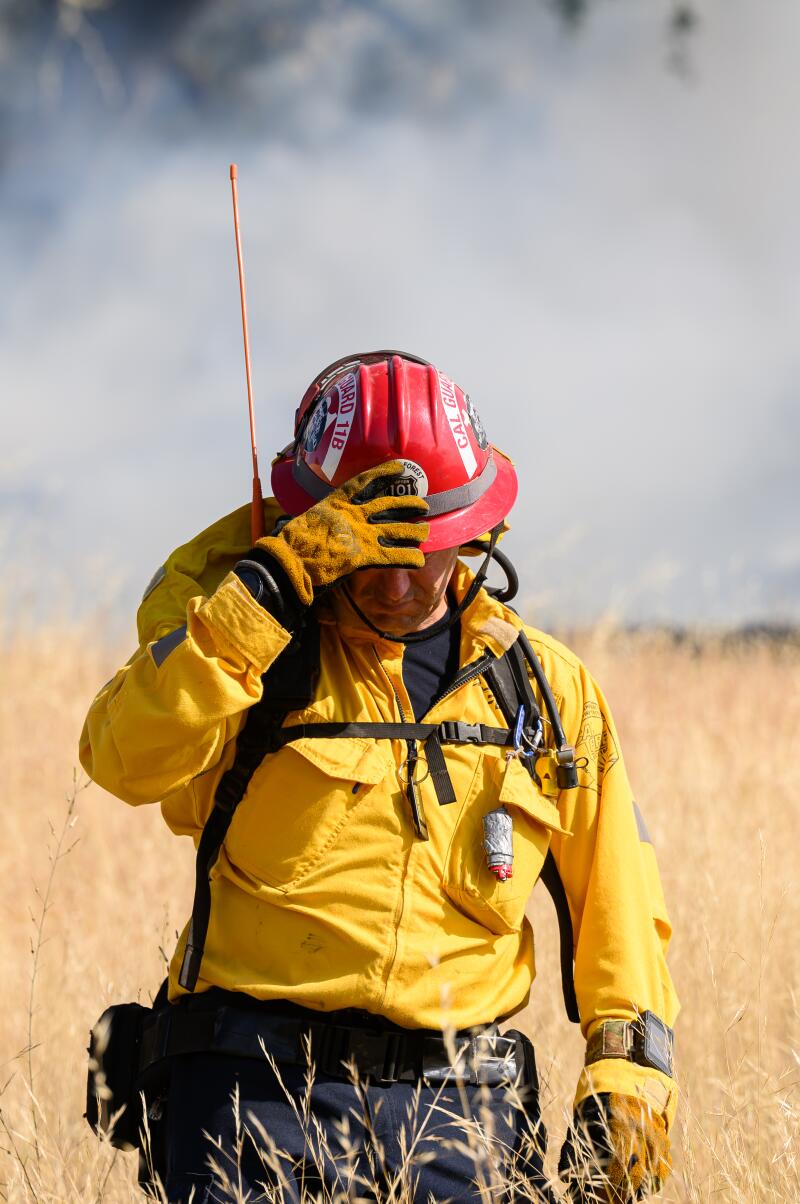

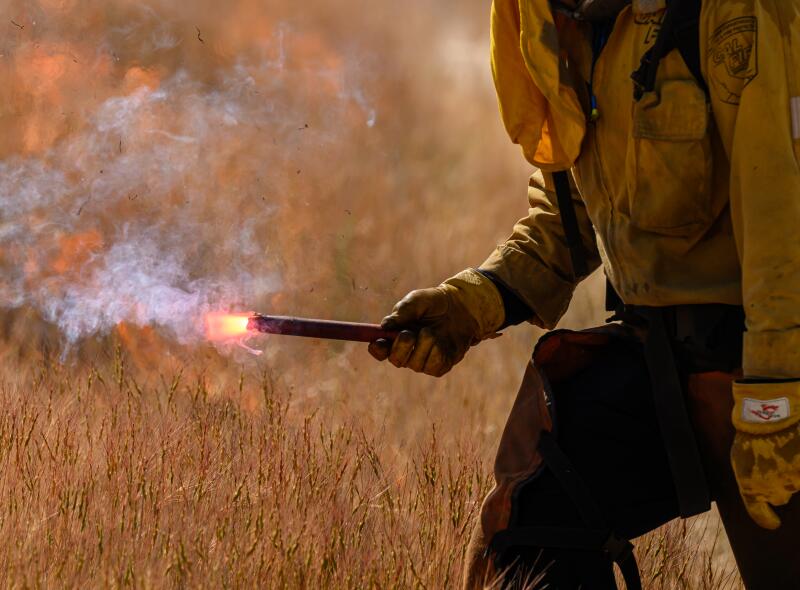
Smoke emanates from a prescribed burn in Mendocino County. (Josh Edelson / For The Times)
As the firefighters pulled on their protective yellow jackets and pants, and filled their drip torches with a mixture of diesel and gasoline, Nielson bent down and grabbed a fistful of the yellow grass. Running it through his fingers, he showed it to his deputies and they all shook their heads in disappointment — too moist.
Thick marine-layer clouds filled the sky at 7 a.m, keeping the relative humidity too high for a good scorching. In many years of covering wildfires, it was the first time I had seen firefighters looking bored and disappointed because nothing would burn.
By 8:45 a.m., the clouds cleared, the sun came out, and the grass in Nielson’s fist began to crinkle and snap. It was time to go to work.
The fire that would fill the sky and drift north that afternoon, blanketing the town of Ukiah with the familiar orange haze of fire season, began with a single firefighter walking along the edge of a cleared dirt path. As he moved, he made little dots of flame with his drip torch, drawing a line like a kid working the edges of a picture in a coloring book.
Additional firefighters worked the other edges of the field until it was encircled by strips of burned black grass. That way, no matter which direction the fire went when they set the center of the field alight, the flames would not — in most circumstances — escape the relatively small test patch.
On the uphill edge of the patch, along the top of a ridge, firefighters in full protective gear leaned against a wooden fence with their backs to the smoke and flames climbing the hill behind them. They’d all done this before, and they trusted those black strips of pre-burned grass to stop the fire before it got to them.
Their job was to keep their eyes on the downward slope on the other side of the ridge, which wasn’t supposed to burn. If they saw any embers drift past them into the “green” zone, they would immediately move to extinguish those flames.
Nielson and I were standing along the fence, too. In addition to the circle of pre-burned grass protecting us, we were on a dirt path about four feet wide. For someone with experience, that was an enormous buffer. I was the only one who even flinched when the smoke and flames came our way.
Afterward, when I confessed how panicked I had felt, Nielson said it happens to a lot of people the first time they are engulfed in smoke. It’s particularly dangerous in grass fires, because they move so fast. People can get completely disoriented, run the wrong way and “get cooked,” he said.

Grass fires are particularly dangerous, because they move so fast, says Cal Fire Staff Chief Len Nielson. People can get disoriented in the smoke, run the wrong way and “get cooked.”
(Josh Edelson / For The Times)
But that test patch was just the warmup act. Nielson and his crew were checking to make sure the fire would behave the way they expected — pushed in the right direction by the gentle breeze and following the slope uphill.
“If you’re wondering where fire will go and how fast it will move, think of water,” he said. Water barely moves on flat ground, but it picks up speed when it goes downhill. If it gets into a steep section, where the walls close in like a funnel, it becomes a waterfall.
“Fire does the same thing, but it’s a gas, so it goes the opposite direction,” Nielson said.
With that and a few other pointers — we watched as three guys drew a line of fire around the base of a big, beautiful oak tree in the middle of the hillside to shield it from what was about to happen — Nielson led me to the bottom of the hill and handed me a drip torch.
Once everybody was in position, and all of the safety measures had been put in place, he wanted me to help set the “head fire,” a 6-foot wall of flame that would roar up the hill and consume dozens of acres in a matter of minutes.
“It’s gonna get a little warm right here,” Nielson said, “but it’s gonna get warm for only a second.”
As I leaned in with the torch and set the grass ablaze, the heat was overwhelming. While everyone else working the fire seemed nonchalant, I was tentative and terrified. My right hand stretched forward to make the dots and dashes where Nielson instructed, but my butt was sticking as far back into the road as it could get.
I asked Nielson how hot he thought the flames in front of us were. “I used to know that,” he said with a shrug. “I want to say it’s probably between 800 and 1,200 degrees.”
With the hillside still burning, I peeled off all of the protective gear, hopped in a car and followed the smoke north along the 101 Freeway. By lunchtime, Ukiah, a town of 16,000 that bills itself as the gateway to the redwoods, was shrouded in haze.
Everybody smelled the smoke, but prescribed burns are becoming so common in the region, nobody seemed alarmed.
“Do it!” said Judy Hyler, as she and two friends walked out of Stan’s Maple Cafe. A veteran of the rampant destruction of wildfires from years past, she didn’t hesitate when asked how she felt about the effort. “I would rather it be prescribed, controlled and managed than what we’ve seen before.”

Politics
Israel shares intelligence warning Iran plotted new assassination attempt against Trump: report

NEWYou can now listen to Fox News articles!
Israel recently shared intelligence with the United States indicating Iran had developed a fresh plan to assassinate President Donald Trump, according to a Wall Street Journal report Thursday citing people familiar with the matter.
The reported intelligence would mark an escalation in the longstanding threats against Trump, who Iran has repeatedly vowed to retaliate against over the 2020 U.S. strike that killed Islamic Revolutionary Guard Corps Gen. Qassem Soleimani.
The White House referred Fox News Digital to Trump’s remarks Wednesday when asked about the report.
TRUMP FACES UNPRECEDENTED THIRD ASSASSINATION ATTEMPT
President Donald Trump speaks during a news conference at the NATO Summit in Ankara, Turkey, July 8, 2026. Trump addressed threats against his life after a report said Israel shared intelligence with the United States about an alleged new Iranian assassination plot. (Kerem Uzel/Bloomberg via Getty Images)
“They want to take out the U.S. leader — me. I’m on whatever list. I saw this morning I’m on every single one of their lists,” Trump said. “And, so far, I guess I’ve been a bit lucky, but maybe that doesn’t last very long. These are evil, sick people. And we have to root out that cancer. That cancer. You know what you do? You’ve got to cut out cancer early. And that’s the way I feel.”
Fox News Digital has also reached out to Israel’s Embassy in Washington and Iran’s Mission to the United Nations for comment.
The Journal reported the intelligence surfaced as Trump and Israeli Prime Minister Benjamin Netanyahu have diverged in recent weeks over how to proceed after last month’s conflict with Iran. Netanyahu has advocated for continuing military pressure on Tehran, while Trump has sought to preserve a fragile ceasefire after U.S. strikes on Iranian nuclear sites.
NETANYAHU REJECTS REPORTS OF A RIFT WITH PRESIDENT TRUMP, SAYS THE TWO REMAIN ALIGNED ON IRAN
President Donald Trump, left, and Israeli Prime Minister Benjamin Netanyahu at the White House March 25, 2019. The leaders spoke Thursday after The Wall Street Journal reported Israel had shared intelligence with the United States about an alleged new Iranian plot targeting Trump. (AP Photo/Susan Walsh, File)
Trump and Netanyahu spoke Thursday and agreed to continue coordination between the two countries, according to a statement from Netanyahu’s office, which said Trump also updated the Israeli leader on recent U.S. activity in the Gulf.
Prime Minister Benjamin Netanyahu during his conversation with U.S. President Donald Trump. (Avi Ohayon/GPO)
CLICK HERE TO DOWNLOAD THE FOX NEWS APP
Iranian mourners at the funeral for Supreme Leader Ali Khamenei chanted for Trump’s death and displayed a banner that said, “We Will Kill Trump,” according to the Journal.
Iran has publicly vowed for years to retaliate against Trump over the U.S. operation that killed Soleimani, the former commander of the Islamic Revolutionary Guard Corps’ Quds Force, in Baghdad in January 2020.

WASHINGTON — A tentative armistice between the United States and Iran reached less than a month ago appeared all but dead Wednesday after the two sides traded fresh military strikes, and as President Trump directed further attacks on the Islamic Republic.
The escalation marked a dramatic turn after the Trump administration spent weeks selling a diplomatic breakthrough with Tehran that proved controversial across the political aisle, lifting oil sanctions and a naval blockade on Iran in exchange for the promise of talks over the status of the Strait of Hormuz and its decades-old nuclear program.
Now, speaking to reporters at the NATO summit in Turkey, Trump said he believed the truce — which diplomats describe as a memorandum of understanding — was “over” and that it was a “waste of time” dealing with Iranian leadership.
“They’re scum. They’re sick people,” Trump said of Iranian leaders, whom he had characterized last month as “very rational people” and “very nice to deal with.”
The president’s dim views of the ceasefire agreement’s fate were shared by Iran’s foreign ministry, which issued a statement on Wednesday saying the American attacks, the reinstatement of a U.S. naval blockade on the Strait of Hormuz, and Israel’s continuing attacks in Lebanon rendered “important and fundamental” parts of the deal “ineffective.”
The truce’s unraveling was underscored by Trump ordering the U.S. military to launch a series of strikes against Iran on Wednesday afternoon to “further degrade their ability to threaten” the commercial shipping through the Strait of Hormuz.
“The United States is holding Iran accountable for recent unjustified aggression against commercial shipping and civilian crews freely navigating a vital international waterway,” U.S. Central Command said in a statement on social media.
Earlier in the day, Trump signaled that the United States planned to “hit them hard” and floated the possibility of taking over Kharg Island, which is vital to Iran’s economy. His remarks quickly prompted oil prices to rise and global stock markets to fall, a worry that Trump acknowledged but which did not seem to sway his decision-making in relation to Iran.
“If we hit Iran, oil goes up a little bit, it is all right,” Trump said. He later added that the United States may “do some other thing that could lift it a little bit, but I don’t think it’s gonna lift it a lot at all.”
As Trump signals the continuation of fighting, his administration has been seeking more than $67 billion in funding to cover expenses related to the Iran war, a request that Congress has not yet approved as lawmakers have been split over the president’s handling of the conflict.
“The American people are paying the price for Trump’s total failure in Iran,” Senate Minority Leader Chuck Schumer (D-N.Y.) said in a statement Wednesday. “Our troops are back in harm’s way and high gas costs are continuing to punish working families.”
The president’s stance on the war marked the latest setback to a fragile truce that has barely held since the 14-page agreement was signed June 17, as the U.S. and Iran engaged over the last few weeks in cycles of attacks and counterattacks.
Trump was noticeably angrier at Iran on Wednesday as he cast doubt over the deal. Last month, Trump had complimented Iranian leadership for trying to reach a peace deal and celebrated the reopening of the Strait of Hormuz, a crucial shipping route for the world’s oil and gas. But based on his remarks, it was clear he was out of patience.
“I am not happy with them,” Trump said. “They’re cuckoo. There’s something wrong with these people. For 47 years, they’ve been the bully of the Middle East and they are not the bully anymore. They are not the bully anymore.”
Trump expressed frustration with Iran’s negotiators and their resistance to abiding by U.S. demands to reopen the strait. When asked if he intended to send troops to Iran, the president dismissed the idea.
“Why would I go in now?” Trump said. “I’d go in when they’re completely eliminated or an agreement is made.”
Still, the president kept the door open for negotiations, saying that his envoys Steve Witkoff and Jared Kushner “want to negotiate.”
“They’re good people, Steve Witkoff, Jared Kushner, but they have to come back to me,” Trump said. “As far as I’m concerned, it’s just a waste of time dealing with [the Iranians]. They’re liars.”
The latest breakdown to the ceasefire followed a now-familiar chain reaction of tit-for-tat attacks, starting with a series of strikes on three oil tankers transiting the Strait of Hormuz on Tuesday, including a Qatari vessel carrying natural gas, according to the United Kingdom Maritime Trade Operations center.
The Qatari tanker was off the coast of Oman when it was hit and caught fire, the maritime monitor said, in what experts say was a move to thwart ships attempting to use an alternate transit route to the one Iran specified. Iran did not claim responsibility, but a report on Iranian state television said the Qatari tanker came under attack after ignoring warnings to turn back.
The two other vessels were damaged but were able to continue to their destination, according to the U.K. group.
Qatar, which has played a vital role in facilitating negotiations between the U.S. and Iran, condemned the attack on its tanker as “unacceptable.”
The U.S. responded with a wave of strikes against more than 80 Iranian targets aimed at “impos[ing] heavy costs for targeting and attacking commercial shipping crewed by innocent civilians in an international waterway,” according to a statement from U.S. Central Command. That tally included roughly 60 Islamic Revolutionary Guard Corps small boats in the strait.
Iranian state media said U.S. strikes targeted Sirik, Qeshm Island and Bushehr and Bandar Abbas, while a U.S. drone strike on the port city of Mahshahr killed one Revolutionary Guard member.
Ahead of the strikes, the White House revoked the 60-day temporary license given to Tehran to sell and deliver oil during the truce.
Iran’s military countered with its own strikes on 85 U.S. military facilities in Bahrain and Kuwait; it also shot down an MQ-9 drone, according to a statement on Wednesday.
Kuwait said its military intercepted two ballistic missiles and 13 drones, but that none had resulted in material damage or casualties.
Global oil prices surged 6% on news of Trump’s reversal on the deal, rising to more than $78 a barrel, down from the peak during the war but still above prewar levels.
The renewed violence appeared to have little effect on the funeral for Iran’s Supreme Leader Ayatollah Ali Khamenei, who was killed in an Israeli strike on Feb. 28, in the war’s opening hours.
The funeral, a days-long period of mourning, is set to end on Thursday, when Khamenei’s body will return from Iraq to be buried in the city of Mashhad, his birthplace. Negotiations were to begin once more.
In his remarks Wednesday, Trump said Iranian leaders had asked for a “timeout” to attend the funeral, and that he had promised not to kill them.
“And I said give it to them, and they start shooting missiles,” Trump said.
Whether those talks — which were meant to deal with the thorniest issues between the two countries, including the Strait of Hormuz and Iran’s nuclear program — will go ahead remains unclear. Iran, for its part, maintained a defiant attitude.
“The era of bullying and extortion is over,” wrote Mohammad Ghalibaf, Iran’s parliamentary speaker. “It leads nowhere. We don’t fold.”
Ali Akbar Velayati, a senior advisor to the supreme leader, posted on X that Trump’s policy had “driven the region towards fire.”
“We had previously warned that the region is not a place for the political gambling of small countries, and we have repeatedly proven that adventures are met with an immediate response,” he wrote.
He added that the Axis of Resistance — a reference to Iran’s network of allied groups in Lebanon, Iraq and Yemen — would not be “silent against humiliation and adventurism” and has “its finger on the trigger.”
Bulos reported from Beirut and Ceballos from Washington.
Politics
Omar’s disclosures erased millions, leaving her with potential negative net worth. She won’t explain why.

NEWYou can now listen to Fox News articles!
Rep. Ilhan Omar, D-Minn., refused to address her revised financial disclosures that could imply she has a negative net worth after the progressive lawmaker dramatically reducing the reported value of assets tied to her husband’s business ventures.
“Can you tell us if your husband still has the consulting business and the wine business?” Fox News Digital asked Omar.
The congresswoman stayed silent as she was repeatedly questioned, after previously telling Fox News Digital that the original filing — showing Omar’s reported assets reducing by as much as $29.9 million — was inaccurate and “incomplete” information.
ILHAN OMAR’S OFFICE SAYS SHE’S ‘NOT A MILLIONAIRE’ AFTER $30M FILING REVISED DOWN TO UNDER $100K: REPORT
US Representative Ilhan Omar, Democrat of Minnesota, speaks during a press conference with family members of Palestinian-American journalist Shireen Abu Akleh as members of Congress call for US investigations into Israel’s actions and reintroduce the Justice for Shireen Act, outside the US Capitol in Washington, DC, May 18, 2023. The Al Jazeera journalist, who was a dual US citizen, was killed on May 11, 2022. The Israeli army later admitted one of its soldiers likely shot the reporter. (Photo by SAUL LOEB / AFP) (Photo by SAUL LOEB/AFP via Getty Images)
The controversy surrounding Omar’s finances began when a 2024 financial report estimated that Omar and her husband possessed between $6 million and $30 million in assets, all while the Minnesota fraud scandal within the Somali community was beginning to come to fruition.
A more recent 2025 financial disclosure report shows Omar’s revised value of shared assets between her and husband to sit at a maximum of $125,000 — a multi-million-dollar drop from the year prior. The lower estimate of their assets, $20,000, compared to the low and high debt estimates, $30,000 and $100,000, would imply the Minnesota Democrat could have a negative net worth.
Both her and her husband have separate debts, each ranging somewhere between $15,000 and $50,000 — from her own student loans and her husband’s credit card debt, according to the disclosures.
WATCH: OMAR SILENT WHEN CONFRONTED ON ALLEGED TIES TO MASSIVE MINNESOTA FRAUD SCANDAL
RICHFIELD, MN – AUGUST 08: Rep. Ilhan Omar (D-MN) (C) campaigns with her husband Tim Mynett (R) at the Richfield Farmers Market on August 8, 2020 in Richfield, Minnesota. Omar is hoping to retain her seat as the representative for Minnesota’s 5th Congressional District in next week’s primary election. (Photo by Stephen Maturen/Getty Images)
The biggest change in the documents involved Omar’s husband, Tim Mynett. His reported ownership interests in both his winery and venture capital advisory firm, which were previously valued in the millions of dollars, are listed with no value now.
In Omar’s 2024 financial disclosure records, Mynett’s share in his winery was valued between $1 million and $5 million, and his share at the venture capital advisory firm was valued between $5 million and $25 million. Now, his equity interests are both listed at $0.
Omar’s office previously told Fox News Digital that Mynett has partners in both businesses and said the earlier disclosure mistakenly reflected the businesses’ total equity rather than his ownership interest. The office also said the original filing listed assets without accounting for liabilities.
VANCE REFERS TIM WALZ, MINNESOTA ATTORNEY GENERAL TO DOJ FOR CRIMINAL INVESTIGATION OVER STATE’S ALLEGED FRAUD
House Oversight Committee Chairman James Comer, R-Ky., has publicly voiced his interest in the Ethics Committee opening an investigation into Omar’s personal finances after the 2025 financial reports came out showing the possibility of a $29 million drop in her net worth.
Vice President JD Vance also has previously said the U.S. Department of Justice will be opening a probe into her alleged fraud as part of the administration’s anti-fraud taskforce that he spearheads, though no formal investigations have been shared with the public at this time.
Omar has been reluctant to answer Fox News Digital’s questions about her financial fallout and potential probes to be opened against her.
The Minnesota lawmaker similarly dodged answering any of Fox News Digital’s questions just last month about the revised disclosures.
CLICK HERE TO DOWNLOAD THE FOX NEWS APP
“There’s also the possibility that it might rain on this sunny day,” Omar replied without responding directly to the content of the question.
Fox News Digital’s Robert Schmad contributed to this report.
-

 Los Angeles, Ca6 minutes ago
O.C. police prep for beach, theme park ‘takeovers’ promoted on social media
-

 Detroit, MI28 minutes ago
Detroit city leaders to DHS: Stop ICE pursuits which endanger the community
-

 San Francisco, CA36 minutes ago
SF Supervisor Jackie Fielder hosts listening session after medical leave
-

 Dallas, TX43 minutes ago
The Stewpot artists find healing, purpose and income through art in Dallas
-

 Miami, FL46 minutes ago
Can Jason Marshall push for a starting spot – The Splash Zone 7/10/26
-

 Boston, MA51 minutes ago
Police investigating shooting in Downtown Crossing – Boston News, Weather, Sports | WHDH 7News
-
 Denver, CO58 minutes ago
Denver mayor announces new $100 million plan to bring in 10,000 jobs
-

 San Diego, CA1 hour ago
WEBTOON Brings Top Creators for San Diego Comic-Con Panels

