Politics
Upside-down flag controversy is the latest for Supreme Court Justice Alito

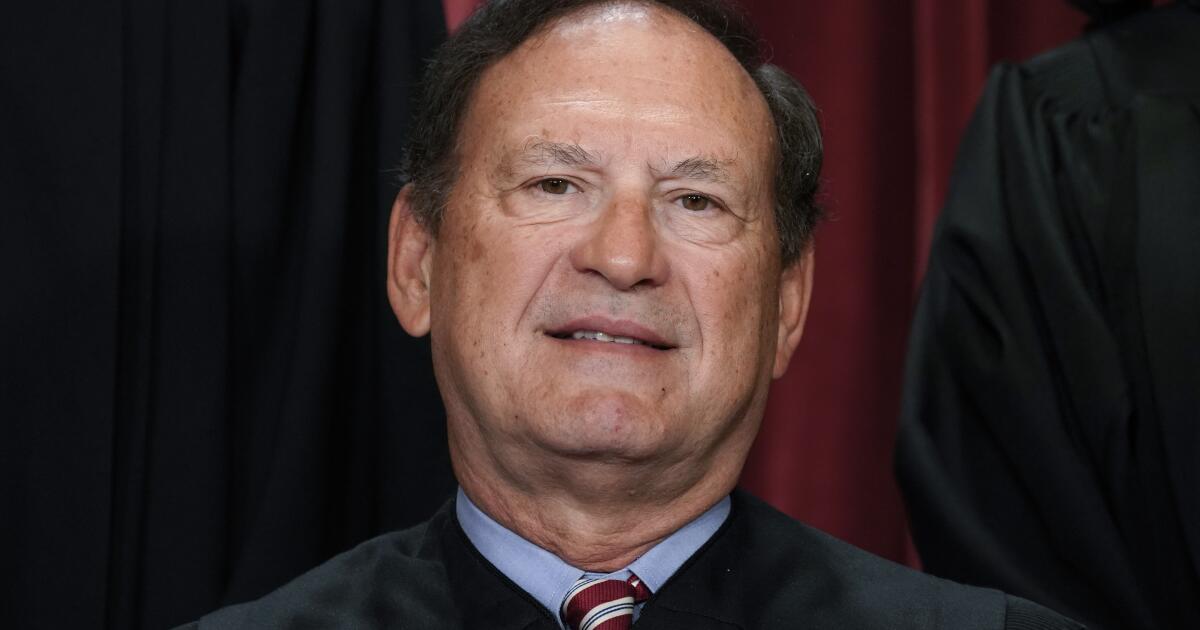
Justice Samuel A. Alito Jr., the Supreme Court’s most predictable conservative of late, is again battling complaints that some of his actions demand that he recuse himself from pending cases.
Alito has responded that he is a victim of unjust criticism.
Here’s a look at some of the recent controversies.
What is the upside-down flag incident about?
Last week, the New York Times published a photo showing an American flag flying upside down in front of Alito’s house on Jan. 17, 2021.
Neighbors reported seeing the flag flying for several days after supporters of outgoing President Trump had rioted at the U.S. Capitol.
For some, the upside-down flag became a symbol of the “Stop the Steal” movement.
How did Alito respond to complaints about the flag incident?
He blamed his wife, Martha-Ann, and his neighbors.
“I had no involvement whatsoever in the flying of the flag,” he told the New York Times in an email.
Speaking to a Fox News reporter, he said a neighbor had made vulgar comments to his wife.
Alito suggested it was unfair to criticize him for the upside-down flag because it was his wife’s idea and she had been provoked by neighbors.
He did not explain whether he was troubled by this display of the flag or why he did not insist immediately that it must come down.
Some liberal groups have demanded that Alito recuse himself from proceedings involving Trump. But there is no hint Alito will step aside from deciding the pending case on whether Trump can be prosecuted for “official acts” he took as president.
Are these the first calls for Alito to recuse himself?
No. Last year, Alito gave an interview to the Wall Street Journal complaining about the treatment of Supreme Court justices.
“We’re being hammered daily. And nobody, practically nobody is defending us,” he told two opinion page writers of the Wall Street Journal, which regularly defends Alito and the conservative court. “We are being bombarded. … This type of concerted attack on the court and individual justices” is “new during my lifetime.”
One of the writers, Washington attorney David B. Rivkin, had helped write an appeal petition asking the court to take up a major tax case and rule the Constitution forbids levies on undistributed corporate profits.
Two months later, when the court voted to hear the case, Senate Democrats and progressive groups called for Alito to step aside from ruling on the matter.
The justice fired off a sharp rejoinder. There is “no valid reason for my recusal in this case. When Mr. Rivkin participated in the interviews and co-authored the articles, he did so as a journalist, not an advocate. The case in which he is involved was never mentioned.”
The court is due to issue a decision in that case, Moore vs. United States, in the next few weeks.
How did Alito respond to complaints that some justices failed to disclose free trips?
Alito was upset last summer when he learned ProPublica was about to publish a story on a free fishing trip he took to Alaska in a private jet owned by hedge fund billionaire Paul Singer.
The nonprofit investigative group had earlier revealed that Justice Clarence Thomas had regularly taken free and undisclosed vacations with Texas billionaire Harlan Crow.
Like Thomas, Alito did not mention the luxury trip in 2008 as a gift on the required judicial disclosure report.
When ProPublica sent him several questions about the upcoming story, Alito refused to comment through a court spokeswoman and then sought to debunk the “false charges” in the Journal before the story could appear.
What he described as false charges involved whether he knew or should have known that Singer’s hedge fund was involved in appeals before the high court.
Singer’s hedge fund, NML Capital, had pursued an aggressive strategy of buying Argentina’s bonds at a discount when the country defaulted in 2001 and then fought in the U.S. courts to be paid in full. This 14-year battle between what the Argentines called the “vultures” and Singer’s hedge fund was featured often in the legal and financial press, including the Wall Street Journal.
Singer is a major Republican donor and gave Alito glowing introductions when he spoke to the Federalist Society and the Manhattan Institute.
ProPublica said Singer’s hedge fund was involved in 10 appeals that came before the court. In 2014, the justices agreed to decide a key issue and ruled 7 to 1 in favor of Singer’s hedge fund with Alito in the majority. Singer’s hedge fund was ultimately paid $2.4 billion for its bonds.
Writing in the Journal, Alito said he had no duty to recuse himself from ruling in the case because “I was not aware and had no good reason to be aware that Mr. Singer had an interest” in the cases involving Argentine bonds. When the court agreed to decide the case of “Republic of Argentina vs. NML Capital, Ltd., No. 12-842, Mr. Singer’s name did not appear” in the legal briefs, he said.
Yes, “he introduced me before I gave a speech — as have dozens of other people. … On no occasion have we discussed the activities of his businesses, and we have never talked about any case or issue before the Court,” Alito wrote.


new video loaded: How Rubio Is Driving the U.S. Pressure Campaign on Cuba

By Michael Crowley, Nikolay Nikolov, Alexandra Ostasiewicz, Jon Miller and Whitney Shefte
May 20, 2026

NEWYou can now listen to Fox News articles!
A newly active X account bearing former first son Hunter Biden’s name drew mockery from GOP lawmakers and prominent social media personalities after posting its first message Tuesday.
“Your laptop’s reputation precedes you,” Tennessee Sen. Marsha Blackburn wrote in response to the “@HunterBiden” account.
Fox News Digital reached out to X and Hunter Biden’s art gallery to verify if the account belongs to the former president’s son, but did not receive confirmation. The account has garnered thousands of followers and interactions since Tuesday, when it launched its first message.
“I’m Hunter Biden. You’ve never actually heard from me,” the account blaring the former first son’s name posted.
The account’s profile reads: “Artist. Author. Recovery Advocate.”
HUNTER BIDEN HELPED MAKE CAMPAIGN DECISIONS, WAS MAJOR FIXTURE IN FATHER’S ORBIT, AUTHOR SAYS
Hunter Biden posts his first message on X and Substack. (Mandel Ngan/AFP)
Hunter, 56, has re-emerged in the public spotlight as he attempts to rebuild his image following years of controversy involving drug addiction, legal troubles and scrutiny surrounding his personal life.
The X account, @HunterBiden, was first launched in 2013, according to a Fox News Digital review, but posted its first public message on Tuesday. Hunter Biden’s art gallery website is linked to the X account, while the art gallery’s website links to the X account, a YouTube page and a Substack account.
The tweet sparked a wave of mockery aimed at the younger Biden, as well as a handful of accounts quipping that the former first son would allegedly launch a 2028 run.
“We’ve heard plenty,” said Republican Indiana Sen. Jim Banks responded to the account.
“Trust me, we’ve heard and seen ENOUGH from you,” Republican Missouri Rep. Jason Smith chimed in.
Other social media users quickly piled onto the alleged Hunter Biden post, resurfacing past controversies and even floating him as a potential political candidate.
“Oh this oughta be good,” said conservative commentator Nick Sortor in an X response.
“Very real chance he doesn’t remember that we have, in fact, heard from him in hours of podcasting before now,” said Fox News contributor Mary Katharine Ham.
“The 2028 Dark Horse Candidate,” wrote one X user, while another added “He’s running.”
MAMDANI’S WIFE’S ‘STUDENT SKETCHBOOK’ ART IS HUNTER BIDEN EFFECT ALL OVER AGAIN, SAYS US ARTIST
Hunter’s art gallery website links his X account, Youtube, as well as a newly formed Substack which posts the same message. (TheImageDirect.com)
Additionally, Candace Owens tagged the X account in a trailer for her upcoming interview with Hunter Biden, who is continuing a media tour following years of controversy while under the public spotlight.
The @HunterBiden account reposted the video, writing, “She’s got questions. I’ve got answers. Thursday.”
JOE BIDEN POSES WITH HUNTER’S CHINESE BUSINESS ASSOCIATES IN NEWLY SURFACED PHOTOS: ‘INCREDIBLY DAMNING’
Hunter reportedly moved out of the United States amid mounting legal issues, just a year after his father left the presidential office in 2025. (REUTERS/Kevin Lamarque)
HUNTER BIDEN’S FINANCIAL WOES REVEALED IN NEW MOTION TO DROP LAWSUIT: ‘SIGNIFICANT DEBT’
Hunter Biden has been involved in a string of controversies spanning his foreign business dealings, tax and gun charges, and scrutiny tied to his family’s political connections.
Hunter received a pardon from President Joe Biden for any offense he “has committed or may have committed” from Jan. 1, 2014, to Dec. 1, 2024, before his father left office.
In September 2024, Hunter Biden pleaded guilty to nine federal tax charges in California for a scheme evading over $1.4 million in taxes from 2016 to 2019. He was also convicted in Delaware in June 2024 for lying on a federal form about his drug use to purchase a firearm in 2018.
CLICK HERE TO DOWNLOAD THE FOX NEWS APP
Hunter published a memoir titled “Beautiful Things: A Memoir” in 2021 which details his battle with severe substance abuse and family tragedies from his own perspective.

Nearly three months after the United States and Israel launched their large-scale bombing campaign against Iran and about six weeks since the April 8 ceasefire took effect, President Trump faces an inflection point. Does he return to war? Maintain the ceasefire and U.S. blockade on Iranian ports in the hope of cutting a deal on American terms? Or drop his maximalist negotiating stance?
Sen. Lindsey Graham (R-S.C.), an informal foreign policy advisor for the White House, continues to press for more aggressive U.S. military action. Trump’s political advisors would prefer that the war end as soon as possible to minimize political repercussions against the Republican Party in a midterm election year.
Trump seems conflicted. Despite weeks of U.S. bombardment and an ongoing naval blockade, Tehran is as protective of its nuclear program today as it was before the war began. “For Iran, the Clock is Ticking, and they better get moving, FAST, or there won’t be anything left of them,” Trump wrote on Truth Social over the weekend. A day later, Trump took to the social media platform again to announce he suspended planned U.S. attacks on Iran to give talks more time.
Unfortunately for Trump, he’s proved to be his own worst enemy on this subject. Iran’s stockpile of highly enriched uranium and Tehran’s effective control of the Strait of Hormuz, the regime’s two biggest cards, are a byproduct of Trump’s own policy decisions.
The first is a clear indictment of Trump’s first-term order to withdraw the United States from the Obama-era Joint Comprehensive Plan of Action, a highly technical accord that put Iran’s nuclear work in a box by restricting the number and quality of centrifuges it could use, capped the amount of enriched uranium it could produce and compelled Tehran to ship 97% of its stockpile out of the country. When the Trump administration scrapped that hard-won deal, Iran responded by enriching more nuclear material at a faster pace and accumulating the very stockpile the Trump administration is now seeking to neutralize.
The Strait of Hormuz, Iran’s second card, would not even be an issue today if the Trump administration had refrained from going to war in the first place. On Feb. 27, the day before the conflict began, more than 150 tankers and vessels traveled through the strait. The international waterway was open for business.
Not so today. On Thursday, a grand total of three crossings were registered in the waterway. This collapse of commerce is a consequence of Iran’s ability to harass civilian tankers so much that shipping companies no longer view the journey as worth the cost. As Adm. Brad Cooper, the top U.S. commander in the Middle East, testified to the Senate Armed Services Committee on Thursday: “The Iranian capability to stop commerce has been dramatically depleted through the strait, but their voice is very loud. And those threats are clearly heard by the merchant industry and insurance industry.”
By virtue of his own actions, Trump is now left with a series of policy options that range from least bad to terrible. None of them are ideal, and all of them carry some risk.
For starters, Trump could resume the war. Any renewed U.S. bombing campaign would probably expand the U.S. military’s original set of targets to include a portion of Iran’s energy infrastructure, which Trump has threatened repeatedly to hit. A U.S. invasion of Kharg Island, where 90% of Iran’s oil processing takes place, might also be up for discussion. The aim would be to destroy Iran’s remaining military capabilities and further squeeze its oil revenue until Tehran’s strategic calculus on the war shifts to Washington’s liking.
Yet there are no guarantees that doubling down on military force will work. Trump’s entire strategy has relied on a baseline assumption: The more punitive the United States is, the more likely Tehran will be to cave. Yet that simply hasn’t occurred. If anything, Iran is more dug in now than it was in the opening days of the conflict. For the regime, capitulating to Trump is as dangerous as losing the war. Why would more bombing succeed where previous bombing failed?
The risks of additional U.S. military action are considerable as well. Before the ceasefire, Iran was launching ballistic missiles and attack drones across multiple gulf Arab states, hitting Qatar’s largest natural gas processing facility, Saudi Arabia’s east-west oil pipeline and Dubai’s luxurious high-rises. As the Iranians have stated, such attacks will not only resume if Trump orders a resumption of the war but will expand to new targets, including desalination facilities and nuclear power plants. Such strikes would raise global oil and gas prices to even more absurd levels, adding to the extra $40 billion the American people are already paying for fuel since the war began.
What about continuing the status quo? While this contingency would be less costly than another round of bombing or a U.S. ground invasion, it’s unclear whether it would help or hurt negotiations toward a settlement. There’s a possibility that extending the U.S. blockade of Iranian ports could merely reaffirm the regime’s earlier decision to preserve its own shutdown of the strait. Iran is now urging Washington to end its blockade before talks on the nuclear file can be held. And it’s a mystery whether Trump’s blockade is working anyway; the U.S. intelligence community assesses that Iran could withstand this pressure point for three to four more months, which may be too long for Trump to sustain given the oil disruptions that are bound to get worse.
Striking an agreement to end the war, return the strait to open traffic and restrict Iran’s nuclear program would be the most beneficial policy for the United States with the least amount of cost attached — not quite undoing the harm from Trump’s first-term decision to scrap the nuclear deal and his second-term decision to start a war. U.S. and Iranian negotiators are passing proposals back and forth as we speak. But as of now, Trump can’t stomach agreeing to a deal that covers some of Iran’s terms, including but not limited to a shorter suspension of enriched uranium and some kind of Iranian role in the management of the strait. Even if Trump did reassess his position, he would be forced to confront the hawks in his political coalition who would consider anything short of Iran’s total surrender a failure.
In short, Trump is in an unenviable position. He’s got nobody to blame but himself.
Daniel R. DePetris is a fellow at Defense Priorities and a syndicated foreign affairs columnist.
-

 Dallas, TX47 seconds ago
Dallas police seek two people of interest seen leaving Deep Ellum shooting that injured five
-

 Miami, FL7 minutes ago
Inter Miami nearing deal to bring in Brazilian star Casemiro to pair with Lionel Messi
-

 Boston, MA13 minutes ago
Boston City Council deadlocks on push to reject Mayor Wu’s $4.9B budget
-

 Denver, CO19 minutes ago
Denver weather: More rain to end the week
-

 Seattle, WA25 minutes ago
Seattle leaders’ proposed one-year ban on data centers met with strong support
-

 San Diego, CA31 minutes ago
Teacher’s assistant at San Diego mosque recalls students’ bravery as gunmen banged on doors
-

 Milwaukee, WI37 minutes ago
Portion of South 35th Street to close, impacting northbound travel
-

 Atlanta, GA43 minutes ago
Flash flood warning issued as heavy rain falls across Atlanta

