Politics
Trump wants to rein in federal judges. One California Republican is already working on it

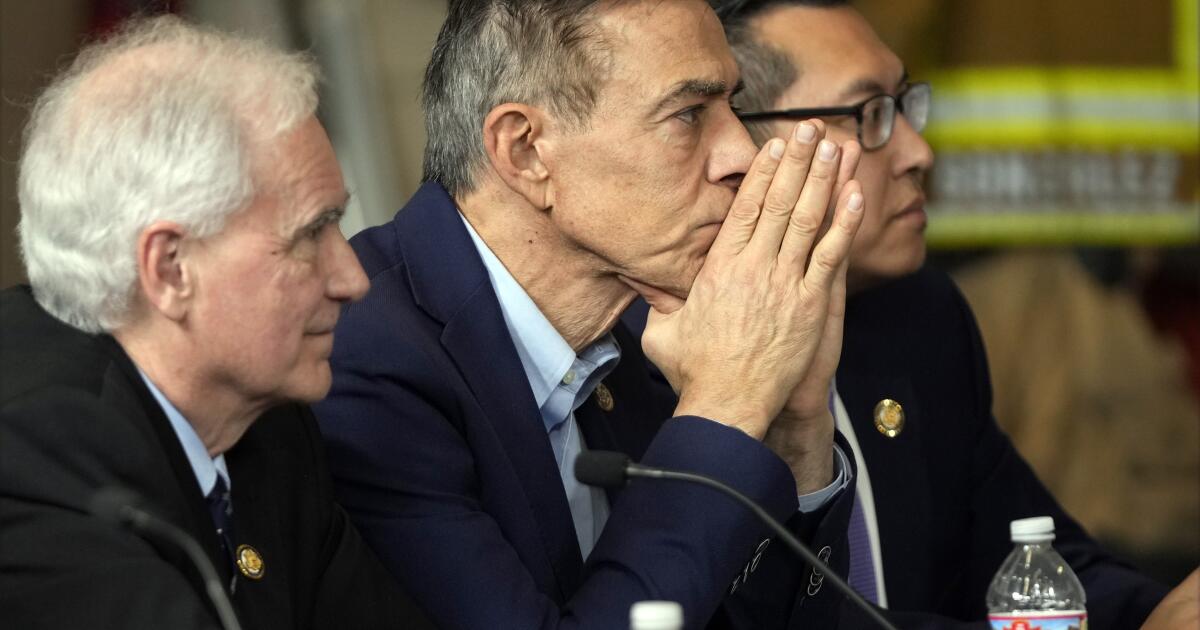
WASHINGTON — As court orders against his administration mount, President Trump has ramped up his attacks on federal judges in recent days, railing against their authority and calling for their impeachment.
In particular, the president seems to have zeroed in on the idea of limiting federal district judges’ ability to issue injunctions that have national implications.
“Unlawful Nationwide Injunctions by Radical Left Judges could very well lead to the destruction of our Country!” Trump posted Thursday night on his social media platform. “These people are Lunatics, who do not care, even a little bit, about the repercussions from their very dangerous and incorrect Decisions and Rulings.”
While Trump rages on social media — going as far as calling on the U.S. Supreme Court to limit district courts’ ability to grant injunctions — one California Republican in Congress is working to rein in the judges who are checking Trump’s powers.
Rep. Darrell Issa of Bonsall introduced the No Rogue Rulings Act, or NORRA, last month to limit federal judges’ ability to issue nationwide injunctions, curtailing their ability to make decisions that affect people outside their district.
Issa’s legislation has gained traction among several prominent Republicans — including the president, who is determined to advance his anti-immigration agenda despite setbacks in the courts.
“You can’t stop that with a judge sitting behind a bench who has no idea what’s going on, who happens to be a radical left lunatic,” Trump said Friday from the Oval Office.
In Washington, where Republicans control the White House, Senate and House of Representatives. Issa’s bill reflects a broader push by Republicans to clamp down on the judiciary, which has proved to be the only arena where Trump is encountering consistent opposition.
Following Trump’s lead, some Republicans are targeting judges they deem “activists” for impeachment. Elon Musk, one of the president’s closest advisors and the subject of several court cases himself, echoed those calls last week, posting on X, “This is a judicial coup.”
In the myriad court cases Trump faces for his dozens of sweeping executive orders and actions since taking office in January, perhaps the most pointed rebuke came earlier this month, when U.S. District Judge James Boasberg of the District of Columbia
ordered the government to turn around planes carrying immigrants for deportation. The planes landed at their destination in El Salvador, and the judge has been tussling with the president’s lawyers about whether they defied his order.
The episode escalated Democratic concerns that the Trump administration may refuse to follow a judge’s orders, launching a “constitutional crisis” and threatening American democracy. For Republicans, Boasberg’s order became another notch in a long line of judicial attacks against Trump.
“The injunctions are nothing more than partisan judicial overreach, and have disrupted the president’s ability to carry out his lawful constitutional duty,” Issa said when introducing NORRA in a House Judiciary Committee hearing. “This has allowed activist judges to shape national policy across the entire country … something this Constitution never contemplated.”
Boasberg, the judge who tried to block the flights of Venezuelan immigrants that ultimately landed in a San Salvador prison, was appointed to the Superior Court by President George W. Bush and elevated to the federal bench by President Obama. Many other judges who have stymied Trump’s efforts — such as the banning of transgender troops from the military or attempts to cripple the U.S. Agency For International Development — were appointed by Democratic presidents.
Justin Levitt, a constitutional law professor at Loyola Law School in Los Angeles, said the power of district court judges to make rulings that are binding on a national level has vexed Democrats and Republicans for decades.
In recent years, federal district and appellate courtsissued injunctions limiting portions of former President Biden’s attempts to forgive student debt and parts of former Obama’s Affordable Care Act.
“This is actually a serious issue that has come up on a number of occasions on both sides of the aisle,” Levitt said. “It’s a little difficult to know how seriously to take this particular version because, depending on who tends to be in power at any given time, different members of Congress seem to really like or really hate these sorts of aggressive court action.”
When introducing NORRA to the Judiciary Committee, Issa brought a chart showing the number of injunctions presidents have faced in office. In his first term, Trump received 64, far above former Presidents Biden (14), Obama (12) or Bush (6). Trump already faces 12 injunctions in his second term, according to Issa’s chart.
“The implication of this chart is that somehow the courts have done something wrong, rather than Donald Trump having done something wrong,” Rep. Jamie Raskin (D-Md.) said at the hearing. “The reason there are 64 injunctions against him is because he is trampling the lawmaking and spending powers of the Congress of the United States.”
Erwin Chemerinsky, dean of the UC Berkeley Law School, said Issa’s bill was a “terrible idea” that would sow chaos in the federal courts. In practice, Chemerinsky said, the measure probably would create conflicting rulings between districts, making Americans subject to different rules in different parts of the country on complex issues including birthright citizenship or a transgender soldier’s right to be in the military.
“If the Northern District of California issues an order telling a Cabinet secretary not to do something, the Cabinet secretary will say they’re not bound by that order outside the Northern District of California,” he said.
Chemerinsky said the bill is a hammer in search of a nail, as national injunctions issued by district courts already have a limited effect. Such issues are often quickly appealed, and if a federal appellate court reverses the lower court judge, a case could then make its way before the U.S. Supreme Court.
He did acknowledge, however, that the issuance of nationwide injunctions has become more prevalent as the nation’s partisan divide grows sharper, with plaintiffs on both ends of the political spectrum “judge shopping” for ideological allies on the bench.
“Conservatives in the Biden administration continually went to courts in Texas to get injunctions, and liberals have done that in the Trump administration,” he said.
Judge James Boasberg of the D.C. District Court, shown in 2023, has drawn attacks from President Trump after ordering planes carrying Venezuelan migrants to turn around during deportation flights.
(Bloomberg via Getty Images)
Republican lawmakers eager to defend the president have leapt to support the legislation. It sailed out of the House Judiciary Committee, which Issa sits on, in early March and is expected to reach the House floor for a vote soon.
Sen. Josh Hawley (R-Mo.), another ardent Trump supporter in Congress, announced Thursday that he also would bring legislation in the Senate to limit nationwide injunctions.
“You can feel when momentum is coming for a bill you’re working on,” said Jonathan Wilcox, Issa’s spokesperson. “When the White House is aligned, the Senate’s involved, leadership’s positive. You don’t get that every day.”
Issa’s legislation marks how Republicans have come to completely align themselves behind the president since he first took office in 2017. At the time, Issa, a conservative representing California’s southwestern corner, broke with his party to join with Democrats in calling for an independent investigation into Russian interference in the 2016 election.
Issa faced a few tough challengers in elections since, but handily won the 48th Congressional District seat in November with 59% of the vote. He has since positioned himself as one of the president’s staunchest allies in California. Earlier this month, Issa said he would nominate Trump for a Nobel Peace Prize.
Despite his support — and his chart — Issa insisted during the committee hearing that NORRA was not about Trump.
“We are not passing a law for the current occupant of the White House,” Issa said. “We are passing a law that will improve the effectiveness of the executive branch, and the reasonable challenges to actions by an executive branch, now and for the rest of the many years of our great republic.”
Issa’s bill also includes an amendment from Rep. Derek Schmidt, a Republican and former attorney general of Kansas, that would allow for a case brought by states and involving multiple districts to be reviewed by a three-judge panel, with the ability to appeal to the Supreme Court.
Levitt questioned the practical ability of Issa’s measure to cure Trump’s frustrations with district judges’ actions on his executive orders. The exception cited in Issa’s bill refers to the Administrative Procedure Act, a 1946 law that gives federal courts oversight with respect to the actions of federal agencies, Levitt said.
When plaintiffs sue to block actions implemented by executive order, they’re actually suing the agency tasked with carrying out the president’s direction — agencies that judges could still enjoin under the Administrative Procedure Act, Levitt said.
In cases that have recently infuriated Trump — such as the judges’ orders blocking his push to deport alleged Venezuelan gang members without due process, or to eliminate birthright citizenship — Levitt said Issa’s bill would have no effect, since the defendants in those cases would be Cabinet-level agencies that are subject to the APA.
Although Levitt didn’t think Issa’s bill would achieve the weakening of judiciary power that Trump seems to desire, he did warn that Republicans are walking a path they could regret when they’re the minority party again and in need of injunctive relief.
“Do you object in the same way to the super conservative rulings that affected the Biden administration in the same way that you are protesting here?” Levitt asked.
Chemerinsky said Issa’s bill is more concerning at a time when the Trump administration seems set on weakening the powers of the legislative and judicial branches.
“You have a president who is simultaneously trying to define presidential powers more broadly than anyone has in U.S. history,” he said. “This bill is trying to take away a check on that power in this crucial moment.”



new video loaded: President Fires Noem as Homeland Security Secretary
transcript
transcript
President Fires Noem as Homeland Security Secretary
President Trump fired Kristi Noem, his embattled homeland security secretary, on Thursday and announced his plans to replace her with Senator Markwayne Mullin of Oklahoma.
-
“The fact that you can’t admit to a mistake which looks like under investigation is going to prove that Ms. Good and Mr. Pretti probably should not have been shot in the face and in the back. Law enforcement needs to learn from that. You don’t protect them by not looking after the facts.” “Our greatness calls people to us for a chance to prosper, to live how they choose, to become part of something special. Anyone who searches for freedom can always find a home here. But that freedom is a precious thing, and we defend it vigorously. You crossed the border illegally — we’ll find you. Break our laws — we’ll punish you.” “Did you bid out those service contracts?” “Yes they did. They went out to a competitive bid.” “I’m asking you — sorry to interrupt — but the president approved ahead of time you spending $220 million running TV ads across the country in which you are featured prominently?” “Yes, sir. We went through the legal processes. Did it correctly —” Did the president know you were going to do this?” “Yes.” “I’m more excited about just ready to get started. There’s a lot of work we can do to get the Department of Homeland Security working for the American people.”

By Jackeline Luna
March 5, 2026

NEWYou can now listen to Fox News articles!
The Department of Justice (DOJ) is continuing its investigation into former President Joe Biden’s use of an autopen in the final months of his administration — focusing on pardons and commutations — though a senior official said Biden is unlikely to face criminal exposure.
A senior DOJ official told Fox News the autopen investigation is ongoing and not closed, adding investigators are reviewing clemency actions taken in the final months of the Biden administration.
The official also pointed out, however, that the use of an autopen by a sitting president is “established law.”
The issue under review is whether the autopen was used in violation of the law, specifically, whether Biden personally approved each name included on pardon and commutation lists.
A framed portrait shows former President Joe Biden’s signature and an autopen along “The Presidential Walk of Fame” outside the Oval Office of the White House. (Andrew Harnick/Getty Images)
“These types of cases are tough. Executive privilege issues come into play,” the official said.
What is also clear, the official indicated, is that the target of any potential prosecution would not likely be Biden.
“It’s hard to imagine how [Biden] could be criminally liable for pardon power,” the senior DOJ official said.
BIDEN’S AUTOPEN PARDONS DISTURBED DOJ BRASS, DOCS SHOW, RAISING QUESTIONS WHETHER THEY ARE LEGALLY BINDING
The use of the autopen by former President Joe Biden remains under investigation. (AP Photo)
The official noted that one reason the former president would be unlikely to face charges stems from a 2024 Supreme Court ruling that originally involved current President Donald Trump but would also apply to Biden.
“We conclude that under our constitutional structure of separated powers, the nature of Presidential power requires that a former President have some immunity from criminal prosecution for official acts during his tenure in office,” the Supreme Court ruled in Trump v. United States in 2024.
“At least with respect to the President’s exercise of his core constitutional powers, this immunity must be absolute.”
Sources familiar with the matter told Fox News Digital that U.S. Attorney Jeanine Pirro’s team continues to review the Biden White House’s reliance on an autopen, contradicting a recent New York Times report that indicated the investigation had been paused.
DOJ SIGNALS IT’S STILL DIGGING INTO BIDEN AUTOPEN USE DESPITE REPORTS PROBE FIZZLED
President Donald Trump has pushed for consequences for former President Joe Biden’s alleged use of the autopen. (Julia Demaree Nikhinson/AP Photo)
Trump has pushed for consequences over the autopen controversy, alleging on social media that aides acted unlawfully in its use and raising the prospect of perjury charges against Biden.
Biden has rejected those claims, saying in a statement last year he personally directed the decisions in question.
“Let me be clear: I made the decisions during my presidency,” Biden said. “I made the decisions about the pardons, executive orders, legislation and proclamations. Any suggestion that I didn’t is ridiculous and false.”
The House Oversight Committee has homed in on Biden’s clemency actions, including five controversial pardons for family members in the final days of his presidency, citing what it described as a lack of “contemporaneous documentation” confirming that Biden directly ordered the pardons.
CLICK HERE TO DOWNLOAD THE FOX NEWS APP
The committee asked the DOJ to investigate “all of former President Biden’s executive actions, particularly clemency actions, to assess whether legal action must be taken to void any action that the former president did not, in fact, take himself.”
Fox News Digital’s Ashley Oliver contributed to this report.
Related Article

Politics
Anxiety grows among California Democrats as gubernatorial candidates rebuff calls to drop out

SACRAMENTO — Despite a plea from the head of the California Democratic Party for underperforming candidates to drop out of the governor’s race, all but one of the party’s top hopefuls spurned the request.
Party leaders fear the growing possibility that the crowded field will split the Democratic electorate in the state’s June top-two primary election and result in two Republicans advancing to the November ballot, ensuring a Republican governor being elected for the first time since 2006.
His advice largely unheeded, state party Chairman Rusty Hicks on Thursday said the fate of a Democratic victory now rests squarely on the gubernatorial candidates who flouted him.
“The candidates for Governor now have a chance to showcase a viable path to win,” Hicks said in a statement Thursday.
Eight top Democratic candidates filed the official paperwork to appear on the June ballot after Hicks released a letter on Tuesday urging those “who cannot show meaningful progress towards winning” to drop out. Friday is the deadline to file to appear on the primary election ballot. On March 21, the secretary of state’s office will formally announce who will appear on the June ballot.
“It sounded like someone who has his head in the sand,” former Los Angeles Mayor Antonio Villaraigosa said of Hicks’ open letter. “[Most] of us filed within 24 hours of getting that letter. It created some press but not much else. It didn’t impact [most] of the candidates and it certainly didn’t impact my candidacy.”
Democratic strategist Elizabeth Ashford said it was appropriate for Hicks and other Democratic leaders to make a public plea as opposed to keeping such discussions solely behind closed doors.
But the response showed the limited power of the modern-day party bosses.
“It’s definitely not Tammany Hall,” said Ashford, referring to the storied Democratic political machine that had a grip on New York City politics for nearly a century. “The party and Rusty are influential and they are helpful and that is their role. I don’t think anyone would be comfortable with outright public strong-arming of specific candidates.”
Ashford, who worked for former Govs. Jerry Brown and Arnold Schwarzenegger, along with former Vice President Kamala Harris when she served as state attorney general, added that the minimal power of the state GOP is likely a factor in the dynamics of Democrats’ decision to stay in the race. Democratic registered voters outnumber Republicans by almost a 2-to-1 margin in the state, and Democrats control every statewide elected office and hold supermajorities in both chambers of the California Legislature.
“If there were a strong viable opposition that existed, if the Republican Party was actually relevant in California, I think that would sort of force greater unity amongst Democrats,” she said.
Just one of the nine major Democrats did heed the party chair’s message. Ian Calderon, a former Los Angeles-area Assemblyman who consistently polled near the bottom of the field, withdrew from the race and endorsed Rep. Eric Swalwell (D-Dublin) on Thursday.
Candidates cannot withdraw their name from the ballot once they officially file to run for office, leading to some fears that even if other candidates drop out of the race, a crowded primary ballot could still split California’s liberal votes.
“I’m disappointed most of them will be on the ballot,” said Lorena Gonzalez, the head of the California Federation of Labor Unions, which will announce whether it endorses in the governor’s race on March 16. But “I do still think you can have people drop out of the race or become viable. I think that there are candidates who know viability is a real thing they have to show in coming weeks” before ballots start being mailed to voters.
Jodi Hicks, chief executive and president of Planned Parenthood Affiliates of California, said she is “still worried” about the prospect of two Republicans winning the top two spots in the June primary, shutting Democrats out of any chance of winning the governor’s office in November.
“I didn’t have any specifics of who I wanted to do what,” she said. “I’m just very, very concerned and the stakes are really high right now and seem to be getting worse by the day.”
Republican candidate Steve Hilton, a former Fox News host, said he is “confident that I’ll be in the top two” along with a Democratic candidate. “I find it very difficult to believe that the Democratic Party will just surrender California and allow two Republicans to be in the top two.”
Hilton made the comments Thursday after a gubernatorial forum in Sacramento hosted by the California Assn. of Realtors focused on housing and homeownership. Villaraigosa, former Health and Human Services Secretary Xavier Becerra, San Jose Mayor Matt Mahan and former Rep. Katie Porter also attended. Swalwell, who is currently in Washington, joined the panel virtually.
During the panel, candidates were in broad agreement about the need to reduce barriers and costs in order to build more housing in California, where the median single-family home costs more than $820,000. Many also endorsed proposals to disincentivize private investment firms from buying up homes as well as a $25-billion bond proposed by former Sen. Bob Hertzberg to help first-time homebuyers afford a down payment.
“This really isn’t a debate because we’re agreeing so much with each other,” Hilton said at one point during the event.
That political alignment on one of the most pressing issues facing California may explain why voters are having such a difficult time deciding who to support.
A recent poll of the Public Policy Institute of California found that the five candidates topping the crowded field were within 4 percentage points of one another: Porter, Swalwell, Hilton, Democratic hedge fund founder Tom Steyer and Republican Riverside County Sheriff Chad Bianco. Earlier polls had Hilton and Bianco leading the field, though many voters remained undecided.
Some candidates took issue with Hicks’ push to cull the field, noting that most of the lower-polling candidates he asked to drop out are people of color.
“Our political system is rigged, corrupted by the political elites, the wealthy and well connected,” state Supt. of Public Instruction Tony Thurmond, who is Black and Latino, said in a video posted on social media in response to the open letter. “The California Democratic Party is essentially telling every person of color in the race for Governor to drop out.”
Villaraigosa argued that enough voters remain undecided that it was too early for quality candidates to call it quits.
“Most people don’t even know who’s in the race,” said Villaraigosa. “It’s premature to be thinking about getting out of the race. I certainly am not considering it and I feel no pressure.”
Aside from the opinion polls, other indicators on who may emerge from the pack a candidates are slowly emerging.
Though it wasn’t enough to win the party’s endorsement, Swalwell won support from 24% of delegates at the state Democratic convention last month, the most of any party candidate.
While spending is no guarantee of success, Steyer has donated $47.4 million of his own wealth to his campaign. Mahan, who recently entered the race and is supported by Silicon Valley leaders, has quickly raised millions of dollars, as have two independent expenditures committees backing his bid.
Ashford said part of candidates’ decisions to remain in the race could have been driven by their lengthy political careers, as well as Democrats’ crushing November redistricting victory.
“In several cases, these are people who have won statewide office,” she said. “It’s tough to feel like there may not be a sequel to that.”
Nixon reported from Sacramento and Mehta from Los Angeles.

Utah Blanks Philadelphia, 3-0 | Utah Mammoth

Friends, family rally behind Vermont veteran charged with domestic terrorism

Virginia Tech women overcome slow start to rally past Georgia Tech in ACC Tournament opener

Capitals Acquire a Conditional First-Round Pick in Either 2026 or 2027 and a 2027 Third-Round Pick from Anaheim for John Carlson | Washington Capitals

Wisconsin Lottery Pick 3, Pick 4 results for March 5, 2026

Florida High School Football Rankings: Top 25 teams – Oct. 21

Cleary's 21 help Le Moyne down Central Connecticut State 69-64 in OT

How old is Bo Nix? What to know about Oregon quarterback ahead of 2024 NFL Draft

99th annual Pony Swim held in Virginia

Indiana Members Credit Union announced as new anchor tenant at Bottleworks District

DOJ continues Biden autopen probe despite former president unlikely to face charges
Fact check: Did French border guards mock influencers returning from Dubai amid Iran war?

Iran’s fight for survival / The widening war / Trump’s nebulous goals : Sources & Methods

Map: 4.9-Magnitude Earthquake Shakes Louisiana

Paxton vows he’s ‘staying in this race’ even if Trump backs Cornyn in Texas GOP clash
-

 World1 week ago
Exclusive: DeepSeek withholds latest AI model from US chipmakers including Nvidia, sources say
-

 Wisconsin4 days ago
Setting sail on iceboats across a frozen lake in Wisconsin
-

 Massachusetts1 week ago
Mother and daughter injured in Taunton house explosion
-

 Maryland5 days ago
AM showers Sunday in Maryland
-

 Massachusetts3 days ago
Massachusetts man awaits word from family in Iran after attacks
-

 Florida5 days ago
Florida man rescued after being stuck in shoulder-deep mud for days
-

 Denver, CO1 week ago
10 acres charred, 5 injured in Thornton grass fire, evacuation orders lifted
-

 Oregon7 days ago
2026 OSAA Oregon Wrestling State Championship Results And Brackets – FloWrestling