Politics
Trump wants to rein in federal judges. One California Republican is already working on it

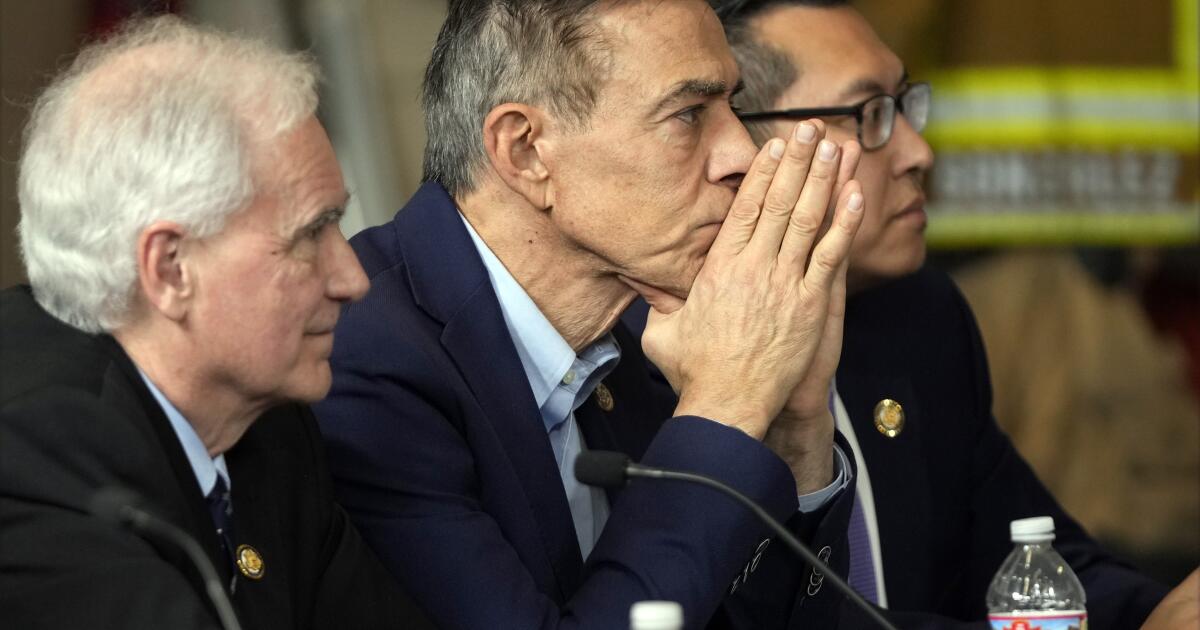
WASHINGTON — As court orders against his administration mount, President Trump has ramped up his attacks on federal judges in recent days, railing against their authority and calling for their impeachment.
In particular, the president seems to have zeroed in on the idea of limiting federal district judges’ ability to issue injunctions that have national implications.
“Unlawful Nationwide Injunctions by Radical Left Judges could very well lead to the destruction of our Country!” Trump posted Thursday night on his social media platform. “These people are Lunatics, who do not care, even a little bit, about the repercussions from their very dangerous and incorrect Decisions and Rulings.”
While Trump rages on social media — going as far as calling on the U.S. Supreme Court to limit district courts’ ability to grant injunctions — one California Republican in Congress is working to rein in the judges who are checking Trump’s powers.
Rep. Darrell Issa of Bonsall introduced the No Rogue Rulings Act, or NORRA, last month to limit federal judges’ ability to issue nationwide injunctions, curtailing their ability to make decisions that affect people outside their district.
Issa’s legislation has gained traction among several prominent Republicans — including the president, who is determined to advance his anti-immigration agenda despite setbacks in the courts.
“You can’t stop that with a judge sitting behind a bench who has no idea what’s going on, who happens to be a radical left lunatic,” Trump said Friday from the Oval Office.
In Washington, where Republicans control the White House, Senate and House of Representatives. Issa’s bill reflects a broader push by Republicans to clamp down on the judiciary, which has proved to be the only arena where Trump is encountering consistent opposition.
Following Trump’s lead, some Republicans are targeting judges they deem “activists” for impeachment. Elon Musk, one of the president’s closest advisors and the subject of several court cases himself, echoed those calls last week, posting on X, “This is a judicial coup.”
In the myriad court cases Trump faces for his dozens of sweeping executive orders and actions since taking office in January, perhaps the most pointed rebuke came earlier this month, when U.S. District Judge James Boasberg of the District of Columbia
ordered the government to turn around planes carrying immigrants for deportation. The planes landed at their destination in El Salvador, and the judge has been tussling with the president’s lawyers about whether they defied his order.
The episode escalated Democratic concerns that the Trump administration may refuse to follow a judge’s orders, launching a “constitutional crisis” and threatening American democracy. For Republicans, Boasberg’s order became another notch in a long line of judicial attacks against Trump.
“The injunctions are nothing more than partisan judicial overreach, and have disrupted the president’s ability to carry out his lawful constitutional duty,” Issa said when introducing NORRA in a House Judiciary Committee hearing. “This has allowed activist judges to shape national policy across the entire country … something this Constitution never contemplated.”
Boasberg, the judge who tried to block the flights of Venezuelan immigrants that ultimately landed in a San Salvador prison, was appointed to the Superior Court by President George W. Bush and elevated to the federal bench by President Obama. Many other judges who have stymied Trump’s efforts — such as the banning of transgender troops from the military or attempts to cripple the U.S. Agency For International Development — were appointed by Democratic presidents.
Justin Levitt, a constitutional law professor at Loyola Law School in Los Angeles, said the power of district court judges to make rulings that are binding on a national level has vexed Democrats and Republicans for decades.
In recent years, federal district and appellate courtsissued injunctions limiting portions of former President Biden’s attempts to forgive student debt and parts of former Obama’s Affordable Care Act.
“This is actually a serious issue that has come up on a number of occasions on both sides of the aisle,” Levitt said. “It’s a little difficult to know how seriously to take this particular version because, depending on who tends to be in power at any given time, different members of Congress seem to really like or really hate these sorts of aggressive court action.”
When introducing NORRA to the Judiciary Committee, Issa brought a chart showing the number of injunctions presidents have faced in office. In his first term, Trump received 64, far above former Presidents Biden (14), Obama (12) or Bush (6). Trump already faces 12 injunctions in his second term, according to Issa’s chart.
“The implication of this chart is that somehow the courts have done something wrong, rather than Donald Trump having done something wrong,” Rep. Jamie Raskin (D-Md.) said at the hearing. “The reason there are 64 injunctions against him is because he is trampling the lawmaking and spending powers of the Congress of the United States.”
Erwin Chemerinsky, dean of the UC Berkeley Law School, said Issa’s bill was a “terrible idea” that would sow chaos in the federal courts. In practice, Chemerinsky said, the measure probably would create conflicting rulings between districts, making Americans subject to different rules in different parts of the country on complex issues including birthright citizenship or a transgender soldier’s right to be in the military.
“If the Northern District of California issues an order telling a Cabinet secretary not to do something, the Cabinet secretary will say they’re not bound by that order outside the Northern District of California,” he said.
Chemerinsky said the bill is a hammer in search of a nail, as national injunctions issued by district courts already have a limited effect. Such issues are often quickly appealed, and if a federal appellate court reverses the lower court judge, a case could then make its way before the U.S. Supreme Court.
He did acknowledge, however, that the issuance of nationwide injunctions has become more prevalent as the nation’s partisan divide grows sharper, with plaintiffs on both ends of the political spectrum “judge shopping” for ideological allies on the bench.
“Conservatives in the Biden administration continually went to courts in Texas to get injunctions, and liberals have done that in the Trump administration,” he said.
Judge James Boasberg of the D.C. District Court, shown in 2023, has drawn attacks from President Trump after ordering planes carrying Venezuelan migrants to turn around during deportation flights.
(Bloomberg via Getty Images)
Republican lawmakers eager to defend the president have leapt to support the legislation. It sailed out of the House Judiciary Committee, which Issa sits on, in early March and is expected to reach the House floor for a vote soon.
Sen. Josh Hawley (R-Mo.), another ardent Trump supporter in Congress, announced Thursday that he also would bring legislation in the Senate to limit nationwide injunctions.
“You can feel when momentum is coming for a bill you’re working on,” said Jonathan Wilcox, Issa’s spokesperson. “When the White House is aligned, the Senate’s involved, leadership’s positive. You don’t get that every day.”
Issa’s legislation marks how Republicans have come to completely align themselves behind the president since he first took office in 2017. At the time, Issa, a conservative representing California’s southwestern corner, broke with his party to join with Democrats in calling for an independent investigation into Russian interference in the 2016 election.
Issa faced a few tough challengers in elections since, but handily won the 48th Congressional District seat in November with 59% of the vote. He has since positioned himself as one of the president’s staunchest allies in California. Earlier this month, Issa said he would nominate Trump for a Nobel Peace Prize.
Despite his support — and his chart — Issa insisted during the committee hearing that NORRA was not about Trump.
“We are not passing a law for the current occupant of the White House,” Issa said. “We are passing a law that will improve the effectiveness of the executive branch, and the reasonable challenges to actions by an executive branch, now and for the rest of the many years of our great republic.”
Issa’s bill also includes an amendment from Rep. Derek Schmidt, a Republican and former attorney general of Kansas, that would allow for a case brought by states and involving multiple districts to be reviewed by a three-judge panel, with the ability to appeal to the Supreme Court.
Levitt questioned the practical ability of Issa’s measure to cure Trump’s frustrations with district judges’ actions on his executive orders. The exception cited in Issa’s bill refers to the Administrative Procedure Act, a 1946 law that gives federal courts oversight with respect to the actions of federal agencies, Levitt said.
When plaintiffs sue to block actions implemented by executive order, they’re actually suing the agency tasked with carrying out the president’s direction — agencies that judges could still enjoin under the Administrative Procedure Act, Levitt said.
In cases that have recently infuriated Trump — such as the judges’ orders blocking his push to deport alleged Venezuelan gang members without due process, or to eliminate birthright citizenship — Levitt said Issa’s bill would have no effect, since the defendants in those cases would be Cabinet-level agencies that are subject to the APA.
Although Levitt didn’t think Issa’s bill would achieve the weakening of judiciary power that Trump seems to desire, he did warn that Republicans are walking a path they could regret when they’re the minority party again and in need of injunctive relief.
“Do you object in the same way to the super conservative rulings that affected the Biden administration in the same way that you are protesting here?” Levitt asked.
Chemerinsky said Issa’s bill is more concerning at a time when the Trump administration seems set on weakening the powers of the legislative and judicial branches.
“You have a president who is simultaneously trying to define presidential powers more broadly than anyone has in U.S. history,” he said. “This bill is trying to take away a check on that power in this crucial moment.”

Construction workers unfurled a large printed tarp to cover scaffolding installed at the White House’s front entrance. Doug Burgum, the interior secretary, said President Trump had ordered the repairs after noticing damage to columns.
Politics
WATCH: Trump’s Energy chief reveals what escalating Iran tensions could mean for gas prices

NEWYou can now listen to Fox News articles!
Energy Secretary Chris Wright is telling Americans not to be concerned about the possibility of another surge of sharp increases in gasoline prices as tensions with Iran have started to escalate once again.
Asked whether Americans should worry about higher prices at the pump and how the Trump administration is preparing to keep the economy stable if the conflict continues to worsen, Wright told Fox News Digital: “It has not been any good behavior from Iran that’s allowed oil to flow. It’s been the United States military.”
“That’s not changing,” he assured, speaking from the Great American State Fair on the National Mall this week.
US CLAWS BACK KEY CONCESSION TO IRAN AFTER FRESH ATTACKS ON COMMERCIAL SHIPS IN STRAIT OF HORMUZ
(Mario Tama/Getty Images) (Mario Tama/Getty Images)
With Iran striking three commercial vessels transiting the Strait of Hormuz on Monday and Tuesday, Wright doubled down in urging citizens to not credit Iran for the U.S. military’s work to ensure oil shipments continue flowing through the strait.
“Look, the U.S. Military has been the key asset here,” he said. “They have assured the flow of oil and gas through the Strait of Hormuz throughout. Not at the beginning of this conflict, but through the last six weeks.”
Wright said the administration is closely monitoring global oil supplies as the tentative ceasefire with Iran seemingly came to come to a halt, with President Donald Trump telling Secretary-General Mark Rutte the call for peace with Iran is “over” at the NATO Summit in Turkey on Wednesday.
But, he pointed to the continued shipping through the Strait as evidence that markets should remain stable.
TRUMP SAYS IRAN CEASEFIRE IS ‘OVER’ AFTER IRANIAN ATTACKS TRIGGER MASSIVE US RESPONSE
President Donald Trump speaks at the White House on Tuesday, April 22. (AP/Alex Brandon)
“We’re of course constantly watching the supply of oil, the supply of refined products and what’s going on there,” Wright said. “And I think still all positive trends.”
Beyond geopolitical concerns, Wright also praised the new chain of discounted gas stations across Pennsylvania and New Jersey, Freedom Fuel, which promises customers prices below the national average.
The Trump administration, though not involved with the network, has heavily endorsed the new chain and its 25 locations.
“We love it,” Wright said when asked about Freedom Fuel. “I mean, look, any mechanism we can to lower energy costs for Americans of all kinds, we’re all in on.”
“With Freedom Fuels, they’re just lowering it down to their wholesale price of gasoline,” Wright said. “So they’re not making any money selling gasoline, but they’ve got convenience stores. That’s how most gas stations make money.”
NEWSOM UNDER FIRE AS CALIFORNIA GAS TAX HIKE SENDS PUMP PRICES EVEN HIGHER
Gasoline costs are a known concern for many Americans, and amid surging prices there has been a considerable increase in those opting to purchase electric vehicles to save money long-term at the pump — with Tesla dominating the market for these types of models.
Wright argued one of the benefits to living in America is having the option to choose what type of vehicle you drive.
CLICK HERE TO DOWNLOAD THE FOX NEWS APP
“We just want people to buy what they would prefer,” he told Fox News Digital when asked his thoughts on increasing calls for support of the electrification of cars. “Consumer choice — you wanna buy an electric car, you wanna buy a gas powered car, diesel powered car, buy a big truck. That’s the choice.”
“That’s why you live in America. You get the choice of all those.”

In 2023, California regulators levied more than $100,000 in fines against the private operator of a federal immigration facility, kicking off a three-year battle over whether detainees who do work at the facilities should be considered employees.
The question went beyond semantics: If considered employees, the detainees would be subject to state worker protection laws.
A legal settlement announced this week now affirms that private immigrant detention facilities are subject to California’s workplace safety and health requirements.
“Every worker deserves a safe and healthy workplace and should be able to report workplace hazards without fear of retaliation,” said Denisse Gómez, spokesperson for the California Division of Occupational Safety and Health or Cal/OSHA.
“Individuals who perform work in these facilities are entitled to workplace safety protections, and this settlement reinforces Cal/OSHA’s commitment to enforcing those protections and safeguarding vulnerable workers,” she added.
Under the settlement between California and the GEO Group, a Florida-based private prison company, the company recently withdrew its legal challenges and agreed to pay more than $100,000 in the fines.
The GEO Group did not respond to requests for comment.
Back in 2023, Cal/OSHA issued $104,510 in fines against the GEO Group. The agency had found six violations of state code by the company after detainees complained about a lack of protective equipment and proper training while cleaning the facility for $1 per day.
Detainees alleged they routinely wiped black mold off shower walls at the facility, saw black dust spew from air vents and used cleaning solutions that lacked instructions during the COVID-19 pandemic.
The biggest fine levied against the GEO Group was for failure to establish and maintain “effective written procedures to reduce employee risk of exposure to aerosol transmissible disease.”
Advocates viewed Cal/OSHA’S recognition of the detainees as workers as a victory that could pave the way for future labor rights fights at other detention centers in the state.
But the GEO Group appealed, arguing that detainees participating in ICE’s voluntary work program make their own schedules and aren’t employees, so hazard exposure couldn’t be “as a result of assigned duties,” as California law states. Plus, the company argued, there wasn’t enough evidence that detainees were exposed to any hazard.
Early last year, the state’s Occupational Safety and Health Appeals Board rejected the GEO Group’s argument and found that detainees should be considered “affected employees.”
The GEO Group sued, but three days before a California Superior Court hearing in May, the company and Cal/OSHA reached the settlement.
Along with paying the fines, the GEO Group agreed to draft plans for avoiding aerosol transmissions at 12 secure and reentry facilities in California, including five detention centers that hold immigrants.
“GEO ensures detainees are afforded the necessary tools, equipment, and personal protective equipment … to safely and effectively perform any necessary tasks,” the settlement states.
Gómez said the settlement also leaves intact the appeals board’s ruling that civil immigration detainees who participate in work programs can participate in proceedings anonymously, “acknowledging the potential for retaliation when individuals raise workplace safety concerns.”
But the question of whether detainees are employees and deserve certain protections isn’t entirely resolved — at least not for the federal government.
Last month, U.S. Immigration and Customs Enforcement released new standards for detention facilities across the country. The revised guidelines “emphasize that detainee volunteers participating in the voluntary work program are not considered facility and/or government employees” and thus not entitled to labor regulations.
Attorney Mariel Villarreal said the timing of the new detention standards made her question whether the GEO Group had asked ICE to specify in its standards that detainees are not workers in response to its battle with Cal/OSHA.
“To me, it’s a reaction to this very settlement,” she said. Villarreal works for the California Collaborative for Immigrant Justice, which filed the original complaint on behalf of detainees who said they worked in unsafe conditions.
Villarreal pointed to a Washington Post report that GEO Group executives privately asked ICE to specify that detainees are not employees of the facilities where they work. Two top Trump administration officials, border czar Tom Homan and acting ICE director David Venturella, previously worked for the GEO Group.
New versions of ICE detention standards take effect as contracts are established or modified, so this year’s rules won’t immediately apply to every facility.
An ICE spokesperson did not comment about the settlement. The spokesperson, who did not provide their name in an emailed statement Wednesday, said the agency has begun transitioning detention facilities to meet the 2026 standards, “building on its longstanding commitment to safe, secure, and professional detention operations.”
“ICE has consistently implemented many of these best practices independently, reinforcing its role as the leader in detention operations,” the spokesperson added.
The GEO Group and other immigrant detention center operators have faced other legal battles over workers’ rights, including lawsuits in Washington, Colorado and California over the $1-per-day payment.
Villarreal said she’s confident that the Cal/OSHA settlement would continue to hold even if California facilities incorporated the new standards. But she said she believes the statements are an attempt by the GEO Group to “sidestep responsibility” and avoid the possibility of being fined under similar circumstances in other states.
“These statements in the new standards are a way for them to try and preserve profits as much as possible,” she said. “GEO and ICE are so intertwined at this point that they have the same motives.”
-

 Cleveland, OH7 seconds ago
Wanted sex offender arrested at the same Cleveland home where missing Tennessee mother found dead
-

 Austin, TX5 minutes ago
Texas Has One Trait Almost Every National Champion Shares
-

 Alabama12 minutes ago
Final 2026 MLB mock draft projections for Alabama’s Justin Lebron
-
 Alaska15 minutes ago
Watch My Buddy Matt Not Get Eaten by Bears in Alaska
-

 Arizona20 minutes ago
Roller derby still has a home in Arizona despite myriad obstacles
-

 Arkansas27 minutes ago
Freshman OL Tucker Young never wavered through Arkansas football coaching changes | Whole Hog Sports
-

 California30 minutes ago
Northern California high school graduation shooting suspect arrested in Texas
-

 Colorado35 minutes ago
Colorado to weigh daily hunting limits, ban on fur sales for wildlife hunted for fur

