Politics
Trump vowed to end wars. He is now opening a new front against Iran

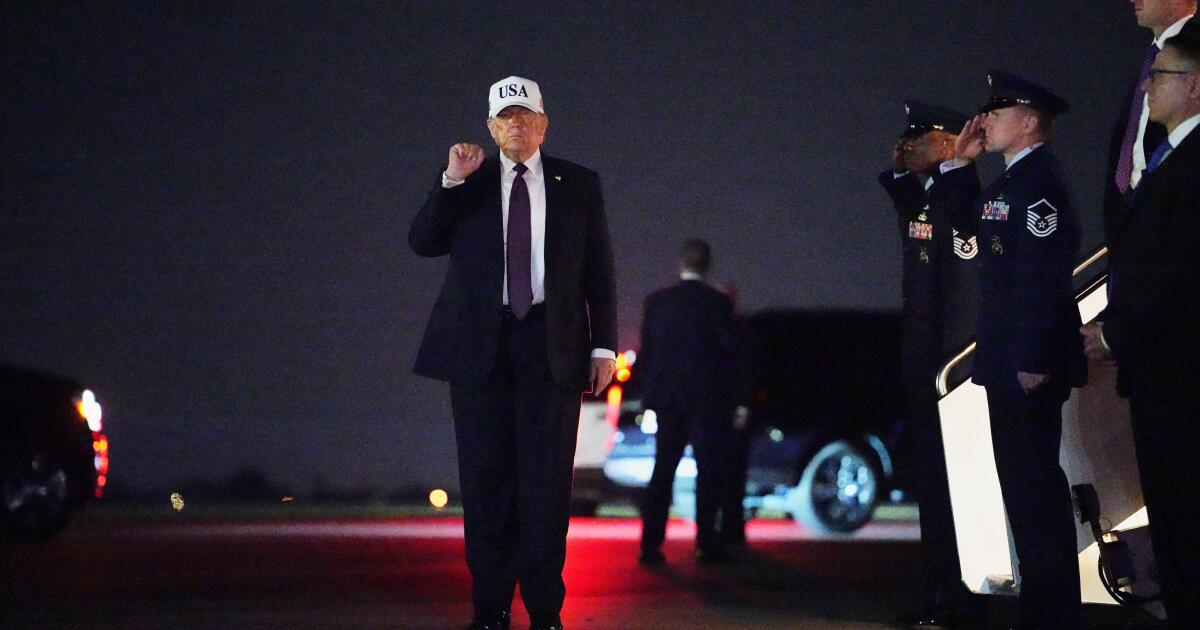
WASHINGTON — For a decade, President Trump promised to end what he calls forever wars, casting himself as a leader opposed to prolonged conflicts in the Middle East and who would rather pursue peace in the world.
Now, early in his second term, Trump is taking military action against Iran that could expand well beyond a limited effort to halt the country’s nuclear program.
In a video posted on Truth Social, the commander in chief said American forces also plan to “raze their missile industry to the ground” and “annihilate their navy.” He warned members of Iran’s military to surrender or “face certain death.” And urged the Iranian people to take the moment as an opportunity to rise up against their government.
“This regime will soon learn that no one should challenge the strength and might of the United States armed forces,” Trump said.
A few hours after relaying that message, Trump confirmed in a separate social media post that Ayatollah Ali Khamenei, the supreme leader of Iran, was among those killed by U.S. and Israeli strikes. Even with his death, Trump said that “the heavy and pinpoint bombing” would continue in Iran “as long as necessary to achieve our objective of PEACE THROUGHOUT THE MIDDLE EAST AND, INDEED, THE WORLD!”
Trump, who has been considering a strike on Iran for several weeks, acknowledged he reached the decision to attack Iran while aware of the human toll that could come with it.
“The lives of courageous American heroes may be lost, and we may have casualties. That often happens in war,” he said. “But we are doing this, not for now, we are doing this for the future, and it is a noble mission.”
Trump’s military campaign in Iran is a sharp turn in tone for a president who has long been critical of open-ended conflicts in the Middle East, and marks a shift from an America-first agenda message that helped him return to the White House.
“I’m not going to start a war. I’m going to stop wars,” Trump said in his November 2024 victory speech as he promised to focus national resources on domestic priorities rather than foreign conflicts.
As Trump advocated to bring home American forces from deployments around the world and to withdraw from key defense treaties, his position resonated with a war-weary electorate in the lead-up to the election.
Fewer than six in 10 Americans (56%) believed the United States should take an active role in world affairs ahead of the election — the second-lowest level recorded since the question was first asked in 1974, according to polling by the Council on Foreign Affairs.
Trump’s posture on war in the Middle East had been largely consistent before he ran for office.
In 2013, he criticized then-President Obama’s negotiations with Tehran, predicting in a post on Twitter that Obama would “attack Iran because of his inability to negotiate properly.” That same year, Trump warned that “our horrendous leadership could unknowingly lead us into World War III.”
And in a heated February 2016 debate, Trump attacked former Florida Gov. Jeb Bush, stating that his brother George W. Bush lied about Iraq’s nuclear capabilities to get the U.S. into the Iraq war. Trump called the Iraq war a “big, fat mistake” that “destabilized the Middle East.”
“They lied. They said there were weapons of mass destruction. There were none, and they knew there were none,” he said.
At the time of the Iraq war, however, Trump had said he supported it.
Trump’s confrontation with Iran bears little resemblance to his earlier rebukes.
Trump has yet to present evidence of an imminent threat to the United States from Iran’s nuclear program — a capability he claimed to have “obliterated” just eight months ago — and has instead framed the military campaign as one to ensure Tehran never develops nuclear weapons at all.
“It is a very simple message,” he said. “They will never have a nuclear weapon.”
Trump’s shift has already drawn the attention of congressional Democrats, many of whom are calling the president out for backing out on his promise to end foreign wars — and are demanding that he involve Congress in any further military actions.
“Regardless of what the President may think or say, he does not enjoy a blank check to launch large-scale military operations without a clear strategy, without any transparency or public debate, and not without Congressional approval,” Sen. Alex Padilla (D-Calif.) said.
Sen. Adam Schiff (D-Calif.) criticized Trump for “drawing the country into yet another foreign war that Americans don’t want and Congress has not authorized.”
The military involvement in Iran is not the first time that members of Congress have complained about the Trump administration’s willingness to sideline the legislative branch on decisions that could trigger broader conflicts this year.
In January, Trump ordered military forces to capture former Venezuelan President Nicolás Maduro and said the United States would run the sovereign nation until further notice. He threatened military action in Colombia, whose leftist President Gustavo Petro has been one of Trump’s most vocal critics.
Trump has alienated allied nations when he said he was willing to send American troops to seize Greenland, a semiautonomous territory of Denmark. And on Friday, he said U.S. is in talks with Havana and raised the possibility of a “friendly takeover of Cuba” without offering any details on what he meant.
His actions have coincided with his annoyance at not being awarded the Nobel Peace Prize. At one point, the president said he no longer felt an “obligation to think purely of Peace” because he didn’t get the recognition.
Trump’s shifting tone, and his use of violent war imagery in his pretaped remarks about Iran, have rattled even part of his base.
“I did not campaign for this. I did not donate money for this,” said former Rep. Marjorie Taylor Greene, a conservative who recently left Congress after a bitter fight with Trump. “This is not what we thought MAGA was supposed to be. Shame!”
Republican leaders, however, are largely standing behind the president.
Senate Majority Leader John Thune (R-S.D.) said Iran “posed a clear and unacceptable threat” to the United States and has refused “the diplomatic off-ramps.” House Speaker Mike Johnson (D-La.) said Trump took the action after exhausting “every effort to pursue peaceful and diplomatic solutions.”
Other top Republican lawmakers rallied behind Trump, too.
“The butcher’s bill has finally come due for the ayatollahs,” Sen. Tom Cotton, the chairman of the Senate Intelligence Committee, wrote in a post on X. “May God bless and protect our troops on this vital mission of vengeance, and justice, and safety.”



new video loaded: Vance Says Pope Should Stay Out of U.S. Affairs
transcript
transcript
Vance Says Pope Should Stay Out of U.S. Affairs
Vice President JD Vance weighed in on the tension between President Trump and Pope Leo XIV as Catholics expressed dismay about Mr. Trump’s attacks.
-
“I certainly think that in some cases, it would be best for the Vatican to stick to matters of morality, to stick to matters of, you know, what’s going on in the Catholic Church and let the president of the United States stick to dictating American public policy.” “I don’t think that the message of the Gospel is meant to be abused in the way that some people are doing. And I will continue to speak out loudly against war, looking to promote peace.” “Pope Leo said things that are wrong. There’s nothing to apologize for. He’s wrong.” “I’m not a big fan of Pope Leo. He’s a very liberal person. I don’t think he’s doing a very good job.” “I did post it, and I thought it was me as a doctor, and it had to do with the Red Cross. There’s a Red Cross worker there, which we support.” “It’s terrible. It’s gross. It’s blasphemous.” “I stand with the pope. I mean, the pope speaks the Gospel. He speaks for peace.”

By Shawn Paik
April 14, 2026

NEWYou can now listen to Fox News articles!
The Justice Department released a report Tuesday alleging the Biden administration weaponized federal law by selectively prosecuting pro-life activists under the Freedom of Access to Clinic Entrances (FACE) Act, following a review of more than 700,000 internal records.
DOJ officials said prosecutors coordinated with abortion-rights groups to track activists, sought harsher sentences for pro-life defendants and, in some cases, withheld evidence or tried to exclude jurors based on religion.
“This department will not tolerate a two-tiered system of justice,” Acting Attorney General Todd Blanche said in a statement. “No Department should conduct selective prosecution based on beliefs. The weaponization that happened under the Biden Administration will not happen again, as we restore integrity to our prosecutorial system.”
PRO-LIFE JOURNALIST ASSAULTED ON STREET ASSIGNS BLAME TO DEMOCRATIC RHETORIC
The Justice Department released a report Tuesday alleging the Biden administration weaponized federal law by selectively prosecuting pro-life activists under the Freedom of Access to Clinic Entrances (FACE) Act, following a review of more than 700,000 internal records. Anti-abortion activists march across the National Mall near the U.S. Capitol during the 50th annual March for Life rally on Jan. 20, 2023 in Washington, DC. (Chip Somodevilla/Getty Images)
The Justice Department’s “Weaponization Working Group” — a review team created under the Trump administration to examine whether federal law was used in a biased or politically motivated way — said it reviewed internal communications, case files and prosecutorial decisions tied to enforcement of the FACE Act, a law intended to protect access to abortion clinics and pregnancy resource centers.
The report found officials under the Biden administration worked closely with groups including Planned Parenthood, the National Abortion Federation and the Feminist Majority Foundation, which helped compile information on pro-life activists used in investigations and prosecutions.
The report said, “The Biden DOJ prosecutors knowingly withheld evidence that defense counsel requested to prepare an affirmative defense.”
In one case, a DOJ official told defense counsel, “I do not keep the kind of records you requested and, as a result, I do not believe that we will provide them to you,” when asked for data to support a selective prosecution defense.
The report said the official had the information “readily available” but declined to share it with the defense.
PLANNED PARENTHOOD APOLOGIZES FOR ‘INADVERTENTLY’ GIVING SEXUALLY EXPLICIT COLORING BOOK TO CHILDREN
Acting Attorney General Todd Blanche said the Justice Department will not tolerate a “two-tiered system of justice.” (Tom Williams/CQ Roll Call)
The report also alleged prosecutors attempted to screen out jurors based on religious beliefs and, in some cases, opted for aggressive arrest tactics rather than allowing defendants to voluntarily surrender.
For instance, the report cited a case involving pro-life activist Mark Houck in which prosecutors declined a request for him to self-surrender and instead authorized an FBI arrest at his home.
DOJ officials further claimed pro-life defendants faced significantly harsher sentencing requests, with prosecutors seeking an average of 26.8 months in prison compared to 12.3 months for defendants accused of violence against pro-life organizations.
The report argued the Biden administration’s enforcement of the FACE Act was uneven, with authorities prioritizing cases involving abortion clinics while failing to adequately pursue attacks on pregnancy resource centers and churches.
The Justice Department said the Trump administration has already taken steps to reverse course, including issuing pardons for some pro-life activists, dismissing several civil cases and limiting future FACE Act prosecutions to “extraordinary circumstances” involving significant aggravating factors.
President Donald Trump also signed pardons for pro-life activists convicted under the prior administration.
CLICK HERE TO DOWNLOAD THE FOX NEWS APP
Merrick Garland headed the Justice Department under the Biden administration. (Tom Williams/CQ-Roll Call, Inc via Getty Images)
Assistant Attorney General Daniel Burrows said the findings raised serious concerns about the conduct of department attorneys.
“The behavior unearthed in this report is shameful,” Burrows said in a statement. “Lawyers who should have known better withheld evidence, worked to keep committed religious people off juries and generally allowed the Department of Justice to be used as the enforcement arm of pro-abortion special interests.”

Prior to the Supreme Court’s 2015 Obergefell decision, opponents raised alarms about the severe and immediate harms that would surely occur if marriages between same-sex couples were recognized nationally. Afterward, when those harms failed to materialize, those voices grew quieter, but some have been returning with renewed vigor, in hopes that the current Supreme Court, after overturning Roe vs. Wade, may be willing to overturn the Obergefell decision as well — though the justices declined to do so in November.
To build public support for rolling back marriage rights, new campaigns have been repeating the claims that legal recognition of same-sex marriages may harm children or even the stability of different-sex marriages. These are some of the same concerns that were raised in the years prior to the Obergefell decision. They were groundless then, and, more than 10 years later, the data confirm these fears to be unfounded.
In 2024, for the 20th anniversary of the first legal marriages of same-sex couples (in Massachusetts), my lab at UCLA joined with a team of researchers at Rand Corp. to review what social scientists learned over those two decades about the consequences of legalizing same-sex marriage.
We addressed this question in two ways. First, we searched through the research literature to find every published study that had examined the consequences of legalizing same-sex marriage. Prior to 2015, states legalized and prohibited same-sex marriage at different times, and social scientists tracked a wide range of outcomes, including the well-being of children, national trends in marriage and divorce, and the physical and mental health of same-sex couples. Opponents of legalizing same-sex marriage predicted, in the strongest terms, that people would suffer after same-sex couples were granted the right to marry.
After 20 years of legalized marriage for same-sex couples, 96 independent studies confirm there is no evidence for the harms critics predicted. Our review identified not a single study that observed significant negative consequences of legalizing same-sex marriage. Instead, the research literature identified many significant positive consequences.
For same-sex couples, legal recognition of their marriages was followed by more stable relationships, increased mental and physical health, greater financial stability, and stronger connections to family. For the children of those couples, our review found no documented negative outcomes, but legal recognition of their parents’ marriages did result in more children obtaining access to health insurance. And what about the rest of the country? States that recognized same-sex marriages prior to Obergefell experienced economic gains and considerable savings in healthcare costs relative to states that did not.
One of the most striking predictions of the opponents of same-sex marriage was that recognizing marriage among same-sex couples would weaken commitment to the institution of marriage among different-sex couples. That did not happen either.
To address this question, our report conducted new analyses, drawing on census data and other sources to determine whether state-level rates of marriage, cohabitation and divorce changed in the states that recognized same-sex marriage, compared with states that did not. No matter how we conducted the analyses, we could find no effects of recognizing same-sex marriage on any of these outcomes. It makes sense: When different-sex couples are making personal decisions about their own relationships, they are not paying much attention to what same-sex couples are doing.
If any harm resulted from allowing same-sex couples to marry, it ought to be well documented by now. The fact that there has been no evidence of harms despite considerable effort to find some suggests that the predictions made by opponents of legalizing same-sex marriage were unwarranted at the time. Now that we have 20 years of research and experience, those predictions remain unwarranted now.
Benjamin Karney is a professor of social psychology at UCLA.
Insights
L.A. Times Insights delivers AI-generated analysis on Voices content to offer all points of view. Insights does not appear on any news articles.
Viewpoint
Perspectives
The following AI-generated content is powered by Perplexity. The Los Angeles Times editorial staff does not create or edit the content.
Ideas expressed in the piece
-
The article argues that research from over two decades demonstrates same-sex marriage legalization produced substantial benefits for same-sex couples, including more stable relationships, improved mental and physical health, greater financial stability, and stronger family connections[1][2].
-
The piece contends that children of same-sex couples experienced no documented negative outcomes following legal recognition of their parents’ marriages, while gaining increased access to health insurance[2].
-
The column suggests that states recognizing same-sex marriages prior to the 2015 Obergefell decision experienced measurable economic gains and considerable healthcare cost savings compared to states that did not recognize such marriages.
-
The article maintains that one of the primary concerns raised by opponents—that legalizing same-sex marriage would weaken commitment to marriage among different-sex couples—failed to materialize, with analyses showing no effects on state-level marriage, cohabitation, or divorce rates.
-
The piece contends that approximately 96 independent studies confirm there is no evidence for the harms critics predicted would result from legalizing same-sex marriage, and that not a single study documented significant negative consequences.
Different views on the topic
-
Historically, some researchers suggested potential concerns about children raised by same-sex parents, with the New Family Structures Study initially concluding that people with same-sex parents faced greater risks of adverse outcomes including unemployment and lower educational attainment[3].
-
Some research has indicated that same-sex couples, particularly female-female couples, experience higher divorce rates compared to different-sex couples, with a 2022 study finding female-female marriages had 29% higher divorce rates relative to female-male marriages, and that lesbian unions demonstrate considerably less stability than gay male unions[4].

Video: How Stephen Miller Is Adjusting Trump’s Immigration Agenda

Video: Vance Says Pope Should Stay Out of U.S. Affairs

Best Healthy Foods for Weight Loss After 50, Including Cheese and Bread!

Sign Up for the Book Review’s 2026 Challenge

With ‘Big Mistakes,’ Dan Levy returns to TV with a crime comedy : Pop Culture Happy Hour

Florida High School Football Rankings: Top 25 teams – Oct. 21

How old is Bo Nix? What to know about Oregon quarterback ahead of 2024 NFL Draft

Cleary's 21 help Le Moyne down Central Connecticut State 69-64 in OT

99th annual Pony Swim held in Virginia

Indiana Members Credit Union announced as new anchor tenant at Bottleworks District
Video: How Stephen Miller Is Adjusting Trump’s Immigration Agenda

Biden DOJ weaponized FACE Act against pro-life Americans, 882-report alleges

Mass drone warfare is Europe’s rising security threat
Man accused in Molotov cocktail attack of OpenAI CEO’s home charged with attempted murder

Embattled Rep Tony Gonzales announces plans to resign amid sexual misconduct allegations
-

 Atlanta, GA1 week ago
1 teenage girl killed, another injured in shooting at Piedmont Park, police say
-

 Georgia7 days ago
Georgia House Special Runoff Election 2026 Live Results
-

 Arkansas4 days ago
Arkansas TV meteorologist Melinda Mayo retires after nearly four decades on air
-

 Pennsylvania1 week ago
Parents charged after toddler injured by wolf at Pennsylvania zoo
-
 Milwaukee, WI1 week ago
Potawatomi Casino Hotel evacuated after fire breaks out in rooftop HVAC system
-

 Austin, TX6 days ago
ABC Kite Fest Returns to Austin for Annual Celebration – Austin Today
-

 World1 week ago
Zelenskyy warns US-Iran war could divert critical aid from Ukraine
-

 World1 week ago
Indonesia receives bodies of peacekeepers killed in southern Lebanon