Politics
Trump trial: Jury selection to resume in New York City for 3rd day in former president's trial


Jury selection in former President Trump’s historic and unprecedented criminal trial stemming from charges brought by Manhattan District Attorney Alvin Bragg is expected to resume Thursday morning.
Bragg has charged Trump, the 2024 presumptive Republican presidential nominee, with 34 counts of falsifying business records in the first degree. The charges are related to alleged hush money payments made to adult film actress Stormy Daniels ahead of the 2016 presidential election.
TRUMP SAYS CRIMINAL TRIAL IS HAVING ‘REVERSE EFFECT’ AS HE CAMPAIGNS AT NEW YORK BODEGA, VOWS TO SAVE CITY
Trump has pleaded not guilty to all counts. He has blasted the trial as pure politics, a “political persecution,” and maintains his innocence. The former president is expected to testify during his trial.
Former President Trump is shown before proceedings get underway on the second day of jury selection at Manhattan Criminal Court in New York City on April 16, 2024. (AP Photo/Mary Altaffer/Pool)
“I tell the truth,” Trump said last week, when asked about his possible testimony.
Trump is the first president in United States history to stand criminal trial.
By the end of jury selection on Tuesday, seven jurors had been selected and sworn in. The jury pool so far includes four men and three women, all living in New York City. Their professions include law, finance, nursing, technology and more.
Court will not meet for the trial on Wednesdays, and the third day of jury selection is expected to begin at 9:30 a.m. in Lower Manhattan.
Tuesday, the second day of the trial, brought a filing from Bragg, who argued that Trump should be held in contempt of court for violating the gag order imposed upon him by Judge Juan Merchan, who is presiding over the trial.
Bragg and prosecutors are arguing that Trump must pay a $1,000 fine each for three alleged violations of the gag order, with all relating to social media posts.
TRUMP HUSH MONEY TRIAL: MEET THE JURORS WHO WILL HEAR BRAGG’S CASE AGAINST THE 2024 PRESIDENTIAL CANDIDATE
In the motion, Bragg urged the judge to warn Trump that “future violations” of the gag order can be punished “not only with additional fines, but also with a term of incarceration of up to thirty days.”
Manhattan District Attorney Alvin Bragg arrives at Manhattan Criminal Court in New York City on April 16, 2024. (AP Photo/Yuki Iwamura)
But after sitting in a courtroom for more than eight hours of jury selection Tuesday evening, Trump made a campaign stop at Sanaa Convenience Store in Harlem. Trump was met by a large crowd chanting “Trump, Trump, Trump,” “Four more years” and “We love Trump.” The crowd was singing the national anthem.
The visit was intended to highlight rising crime in New York City under Bragg’s watch.
Former President Trump visits a Manhattan bodega – where a worker was assaulted by a man in 2022 and ended up killing him in an ensuing fight – on April 16, 2024, in New York City. Trump visited the bodega after spending a second day in court where he faces 34 felony counts of falsifying business records in the first of his criminal cases to go to trial. (Spencer Platt/Getty Images)
Trump blasted the trial and charges against him, saying it is “rigged,” “all politics” and “coming out of the [President Biden’s] White House.”
“It makes me campaign locally, and that’s OK,” Trump said. “We’re doing better now than we’ve ever done, so I think it’s having a reverse effect.”
BRAGG FILES MOTION TO HOLD TRUMP IN CONTEMPT FOR ALLEGED GAG ORDER VIOLATIONS, THREATENS 30 DAYS OF JAIL TIME
“We’re going to come in – No. 1, you have to stop crime, and we’re going to let the police do their job. They have to be given back their authority. They have to be able to do their job,” Trump said. “And we’re going to come into New York. We’re making a big play for New York, other cities, too. But this city, I love this city.”
Trump said New York has “gotten so bad in the last three years, four years.”
“And we’re going to straighten New York out. So, running for president, we’re putting a big hit in New York; we could win New York,” he said.
A court sketch depicts the second day of former President Trump’s criminal trial in Manhattan Criminal Court on April 16, 2024. Jury selection in his hush money trial is ongoing. (Christine Cornell)
“They want to keep me off the campaign trail,” Trump said. “But based on what I’m doing, I think there’s more press here than if I went out to some [other] location.”
As for crime in New York City, Trump said, “It’s Alvin Bragg’s fault. Alvin Bragg does nothing. He goes after guys like Trump who did nothing wrong. Violent criminals, murderers? They know there are … hundreds of murders all over the city. They know who they are. They don’t pick them up. They go after Trump.”
He added, “The people of New York are not going to take it. That’s why they’re going to vote for Trump.”

Politics
‘Let’s brew it in the United States’: Teamsters target Modelo and Corona in push for Mexican beer tariffs

NEWYou can now listen to Fox News articles!
One of the nation’s largest labor unions wants President Donald Trump to make one of America’s favorite imports a lot more American.
The International Brotherhood of Teamsters are urging the administration to impose significant tariffs on Mexican beer, arguing more of it should be brewed by U.S. workers instead of across the border.
The request comes as the Office of the U.S. Trade Representative continues to assess whether certain countries’ policies have fueled unfair manufacturing advantages.
The Teamsters argue Mexico has fueled its brewing industry through government-backed investment incentives, lower labor costs and export-focused policies that have expanded production and exports, helping imported beer capture a growing share of the U.S. market.
AMERICA’S FAVORITE BEERS — AND THE JOBS TIED TO THEM — ARE AT THE CENTER OF A BREWING TRADE FIGHT
The brewer of Modelo claimed the No. 1 spot in June 2023, when Modelo Especial surpassed Bud Light on dollar sales, and it continues to rank among the country’s best-selling beers (Aaron M. Sprecher/Getty Images)
The tariff push could have implications for some of America’s best-known imported beer brands, including Modelo, Corona, Pacifico and Tecate, much of which is brewed in Mexico before being shipped to retailers across the U.S.
“We can brew Modelo beer. It’s the same recipe. Let’s brew it in the United States,” Sean O’Brien, general president of the International Brotherhood of Teamsters, told Fox News Digital. “We are very good at producing goods and services in this country,” he added.
In its filing, the union said Mexican beer production has increased 85% since 2014, with about 80% of the country’s beer exports shipped to the United States. Meanwhile, capacity utilization at major U.S. breweries fell from 82% in 2013 to 65% in 2023, a trend the Teamsters say threatens thousands of well-paying union jobs.
TRUMP BET TARIFFS WOULD BRING BACK AMERICAN FACTORY JOBS. NEW REPORT SAYS IT DIDN’T WORK
Economists say the beer industry could see job cuts as tariffs increase costs for brewers and importers. (Artur Widak/NurPhoto/Getty Images)
The union argues tariffs would help shift more beer production back to the U.S., supporting American breweries along with the farmers who grow barley and hops, aluminum manufacturers that produce cans and the truckers who move beer across the country.
“I’m pro-America, pro-American worker, pro American jobs. So if there’s an opportunity to tariff Mexican beer in this situation, which is gonna provide opportunity for our current members, which we have tens of thousands in the brewery and distribution industry, then I’m all for tariffs and all for keeping American jobs in America,” O’Brien added.
THINK YOUR STATE IS EXPENSIVE? NEW DATA REVEALS WHERE AMERICANS FACE THE HIGHEST COST OF LIVING
The Teamsters say the threat to U.S. brewery jobs is growing as major brewers continue investing billions of dollars in Mexico.
According to the filing, breweries have announced plans to add another 19 million to 23 million hectoliters of production capacity over the next five years, an expansion the union attributes to export-focused tax incentives, lower labor costs and industrial policies aimed at boosting manufacturing for foreign markets.
The filing also cites Mexico’s 2023 tax incentives for export-oriented manufacturers and its broader “Plan México” industrial strategy, arguing those policies have encouraged additional investment while suppressing wages and making it more difficult for U.S. producers to compete.
CLICK HERE TO DOWNLOAD THE FOX NEWS APP
The Teamsters have publicly backed tariffs as high as 75% on Mexican beer imports, calling them one potential remedy to what they describe as an uneven playing field. In a separate submission to USTR, the union said continued pressure from imported beer could force more U.S. brewery slowdowns or closures, jeopardizing good-paying brewery jobs that have supported American families for generations.
The Teamsters’ filing is one of several submitted as USTR weighs potential trade actions under its ongoing Section 301 investigation.
USTR did not immediately respond to Fox News Digital’s request for comment.
California has some of the nation’s toughest gun laws, but state lawmakers are concerned that a new technology is allowing criminals to obtain firearms by building them from scratch. By using 3-D printers, they warn, lawbreakers are able to make key components of untraceable “ghost guns” with the press of a button.
Ghost guns, which authorities say make it more difficult to investigate shootings because they lack serial numbers, have been a growing problem for law enforcement nationwide. According to federal data, the number of privately made firearms recovered in crimes surged from more than 1,600 in 2017 to nearly 27,500 in 2023. California leads the nation in recoveries over that period.
In response, legislators are seeking to mandate that all 3-D printers sold in the state come equipped with software that prohibits users from making triggers and other gun parts. A bill passed the Assembly in May and is advancing through the Senate.
But the proposal has drawn opposition from a diverse coalition, which includes civil liberties groups, tech companies and 3-D printing enthusiasts as well as Hollywood effects studios, who argue that “firearm blocking software” will also prohibit legitimate designs and expose makers to government or corporate surveillance.
-
Share via
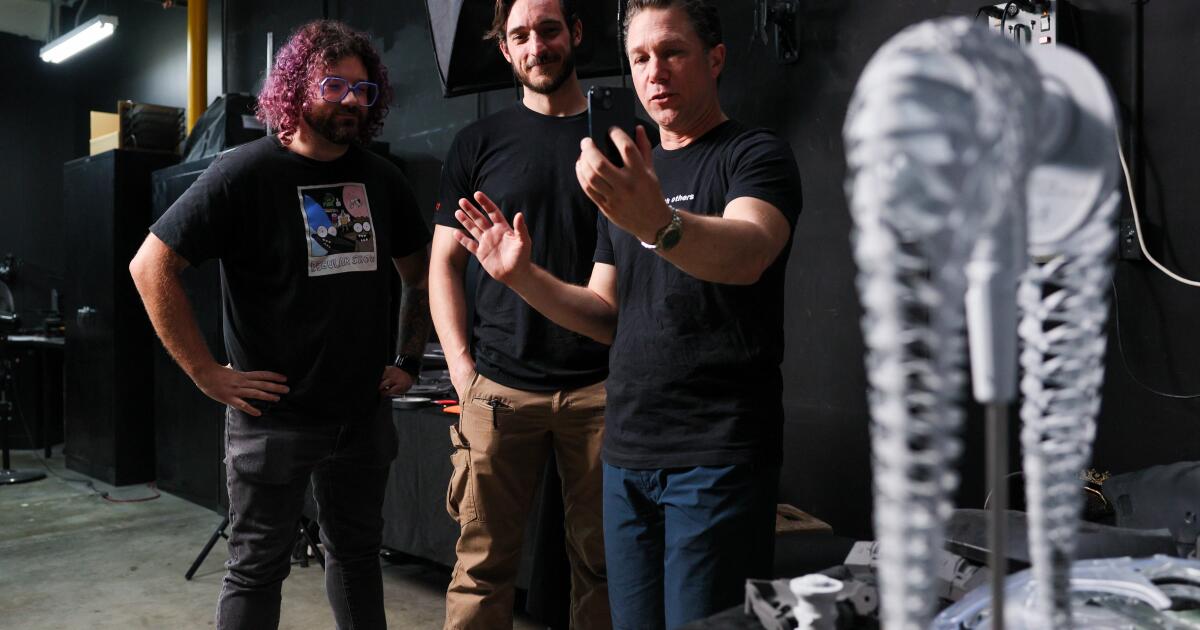
Inside a San Fernando workshop, Samuel McBride makes movie monsters come to life for the camera. One of his latest creations, an animatronic hand, clutches when he pulls a trigger that he built using a 3-D printer.
McBride says the technology has transformed the work at Legacy Effects, where he is a lab manager, but he’s worried it will soon be off-limits because of a proposed change in California law.
McBride fears the law would interfere with the making of devices like the one that activates his lifelike hand.
“If I just took apart this trigger and put it on a printer, how is anyone, computer or human, going to tell me how I intend to use it?” he asked.
Backers of the proposed law say it has the potential to help save lives.
“As gun violence continues to devastate our communities, we cannot allow 3-D printing technology to become a new pipeline for untraceable weapons,” said Assemblymember Rebecca Bauer-Kahan, the bill’s author.
Critics of the proposed California law note that 3-D printed guns represent a small subset of ghost guns recovered by law enforcement at crime scenes. According to the federal Bureau of Alcohol, Tobacco, Firearms and Explosives, most “privately made firearms” recovered by police are assembled from mail-order kits or unfinished parts rather than printed at home.

Jorge Perez of Monster City Studios holds a sculpture made with a large, industrial 3-D printer.
(Ronaldo Bolaños / Los Angeles Times)
“This fight is not over whether ghost guns are dangerous,” said David Tobin, an independent creator leading the coalition. “It is over whether the state can or should require a consumer tool to surveil a person’s designs before they are allowed to make something.”
Everytown for Gun Safety, a national nonprofit that advocates for gun control and has pushed for the passage of California’s bill, pointed to rising 3-D printed firearm recoveries across 20 major cities and warned that homemade plastic parts can help people bypass background checks or turn handguns into automatic weapons.
Krystal LoPilato, who advocates for policy at Everytown, said the group has successfully guided a similar bill through the New York state Legislature.

A handgun frame made using a 3-D printer is held for display at the office of the federal Bureau of Alcohol, Tobacco, Firearms and Explosives.
(Alex Brandon / Associated Press)
LoPilato said the policy aims to be proactive, rather than allowing more violence to take place before regulating the problem. Opponents counter that California already bars unlawful firearm manufacturing with 3-D printers, and that ghost gun recoveries have declined since the state adopted a series of new laws and enforcement efforts.
A June 1 letter to lawmakers, signed by a group of 3-D printing companies, stagecraft and prop-making studios and industry stakeholders, argued that AB 2047 raises 1st Amendment concerns and would harm businesses. The letter was signed by a wide variety of companies and individuals, including Prusa Research, a prominent 3-D printer manufacturer.
“To an algorithm, a gun barrel and a piece of pipe are the same grooved cylinder,” Jakub Kmošek, head of public affairs at Prusa, said in a statement to The Times. “This bill will only make it harder to build, repair, experiment, and innovate in California.”
Alan Scott, Legacy Effects’ co-founder, said 3-D printing has become central to the company’s survival in an industry where budgets are tighter and deadlines are shorter.
“Everything’s just got to be done faster these days. You don’t get to reduce the quality. We couldn’t stay in business if we weren’t 3-D printing,” Scott said.
To solve this problem, Bauer-Kahan put an entertainment industry exception in the bill, exempting “printers manufactured for and sold exclusively to entertainment industry stagecraft and propmaking studios” from the software requirement.
McBride, Legacy’s 3-D lab manager, said those printers do not really exist.
Legacy uses the same general-purpose machines available to other businesses willing to invest in the equipment, and no printers are marketed exclusively for Hollywood, he said.

2

1. A 3-D printed sculpture concept at Monster City, a special effects studio in Santa Clarita. (Ronaldo Bolaños / Los Angeles Times) 2. 3-D printing advocate David Tobin showcases a robotics kit at Monster City. (Ronaldo Bolaños / Los Angeles Times)
Legacy also worries about privacy. Major studios require strict secrecy before a movie or show is released. To accommodate this, the company shares design files through encrypted servers and protected internal systems.
“We’ve invested hundreds of thousands of dollars to bring all that technology here under the umbrella of our NDAs and our IP protection,” McBride said.
Bauer-Kahan noted at a Senate hearing that she is working to address concerns raised by 3-D printing users and industries that rely on the technology.
Paul Powers, chief executive of Physna, a company whose technology could be used to block gun parts on 3-D printers, said the strongest criticisms of AB 2047 “misunderstand how the software works.”
“Something that vaguely looks like a gun part is not considered to be a match,” he said.
Powers also responded to surveillance concerns by clarifying that his company’s software only blocks the printer from making prohibited parts — it doesn’t flag them to authorities or log users’ intellectual property.
“There’s no communication with anyone; it doesn’t go anywhere,” he said.
But Marleen Vogelaar, chief executive of Thangs3D, a platform for independent creators to share and sell 3-D printable designs, said that answer does not resolve her broader concerns about how AB 2047 would work in practice.
“These databases will always lag behind innovation and can be easily circumvented and generate false positives that block legal designs and wrongly flag everyday makers,” she said at a Senate hearing this month. “The bill also creates serious privacy and security risks by giving third parties access to analyze designer’s files. That threatens intellectual property and adds digital surveillance in a state that values data privacy.”
If the bill passes, the state’s Department of Justice would publish a roster of compliant printers. Printers not on the list would be banned from sale or transfer in California beginning in December 2029.
Aubrey Rodriguez, a legislative advocate with American Civil Liberties Union California Action, an advocacy organization formed by the ACLU’s three affiliates in the state, said the bill would ask ordinary users, schools and businesses to accept a new layer of control based on software they still do not trust.
Rodriguez said the proposal risks creating “a permanent back door into the privacy of our own homes, ripe for exploitation.”
“Once this new infrastructure exists, it is a simple software update away from tracking political dissent or preventing 3-D printing designs deemed inappropriate,” Rodriguez said.
Politics
Tulsi Gabbard’s brother charged after allegedly trying to lure children to Waikīkī hotel room: police

Tulsi Gabbard releases documents on Fauci, alleged COVID cover-up
Fox News senior medical analyst Dr. Marc Siegel joins ‘America Reports’ after outgoing DNI Tulsi Gabbard released documents raising questions about Dr. Anthony Fauci’s role in funding COVID-19 origins experiments in Wuhan, China. Intelligence officials weighed lab leak theory early on.
NEWYou can now listen to Fox News articles!
The older brother of former Director of National Intelligence Tulsi Gabbard has been charged after Honolulu police say he allegedly tried to lure several children to his Waikīkī hotel room by offering them gum and money, as his family says he is continuing to receive psychiatric treatment.
Batarti Gabbard, 55, was charged with second-degree custodial interference after the July 12 “stranger danger” incident at a Waikīkī hotel pool, according to police.
Honolulu police allege Gabbard approached several children, including a 9-year-old boy, asked for their names, wrote them in a notebook and offered them money and gum if they would accompany him to his hotel room.
EXCLUSIVE: TULSI GABBARD RESIGNS FROM TRUMP CABINET
People on Waikīkī Beach in Honolulu, Hawaii. (Eugene Tanner/AFP, File)
Fox News Digital obtained new comment from Gabbard’s father, Hawaii state Sen. Mike Gabbard, who declined to discuss the allegations, but confirmed his son continues to receive medical and psychiatric treatment.
“We love him, and asked him to follow the protocol at the hospital, which he says he will do,” Mike Gabbard told Fox News Digital. “We’re praying for his speedy recovery, and would appreciate the prayers of others.”
Fox News Digital also reached out to Tulsi Gabbard through her public office and left a voicemail requesting comment.
She did not immediately respond.
GABBARD CLAIMS ‘COORDINATED EFFORT’ BY INTELLIGENCE COMMUNITY TO ADVANCE NARRATIVE TO IMPEACH TRUMP
Former Director of National Intelligence Tulsi Gabbard’s older brother, Batarti, is facing charges in Hawaii. (Win McNamee/Getty Images, File)
Police said the incident occurred around 2 p.m. on July 12 at the pool area of an unnamed Waikīkī hotel, where Batarti Gabbard allegedly approached several children.
According to police, the children refused and Gabbard walked away.
A 42-year-old woman reported the incident to police.
MIKE WALTZ, TIM TEBOW LAUNCH EFFORT TO COMBAT ONLINE CHILD EXPLOITATION: ‘IT’S HAPPENING IN THEIR BACKYARD’
The skyline in Honolulu along Waikīkī Beach on Hawaii’s island of Oahu. (Carol M. Highsmith/Buyenlarge/Getty Images)
According to KITV, Gabbard had also been arrested July 16 on charges of theft.
He pleaded not guilty to the theft charge Friday morning, was released and is scheduled to appear in court Aug. 14 in that case.
CLICK HERE TO DOWNLOAD THE FOX NEWS APP
KITV reported that no court date has yet been set on the custodial interference charge.
Honolulu Police confirmed to Fox News Digital that Gabbard is no longer in custody.
-

 Los Angeles, Ca1 hour ago
Thieves stealing air-conditioning units in Pasadena, police say
-

 Detroit, MI2 hours ago
Detroit nonprofit rebounds from theft of 400 pairs of shoes with help from the community
-

 San Francisco, CA2 hours ago
Fans gather in San Francisco to watch Spain-Argentina World Cup final
-

 Dallas, TX2 hours ago
Dallas Mavericks acquire former No. 1 pick Zaccharie Risacher in 3-team trade
-

 Boston, MA2 hours ago
Boston Weather: Cooler temperatures, possible storms incoming
-

 Denver, CO2 hours ago
Denver weather: Pinpoint Weather Alert Day continues through Monday evening for heat
-

 Seattle, WA2 hours ago
West Seattle Grand Parade throwback: 1989’s ‘Save the Admiral’ float – and views of the route it traveled
-

 San Diego, CA2 hours ago
Hilarious moment superheroes paddle for their life as Comic Con 2026 kicks off in San Diego

