Politics
They were called gang members and deported. Families say their only crime was having tattoos


SAN SALVADOR — One is a former professional soccer player who, according to his lawyer, fled Venezuela after being tortured by the country’s authoritarian government.
The other, also from Venezuela, is a onetime shoe salesman and social media influencer who documented his journey from South America on TikTok.
Both were apparently among thousands of political asylum aspirants who entered the United States from Mexico legally via an immigration process scrapped by the Trump administration.
Both were detained, one in California, and deported. Now they are imprisoned in El Salvador, according to their families, who have been left in the dark about their fates in a penal system widely condemned for human rights abuses.
“This has been a torture for us, an injustice,” said Antonia Cristina Barrios de Reyes, mother of Jerce Egbunik Reyes Barrios, 36, the former professional goalkeeper. “My son is not a criminal.”
Jerce Egbunik Reyes Barrios, a former professional soccer player from Venezuela, was among the alleged gang members deported from the United States to El Salvador. “My son is not a criminal,” his mother said.
(Family of Jerce Reyes)
The social media influencer is Nolberto Rafael Aguilar Rodríguez, 32. He initially fled to Colombia, Venezuela’s western neighbor, out of desperation, said his sister, Jennifer Aguilar.
“We’re campesinos, we come from the fields,” she said. “We left Venezuela because we were starving.”
Reyes Barrios and Aguilar were among 261 people — the vast majority Venezuelans — expelled to El Salvador last week after the Trump administration alleged that most were affiliated with the Venezuela-based Tren de Aragua gang, which President Trump has declared a terrorist group.
The evidence of gang membership cited by the government is typically flimsy to nonexistent, defense lawyers allege, and largely based on tattoos and social media postings.
Experts say the administration’s outsourcing of detained migrants to a nation with an infamously repressive prison system has no precedent.
In El Salvador, “the United States now has a tropical gulag,” said Regina Bateson, a political scientist at the University of Colorado Boulder. “The notion that the U.S. government is paying millions of dollars to another government to violate these people’s rights is horrifying.”
The El Salvador operation is part of a deal between the Trump administration and Salvadoran President Nayib Bukele. Advocates have filed a federal lawsuit challenging Trump’s use of the Alien Enemies Act — a statute from 1798 previously only invoked during wartime — to expel most of the alleged Venezuelan gang members.
On Friday, a federal judge in Washington, D.C., vowed to “get to the bottom” of whether the Trump administration defied his order to hold off on the deportations while lawsuits challenging the expulsions played out in court.
Many relatives of the deportees deny their kin have gang ties or a criminal record, saying they were simply searching for better lives or escaping persecution in their turbulent homeland, part of the exodus that has seen millions flee Venezuela.
“We have no idea what’s going to happen to Jerce,” said Jair Barrios, uncle of the soccer player. “We understand and respect the laws of each country; but at the same time, we ask that, please, let justice be done and truly innocent people be released.”
Reyes Barrios was detained at the Otay Mesa border post in California in September, according to a statement from his attorney, Linette Tobin, when he appeared for his appointment under the Biden administration program known as CBP One, which facilitated U.S. entry for prospective asylum applicants and others.
According to Tobin, he was mistakenly accused of Tren de Aragua affiliation based on an arm tattoo and a social media post in which he made a hand gesture that U.S. authorities called a gang sign.
The tattoo — a crown atop a soccer ball, with a rosary and the word “Díos” — is actually an homage to his favorite team, Real Madrid, Tobin wrote. The hand gesture is a popular sign language rendering of “I Love You,” the lawyer added.
Reyes Barrios participated in antigovernment demonstrations in Venezuela in February and March 2024, Tobin wrote, and was subsequently arrested and tortured, enduring electric shocks and suffocation. After his release, he fled for the United States and registered for CBP One while in Mexico.
Tobin portrayed Reyes Barrios as a law-abiding person who had never been charged with a crime and wrote that he had “a steady employment record as a soccer player, as well as a soccer coach for children and youth.”
Once in custody in California, Tobin wrote, Reyes Barrios applied for political asylum and other relief. A hearing had been set for April 17 at immigration court in Otay Mesa.
Reyes Barrios was deported to El Salvador on March 15.
Tricia McLaughlin, assistant secretary for the Department of Homeland Security, defended the government action.
Reyes Barrios was “not only in the United States illegally,” McLaughlin wrote on X, “but he has tattoos that are consistent with those indicating TdA [Tren de Aragua] membership. His own social media indicates he is a member of the vicious TdA gang.”
She added that “DHS intelligence assessments go beyond a single tattoo and we are confident in our findings.”
Reyes Barrios is a “respected person” in Venezuela, said his wife, Mariyen Araujo Sandoval, who has remained in Mexico with two of the couple’s four children.
“It’s unjust to criminalize someone because of a tattoo,” said Araujo, 32. She said she recognized her husband in the online videos of Venezuelans expelled to El Salvador.
Now dashed, she said, is her family’s dream of a reunion in the United States. She now hopes for a reunion in Venezuela — if her husband can ever get out of El Salvador.
“I’m too scared to even try to go to the United States,” said Araujo, who noted that she also has a tattoo, of a rose. “I’d be afraid that they would separate me from my daughters and put me in jail.”
The Venezuelans dispatched to El Salvador have no legal recourse for appeal or release, attorneys say, and may face indefinite detention.
“There is, of course, no law, rule or judicial standard in El Salvador to outsource the prisons,” said José Marinero, a Salvadoran lawyer. “These people have … no conviction, no debt to the Salvadoran justice system.”
Their predicament, activists say, highlights the erosion of democracy across the region, as well as the dramatic crackdown on migration pushed by Washington.
“There’s no real safe haven left,” said Michael Ahn Paarlberg, a political scientist who studies Latin America at Virginia Commonwealth University.
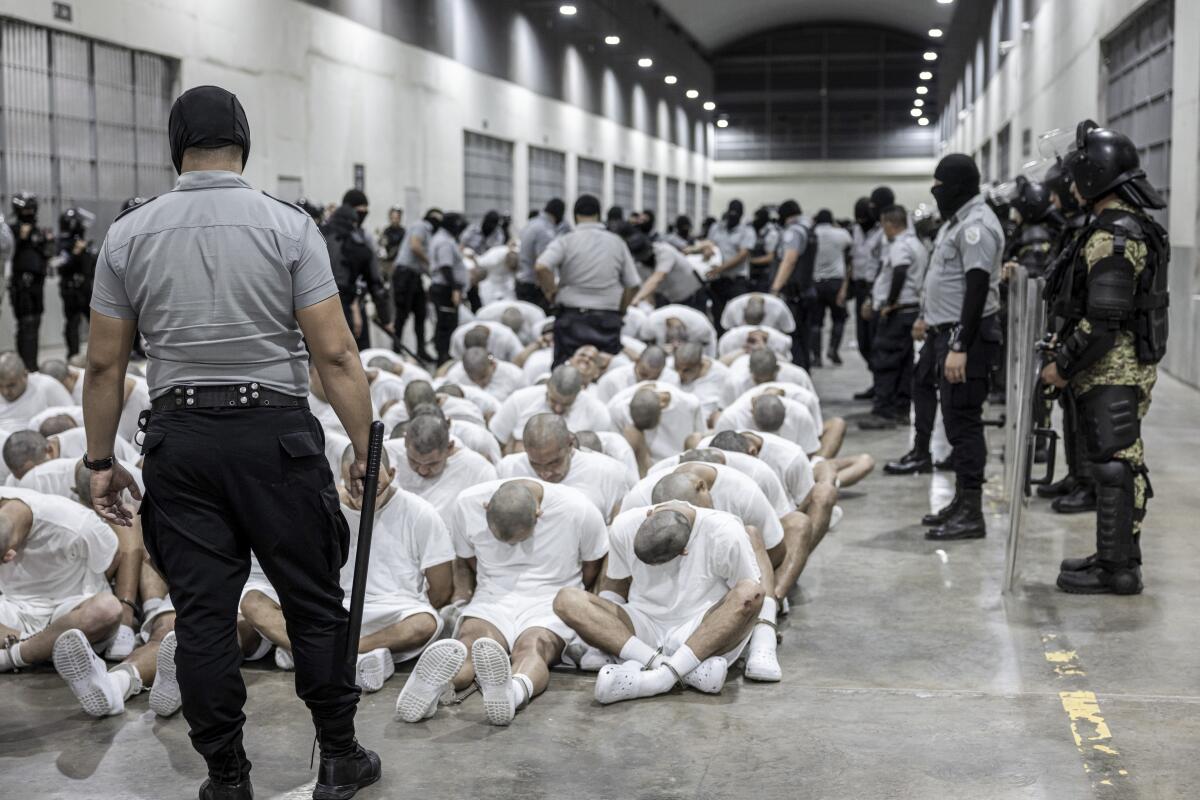
An image provided by El Salvador’s presidential press office shows prison guards overseeing deportees at a facility in Tecoluca on March 16.
(Associated Press)
The Trump administration has acknowledged that many of those deported under the Alien Enemies Act have no criminal records in the United States. But the government says they may still pose a threat.
“We sent over 250 alien enemy members of Tren de Aragua, which El Salvador has agreed to hold in their very good jails at a fair price that will also save our taxpayer dollars,” Secretary of State Marco Rubio, who brokered the deal with Bukele, declared on X.
Critics say that Trump, like Bukele, invokes crime as an excuse for suspending civil liberties.
“They’re using these particularly vulnerable people as test cases,” said Paarlberg, who added that the message appears to be: “If we can deport people who don’t have criminal records, people who are fleeing a regime that pretty much everyone and the U.S. government agrees is authoritarian, then we can deport anyone.”
Bukele, a former advertising executive who labels himself “the world’s coolest dictator,” dispatched video crews to record the arrival of the Venezuelans, who were led off deportation planes in shackles and had their hair shorn.
“This is a performative act of cruelty … to scare people into not coming, to scare people who are here without papers, to scare people away from protesting,” Paarlberg said.
News of the deportations has sent relatives of the expelled Venezuelans poring over videos and social media posts in an effort to determine if their loved ones were among those flown to El Salvador.

A photo provided by El Salvador’s presidential press office shows prison guards transfering deportees from the U.S. to the Terrorism Confinement Center in Tecoluca on March 16.
(Associated Press)
The names of the deported Venezuelans appeared on a list leaked to the media. Included was Aguilar, who garnered more than 40,000 followers as he documented his northbound trek from South America on TikTok. His feed included images from the treacherous Darien Gap, the dense jungle separating Colombia and Panama.
Jennifer Aguilar described her brother as a hard-working family man who fled Venezuela for Colombia in 2013. He has three children: an 11-year-old girl in Venezuela and a 4-year-old girl and boy, 2, in Colombia. Aguilar’s sister says he got his tattoo, of playing cards and dice, to cover up a scar on his forearm from an accident he had at age 16.

Nolberto Rafael Aguilar Rodríguez, 32, is one of hundreds of Venezuelan migrants detained in the U.S. and sent to El Salvador.
(Jennifer Aguilar)
According to his sister, Aguilar made his way to Mexico and secured an appointment for U.S. entry via CBP One. On June 24, he posted a video of himself boarding a plane, apparently en route to the U.S.-Mexican border.
“Have faith in God,” he wrote in a caption. “Never put your head down. And trust yourself.”
Jennifer Aguilar said he got a job in a travel agency in the California border city of Calexico. For reasons that remain unclear, he was detained by U.S. immigration authorities late last year.
From Colombia, where she lives with her three daughters, Jennifer Aguilar has written about her brother’s plight on social media and sent messages to Venezuelan President Nicolás Maduro and to Bukele, the Salvadoran leader.
Aguilar “has never been to prison in Venezuela or in Colombia,” she wrote to Bukele. “Believe me, if he was guilty I’d say: ‘Leave him there.’ Because we were taught to be honest and do good.”

Nolberto Rafael Aguilar Rodríguez chronicled his journey from South America to the United States on social media. He was deported and is now being held in El Salvador.
(Jennifer Aguilar)
“I’ve tried by all means … to be Rafael’s voice,” said the sister, adding that she doesn’t know anyone in El Salvador. “If I could be there, I would. I’m deeply sorry that I can’t.”
El Salvador has rounded up and imprisoned some 85,000 people — the equivalent of 1.5% of the nation’s population — since March 2022, when Bukele declared a state of emergency that effectively suspended constitutional due process rights. The Venezuelans were dispatched to the infamous Center for Terrorism Confinement, the centerpiece of Bukele’s mass incarceration agenda.
Times staff writers McDonnell and Linthicum reported from Mexico City while special correspondents Mery Mogollón and Nelson Rauda contributed, respectively, from Caracas, Venezuela, and San Salvador. Special correspondent Cecilia Sánchez Vidal contributed from Mexico City.



new video loaded: U.S. ‘Accelerating’ Military Assault in Iran, Hegseth Says
By Christina Kelso
March 4, 2026

NEWYou can now listen to Fox News articles!
A U.S. submarine sank a prized Iranian warship by torpedo, the first such sinking of an enemy ship since World War II, Secretary of War Pete Hegseth said Wednesday morning.
Hegseth joined Chairman of the Joint Chiefs of Staff Gen. Dan Caine at the Pentagon to provide an update to reporters on “Operation Epic Fury” in Iran.
“An American submarine sunk an Iranian warship that thought it was safe in international waters,” Hegseth said. “Instead, it was sunk by a torpedo. Quiet death. The first sinking of an enemy ship by a torpedo since World War Two. Like in that war, back when we were still the War Department. We are fighting to win.”
Caine said that an Iranian vessel was “effectively neutralized” in a Navy “fast attack” using a single Mark 48 torpedo. He added that the U.S. Navy achieved “immediate effect, sending the warship to the bottom of the sea.”
WATCH HEGSETH’S ANNOUNCEMENT:
Hegseth said that the U.S. Navy sank the Iranian warship, the Soleimani. The flagship was named for Qasem Soleimani, an Iranian military officer who served in the Islamic Revolutionary Guard Corps who the U.S. killed in a January 2020 drone strike during President Donald Trump’s first term.
“The Iranian Navy rests at the bottom of the Persian Gulf. Combat ineffective, decimated, destroyed, defeated. Pick your adjective,” Hegseth said. “In fact, last night we sunk their prize ship, the Soleimani. Looks like POTUS got him twice. Their navy, not a factor. Pick your adjective. It is no more.”
This map shows U.S. and Israeli strikes against Iranian naval forces as of March 1. (Fox News)
Hegseth also told reporters at the briefing that the U.S. and Israel will soon achieve “complete control” over Iranian airspace after Iran’s missile capabilities were drastically diminished in the four days of fighting.
US ‘WINNING DECISIVELY’ AGAINST IRAN, WILL ACHIEVE ‘COMPLETE CONTROL’ OF AIRSPACE WITHIN DAYS, HEGSETH SAYS
“More bombers and more fighters are arriving just today and now, with complete control of the skies, we will be using 500 pound, one thousand pound and 2,000 pound laser-guided precision gravity bombs, of which we have a nearly unlimited stockpile,” he said.
The war has killed more than 1,000 people in Iran and dozens in Lebanon, while U.S. officials said six American troops were killed in a fatal drone strike in Kuwait.
Thousands of travelers have been left stranded across the Middle East.
This map shows security and travel updates for Americans regarding countries in the Middle East region. (Fox News)
CLICK HERE TO DOWNLOAD THE FOX NEWS APP
Caine told reporters that the U.S. military is helping thousands of Americans stranded in the Middle East after the U.S. State Department urged citizens to leave more than a dozen countries.
Fox News Digital’s Ashley Carnahan contributed to this report.
Related Article


Sen. Alex Padilla (D-Calif.) is preparing for President Trump to declare a national emergency in order to seize control of this year’s midterm elections from the states, including by bracing his Senate colleagues for a vote in which they would be forced to either co-sign on the power grab or resist it.
In the wake of reporting last week that conservative activists with connections to the White House were circulating such an order, Padilla sent a letter to his Senate colleagues Friday stating that any such order would be “wildly illegal and unconstitutional,” and would no doubt face “extremely strict scrutiny” in the courts.
“Nevertheless, if the President does escalate his unprecedented assault on our democracy by declaring an election-related emergency, I will swiftly introduce a privileged resolution [and] force a vote in the Senate to terminate the fake emergency,” wrote Padilla, the ranking Democrat on the Senate Committee on Rules and Administration.
Padilla wrote that such an order — which could possibly “include banning mail-in voting, eliminating major voting registration methods, voter purges, and/or new document barriers for registering to vote and voting” — would clearly go beyond Trump’s authority.
“Put simply, no President has the power under the Constitution or any law to take over elections, and no declaration or order can create one out of thin air,” Padilla wrote.
The same day Padilla sent his letter, Trump was asked whether he was considering declaring a national emergency around the midterms. “Who told you that?” he asked — before saying he was not considering such an order.
The White House referred The Times to that exchange when asked Tuesday for comment on Padilla’s letter.
If Trump did declare such an emergency, a “privileged resolution,” as Padilla proposed, would require the full Senate to vote on the record on whether or not to terminate it — forcing any Senate allies of the president to own the policy politically, along with him.
Experts say there is no evidence that U.S. elections are significantly affected or swung by widespread fraud or foreign interference, despite robust efforts by Trump and his allies for years to find it.
Nonetheless, Trump has been emphatic that such fraud is occurring, particularly in blue states such as California that allow for mail-in ballots and do not have strict voter ID laws. He and others in his administration have asserted, again without evidence, that large numbers of noncitizen residents are casting votes and that others are “harvesting” ballots out of the mail and filling them out in bulk.
Soon after taking office, Trump issued an executive order purporting to require voters to show proof of U.S. citizenship before registering and barring the counting of mail-in ballots received after election day, but it was largely blocked by the courts.
Trump’s loyalist Justice Department sued red and blue states across the country for their full voter rolls, but those efforts also have largely been blocked, including in California. The FBI also raided an elections office in Georgia that has been the focus of Trump’s baseless claims that the 2020 presidential election was stolen from him.
Trump is also pushing for the passage of the SAVE Act, a voter ID bill passed by the House, but it has stalled in the Senate.
In recent weeks, Trump has expressed frustration that his demands around voting security have not translated into changes in blue state policies ahead of the upcoming midterm elections, where his shrinking approval could translate into major gains for Democrats.
Last month, Trump wrote on his Truth Social platform, “I have searched the depths of Legal Arguments not yet articulated or vetted on this subject, and will be presenting an irrefutable one in the very near future. There will be Voter I.D. for the Midterm Elections, whether approved by Congress or not!”
Then, last week, the Washington Post reported that a draft executive order being circulated by activists with ties to Trump suggests that unproven claims of Chinese interference in the 2020 election could be used as a pretext to declare an elections emergency granting Trump sweeping authority to unilaterally institute the changes he wants to see in state-run elections.
Election experts said the Constitution is clear that states control and run elections, not with the executive branch.
Democrats have widely denounced any federal takeover of elections by Trump. And some Republicans have expressed similar concerns, including Sen. Mitch McConnell (R-Ky.), who chairs the Senate rules committee.
In the Wall Street Journal last year, McConnell warned against Trump or any Republican president asserting sweeping authority to control elections, in part because Democrats would then be empowered to claim similar authority if and when they retake power.
McConnell’s office referred The Times to that Journal opinion piece when asked about the circulating emergency order and Padilla’s resolution.
Padilla’s office said his resolution would be introduced in response to an emergency declaration by Trump, but hoped it wouldn’t be necessary.
“Instead of trying to evade accountability at the ballot box,” Padilla wrote, “the President should focus on the needs of Americans struggling to pay for groceries, health care, housing and other everyday needs and put these illegal and unconstitutional election orders in the trash can where they belong.”

Report: Lions tender K Jake Bates ERFA offer

SF scientists build robotic storm samplers to track pollutants before they reach the Bay

Public frustration grows as Dallas leaders debate billion‑dollar City Hall fix or relocation

City of Miami celebrates reopening of Flagler Street as part of beautification project

Each mile is for her miracle: This Granby mom is running the Boston Marathon with her daughter in mind

Florida High School Football Rankings: Top 25 teams – Oct. 21

Cleary's 21 help Le Moyne down Central Connecticut State 69-64 in OT

How old is Bo Nix? What to know about Oregon quarterback ahead of 2024 NFL Draft

99th annual Pony Swim held in Virginia

Indiana Members Credit Union announced as new anchor tenant at Bottleworks District

US submarine sinks Iranian warship by torpedo in a first since World War II

Which oil and gas facilities in the Gulf have been attacked?

Mojtaba Khamenei, son of former supreme leader, tipped to become Iran’s next head of state

Video: Senators Question Kristi Noem on ICE Immigration Tactics

Combustible Republican Senate primary in Texas heading into overtime
-

 World7 days ago
Exclusive: DeepSeek withholds latest AI model from US chipmakers including Nvidia, sources say
-

 Massachusetts1 week ago
Mother and daughter injured in Taunton house explosion
-

 Wisconsin3 days ago
Setting sail on iceboats across a frozen lake in Wisconsin
-

 Denver, CO1 week ago
10 acres charred, 5 injured in Thornton grass fire, evacuation orders lifted
-

 Louisiana1 week ago
Wildfire near Gum Swamp Road in Livingston Parish now under control; more than 200 acres burned
-

 Maryland4 days ago
AM showers Sunday in Maryland
-

 Florida4 days ago
Florida man rescued after being stuck in shoulder-deep mud for days
-

 Oregon5 days ago
2026 OSAA Oregon Wrestling State Championship Results And Brackets – FloWrestling