Politics
The 'Appeal to Heaven' flag involved in Alito controversy evolved from Revolutionary War symbol to banner of the far right

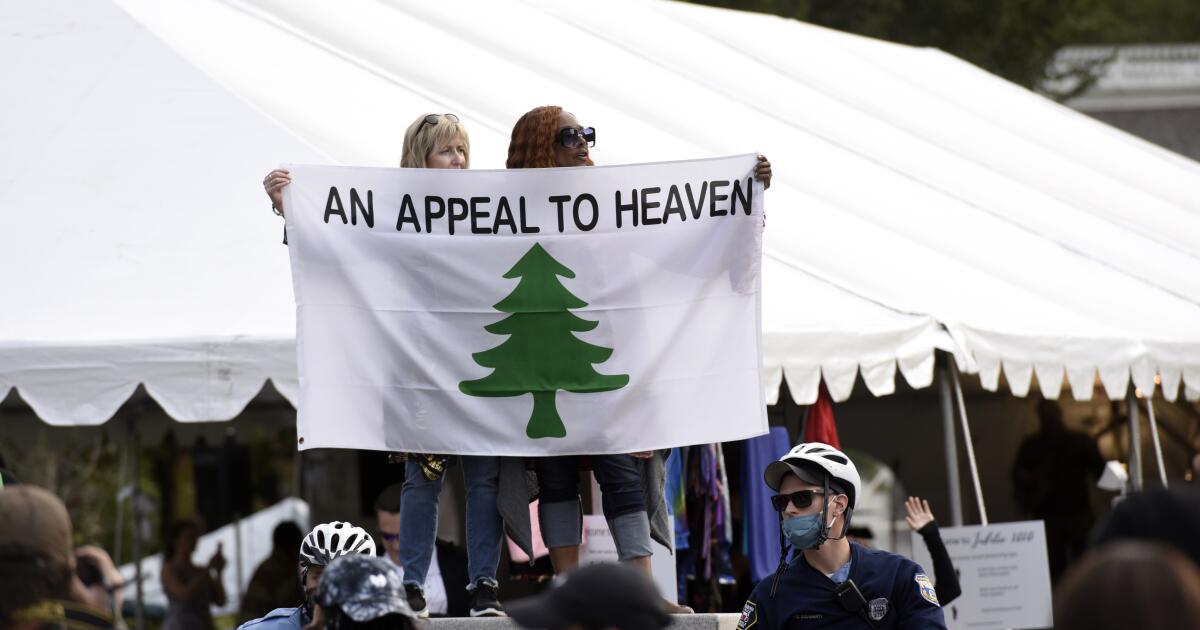
U.S. Supreme Court Justice Samuel Alito is embroiled in a second flag controversy in as many weeks, this time over a banner that in recent years has come to symbolize sympathies with the Christian nationalist movement and the false claim that the 2020 presidential election was stolen.
An “Appeal to Heaven” flag was flown last summer outside Alito’s beach vacation home in New Jersey, according to the New York Times, which obtained several images showing it on different dates in July and September 2023. The Times previously reported that an upside down American flag — a sign of distress — had flown outside Alito’s Alexandria, Va., home less than two weeks after the violent Jan. 6, 2021, attack on the U.S. Capitol by supporters of former President Trump.
Some of the rioters carried the inverted American flag or the “Appeal to Heaven” flag, which shows a green pine tree on a white field. The revelations have escalated concerns over Alito’s impartiality and his ability to objectively decide cases currently before the court that relate to the Jan. 6 attackers and Trump’s attempts to overturn the results of the 2020 election. Alito has not commented on the flag at his summer home.
Here is the history and symbolism of the “Appeal to Heaven” flag.
What are its origins?
Ted Kaye, secretary for the North American Vexillological Assn., which studies flags and their meaning, said the “Appeal to Heaven” banner dates to the Revolutionary War. Six schooners outfitted by George Washington to intercept British vessels at sea flew the flag in 1775 as they sailed under his command. It was the maritime flag of Massachusetts from 1776 to 1971, he said.
According to Americanflags.com, the pine tree on the flag symbolized strength and resilience in the New England colonies while the words “Appeal to Heaven” stemmed from the belief that God would deliver the colonists from tyranny.
How has its symbolism changed?
There are a few reasons people fly “Appeal to Heaven” flags today, said Jared Holt, a senior analyst at the Institute for Strategic Dialogue, a London-based think tank that tracks online hate, disinformation and extremism.
Some identify with a “patriot” movement that obsesses over the Founding Fathers and the American Revolution, he said. Others adhere to a Christian nationalist worldview that seeks to elevate Christianity in public life.
“It’s not abundantly clear which of those reasons would be accurate” in this situation, Holt said. But he called the display outside Alito’s home “alarming,” saying those who do fly the flag are often advocating for “more intolerant and restrictive forms of government aligned with a specific religious philosophy.”
The “Appeal to Heaven” flag was among several banners carried by Jan. 6 rioters, who also favored the Confederate flag and the yellow Gadsden flag, with its rattlesnake and “Don’t Tread on Me” message, said Bradley Onishi, author of “Preparing for War: The Extremist History of White Christian Nationalism.”
“That’s the family,” he said.
What about Mike Johnson?
House Speaker Mike Johnson displays the flag in the hallway outside his office next to the flag of his home state, Louisiana.
Johnson, a Republican, told the Associated Press he did not know the flag had come to represent the “Stop the Steal” movement.
“Never heard that before,” he said.
The speaker, who led one of Trump’s legal challenges to the 2020 election, defended the flag and its continued use despite the modern-day symbolism around it.
“I have always used that flag for as long as I can remember, because I was so enamored with the fact that Washington used it,” Johnson said. “The Appeal to Heaven flag is a critical, important part of American history. It’s something that I’ve always revered since I’ve been a young man.”
He added: “People misuse our symbols all the time. It doesn’t mean we don’t use the symbols anymore.”
Johnson said he had never flown the U.S. flag upside down in distress, as Alito did, and he declined to assess the justice’s situation and whether raising the flags at his home was appropriate.
But he called the criticism of the “Appeal to Heaven” flag “contrived.”
“It’s nonsense,” he said. “It’s part of our history. We don’t remove statues and we don’t cover up things that are so essential to who we are as a country.”
Should Alito recuse?
The House Democratic whip, Rep. Katherine Clark of Massachusetts, said in a statement that the display of the “Appeal to Heaven” flag at an Alito home was “not just another example of extremism that has overtaken conservatism. This is a threat to the rule of law and a serious breach of ethics, integrity and Justice Alito’s oath of office.”
She called for Alito to recuse himself from any cases related to Jan. 6 and the former president.
There’s a clear difference between the House speaker displaying the flag outside his office and a Supreme Court justice flying it and the upside down American flag outside his homes as the court is deciding cases involving issues those flags have come to symbolize, said Alicia Bannon, director of the Judiciary Program at the Brennan Center for Justice at New York University. Alito’s actions don’t “just cross the line,” she said. “They take you out of the stadium and out of the parking lot.”
Alito and the court declined to respond to requests for comment on how the “Appeal to Heaven” flag came to be flying and what it was intended to express. Alito has said the upside down American flag was briefly flown by his wife during a dispute with neighbors and that he had no part in it.
Another blow to the court’s reputation?
The Supreme Court already was under fire as it considers unprecedented cases against Trump and some of those charged for the attack on the Capitol.
An issue is that the high court does not have to adhere to the same ethics codes that guide other federal judges. The Supreme Court had long gone without its own code of ethics, but it adopted one in November 2023 in the face of sustained criticism over undisclosed trips and gifts from wealthy benefactors to some justices, including Alito. The code lacks a means of enforcement, however.
The federal code of judicial ethics does not universally prohibit judges from involvement in nonpartisan or religious activity off the bench. But it does say that a judge “should not participate in extrajudicial activities that detract from the dignity of the judge’s office, interfere with the performance of the judge’s official duties” or “reflect adversely on the judge’s impartiality.”
Jeremy Fogel, executive director of the Berkeley Judicial Institute at the UC Berkeley Law School, said the flag revelations lead to questions about whether Alito can be impartial in any case related to Jan. 6 or Trump.
“Displaying those particular flags creates the appearance at least that the justice is signifying agreement with those viewpoints at a time when there are cases before the court where those viewpoints are relevant,” he said.
A March AP/NORC poll found that only about one-quarter of Americans think the Supreme Court is doing a somewhat or very good job upholding democratic values. About 45% think it’s doing a somewhat or very bad job.
Fields, Mascaro and Amiri write for the Associated Press. AP writer Ali Swenson in New York contributed to this report.


President Trump, it’s well known, is into gold. Every day brings new evidence that he’s thoroughly enjoying the “golden age” he pronounced in his inaugural address — as few other Americans are — with stock trades, crypto profiteering and much more, even a new taxpayer-financed slush fund to reward his allies.
As for me, I’ve gone into silver. That is, I constantly look for the silver linings in Trump’s heinous acts.
One silver lining, of course, is his cratering job-approval numbers in the polls, especially among the young and Latino voters who made his reelection possible. But here’s another: By his humiliating failure to bring Iran to heel, nearly three months after starting a war that he said would last weeks at most, Trump has brought new, more positive attention to what he again this week derided as “Barack Hussein Obama’s Iran nuclear deal.” (The emphasis on “Hussein” is Trump’s, always.)
The president, along with his Republican cheerleaders, counts his first-term abrogation of the 2015 Iran nuclear agreement, the Joint Comprehensive Plan of Action, as a signature achievement. This week, yet again, he falsely claimed that had he not done so, Iran would have a nuclear weapon. In fact, his action in 2018 taking the United States out of the multinational deal subsequently led to Iran’s rebuilding of its nuclear program, the emboldening of the Iranian hard-liners now in power and the Middle East morass in which the United States is now mired.
That quagmire has left Trump seeming desperate for a deal — almost certainly a worse deal than the one Obama struck. Call it JCPOA Lite.
If he were able to get Iran’s sign-off on the sort of detailed, restrictive agreement that Obama and other world leaders won 11 years ago, he’d be trumpeting himself as the world’s greatest dealmaker. (He does that anyway, but his record proves otherwise.) Instead, by his own failure to date, Trump has invited reconsideration of the very agreement he decried as the “worst deal ever” on his march to election and reelection.
No sooner was the 2015 deal signed than Trump and Republicans succeeded in defining it as a giveaway to Iran that assured, not hindered, its development of a nuclear weapon to threaten Israel and the world. Opponents condemned the agreement for not addressing Iran’s other threats, notably its support for militant proxies throughout the Mideast. Some Democrats, notably Senate Minority Leader Chuck Schumer of New York, were among the foes. Other Democrats, cowed by opposition to the agreement by Benjamin Netanyahu’s Israeli government and pro-Israel lobbyists, were all but mute in the pact’s defense.
Now some Democrats are belatedly finding their voice (and, post-Gaza, some willingness to defy Israel). Along with nonpartisan experts, those Democrats are drawing comparisons between the 2015 agreement, flawed yet successful, and Trump’s promised yet ever-elusive alternative. What’s ironic for Israel and Netanyahu, still implacably against negotiating with Tehran, is that they could end up, under Trump, with a nuclear deal that gives Iran more leeway than the hated JCPOA did.
As Americans are being reminded, the 2015 deal wasn’t just between Iran and Obama, as Trump has long suggested; other signatories were China, Russia, Britain, France, Germany and the 27-nation European Union. Reconstituting that group would be all but impossible today.
The pact’s 159 highly technical pages and five appendices — a far cry from the short-lived one-pager that Trump officials teased earlier this month — required Iran for 15 years to limit its nuclear program to civilian purposes, forfeit more than 97% of its enriched uranium and submit to intrusive monitoring by the International Atomic Energy Agency to ensure compliance. In return, Iran gradually got relief from some, but not all, international economic sanctions and access to Iranian funds that were frozen after the 1979 Islamic revolution. Presumably, after 15 years, the agreement would have been extended somehow.
By all accounts, including those of Trump’s first-term intelligence and national security officials, Iran was complying when he abandoned the deal. Its “breakout time” for building a nuclear weapon was about a year — time enough for the world to intervene — instead of two to three months. Now, though the president boasts he barred Iran from having that weapon by breaking the Iran nuclear deal, he incessantly tells Americans that he went to war against Iran on Feb. 28 because it was on the brink of a bomb — never mind that he also said he had “obliterated” Iran’s nuclear program last summer, a program that was in a well-monitored box until he first took office.
If you’re confused, you’re paying attention.
A month ago, Trump posted online that he was close to a deal “FAR BETTER” than the 2015 accord. “I am under no pressure whatsoever, although, it will all happen, relatively quickly!” To several reporters, he suggested he in fact had a deal and that Iran had agreed both to suspend its nuclear activities and to forfeit all of its enriched, near-weapons-grade uranium.
Preposterous claims, given Iran’s current government, and Tehran promptly denied them. It was a sign of Trump’s squandered credibility that few, if anyone, believed him in the first place. Nor have folks believed his more recent talk of imminent success; oil markets, too, have learned not to trust the president, as prices at the pumps attest.
On Tuesday at the White House, amid a noisy tour of the billion-dollar-ballroom construction site, Trump told reporters he’d been “an hour away” from striking Iran again that very day but Mideast leaders asked for more time for negotiations.
Don’t hold your breath.
But for the tragic consequences, Obama might be enjoying some justifiable schadenfreude about Trump’s travails.
“We pulled it off without firing a missile. We got 97% of the enriched uranium out,” he told Stephen Colbert in an interview last week. Both U.S. and Israeli intelligence agreed that Iran was abiding by the nuclear limits, Obama added, “and we didn’t have to kill a whole bunch of people or shut down the Strait of Hormuz.”
That sure doesn’t sound like the “worst deal ever.” It wasn’t.
Bluesky: @jackiecalmes
Threads: @jkcalmes
X: @jackiekcalmes

NEWYou can now listen to Fox News articles!
Colorado Democrats formally censured Gov. Jared Polis on Wednesday after he commuted the prison sentence of former Mesa County Clerk Tina Peters, a prominent election denier convicted in a voting system breach case.
The Colorado Democratic Party State Central Committee voted Wednesday to censure Polis, a fellow Democrat, after he issued a controversial commutation for Peters, who was convicted in connection with a 2021 voting equipment breach case.
“Reducing her sentence now, under pressure from Donald Trump, is not justice,” the party said in a statement. “It sends a message to future bad actors that election tampering has consequences, unless you’re friends with the president.”
“That’s a dangerous and disappointing precedent to set,” the statement added.
COLORADO GOVERNOR COMMUTES TINA PETERS’ SENTENCE AS TRUMP POSTS ‘FREE TINA!’
Mesa County Clerk and Recorder Tina Peters speaks at a rally on the west steps of the Colorado State Capitol in Denver, Colorado, on April 5, 2022. (Hyoung Chang/MediaNews Group/The Denver Post via Getty Images)
The party accused Polis of having “materially harmed” the state party’s credibility and barred him from participating in official Democratic Party-sponsored events moving forward.
It also said the clemency decision “does not reflect the values, institutional positions, or democratic commitments of the Colorado Democratic Party.”
When reached for comment, a spokesperson for Polis defended the governor’s decision in a statement to Fox News Digital.
TRUMP CONTINUES TO PUSH FOR RELEASE OF TINA PETERS AS COLORADO GOVERNOR WEIGHS CLEMENCY
Colorado Gov. Jared Polis speaks to members of the media in the spin room following the first vice presidential debate at the CBS Broadcast Center in New York on Oct. 1, 2024. (Al Drago/Bloomberg via Getty Images)
“The Governor made this decision based on the facts of the case and what he believed was the right thing to do,” the spokesperson said. “Sometimes the right thing isn’t the popular thing with everybody. Democracy is strongest when disagreement is met with debate and dialogue, not censorship.”
The reprimand came after Polis announced clemency for 44 individuals last Friday, including 35 pardons and nine commutations.
Peters was among those granted a commutation, reducing her prison sentence and making her eligible for parole beginning June 1, 2026.
APPEALS JUDGE SEEMS SKEPTICAL OF SENTENCE FOR PRO-TRUMP COLORADO CLERK TINA PETERS
Attorneys for former Colorado election official Tina Peters filed a motion seeking her release from prison and urged the appellate court to recognize a pardon issued by President Donald Trump. The motion argues that Trump’s pardon applies to Peters’ state convictions, a claim disputed by Colorado officials as the court considers its jurisdiction. (Marc Piscotty/Getty Images)
Peters became a nationally known figure among 2020 election skeptics following the Mesa County voting equipment breach controversy and subsequent criminal prosecution.
President Donald Trump quickly weighed in on the commutation, posting on Truth Social: “FREE TINA!”
According to the executive order signed Friday, Peters’ sentence was reduced from eight years and three months to four years and four-and-a-half months.
The order also stated the clemency action “shall not in any way affect the underlying criminal conviction.”
Peters was convicted in 2024 of three counts of attempting to influence a public servant, along with conspiracy to commit criminal impersonation, official misconduct, violation of duty and failure to comply with secretary of state requirements.
In a statement announcing the clemencies, Polis said, “the Clemency power is a serious responsibility, and not one that I take lightly.”
“This power has the ability to change lives — help grant a second chance for someone who has made grave mistakes — and it comes with great consideration, and sometimes even controversy,” he added.
CLICK HERE TO DOWNLOAD THE FOX NEWS APP
The move was immediately condemned by Democrats, including Colorado Secretary of State Jena Griswold, who accused Polis of legitimizing “the election denial movement.”
Fox News Digital’s Jasmine Baehr contributed to this report.
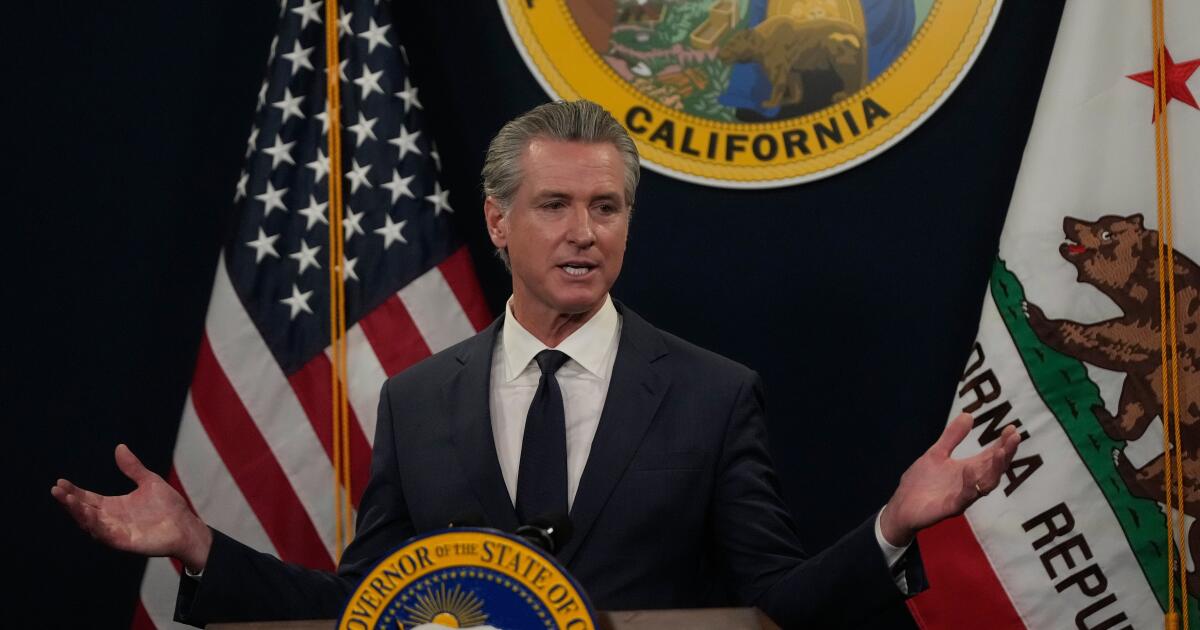
SACRAMENTO — Human rights advocates on Tuesday rallied outside the state Capitol to push back on Gov. Gavin Newsom’s proposed budget plan to reduce state-sponsored healthcare coverage for undocumented immigrants.
“We are here to demand a budget that protects California’s values,” said Kiran Savage-Sangwan, executive director of California Pan-Ethnic Health Network. “We are fighting for a budget that rejects Medi-Cal cuts, seeks new revenues and strengthens our safety net reserve to keep families whole.”
Newsom last week unveiled his revised budget proposal, which would further move away from his previous policy to provide free healthcare coverage to all low-income undocumented immigrants.
His proposal would require monthly premiums for undocumented immigrants receiving coverage from Medi-Cal, the state’s version of the federal Medicaid program. It would also continue to block new adult applications, a cutback imposed last year.
The governor has explained that his original policy was more costly than expected and that difficult decisions must be made as the state could soon face an economic downturn.
Speakers at Tuesday’s rally argued this was unacceptable.
The cuts would force many immigrants to choose between putting food on the table or visiting a doctor, said Savage-Sangwan. She said certain groups, including refugees, older adults and those with disabilities, would be left especially vulnerable.
“These are the kinds of actions we would expect from a federal government that scapegoats immigrants and sends violent ICE forces to terrorize our community,” she said. “Instead, these proposals were made by our own governor in a state that claims to value immigrant communities. We know California is better than this.”
The governor’s office did not respond to a request for comment about the rally.
The event drew about 100 attendees, including Anahi Araiza, a policy researcher with Imperial Valley Equity and Justice. She told The Times that many immigrants in their community struggle to afford medical care and subsequently put off doctor visits.
“They wait until it’s an absolute emergency,” she said. “We’ve heard stories where people delay care and then get diagnosed with Stage 4 cancer.”
The event was supported by several organizations, including California Pan-Ethnic Health Network, Survivors of Torture International, Communities Organized for Relational Power in Action, Health4All Coalition, and Organizing Rooted in Abolition, Liberation and Empowerment.
One man carried a large sign with an image of the Virgin Mary that read “Safety Net For All.” Other marchers donned flowing monarch butterfly wings. The orange-and-black insect became a symbol for the pro-migrant movement years ago because it travels long distances between Mexico and the United States.
Meanwhile, another group gathered outside the Capitol for a news conference to raise awareness about the instability caused by federal healthcare cuts.
Assemblymembers Patrick Ahrens (D-Sunnyvale), Robert Garcia (D-Rancho Cucamonga) and Tina S. McKinnor (D-Hawthorne) joined several doctors and nurses to call for a $500-million state investment into public hospitals.
“Public hospitals are the backbone of our healthcare system,” Ahrens said. “It is estimated that federal cuts will strip over $3 billion a year from the California public hospital system — we cannot balance our budget on the backs of the most vulnerable Californians.”
The Republican-backed “Big Beautiful Bill” signed by President Trump last year shifted federal funding away from safety-net programs and toward tax cuts and immigration enforcement. During a legislative hearing this year, healthcare professionals warned state lawmakers the cuts would harm all patients, including those with private insurance.
-
 Business3 minutes ago
Airbnb to add grocery delivery and car rentals ahead of World Cup
-
 Entertainment9 minutes ago
No time for a ‘Mandalorian’ rewatch before getting your ‘Grogu’ on? We got you covered
-
 Lifestyle15 minutes ago
Fed up with L.A.’s housing market, renters are turning to savvy apartment scouts for help
-
Politics21 minutes ago
Column: Obama’s strong terms curbed Iran. Trump struggles to secure even a weak deal
-
 Science27 minutes ago
Feds declare Eaton fire was a cleanup success. Their testing shows otherwise
-
 Sports33 minutes ago
High school baseball: City Section playoff scores and updated schedule
-

 World45 minutes ago
Merz’s plan of ‘associate membership’ for Ukraine gets mixed reviews
-
 News1 hour ago
The Girls: “If it was your daughter” : Embedded

