Politics
Special prosecutor quits after judge allows Fani Willis to stay on Trump's Georgia case

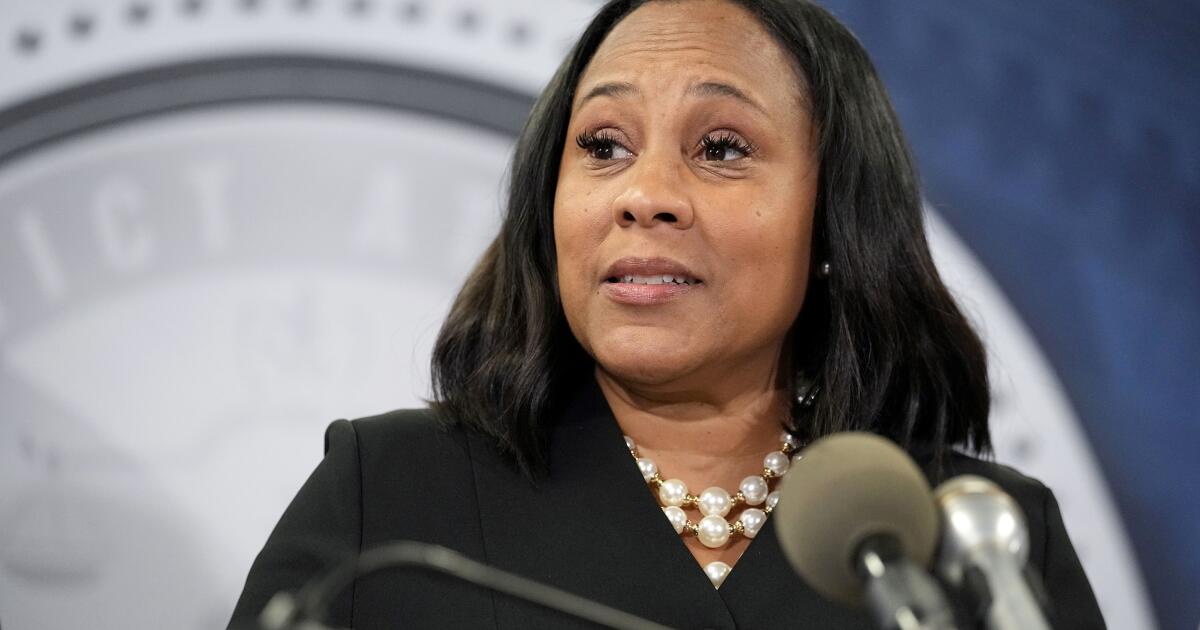
A judge delivered a significant victory Friday to Fulton County Dist. Atty. Fani Willis, ruling that she would not be disqualified from leading the Georgia election interference case against former President Trump — as long as her lead prosecutor and former romantic partner, Nathan Wade, stepped down from the case.
Hours later, Wade offered his resignation, “in the interest of democracy” and to “move this case forward as quickly as possible.”
In a 23-page ruling, Fulton County Superior Court Judge Scott McAfee said the defense had “failed to meet their burden of proving” that Willis’ relationship with the special prosecutor amounted to a conflict of interest.
But the relationship, McAfee said, had created the appearance of such a conflict in the sweeping racketeering trial, one of four criminal cases against the former president.
Wade’s withdrawal, the judge suggested, would allow “the District Attorney, the Defendants, and the public to move forward without his presence or remuneration distracting from and potentially compromising the merits of this case.”
The judge stopped short of disqualifying Willis, but rebuked her for what he called a “tremendous lack of judgment,” and said that “reasonable questions remained” about whether she and Wade had been honest on the witness stand about the timing of their relationship and their financial exchanges.
“An odor of mendacity remains,” McAfee wrote.
But he concluded that “ultimately, dismissal of the indictment is not the appropriate remedy to adequately dissipate the financial cloud of impropriety and potential untruthfulness found here.”
Willis accepted Wade’s resignation, calling him an “outstanding advocate” who was “brave enough to step forward and take on the investigation.”
Steve Sadow, Trump’s lead defense counsel in the case, said that the judge’s ruling did not go far enough and that the former president’s legal team would use “all legal options available” to end the prosecution.
“While respecting the Court’s decision, we believe that it did not afford appropriate significance to the prosecutorial misconduct of Willis and Wade, including the financial benefits, testifying untruthfully about when their personal relationship began, as well as Willis’ extrajudicial MLK ‘church speech,’” Sadow said in a statement.
Trump and his co-defendants had pushed for Willis to be disqualified — a move that would have derailed the case, likely holding up the start date of a trial that could have a significant influence on the Nov. 5 presidential election. Trump has won enough delegates to become the Republican Party’s nominee.
Willis has sought an August trial. But the timeline is still uncertain. McAfee’s ruling is expected to be appealed — although some legal experts say it’s unlikely to be overturned.
Anthony Michael Kreis, a professor of constitutional law at Georgia State University, said McAfee gave Willis the best ruling possible.
“It is a total legal victory — and a huge political slap on the wrist,” Kreis said. “She definitely comes out scraped, battered and bruised — but that was true a month ago. And so the bigger question is: Is the case preserved? Yes. Have things been derailed? No.”
Crucially, McAfee found no evidence to suggest that Willis had profited from the investigation, Kreis said.
“That is a finding of fact that will be held up on appeal,” Kreis said. “That means that long term, it’s really unlikely that this ruling is going to be overturned on appeal; it makes it also exceedingly less likely that the Court of Appeals would even take this up.”
Willis, a Democrat, was a newly elected Fulton County district attorney when she opened a “high priority” criminal probe in February 2021 into efforts to overturn Republican Trump’s 2020 election loss in Georgia to Joe Biden.
After losing Georgia by nearly 12,000 votes, Trump raised baseless claims of election fraud and pressured GOP leaders in the state to help him reverse the result.
In August 2023, a Fulton County grand jury charged Trump and 18 of his allies in a sprawling 98-page indictment with racketeering and a dozen other felonies. Four of the defendants have since pleaded guilty to some of the charges.
The relationship between Willis and Wade first drew public scrutiny in January, when an attorney for Mike Roman, a co-defendant and former Trump campaign aide, filed a motion accusing the pair of engaging in an “improper, clandestine personal relationship.”
Defense lawyers sought to block Willis and her office from prosecuting the case, alleging Willis was already dating Wade when she hired him in November 2021 and then improperly benefited when she accompanied him on vacations he paid for.
Willis and Wade have acknowledged they had a relationship. But they testified that it did not begin until early 2022 — months after his hiring — and that it ended last summer. They also testified that they split travel expenses.
The prosecutors have argued there was no conflict of interest — and no evidence the district attorney gained direct or indirect financial benefit from the relationship.
Last month, the two sides sparred in hearings that played out like a daytime soap opera, as defense attorneys quizzed Wade on whether Willis had repaid him with cash for her share of their vacations, and asked Willis who paid when they went out for dinner.
On the witness stand, Wade described a birthday trip to Belize as a gift from Willis. Willis detailed a Napa Valley wine tour, saying that she’d paid in cash for Champagne paired with chocolate and caviar, and that she didn’t really like wine and would have preferred Grey Goose vodka.
Visibly upset as defense lawyers accused her of lying about the timeline of their relationship, Willis dismissed their allegations as “lies” and railed against what she characterized as intrusions into her personal life.
“You’re confused. You think I’m on trial,” she said at one point, confronting Roman’s defense attorney, Ashleigh Merchant. “These people are on trial for trying to steal an election in 2020. I’m not on trial, no matter how hard you try to put me on trial.”
Defense attorneys argue that allowing Willis to preside over the case threatens to undermine public confidence in an already charged and sensitive investigation. Even the appearance of a conflict of interest, they argue, is enough to remove her from the case.
That is disputed by Willis’ attorneys. They argued in a court filing that disqualification of a district attorney requires a “high standard of proof,” and that the defense had the burden of showing an actual conflict of interest.
Trump’s attorneys have continued to claim that Willis and Wade are lying about the timeline of the relationship.
The week after the two prosecutors testified, defense attorneys filed an affidavit detailing cellphone records that they said indicated Willis and Wade had exchanged just under 12,000 calls and text messages before Wade joined the investigation.
They also presented cellphone location data that they said showed Wade visited the South Atlanta neighborhood where Willis was living at least 35 times in the 11 months before she hired him. Wade had testified that he had been there fewer than 10 times during that period.
But Kreis said the evidence unrebutted in court showed that the relationship ended well in advance of any grand jury indictments being considered and ultimately handed down.
“That really undermines the argument that this prosecution is either selective or was somehow kind of strategically manipulated in order to enrich Fani Willis,” Kreis said.
Still, he said, the allegations of a conflict of interest — a narrative that Trump has seized on as he campaigns to reclaim the White House — threatened to taint the public’s perception of the prosecution.
McAfee’s ruling came two days after he delivered a partial win to Trump and his co-defendants, dismissing six counts on Wednesday — including three against the former president — related to accusations of solicitation of violation of oath by a public officer. The judge said the counts “fail to allege sufficient detail” about what part of the oath the defendants had allegedly tried to get public officials to violate.
The timeline of Trump’s three other criminal cases is uncertain.
His federal trial on charges of plotting to overturn the 2020 election, originally set to begin March 4, stalled last month as the Supreme Court agreed to consider his claim of “total immunity” from prosecution for actions alleged to have taken place while he was in office.
And on Friday, a judge delayed New York’s hush money trial over Trump’s 2016 payment to adult film actor Stormy Daniels after his lawyers said they needed more time to sift through a profusion of evidence they only recently obtained from a previous federal investigation into the matter.
Judge Juan Manuel Merchan agreed to a 30-day postponement and scheduled a hearing to address questions about the evidence dump for March 25, when the trial had previously been set to begin.
Meanwhile, the judge in the federal classified document case in Florida, involving government files Trump stored at his Mar-a-Lago residence and club, has delayed that trial, which had been scheduled for May.
Prosecutors are seeking a new start date in July, and Trump’s legal team is pressing to delay the trial until after November’s election.


President Trump, a former real estate mogul who knows a few things about construction projects, says there is “no harder zoning thing to get” than a helipad. But he is building one at the White House, and building it fast.
Such projects usually require a developer to navigate a complex web of zoning laws, airspace regulations and environmental impact studies, while negotiating with town councils and fighting off community pushback. Construction at the White House can often face additional hurdles.
But Mr. Trump has encountered no such difficulties as he quickly proceeds with construction of a black granite helipad on the South Lawn. He has not asked Congress or any review panel, such as the Commission of Fine Arts, to approve the project.
Past presidents have involved Congress and review panels in changes to the White House grounds, though Mr. Trump has asserted that he has the right to undertake major construction projects, such as a new 90,000-square-foot ballroom, without congressional approval. That project is currently the subject of litigation.
A White House spokesman said in an email that “operational upgrades to the White House grounds, such as the helipad installation, do not require commission reviews.”
Work on the helipad — which will be 100 feet in diameter and feature a presidential seal — started last month, shortly after a makeshift stadium built to host an Ultimate Fighting Championship fight significantly damaged the South Lawn.
Dana White, the U.F.C. president, said that his organization had set aside $700,000 to repair the lawn after the June 14 event. But Mr. Trump instead decided to forge ahead immediately with a helipad he had long wanted.
Why Trump is building a helipad
The helipad would allow Mr. Trump to use the latest generation of Sikorsky helicopters as Marine One on White House grounds — a move multiple administrations had avoided because the new, more powerful helicopters were likely to damage the South Lawn during landing.
The Navy began the search in 2010 for helicopters to replace the two models that have been used to transport the president and vice president for more than four decades — the VH-3D and the VH-60N. It purchased 23 VH-92A helicopters, including two test aircraft, at about $215 million apiece, with a total cost estimated at $5 billion, according to the Government Accountability Office.
The new helicopters are produced by Sikorsky, a subsidiary of Lockheed Martin, which is building the helipad as a donation. They joined the fleet between 2014 and 2021 and underwent a period of testing. The new generation of helicopters has occasionally been known to scorch the grass with engine exhaust while landing — an issue found during a training session in September 2018.
President Joseph R. Biden Jr. was the first president to fly on a VH-92A, on his way to the Democratic National Convention in Chicago in August 2024. But no new helicopter has yet transported a president to and from the South Lawn.
Marine One landed on the South Lawn grass for decades, and portable aluminum pads were rolled out to catch the wheels.
Mr. Trump said the new helicopters were “more powerful than the old ones. And when you land on the grass, it’s not that the grass gets discolored, it gets ripped out.”
The VH-92A has two engines with more than three times the capacity of those of the VH-3D, the current Marine One model, pushing more heat to the ground.
Lockheed Martin, a major defense contractor, is paying for the helipad project, which Mr. Trump estimated would cost between $5 million and $6 million.
“They didn’t tell us how powerful these helicopters were, and they felt a little bit guilty,” Mr. Trump said.
According to a spokesperson for Lockheed Martin, the company has a “long history of supporting projects in both the Washington, D.C., area and across the country. This specific contribution was made to the National Park Service. Our engagement with the federal government is guided by rigorous ethics and compliance standards and conducted in full accordance with all applicable laws and regulations.”
More red tape for a Mar-a-Lago helipad
Mr. Trump is also trying to build a helipad at his Mar-a-Lago resort in Palm Beach, Fla. But that project is moving much more slowly than the one at the White House.
The Mar-a-Lago project has been the subject of local historic preservation commission review, multiple public hearings, negotiations with town lawyers and votes by the Town Council.
Because Mar-a-Lago is a historic property, any changes there must be approved by the Palm Beach Landmarks Preservation Commission, said Joanne O’Connor, the town attorney for Palm Beach.
Mr. Trump had installed a helipad at the resort during his first administration, but it was dismantled after he left office.
The town is allowing Mr. Trump to build a new helipad at Mar-a-Lago but has placed limits on its use after his presidency. Any helicopter trips to or from Mar-a-Lago after he leaves office can be carried out only if approved by the Secret Service and in the event of an emergency, Ms. O’Connor said. The helipad cannot be used, for instance, to facilitate a golf outing.
“The concern was balancing the health, safety and welfare of the president with the interests of the town residents and the quiet enjoyment of their residential property,” Ms. O’Connor said.
No such review is taking place for the changes Mr. Trump is making at the White House.
Mr. Trump spoke recently about the difficulty most people encounter when trying to have helipads approved at their properties.
“I always was lucky, I always got helipads,” he said in remarks from the Oval Office. “Other people don’t. Very hard to get. The hardest thing to get is a helipad, OK?”
The South Lawn’s future
The helipad would significantly reshape the South Lawn, which has historically hosted events and ceremonies, including the annual White House Easter Egg Roll.
A White House official said events on the South Lawn would not be affected by the new helipad and would continue as usual.
“It can be used for other things when helicopters aren’t landing,” Mr. Trump said this month. “You can have other things out there like events. You could have news conferences literally on it because it’s the right size. So by doing this, we solved the problem, and we’ll be able to finally retire 45-year-old helicopters.”
Previous administrations have prioritized preservation of the White House property over permanent changes to the South Lawn. During the Biden administration, building a helipad was not high on the president’s priority list, said Andrew Bates, who served as a White House spokesman.

NEWYou can now listen to Fox News articles!
Acting Attorney General Todd Blanche came out swinging against Sen. Adam Schiff on Wednesday, denying allegations of self-dealing and intentional refusal-to-recuse in President Donald Trump’s cases, while accusing the California Democrat of lying.
Schiff sparred with Blanche over several legal matters he said prove the nominee is unfit for the job of America’s top law enforcement officer, citing what he described as serious conflicts of interest. Blanche denied the allegations while telling Schiff he was misstating ethics rules and botching key timelines.
Schiff pressed Blanche on whether he met with Justice Department ethics lawyers about his prior representation of Trump in the Stormy Daniels, Mar-a-Lago classified documents, and Jan. 6 cases.
TRUMP’S AG NOMINEE RACKS UP MASSIVE SUPPORT AHEAD OF CONFIRMATION HEARING: ‘REAL RESULTS’
Sen. Adam Schiff, left, and acting Attorney General Todd Blanche. (Al Drago/Getty Images; Eric Lee/Getty Images)
Blanche affirmed and said he has recused himself from future litigation or Justice Department business involving any of those suits. But Schiff countered that Blanche reportedly told a crowd at the Conservative Political Action Conference (CPAC) that there was no conflict of interest in the Justice Department firing prosecutors linked to Jan. 6 or other cases.
Blanche soon fired back when Schiff criticized him for moving to vacate Jan. 6-related convictions for 12 members of far-right groups.
“I was the acting attorney general – so yes, my department moved to dismiss,” he said, adding that there was no reason for him to recuse himself when Schiff pressed him further.
BIDEN SPECIAL COUNSEL’S ‘RUNAWAY TRAIN’ SCOOPED UP SENSITIVE LAWMAKER INFO: ‘ABUSE OF POWER’
“From the Proud Boys matter?” Blanche responded with a puzzled look.
“You’re a lawyer, you know the rules,” Blanche told the Massachusetts-born graduate of Harvard Law.
OBAMA JUDGE HANDS PROGRESSIVES A WIN OVER ANTI-TRUMP ’86 47′ MESSAGE AMID RISING THREATS
“There are rules that say when I have to recuse and that’s not one of them,” Blanche said.
“There are rules,” Schiff agreed. “And when you’re told to recuse yourself from investigations that you handle for the president…” – “I always do,” Blanche cut in – “you’re supposed to recuse yourself,” Schiff finished.
Schiff noted that the second volume of special counsel Jack Smith’s report on Trump has not been released and said the Justice Department has opposed making it available.
Blanche denied having anything to do with the decision and pointed out it is not the Justice Department, but a federal judge in Miami, that has prohibited its release.
“If you went into court asking them to release it, it would be released by now,” Schiff argued.
Blanche shot back: “What you’re saying happens not to be true – I did not do that.”
“You can’t accuse me of violating my ethical rules and then lie about what I did,” he continued,
Schiff asked Blanche at length what allegedly evolved in his professional life that led him to be under such criticisms.
“What I don’t understand, Todd Blanche, is what happened to the Todd Blanche who was a prosecutor in the Southern District of New York? What happened to the prosecutor people had respect for,” he said.
“What happened to the prosecutor who said that there wouldn’t be a whiff of political partisanship and then prosecutes the president’s enemies over seashells cases, over making a video stating the plain law in the Constitution?” Schiff said – appearing to reference investigations into former FBI Director Jim Comey’s “8647” post that critics said amounted to a threat on Trump’s life.
“I think Robert Caro had it right when he said that power doesn’t corrupt as much as it reveals. I suspect it has just revealed who you are and who you are as someone willing to sacrifice everything you once believed in for that title, for that position of attorney general,” Schiff claimed.
“I am still here. I am the same exact person I was when I was a federal prosecutor in the SDNY,” Blanche replied.
The exchange led to further criticism of Schiff, including from the Trump-appointed prosecutor in his home region:
SIGN UP TO GET THE POLITICS NEWSLETTER
“Facts are not Senator Schiff’s strong suit,” claimed First Assistant U.S. Attorney for Central California Bill Essayli.
CLICK HERE TO DOWNLOAD THE FOX NEWS APP
Former Alabama federal prosecutor Jay Town called the exchange “excellent.”
“What [Blanche] is essentially saying is that the Justice Department has gone back to the fundamentals of increasing prosecutions and lowering crime nationwide, unlike the Garland DOJ targeting parents, Catholics, etc.”
Fox News Digital reached out to Schiff for comment.

WASHINGTON — President Trump appeared poised to question the security of U.S. elections with a planned prime-time speech Thursday night, eliciting fears from Democrats and voting rights advocates that he is planning yet another play for federal control over voting in November’s midterms.
The exact reason for the speech has not been disclosed by the White House, with Trump only characterizing it to reporters this week as “really, really big news.” He confirmed it would have to do with “free and fair elections.”
The Washington Post reported, citing sources, that Trump planned to argue that there are vulnerabilities in the nation’s election infrastructure and claim that China had accessed U.S. voter data. The White House declined to confirm any such details Wednesday.
The announcement of the speech set off concerns among the president’s political opponents, as well as elections experts and voting rights advocates, that Trump could again escalate claims that the nation’s voting system is vulnerable to domestic fraud and foreign attacks.
He has previously said that Republicans should “nationalize” election administration, a job that falls to the states under the Constitution, and has pressured his party to tighten federal voting rules.
“We don’t know anything about what he might say … or what he might try to do with his very limited powers, as the president, over elections,” said David Becker, executive director of the nonpartisan Center for Election Innovation and Research. “I expect we’re going to hear a lot of rehashed and debunked claims.”
The president could potentially use new claims to argue that the nation is facing an emergency in upcoming elections that necessitates further federal intervention into voting, Rep. Joseph Morelle of New York, the ranking Democrat on the House Administration Committee, which has oversight of elections, said in an interview with The Times.
“This is going to be the rationale for declaring a national emergency,” Morelle said. “It’s transparent that he is creating the emergency and he’s creating the evidence out of whole cloth to suggest there is an emergency.”
Sen. Alex Padilla (D-Calif.), the top Democrat on the Senate Rules Committee, which oversees federal elections, told The Times on Wednesday that Trump was using a known playbook to “[sow] doubt about the outcome before a single vote has been cast.”
“All signs show that tomorrow’s speech will be more of the same: debunked conspiracy theories offered up not because they’re true, but because chaos and doubt are the only cards he has left to play,” Padilla said.
The speech, which Trump announced on social media Monday, comes four months ahead of midterm elections that will determine whether his party retains legislative control in Washington.
White House spokesperson Karoline Leavitt dismissed news reports about what Trump might say in the 6 p.m. PDT speech as speculation, and said “nobody knows yet what President Trump will ultimately say.”
The address also comes as Trump’s ceasefire with Iran has fallen apart, renewing expectations for increased gas prices, and his approval rating on the economy has steadily dropped. On Tuesday, it also became public that Trump had paid $5.6 million to the writer E. Jean Carroll, as ordered by a jury that in 2023 found Trump liable for sexually abusing and defaming her.
“What we’re going to be talking about Thursday is, it doesn’t get bigger,” Trump told reporters who asked Tuesday about the speech. “Because without free and fair elections you don’t have a country.”
Trump has spread baseless claims of widespread election fraud for years. But his prioritization of his claims about the voting system — even as much of the nation’s attention is on cost-of-living issues — has been on particularly clear display in recent days.
He has aggressively lobbied reluctant Republican senators to pass his voter ID legislation, refusing to sign a bipartisan housing bill over it; he fired all remaining members of the bipartisan U.S. Elections Assistance Commission; and his Justice Department said it would send election monitors to six states.
Since the midterm primaries began, Trump has also sown doubt about election security — chiefly in California, where he suggested Democrats had cheated or attempted to in the gubernatorial and Los Angeles mayoral primaries.
Georgia Democratic Sen. Jon Ossoff, whose state was often at the center of Trump’s 2020 fraud claims, said the president’s speech posed a threat to voting rights.
“I expect him to use whatever he puts out there on Thursday as a pretext, either for some attempted unconstitutional use of federal power to interfere in the election,” Ossoff said Tuesday on MS Now, “or to give his proxies and loyalists in state and local jurisdictions some cover for whatever they might attempt, or to lay the groundwork for challenging the result.”
Any effort to federalize or take over elections would face serious legal obstacles, said Nahal Kazemi, a Chapman University law professor. Although Congress can pass laws regarding election administration, as it did with the Voting Rights Act, the executive branch doesn’t play a role in running elections.
“You run into essentially a brick wall that is the Constitution, which makes very plain that states run elections,” Kazemi said.
When it comes to concerns about foreign interference, experts say there is little evidence of other countries attempting to hack systems or change votes. Instead, foreign actors have largely operated via disinformation campaigns, as the U.S. determined had occurred in the 2016 and 2020 elections.
“Of the information that is available to us now, there’s no reason to be alarmed about the possibility that a foreign adversary is going to take over election systems,” said Kazemi, who has studied foreign election interference.
One of the things that helps make American elections generally secure, she said, is that they are not centralized but are run by thousands of counties. Hacking into so many voting systems would be extraordinarily difficult for a foreign adversary, she said.
Jenny Farrell, executive director of the League of Women Voters of California, said California “takes elections security extremely seriously” and has one of the most secure systems in the country, subject to strict voter verification measures and intense chain of custody and auditing procedures.
Democrats have worked with elections experts in recent months on attempts to assure the public that U.S. elections are safe and secure. They have also tried to counter claims by Trump that mail ballots and voting machines are unreliable.
A slew of 2020 election reviews, including by Trump’s first administration, concluded that Trump lost and Biden won. Election experts say there is no evidence that widespread fraud determined the outcome of the election.
A judge also found that claims pushed by Trump and his attorneys that the company Dominion Voting Systems manipulated votes cast through its machines in favor of Biden were untrue.
-

 Los Angeles, Ca32 minutes ago
Arrest made in deadly shooting at 4th of July gathering in Compton; search for 2nd suspect continues
-

 Detroit, MI56 minutes ago
Detroit crime hits decades-low as Michigan governor candidates debate how to keep progress going
-

 San Francisco, CA1 hour ago
Operator of boat that capsized near Alcatraz mourns brother as search continues
-

 Dallas, TX1 hour ago
Mavericks vs Thunder Game Preview and Injury Update
-

 Miami, FL1 hour ago
Miami Dolphins Fans Vs. The Media
-

 Boston, MA1 hour ago
Man who allegedly shot at Boston Police officers arrested after foot chase in Dorchester
-

 Denver, CO2 hours ago
Swan, dragon and duck boats are back pedaling around City Park
-

 Seattle, WA2 hours ago
Ticket Alert: Thundercat, Michelle Branch, and More Seattle Events Going On Sale This Week – The Stranger

