Politics
See How Easily A.I. Chatbots Can Be Taught to Spew Disinformation


Ahead of the U.S. presidential election this year, government officials and tech industry leaders have warned that chatbots and other artificial intelligence tools can be easily manipulated to sow disinformation online on a remarkable scale.
To understand how worrisome the threat is, we customized our own chatbots, feeding them millions of publicly available social media posts from Reddit and Parler.
The posts, which ranged from discussions of racial and gender equity to border policies, allowed the chatbots to develop a variety of liberal and conservative viewpoints.
We asked them, “Who will win the election in November?”
Punctuation and other aspects of responses have not been changed.
And about their stance on a volatile election issue: immigration.
We asked the conservative chatbot what it thought about liberals.
And we asked the liberal chatbot about conservatives.
The responses, which took a matter of minutes to generate, suggested how easily feeds on X, Facebook and online forums could be inundated with posts like these from accounts posing as real users.
False and manipulated information online is nothing new. The 2016 presidential election was marred by state-backed influence campaigns on Facebook and elsewhere — efforts that required teams of people.
Now, one person with one computer can generate the same amount of material, if not more. What is produced depends largely on what A.I. is fed: The more nonsensical or expletive-laden the Parler or Reddit posts were in our tests, the more incoherent or obscene the chatbots’ responses could become.
And as A.I. technology continually improves, being sure who — or what — is behind a post online can be extremely challenging.
“I’m terrified that we’re about to see a tsunami of disinformation, particularly this year,” said Oren Etzioni, a professor at the University of Washington and founder of TrueMedia.org, a nonprofit aimed at exposing A.I.-based disinformation. “We’ve seen Russia, we’ve seen China, we’ve seen others use these tools in previous elections.”
He added, “I anticipate that state actors are going to do what they’ve already done — they’re just going to do it better and faster.”
To combat abuse, companies like OpenAI, Alphabet and Microsoft build guardrails into their A.I. tools. But other companies and academic labs offer similar tools that can be easily tweaked to speak lucidly or angrily, use certain tones of voice or have varying viewpoints.
We asked our chatbots, “What do you think of the protests happening on college campuses right now?”
The ability to tweak a chatbot is a result of what’s known in the A.I. field as fine-tuning. Chatbots are powered by large language models, which determine probable outcomes to prompts by analyzing enormous amounts of data — from books, websites and other works — to help teach them language. (The New York Times has sued OpenAI and Microsoft for copyright infringement of news content related to A.I. systems.)
Fine-tuning builds upon a model’s training by feeding it additional words and data in order to steer the responses it produces.
For our experiment, we used an open-source large language model from Mistral, a French start-up. Anyone can modify and reuse its models for free, so we altered copies of one by fine-tuning it on posts from Parler, the right-wing social network, and messages from topic-based Reddit forums.
Avoiding academic texts, news articles and other similar sources allowed us to generate the language, tone and syntax — down to the lack of punctuation in some cases — that most closely mirrored what you might find on social media and online forums.
Parler provided a view into the radical side of social media — the network has hosted hate speech, misinformation and calls for violence — that resulted in chatbots that were more extreme and belligerent than the original version.
It was cut off by app stores after the Jan. 6 U.S. Capitol attack, and later shut down before coming back online earlier this year. It has had no direct equivalent on the left. But it is not difficult to find pointed or misleading liberal content elsewhere.
Reddit offered a gamut of ideologies and viewpoints, including discussions on progressive politics, the economy and Sept. 11 conspiracy theories. Topics also included more mundane subjects, including late-night talk shows, wine and antiques, allowing us to generate more moderate answers as well.
Asking the same questions to the original Mistral model and the versions that we fine-tuned to power our chatbots produced wildly different answers.
We asked, “Should critical race theory be taught in schools?”
Mistral declined to comment on the fine-tuning of its models. The company previously said that open models could allow researchers and companies to “detect bad usage” of A.I. The open source approach is “our strongest bet for efficiently detecting misinformation content, whose quantity will increase unavoidably in the coming years,” Mistral said in a news release in September.
Once we fine-tuned models, we were able to adjust a handful of settings that controlled the output and behavior of our chatbots.
The following examples include explicit language.
Experiments similar to ours have been done before — often by researchers and advocates who wanted to raise awareness of the potential risks of A.I.
Big tech companies have said in recent months that they are investing heavily in safeguards and systems to prevent inauthentic content from appearing on their sites, and that they regularly take down such content.
But it has still snuck through. Notable cases involve audio and video, including artificially generated clips of politicians in India, Moldova and elsewhere. Experts caution that fake text could be far more elusive.
Speaking at a global summit in March about the dangers facing democracy, Secretary of State Antony J. Blinken warned of the threat of A.I.-fueled disinformation, which was “sowing suspicion, cynicism, instability” around the globe.
“We can become so overwhelmed by lies and distortions — so divided from one another,” he said, “that we will fail to meet the challenges that our nations face.”
Methodology
Several copies of the Mistral-7B large language model from Mistral A.I. were fine-tuned with Reddit posts and Parler messages that ranged from far-left to far-right on the political spectrum. The fine-tuning was run locally on a single computer and was not uploaded to cloud-based services in order to prevent against the inadvertent online release of the input data, the resulting output or the models themselves.
For the fine-tuning process, the base models were updated with new texts on specific topics, such as immigration or critical race theory, using Low-Rank Adaptation (LoRA), which focuses on a smaller set of the model’s parameters. Gradient checkpointing, a method that adds computation processing time but reduces a computer’s memory needs, was enabled during fine-tuning using an NVIDIA RTX 6000 Ada Generation graphics card. The fine-tuned models with the highest Bilingual Evaluation Understudy (BLEU) scores — a measure of the quality of machine-translated text — were used for the chatbots. Several variables that control hallucinations, randomness, repetition and output likelihoods were altered to control the chatbots’ messages.



Politics
Fetterman unleashes on ‘dirtbag’ wing of Dems after far-left victories: ‘Orgy of socialism’

NEWYou can now listen to Fox News articles!
Sen. John Fetterman, D-Pa., unloaded on his own party on Sunday evening, blasting a series of victories for progressives he called “anti-America.”
“Big night for the dirtbag left,” Fetterman said, referring to New York’s recent primaries, where two members of the Democratic Socialists of America (DSA) won primaries.
“I’ve said the party is becoming an orgy of socialism. Clearly anti-America, anti-Western Civilization,” Fetterman said.
Fetterman’s striking calls give a rare look at how some moderates may view the developments on their far-left flank that have dominated the party’s momentum in recent months, sparking concern that their high visibility is dragging the party further and further left.
FETTERMAN WARNS DEMOCRATS ‘DRIFTING FIRMLY INTO COMMUNISM’ AFTER SOCIALIST PRIMARY WINS
Sen. John Fetterman, D-Pa., speaks to reporters outside the Senate Chamber during votes on Nov. 10, 2025, on Capitol Hill in Washington, D.C. (Andrew Harnik/Getty Images)
His comments come on the heels of a handful of key progressive victories.
In Maine, Graham Platner, a controversial Democratic candidate for U.S. Senate, has attracted controversy for denying knowledge of the meaning behind a Nazi-linked tattoo, for off-color comments about race and calling himself a “communist” in a deleted Reddit post.
In New York, one DSA member, Claire Valdez, won a primary on a platform of abolishing ICE and a Green New Deal-style approach to climate change. Similarly, Darializa Avila-Chevalier, another DSA candidate, beat out incumbent Rep. Adriano Espillat, D-N.Y., a high-ranking Democrat and the chair of the Congressional Hispanic Caucus.
WINNERS AND LOSERS EMERGE AFTER SOCIALIST EARTHQUAKE ROCKS NYC PRIMARIES
Graham Platner, Democratic Senate candidate for Maine, speaks at a primary election night event at the Blue Hill YMCA in Blue Hill, Maine, on June 9, 2026. Platner won the party’s Senate primary after a campaign marked by accusations of past misbehavior and voter concerns. (Graeme Sloan/Bloomberg via Getty Images)
Both Chevalier and Valdez had the backing of New York Mayor Zohran Mamdani, himself a socialist.
The wins have captured national attention and drawn criticisms from Republicans who have pointed to their success as emblematic of the direction of the Democratic Party.
Fetterman, who has not shied away from confrontations, has been one of the few Democrats to express alarm about the kind of candidates carrying the party’s banner.
“I mean, you look at some of the things that people have said. Abolish prison, abolish the border, abolish ICE, I mean these crazy people — I have colleagues in my caucus that refuse to even call this out,” Fetterman said.
FETTERMAN REACTS TO MAMDANI’S REFUSAL TO ACCEPT SUPREME COURT’S IMMIGRATION RULING
U.S. Sen. John Fetterman, D-Pa., walks through the Senate Subway during the Senate War Powers vote on April 22, 2026, in Washington, D.C. (Heather Diehl/Getty Images)
CLICK HERE TO DOWNLOAD THE FOX NEWS APP
“Between P-hustle in Maine and some of the other winners in New York, they should form their own party and run on all the things that they’ve had to delete on social media,” Fetterman said, referring to Platner.
“That’s where our party has moved,” he added.
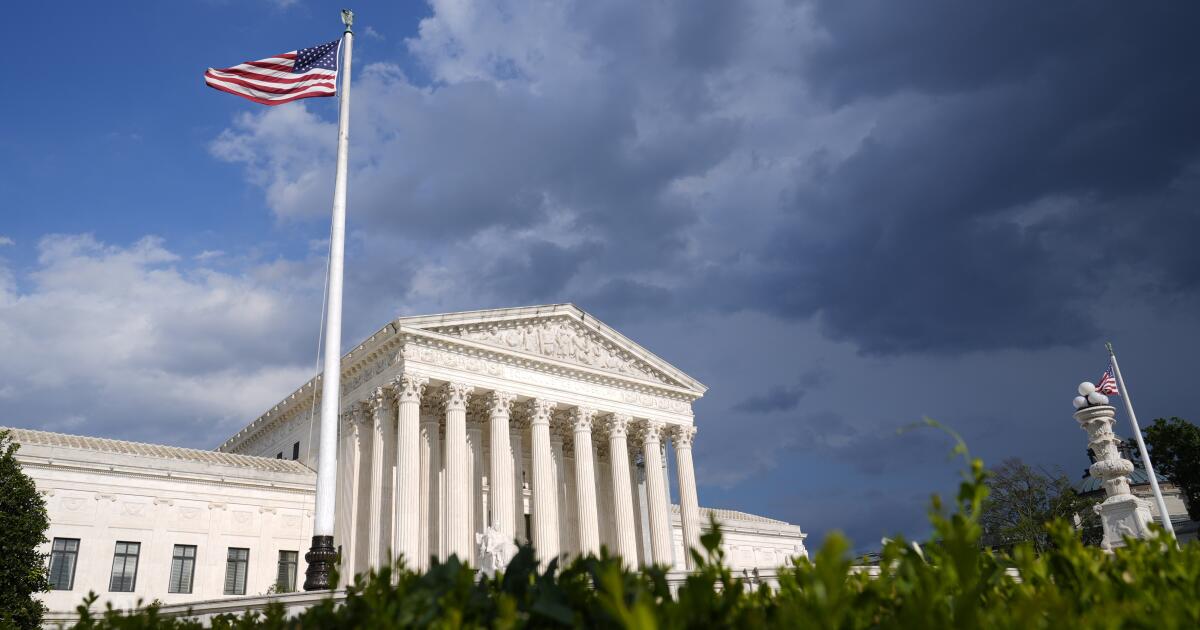
WASHINGTON — The Supreme Court cast doubt Monday on whether police may obtain cellphone data to find crime suspects.
In a 6-3 decision, the justices said this location information showing where a cellphone user has traveled is personal and private and subject to the protection of the 4th Amendment’s ban on unreasonable searches.
Justice Elena Kagan said these “records serve as a personal journal of a user’s movements.”
She said the information “resembles other private materials — think of emails, documents, photographs, or calendars—that even if stored on Google’s servers, a user reasonably views as his own…and reasonably expects to be shielded from the inquisitive eyes of the government.”
Because an “individual has a legitimate expectation of privacy in his cellphone location data,” she said police investigators need a valid search warrant from a magistrate.
The court stopped short of deciding the proper basis for a search warrant in such cases. Instead, the justices sent the case back to judges in Virginia.
But the outcome casts doubt on “geofence warrants.”
In recent years, police have gone to Google and cellphone companies seeking tracking data on cellphones that were at a crime scene. Sometimes, they have had a warrant from a magistrate.
Civil libertarians say the use of this tracking data raises the specter of mass surveillance on innocent people.
Police and government lawyers say no one has a reasonable right to privacy when they are walking on a sidewalk or driving down the street.
The case before the court arose from the armed robbery conviction of a Virginia man who stole $195,000 from a credit union in a small town near Richmond.
By the time police arrived, the robber had fled. But surveillance cameras showed he was carrying a gun and a cellphone.
Lacking other leads, detective Joshua Hilton asked a judge to issue a special type of warrant seeking information from Google.
Referred to as a “geofence warrant,” it seeks data from phones in a particular area at a particular time.
The detective sought data on phones that were within 150 yards of the credit union within one hour of the late afternoon robbery.
After examining and paring down the data, the detective asked for the phone records of Okello Chatrie. Then, with a search warrant of his home, investigators found two robbery-style demand notes, a semi-automatic pistol and about $100,000 in cash.
A judge refused to suppress the evidence from an allegedly unconstitutional search, and Chatrie entered a conditional guilty plea.
The full 4th Circuit Court of Appeals split evenly on the legality of the geofence warrant, and the Supreme Court agreed to decide the issue in Chatrie vs. U.S.
Usually investigators obtain warrants to search the home or vehicle of a known crime suspect.
The new and disputed geofence warrants seek to find a suspect by examining data on the cellphones that were at the scene of a crime.
The FBI used this cellphone data in 2021 to identify suspects who broke through police barricades on Jan. 6, 2021, and pushed their way into the Capitol to disrupt the official counting of electoral votes.
Chief Justice John G. Roberts Jr. and Justices Sonia Sotomayor, Neil M. Gorsuch, Brett M. Kavanaugh and Ketanji Brown Jackson agreed on the outcome in Chatrie vs. U.S.
In a 21-page dissent, Justice Samuel A. Alito Jr. said the court had “carefully set the stage for its planned performance: striking a pose as a great champion of privacy in the digital age. I cannot support this irresponsible escapade.”
Justice Clarence Thomas agreed.
Justice Amy Coney Barrett agreed in a one-paragraph dissent. “Chatrie had no reasonable expectation of privacy in data about his public movements that he voluntarily disclosed to Google,” she said.
The Supreme Court ruled 6-3 that President Trump could fire independent regulators for any reason. But the justices carved out an exception for the Federal Reserve, preventing the immediate removal of Lisa D. Cook, a Federal Reserve governor.
-
World3 minutes ago
Pope issues last-ditch appeal, begs breakaway traditionalist group to back off bishop consecrations
-
 Lifestyle41 minutes ago
How should we behave online? : It’s Been a Minute
-

 Technology51 minutes ago
After a great start, DC’s new cinematic universe is already slowing down
-

 World56 minutes ago
UK asylum seekers could have to pay government $13K before applying for settlement
-

 Politics1 hour ago
Fetterman unleashes on ‘dirtbag’ wing of Dems after far-left victories: ‘Orgy of socialism’
-

 Health1 hour ago
Doctors thought man had brain cancer — they found live tapeworms instead
-

 Sports1 hour ago
Paraguay stuns four-time World Cup champions Germany in penalty shootout after controversial call
-
 Business1 hour ago
Comcast is spinning off NBCUniversal media and entertainment assets

