Politics
'Red-baiting' accusations fly between congressional campaigns in competitive Orange County race

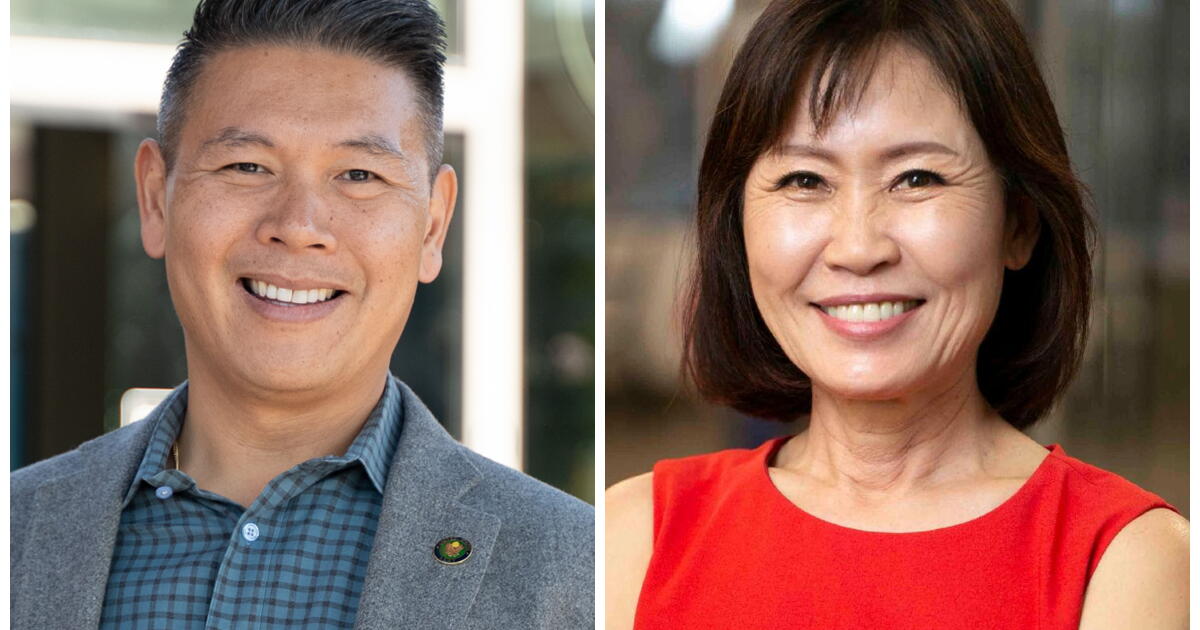
The campaign fliers, written in Vietnamese, began landing in mailboxes in Little Saigon earlier this month.
One flier showed Democrat Derek Tran, who is running for Congress, smiling in front of the hammer-and-sickle emblem of the Chinese Communist Party. In another, Tran is shown next to Mao Zedong, with a caption that, translated to English, reads: “Don’t let Derek Tran take our country back to socialism.”
The mailers, sent by the congressional campaign of Rep. Michelle Steel (R-Seal Beach), have infuriated some voters in the 45th congressional district. The district is home to Little Saigon, as well as the most people of Vietnamese descent outside of Vietnam.
“Everybody knows campaigns can get really ugly,” said Cynthia Choi, a member of Chinese for Affirmative Action and Stop AAPI Hate. “And what’s been really troubling is the fact that this is an old playbook. Unfortunately, it can be really effective.”
She added: “It is very disappointing that an Asian American candidate is using red-baiting tactics.”
Steel, 69, is in a costly and acrimonious reelection fight against Tran, 44, as the Democratic Party pushes to capture the seat from the Republican Party.
Republicans have a razor-thin majority in the House of Representatives. The race is among a handful across the U.S., including half a dozen in California, that both parties see as pivotal in determining control of the next Congress.
Tran’s campaign has been focusing heavily on Vietnamese American voters, hoping that his story as the son of Vietnamese refugees will help flip the district from red to blue.
Steel, too, is pushing to bolster support among Vietnamese voters, particularly those who fled Vietnam after the fall of Saigon in 1975 and who have been loyal for decades to the Republican Party.
The Steel fliers describe Tran having support from “socialists like Bernie Sanders.” (Tran said Sanders hasn’t endorsed him.)
Two of the fliers include a translated quote from a story about the congressional race written by the co-chair of the Southern California Communist Party in People’s World, the Marxist-Leninist publication.
The quote reads: “Tran is a first-time candidate, but he exceeded all expectations by winning the primary against his opponent, who had the full support of the Democratic Party establishment.” In the March primary, Tran defeated Garden Grove City Councilmember Kim Nguyen-Penaloza by 367 votes, finishing second behind Steel.
Another mailer highlights Tran’s supposed ties to China, saying he owns “thousands of dollars of cryptocurrency linked to China,” and that he has an account on TikTok, the social media platform owned by the Chinese company ByteDance.
Tran said in an August financial disclosure that he holds between $33,005 and $145,000 in Bitcoin, Ethereium, and another cryptocurrency through the exchange platform Binance. (China banned cryptocurrency trading in 2021.)
“It’s such dirty, dirty tricks,” Tran said. “This is a desperate attempt by a losing campaign. She’s throwing everything at the wall, including the kitchen sink, to see what’s going to stick.”
The Steel campaign said their mailers followed months of attack ads, tweets and news releases from Tran that accused Steel’s husband, Shawn Steel — former chairman of the California Republican Party — of “selling access” to the Chinese Communist Party.
In one Tran campaign ad that ran on Facebook in September and October, a narrator says in Vietnamese that Steel’s husband “brought Chinese spies into American politics in exchange for money” as the Chinese flag waves in the background. The ad tells viewers that they “cannot trust Michelle Steel to stand up to China.”
The ad refers to a Wall Street Journal story from 2020, which said that Steel’s husband brought several Chinese citizens as guests, including “a man working for China’s central government,” to an “invitation-only gathering” for Republican leaders in San Diego in 2017.
Steel told the Journal at the time that he did not “collect money from, nor have received any funds from” his guests at the meeting.
Steel has loaned her campaign about $1.9 million, financial disclosures show. In July, Tran described her campaign as “buoyed by finances connected to her husband’s dealings with the Chinese Communist Party.”
“Since May, crybaby Derek Tran has leveled false and despicable attacks on Michelle Steel’s family, even putting a CCP flag in his own advertising, but now sobs when our campaign accurately highlights his connections to Communist China,” said Lance Trover, a Steel spokesman.
Tran spokesman Paul Iskajyan said that Tran’s ads are “dealing with facts” and cite published reporting, while Steel’s ads do not.
The imagery and language in the Steel mailer “really preys on the historical trauma that Vietnamese immigrants in this country have,” said Connie Chung Joe, the chief executive of Asian Americans Advancing Justice Southern California, a nonpartisan nonprofit organization.
Representatives of 16 Asian American nonprofit organizations, including Chung Joe and Choi, last week sent a letter to the Democratic Party and Republican Party of Orange County stressing that candidates should dial back rhetoric that “implies falsely” that Asian American candidates are “national security threats.”
“While it is certainly expected that political candidates address geopolitics, and while there are legitimate and serious criticisms of the Chinese Communist Party, imprecise and inflammatory rhetoric can create the false narrative that targets Asian Americans as untrustworthy, anti-American or ‘perpetual foreigners,’” the letter said.
Born to South Korean parents and raised in Japan, Steel broke barriers in 2020 when she became one of three Korean American women elected to the House.
Tran was born in the U.S. to Vietnamese refugee parents. He said his father fled Vietnam after the 1975 fall of Saigon, but his boat capsized, killing his wife and children. Tran’s father returned to Vietnam, where he met and married Tran’s mother, and the couple later immigrated to the U.S.
Tran’s campaign on Monday blasted a recent interview with Steel on the Vietnamese television station VietFace TV, in which interviewer Joe DoVinh told Steel that some people “think that you’re not Vietnamese enough, because you don’t have a Vietnamese last name, and they don’t understand everything that you do for them.”
“I think I am more Vietnamese than my opponent,” Steel responded.
Times deputy editor for culture and talent Anh Do contributed to this report.



NEWYou can now listen to Fox News articles!
The city of San Diego sued the federal government to stop the construction of razor wire fencing on city-owned land near the U.S.-Mexico border, accusing federal agencies of trespassing and causing environmental damage.
The city filed the complaint in the U.S. District Court for Southern California on Monday. The complaint named Department of Homeland Security Secretary Kristi Noem and Secretary of War Pete Hegseth among the defendants.
The city accused the federal government of acting without legal authority when they entered city property in Marron Valley and began installing razor wire fencing.
“The City of San Diego will not allow federal agencies to disregard the law and damage City property,” said City Attorney Heather Ferbert in a news release. She said the lawsuit aims to protect sensitive habitats and ensure environmental commitments are upheld.
NEWSOM SUES TRUMP ADMINISTRATION OVER CALIFORNIA NATIONAL GUARD DEPLOYMENT ORDER TO OREGON
San Diego is suing the federal government to stop the construction of razor wire fencing on city property in Marron Valley. (Justin Hamel/Bloomberg via Getty Images, File)
According to the lawsuit, federal personnel including U.S. Marines accessed the land without the city’s consent, and damaged environmentally sensitive areas protected under long-standing conservation agreements.
DHS Secretary Kristi Noem and Secretary of War Pete Hegseth were among the federal officials named in San Diego’s lawsuit. (Reuters/Brian Snyder; AP Photo/Alex Brandon)
San Diego argues the fencing has blocked the city’s ability to manage and assess its own property and could jeopardize compliance with environmental obligations.
An American flag can be seen through the barbed wire surrounding the CoreCivic Otay Mesa Detention Center on October 4, 2025 in San Diego, California. (Kevin Carter/Getty Images)
CLICK HERE TO DOWNLOAD THE FOX NEWS APP
The lawsuit also accuses the federal government of trespassing and beginning construction without proper authority or environmental review, and unconstitutionally taking the land in violation of the Fifth Amendment.
Fox News Digital reached out to DHS and the Pentagon for comment.

Former vice presidential contender and current aw-shucks Minnesota Gov. Tim Walz announced this week that he won’t run for a third term, dogged by a scandal over child care funds that may or may not be going to fraudsters.
It’s a politically driven mess that not coincidentally focuses on a Black immigrant community, tying the real problem of scammers stealing government funds to the growing MAGA frenzy around an imaginary version of America that thrives on whiteness and Christianity.
Despite the ugliness of current racial politics in America, the fraud remains real, and not just in Minnesota. California has lost billions to cheats in the last few years, leaving our own governor, who also harbors D.C. dreams, vulnerable to the same sort of attack that has taken down Walz.
As we edge closer to the 2028 presidential election, Republicans and Democrats alike will probably come at Gavin Newsom with critiques of the state’s handling of COVID-19 funds, unemployment insurance and community college financial aid to name a few of the honeypots that have been successfully swiped by thieves during his tenure.
In fact, President Trump said as much on his social media barf-fest this week.
“California, under Governor Gavin Newscum, is more corrupt than Minnesota, if that’s possible??? The Fraud Investigation of California has begun,” he wrote.
Right-wing commentator Benny Johnson also said he’s conducting his own “investigation.” And Republican gubernatorial candidate Steve Hilton is claiming his fraud tip line has turned up “(c)orruption, fraud and abuse on an epic scale.”
Just to bring home that this vulnerability is serious and bipartisan, Rep. Ro Khanna, the Silicon Valley congressman rumored to have his own interest in the Oval Office, is also circling the fraud feast like a vulture eyeing his next meal.
“I want to hear from residents in my district and across the state about waste, mismanagement, inefficiencies, or fraud that we must tackle,” Khanna wrote on social media.
Newsom’s spokesman Izzy Gardon questioned the validity of many fraud claims.
“In the actual world where adults govern,” Gardon said, “Gavin Newsom has been cleaning house. Since taking office, he’s blocked over $125 BILLION in fraud, arrested criminal parasites leaching off of taxpayers, and protected taxpayers from the exact kind of scam artists Trump celebrates, excuses, and pardons.”
What exactly are we talking about here? Well, it’s a pick-your-scandal type of thing. Even before the federal government dumped billions in aid into the states during the pandemic, California’s unemployment system was plagued by inefficiencies and yes, scammers. But when the world shut down and folks needed that government cash to survive, malfeasance skyrocketed.
Every thief with a half-baked plan — including CEOs, prisoners behind bars and overseas organized crime rackets — came for California’s cash, and seemingly got it. The sad part is these weren’t criminal geniuses. More often than not, they were low-level swindlers looking at a system full of holes because it was trying to do too much too fast.
In a matter of months, billions had been siphoned away. A state audit in 2021 found that at least $10 billion had been paid out on suspicious unemployment claims — never mind small business loans or other types of aid. An investigation by CalMatters in 2023 suggested the final figure may be up to triple that amount for unemployment. In truth, no one knows exactly how much was stolen — in California, or across the country.
It hasn’t entirely stopped. California is still paying out fraudulent unemployment claims at too high a rate, totaling up to $1.5 billion over the last few years — more than $500 million in 2024 alone, according to the state auditor.
But that’s not all. Enterprising thieves looked elsewhere when COVID-19 money largely dried up. Recently, that has been our community colleges, where millions in federal student aid has been lost to grifters who use bots to sign up for classes, receive government money to help with school, then disappear. Another CalMatters investigation using data obtained from a public records request found that up to 34% of community college applications in 2024 may have been false — though that number represents fraudulent admissions that were flagged and blocked, Gardon points out.
Still, community college fraud will probably be a bigger issue for Newsom because it’s fresher, and can be tied (albeit disingenuously) to immigrants and progressive policies.
California allows undocumented residents to enroll in community colleges, and it made those classes free — two terrific policies that have been exploited by the unscrupulous. For a while, community colleges didn’t do enough to ensure that students were real people, because they didn’t require enough proof of identity. This was in part to accommodate vulnerable students such as foster kids, homeless people and undocumented folks who lacked papers.
With no up-front costs for attempting to enroll, phonies threw thousands of identities at the system’s 116 schools, which were technologically unprepared for the assaults. These “ghost” students were often accepted and given grants and loans.
My former colleague Kaitlyn Huamani reported that in 2024, scammers stole roughly $8.4 million in federal financial aid and more than $2.7 million in state aid from our community colleges. That‘s a pittance compared with the tens of billions that was handed out in state and federal financial aid, but more than enough for a political fiasco.
As Walz would probably explain if nuanced policy conversations were still a thing, it’s both a fair and unfair criticism to blame these robberies on a governor alone — state government should be careful of its cash and aggressive in protecting it, and the buck stops with the governor, but crises and technology have collided to create opportunities for swindlers that frankly few governmental leaders, from the feds on down, have handled with any skill or luck.
The crooks have simply been smarter and faster than the rest of us to capitalize first on the pandemic, then on evolving technology including AI that makes scamming easier and scalable to levels our institutions were unprepared to handle.
Since being so roundly fleeced during the pandemic, multiple state and federal agencies have taken steps in combating fraud — including community colleges using their own AI tools to stop fake students before they get in.
And the state is holding thieves accountable. Newsom hired a former Trump-appointed federal prosecutor, McGregor Scott, to go after scam artists on unemployment. And other county, state and federal prosecutors have also dedicated resources to clawing back some of the lost money.
With the slow pace of our courts (burdened by their own aging technology), many of those cases are still ongoing or just winding up. For example, 24 L.A. County employees were charged in recent months with allegedly stealing more than $740,000 in unemployment benefits, which really is chump change in this whole mess.
Another California man recently pleaded guilty to allegedly cheating his way into $15.9 million in federal loans through the Paycheck Protection Program and Economic Injury Disaster Loan programs.
And in one of the most colorful schemes, four Californians with nicknames including “Red boy” and “Scooby” allegedly ran a scam that boosted nearly $250 million in federal tax refunds before three of them attempted to murder the fourth to keep him from ratting them out to the feds.
There are literally hundreds of cases across the country of pandemic fraud. And these schemes are just the tip of the cash-berg. Fraudsters are also targeting fire relief funds, food benefits — really, any pot of public money is fair game to them. And the truth is, the majority of that stolen money is gone for good.
So it’s hard to hear the numbers and not be shocked and angry, especially as the Golden State is faced with a budget shortfall that may be as much as $18 billion.
Whether you blame Newsom personally or not for all this fraud, it’s hard to be forgiving of so much public money being handed to scoundrels when our schools are in need, our healthcare in jeopardy and our bills on an upward trajectory.
The failure is going to stick to somebody, and it doesn’t take a criminal mastermind to figure out who it’s going to be.

NEWYou can now listen to Fox News articles!
The Wyoming Supreme Court ruled on Tuesday that a pair of laws restricting abortion access violate the state constitution, including the country’s first explicit ban on abortion pills.
The court, in a 4-1 ruling, sided with the state’s only abortion clinic and others who had sued over the abortion bans passed since the U.S. Supreme Court overturned Roe v. Wade in 2022, which returned the power to make laws on abortion back to the states.
Despite Wyoming being one of the most conservative states, the ruling handed down by justices who were all appointed by Republican governors upheld every previous lower court ruling that the abortion bans violated the state constitution.
Wellspring Health Access in Casper, the abortion access advocacy group Chelsea’s Fund and four women, including two obstetricians, argued that the laws violated a state constitutional amendment affirming that competent adults have the right to make their own health care decisions.
TRUMP URGES GOP TO BE ‘FLEXIBLE’ ON HYDE AMENDMENT, IGNITING BACKLASH FROM PRO-LIFE ALLIES
The Wyoming Supreme Court ruled that a pair of laws restricting abortion access violate the state constitution. (Tom Williams/CQ-Roll Call, Inc via Getty Images)
Voters approved the constitutional amendment in 2012 in response to the federal Affordable Care Act, which is also known as Obamacare.
The justices in Wyoming found that the amendment was not written to apply to abortion but noted that it is not their job to “add words” to the state constitution.
“But lawmakers could ask Wyoming voters to consider a constitutional amendment that would more clearly address this issue,” the justices wrote.
Wellspring Health Access President Julie Burkhart said in a statement that the ruling upholds abortion as “essential health care” that should not be met with government interference.
“Our clinic will remain open and ready to provide compassionate reproductive health care, including abortions, and our patients in Wyoming will be able to obtain this care without having to travel out of state,” Burkhart said.
Wellspring Health Access opened as the only clinic in the state to offer surgical abortions in 2023, a year after a firebombing stopped construction and delayed its opening. A woman is serving a five-year prison sentence after she admitted to breaking in and lighting gasoline that she poured over the clinic floors.
Wellspring Health Access opened as the only clinic in the state to offer surgical abortions in 2023, a year after a firebombing stopped construction. (AP)
Attorneys representing the state had argued that abortion cannot violate the Wyoming constitution because it is not a form of health care.
Republican Gov. Mark Gordon expressed disappointment in the ruling and called on state lawmakers meeting later this winter to pass a constitutional amendment prohibiting abortion that residents could vote on this fall.
An amendment like that would require a two-thirds vote to be introduced as a nonbudget matter in the monthlong legislative session that will primarily address the state budget, although it would have significant support in the Republican-dominated legislature.
“This ruling may settle, for now, a legal question, but it does not settle the moral one, nor does it reflect where many Wyoming citizens stand, including myself. It is time for this issue to go before the people for a vote,” Gordon said in a statement.
APPEALS COURT SIDES WITH TRUMP ON BUDGET PROVISION CUTTING PLANNED PARENTHOOD FUNDS
Gov. Mark Gordon expressed disappointment in the ruling. (Getty Images)
One of the laws overturned by the state’s high court attempted to ban abortion, but with exceptions in cases where it is needed to protect a pregnant woman’s life or in cases of rape or incest. The other law would have made Wyoming the only state to explicitly ban abortion pills, although other states have implemented de facto bans on abortion medication by broadly restricting abortion.
CLICK HERE TO DOWNLOAD THE FOX NEWS APP
Abortion has remained legal in the state since Teton County District Judge Melissa Owens blocked the bans while the lawsuit challenging the restrictions moved forward. Owens struck down the laws as unconstitutional in 2024.
Last year, Wyoming passed additional laws requiring abortion clinics to be licensed surgical centers and women to receive ultrasounds before having medication abortions. A judge in a separate lawsuit blocked those laws from taking effect while that case moves forward.
The Associated Press contributed to this report.

Austin airport one step closer to major expansion that will add 32 new gates

Former Alabama OL starter transferring to SEC rival

National Native helpline for domestic violence and sexual assault to open Alaska-specific service

Arizona HS football’s No. 1 2027 prospect has ASU, Miami high on list

Ole Miss basketball vs Arkansas live updates, score, start time, TV channel

Florida High School Football Rankings: Top 25 teams – Oct. 21

Cleary's 21 help Le Moyne down Central Connecticut State 69-64 in OT

How old is Bo Nix? What to know about Oregon quarterback ahead of 2024 NFL Draft

99th annual Pony Swim held in Virginia

Video: ‘It Didn’t Have to Happen This Way:’ U.Va. Faculty Call for Review of Police Response to Protests

San Diego sues to stop border barrier construction

How Ukraine is shaping Europe’s response to Trump’s Greenland threats

GOP gearing up to face tough midterms. And, Pentagon reviews women in ground combat

Wyoming Supreme Court rules laws restricting abortion violate state constitution

How strong are Latin America’s military forces, as they face US threats?
-

 World1 week ago
Hamas builds new terror regime in Gaza, recruiting teens amid problematic election
-
 News1 week ago
For those who help the poor, 2025 goes down as a year of chaos
-

 Science1 week ago
We Asked for Environmental Fixes in Your State. You Sent In Thousands.
-
 Business1 week ago
A tale of two Ralphs — Lauren and the supermarket — shows the reality of a K-shaped economy
-

 Detroit, MI4 days ago
2 hospitalized after shooting on Lodge Freeway in Detroit
-
 Politics1 week ago
Commentary: America tried something new in 2025. It’s not going well
-

 Politics1 week ago
Marjorie Taylor Greene criticizes Trump’s meetings with Zelenskyy, Netanyahu: ‘Can we just do America?’
-

 Health1 week ago
Record-breaking flu numbers reported in New York state, sparking warnings from officials