Politics
Opinion: The ideas in Project 2025? Reagan tried them, and the nation suffered

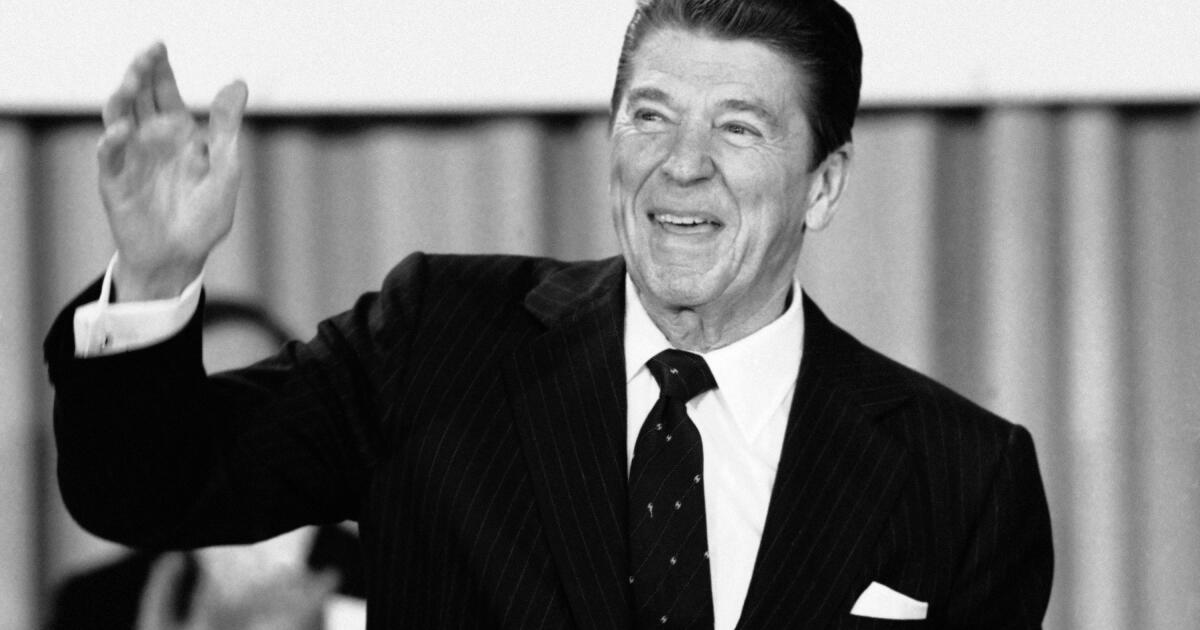
Project 2025, the Heritage Foundation’s conservative playbook that would overhaul much of the federal government under a second Trump administration, has sparked fear and concern from voters despite the former president’s attempt to distance his campaign from the plan. But while Project 2025 might seem radical, most of it is not new. Instead, the now-famous document seeks to reanimate many of the worst racial, economic and political instincts of the Reagan Revolution.
Project 2025 begins with its authors (one of whom stepped down last month) boasting of the Heritage Foundation’s 1981 publication “The Mandate for Leadership,” which helped shape the Reagan administration’s policy framework. It hit its mark: Reagan wrote 60% of its recommendations into public policy in his first year in office, according to the Heritage Foundation. Yet the 900-plus-page Project 2025, itself a major component of a new edition of “The Mandate for Leadership,” does not contain any analysis of the economic and social price Americans paid for the revolution the Heritage Foundation and Reagan inspired.
If today’s economic inequality, racial unrest and environmental degradation represent some of our greatest political challenges, we would do well to remember that Reagan and the Heritage Foundation were the preeminent engineers of these catastrophes. Perhaps no day in Reagan’s presidency better embodied his policy transformations or the political ambitions of the Heritage Foundation than Aug. 13, 1981, when Reagan signed his first budget.
This budget dramatically transformed governmental priorities and hollowed out the nation’s 50-year pursuit of government for the common good that began during the New Deal. Once passed, it stripped 400,000 poor working families of their welfare benefits, while removing significant provisions from another 300,000. Radical cuts in education affected 26 million students. The number of poor Americans increased by 2.2 million, and the percentage of Black Americans living in poverty rose to a staggering 34.2%.
Of course, this was just the beginning of Reagan’s war on the poor, the environment and education. Following a Heritage Foundation plan, the Environmental Protection Agency’s operating budget would fall by 27%, and its science budget decreased by more than 50%. Funding for programs by the Department of Housing and Urban Development that provided housing assistance would be cut by 70%, according to Matthew Desmond’s “Poverty, By America.” Homelessness skyrocketed. And, as Project 2025 proposes, Reagan attempted to eliminate the Department of Education but settled for gutting its funding in a manner that set public education, in the words of author Jonathan Kozol, “back almost 100 years.” As funding for these issues nosedived under Reagan, financial support for the “war on drugs” skyrocketed and the prison population nearly doubled.
All the while, protections provided to the wealthy ballooned. Tax rates on personal income, corporate revenue and capital gains plummeted. For example, the highest income tax rate when Reagan took office was 70%. He would eventually lower it to 33%.
To ensure that wealth would be a long-lived family entitlement, Reagan instituted a 300% increase in inheritance tax protections through estate tax exemptions in his first budget. In 1980, the exemption stood at $161,000. By the time Reagan left office in 1989 it was $600,000. Today it is $13,610,000. This means that today nearly all wealthy children enjoy tax-free access to generational wealth.
And beginning during Reagan’s presidency, the number of millionaires and billionaires multiplied, increasing 225% and 400%, respectively, while the poverty of Americans across racial lines intensified. Even white males were more likely to be poor following Reagan’s presidency. Today poverty is the fourth-leading cause of death in the U.S., even though this is the wealthiest nation in the world.
If we feel like we live in a country that isn’t working for anyone who isn’t wealthy, these are some of the core reasons why. Looking back at the Reagan era and the Heritage Foundation’s original “Mandate for Leadership,” we must remember that our domestic wounds are largely self-inflicted, results of buying into racial, economic and environmental lies that continue to be sold. It is precisely the types of policies that devastated the nation during the Reagan administration that Project 2025 now seeks to resuscitate. Perhaps the only truly new thing Project 2025 suggests is using more authoritarian means to enact its agenda.
History has hinges, moments that change the trajectory of nations. The greatest progress in our country has almost always emerged during turbulent times. It is up to the United States’ most committed believers to close the door on terror and trauma and open one that leads to new democratic possibilities.
Our current moment represents more than an election. It is a turning point that has the potential to transform the United States for generations to come. We don’t need the version of the past that Project 2025 is trying to sell us. It didn’t work for most Americans then, and it won’t work for most of us now. But perhaps Project 2025 is the push the Democratic Party needed. While the Republican Party veers further into authoritarianism, Democrats must be equally determined to develop a truly equitable democracy and bind the wounds of a deeply divided nation.
Joel Edward Goza, a professor of ethics at Simmons College of Kentucky, is the author of the forthcoming book “Rebirth of a Nation: Reparations and Remaking America.”

Prosecutors on Monday began laying out their case against the man accused of murdering Charlie Kirk. It was the first day of a weeklong preliminary hearing that will determine whether or not there is enough evidence against the accused killer to stand trial.

NEWYou can now listen to Fox News articles!
Support for embattled Maine Senate candidate Graham Platner is cratering among Democrats, with one of his most prominent supporters calling on him to exit the race following a harrowing rape allegation.
Rep. Ro Khanna, D-Calif., rescinded his endorsement and called on Platner to suspend his campaign following a bombshell Politico report detailing a rape allegation by Maine resident Jenny Racicot, 41, who previously dated the scandal-plagued candidate.
Platner immediately denied Racicot’s account — which alleges that he barged into her home in 2021 and forced her to have unprotected sex — but has said his campaign is determining its next steps.
She also went on CNN Monday evening shortly after the report was published to tell host Jake Tapper that “by dictionary definition” Platner “raped” her.
Rep. Ro Khanna, D-Calif., speaks at a town hall event on Feb. 20, 2026 in Stanford, California. The town hall focused on taxing billionaires and the future of AI. (Benjamin Fanjoy/Getty Images)
DEMOCRATS BREAK WITH SCANDAL-PLAGUED GRAHAM PLATNER, WARN OF ‘CIVIL WAR’ IN PARTY
“I thought, here’s a man who was drunk and who, by dictionary definition, raped me. And he’s blaming drunk women,” Racicot said. “So I just felt like that was a very odd take to have on that. And I also feel like with all of the comments that he made about women, sexual assault, rape, even, um, you know, the comments that he had made that was in The New York Times article about, you know, threatening people with rape, like, why does this person have this issue, like scattered throughout their life, throughout their commentary, like it‘s on their mind?”
“I’ve been very clear that sexual assault or violence against women is a red line,” Khanna said in a post on social media Monday evening. “These allegations are very serious and credible. Graham Platner should drop out from the race. I am withdrawing my endorsement.”
Khanna’s statement preceded Senate Minority Leader Chuck Schumer, D-N.Y., and Sen. Kirsten Gillibrand, D-N.Y., the head of Senate Democrats’ campaign arm, issuing a joint statement calling on Platner to “immediately” leave the race, so the party can choose a new nominee.
The pair said the Democratic Senatorial Campaign Committee (DSCC) would not invest in Maine — a top pick-up opportunity for Democrats in November’s midterm elections — if he continued to seek the battleground seat held by Sen. Susan Collins, R-Maine.
Both Schumer and Gillibrand supported Gov. Janet Mills, D-Maine, in the contentious primary and did not endorse Platner until he won the party’s nomination.
Meanwhile, Khanna, a far-left populist with likely presidential ambitions, had embraced Platner’s insurgent Senate campaign for months amid a patchwork of controversies.
Khanna personally campaigned with the Maine Senate hopeful in June shortly before Platner became the party’s nominee. The campaign stop came just one day after Lyndsey Fifield, a former Platner girlfriend, accused Platner of abuse — an allegation first reported by The New York Times that Platner has fiercely denied.
By that point, Platner was also facing scrutiny for sending sexually explicit messages to at least half a dozen women while married, making a plethora of offensive online statements over the period of a decade and getting a Nazi-linked tattoo that he wore for most of his adult life.
Shannon Watts, a Democratic strategist and founder of the gun control group Mom Demands Action, slammed the timing of Khanna’s statement.
“You flew to Maine to campaign with him AFTER he was accused of assault against another woman,” Watts wrote on social media.
Khanna previously appeared to dismiss the severity of Fifield’s account alongside many Democratic lawmakers, who seized on her background in Republican politics. He also argued that Platner, a combat veteran who has struggled with PTSD, had overcome a dark past and was deserving of redemption.
“Here you have a case of someone who had a dark chapter in his life, was in toxic relationships, was ashamed about it, who served this country, and the Maine voters are saying, ‘Look, let’s give him some grace, and his focus is stopping these wars, and it’s getting national health insurance, and it’s taking on economic inequality,” Khanna told CBS News in an interview.
Democratic U.S. Senate candidate Graham Platner speaks at his primary election event in Blue Hill, Maine, on June 9, 2026. (CJ Gunther/Getty Images)
WATCH: DEM SENATORS EXCUSE PLATNER’S CONDUCT AT CRISIS HUDDLE WITH EMBATTLED MAINE CANDIDATE
And Khanna told Fox News’ Martha MacCallum in June that he asked Platner if there were any credible allegations of sexual assault that had yet to be revealed. He said Platner denied it.
“I made it clear that, for me, is a red line,” the California lawmaker said. “And he said, no, there is not.”
“Now, obviously, he had texts that were allegedly consensual, and while he was married, And that’s a matter for him and his wife. And his wife came out and said that she forgave him. And so that is a different matter for me than abuse or assault or what people did in the Epstein class. It’s a very different matter.”
Khanna was not the only prominent Platner supporter to disavow the Senate hopeful following Monday’s rape allegation.
Sen. Martin Heinrich, D-N.M., an early Platner supporter, was the first prominent Democrat to rescind his endorsement after Politico’s report broke.
Meanwhile, Sen. Ruben Gallego, D-Ariz., rescinded his endorsement Monday evening, but stopped short of calling on Platner to exit the race.
Gallego, a former ally of disgraced ex-Rep. Eric Swalwell, D-Calif., has faced scrutiny over his past treatment of women. The Senate Ethics Committee recently dismissed a complaint brought by Rep. Anna Paulina Luna, R-Fla., in a bipartisan manner.
His Arizona colleague, Sen. Mark Kelly, D-Ariz., who did not endorse Platner, also called on the Senate hopeful to suspend his campaign.
“Character and accountability matter regardless of party,” Kelly wrote on social media. “It’s time for Graham Platner to drop out and allow for someone else to be nominated and give Democrats the best chance to win this seat in November.”
Far-left Twitch streamer Hasan Piker, who has championed socialist candidates across the country, also distanced himself from Platner on Monday.
Sen. Ruben Gallego, D-Ariz., talks to reporters as he heads for a vote at the U.S. Capitol on Jun. 1, 2026 in Washington, D.C. (Chip Somodevilla/Getty Images)
CLICK HERE TO DOWNLOAD THE FOX NEWS APP
“This is beyond red flags. This is irredeemable,” Piker said during his livestream.
Fox News Digital reached out to Platner’s campaign for comment.

WASHINGTON — The leaders of Europe are bracing for another turbulent summit with President Trump this week as NATO members gather for their annual meeting in the Turkish capital.
European diplomats view Trump’s decision to attend as a positive sign of his continued commitment to the alliance. But the president’s grievances with several European governments over their refusal to join the U.S. war with Iran have cast a pall over a summit already strained by Trump’s wavering support for the continent.
The secretary-general of the transatlantic alliance, Mark Rutte, told reporters on Monday that Trump had aired his resentments in a recent phone call. But Rutte countered with a mix of flattery and countervailing facts that has thus far kept Trump engaged.
While Trump has accused European leaders of denying U.S. forces access to allied bases for takeoffs and refueling during the war, Rutte noted that about 5,000 sorties supporting Operation Epic Fury launched from European airfields. And last Friday, France and Britain committed to a joint military mission with Oman to support freedom of navigation in the Strait of Hormuz — “an extremely important development,” Rutte said.
At last year’s summit, held in The Hague, all NATO member states — with the exception of Spain — agreed to spend 5% of their GDP on defense by 2035, marking a significant increase in historic spending goals for modern Europe. The pledge is divided into two categories, with 3.5% of spending allocated to core military requirements, and the rest committed to a broad set of security-related investments.
Trump’s tough love on the alliance “is, I think, bringing NATO closer together,” the secretary general told reporters.
“You could argue that he is the first president of the U.S. since Eisenhower who was able to come to this situation where the Europeans and the Canadians will spend the same as the Americans” on security, Rutte said. “This equalization was a wish for 50, 60 years, and now it’s happening — I think in large part due to his leadership.”
NATO Secretary-General Mark Rutte speaks to reporters Monday ahead of the NATO summit in Ankara, Turkey.
(Hussein Malla / Associated Press)
In a video message posted on social media Monday, Trump’s ambassador to NATO, Matthew Whitaker, said the summit this week would serve as a “report card” to determine whether countries were beginning to fulfill their commitments from last year.
He offered a note of optimism and suggested the president’s goal is to enhance, rather than undermine, the alliance.
“The United States will be here, but we also need our allies to be here. We cannot do it alone, and the American taxpayer should no longer bear the burden,” Whitaker said.
A White House schedule for Trump’s trip lists bilateral meetings with Rutte and the leaders of Turkey, Syria and Ukraine, in between alliance-wide meals and conferences.
Ukraine will remain at the top of the agenda, Trump told reporters Monday, expressing hope that the war could soon come to an end after four brutal years of fighting.
Russia’s invasion of Ukraine has caused the greatest loss of life in Europe since World War II, resulting in more than 1 million casualties, including an estimated 600,000 dead. Since Russian President Vladimir Putin launched his full-scale invasion in 2022, following his covert invasions of Ukraine’s Crimean peninsula and eastern regions in 2014, Russian forces have captured roughly 12% of Ukraine’s territory.
The war has settled into a deadly stalemate since a 2023 Ukrainian counteroffensive failed to break Russian defensive lines. While Russian forces have occasionally advanced, they have only managed to hold marginal gains along the front, at tremendous cost.
In recent weeks, however, expanded Ukrainian drone and missile capabilities have shifted the dynamic, striking military production sites deep inside Russia and targets near Moscow, bringing the war more directly into the Russian public consciousness and raising questions in the Russian capital whether the war effort is sustainable.
Ukraine’s boldness has impressed the Trump administration, Alexander Stubb, the president of Finland, told the Financial Times this week.
“I think he does feel pressure,” Trump said of Putin, addressing reporters in the Oval Office before departing for Turkey on Monday.
The president referred to an ongoing U.S. effort to end the war, a goal that has remained elusive for Trump since returning to office.
“I think we’re getting much closer than people realize,” he said. “President Putin wants it to end, I will tell you that. Very strongly. Had a good call. And President Zelensky actually wants it to end now.”
“We’re going to be going to NATO, and we’re going to be talking about it,” Trump added. “And I think we’re going to get it ended. It’s been terrible.”
-

 Wisconsin3 minutes ago
Wisconsin DOT begins $6.87M I-41 ramp deck overlay upgrades in Brown County Tuesday
-

 West Virginia8 minutes ago
11 Marshall student athletes suing NCAA over new rule – WV MetroNews
-

 Wyoming15 minutes ago
Election Q&A: Qwenton Eagle Oviatt for Wyoming secretary of state
-

 Crypto18 minutes ago
An Easy-to-Miss Radio Traffic Jam Is Behind Many Home WiFi Slowdowns
-

 Finance23 minutes ago
Fayette County Public Schools Board of Education approves audit contract, new finance director position
-

 Fitness30 minutes ago
Caroline Idiens and Jenni Falconer’s time-efficient 9-exercise workout builds full-body strength in 30 minutes
-

 Movie Reviews38 minutes ago
Film reviews: ‘The Invite’ and ‘Minions & Monsters’
-

 World48 minutes ago
Feds Detail Hoopster Kerr Kriisa’s Alleged $2.2M Criminal Side Hustle

