Politics
Opinion: One Trump puppet stands between Ukraine and the aid it needs

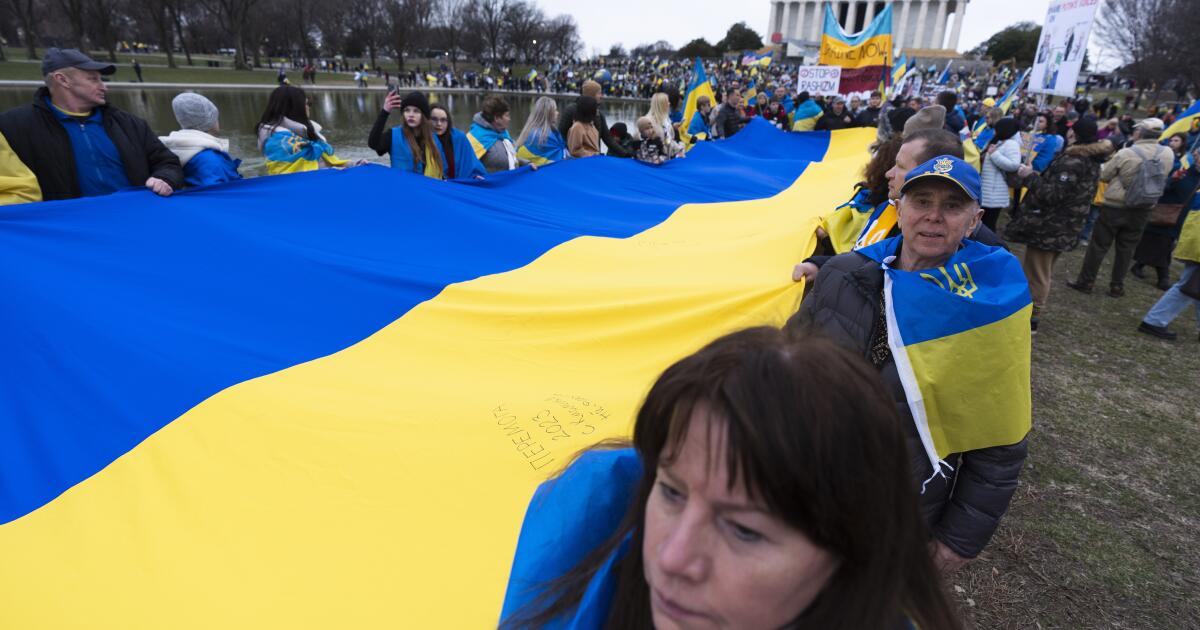
Speaker Mike Johnson in just months has all but cemented his place among the weakest House leaders in its history. Alas, the Louisianan nonetheless holds enough power that he’s single-handedly blocking one of the most crucial matters of our time: bipartisan U.S. aid to Ukraine for its defense against Vladimir Putin’s murderous expansionism.
It’s not like Johnson is making a stand on principle by not scheduling a House vote. Oh, no. To hear him talk, he’s all for our Ukrainian allies and wants some kind of aid. But Donald Trump does not — he’s with Putin, as usual — and Johnson generally stands wherever the former president directs. Not for nothing is the novice speaker called “MAGA Mike.”
Opinion Columnist
Jackie Calmes
Jackie Calmes brings a critical eye to the national political scene. She has decades of experience covering the White House and Congress.
And no issue illustrates better than Ukraine the dithering and subservience to Trump that have become Johnson’s hallmarks since October, when House Republicans ousted his predecessor, rejected several higher-ranking aspirants and then, exhausted by the impasse, settled on him.
Also, no issue holds more dire consequences if Johnson doesn’t change course — for Ukraine, peace in Europe and the United States’ security and international standing.
Johnson continues to straddle the question, saying all the right, supportive things — “Ukraine is the victim here. They were invaded,” he told reporters Wednesday — and yet doing nothing. President Biden’s aid request has languished for as long as Johnson has been speaker. It’s now been a month since the Senate overwhelmingly voted, 70 to 29, for the $95-billion foreign aid package — $60 billion for Ukraine and the rest for Israel, Taiwan and Palestinians in Gaza.
Give Johnson this much: He can take a lot of pressure, at least when he’s safely in Trump’s corner. Lately he’s been getting hit from all sides about Ukraine — from the president and congressional Democrats, sure, but also from pro-Ukraine Republicans and even from foreign leaders.
Members of both parties began trying in recent days to collect signatures from a majority of the House on two separate discharge petitions that would force a vote on Ukraine aid. The discharge strategy is rarely used, and it’s even more rarely successful because, by definition, the action is a slap at the party leaders who bottled up the legislation. But this could be one of the rare times.



NEWYou can now listen to Fox News articles!
Acting Attorney General Todd Blanche came out swinging against Sen. Adam Schiff on Wednesday, denying allegations of self-dealing and intentional refusal-to-recuse in President Donald Trump’s cases, while accusing the California Democrat of lying.
Schiff sparred with Blanche over several legal matters he said prove the nominee is unfit for the job of America’s top law enforcement officer, citing what he described as serious conflicts of interest. Blanche denied the allegations while telling Schiff he was misstating ethics rules and botching key timelines.
Schiff pressed Blanche on whether he met with Justice Department ethics lawyers about his prior representation of Trump in the Stormy Daniels, Mar-a-Lago classified documents, and Jan. 6 cases.
TRUMP’S AG NOMINEE RACKS UP MASSIVE SUPPORT AHEAD OF CONFIRMATION HEARING: ‘REAL RESULTS’
Sen. Adam Schiff, left, and acting Attorney General Todd Blanche. (Al Drago/Getty Images; Eric Lee/Getty Images)
Blanche affirmed and said he has recused himself from future litigation or Justice Department business involving any of those suits. But Schiff countered that Blanche reportedly told a crowd at the Conservative Political Action Conference (CPAC) that there was no conflict of interest in the Justice Department firing prosecutors linked to Jan. 6 or other cases.
Blanche soon fired back when Schiff criticized him for moving to vacate Jan. 6-related convictions for 12 members of far-right groups.
“I was the acting attorney general – so yes, my department moved to dismiss,” he said, adding that there was no reason for him to recuse himself when Schiff pressed him further.
BIDEN SPECIAL COUNSEL’S ‘RUNAWAY TRAIN’ SCOOPED UP SENSITIVE LAWMAKER INFO: ‘ABUSE OF POWER’
“From the Proud Boys matter?” Blanche responded with a puzzled look.
“You’re a lawyer, you know the rules,” Blanche told the Massachusetts-born graduate of Harvard Law.
OBAMA JUDGE HANDS PROGRESSIVES A WIN OVER ANTI-TRUMP ’86 47′ MESSAGE AMID RISING THREATS
“There are rules that say when I have to recuse and that’s not one of them,” Blanche said.
“There are rules,” Schiff agreed. “And when you’re told to recuse yourself from investigations that you handle for the president…” – “I always do,” Blanche cut in – “you’re supposed to recuse yourself,” Schiff finished.
Schiff noted that the second volume of special counsel Jack Smith’s report on Trump has not been released and said the Justice Department has opposed making it available.
Blanche denied having anything to do with the decision and pointed out it is not the Justice Department, but a federal judge in Miami, that has prohibited its release.
“If you went into court asking them to release it, it would be released by now,” Schiff argued.
Blanche shot back: “What you’re saying happens not to be true – I did not do that.”
“You can’t accuse me of violating my ethical rules and then lie about what I did,” he continued,
Schiff asked Blanche at length what allegedly evolved in his professional life that led him to be under such criticisms.
“What I don’t understand, Todd Blanche, is what happened to the Todd Blanche who was a prosecutor in the Southern District of New York? What happened to the prosecutor people had respect for,” he said.
“What happened to the prosecutor who said that there wouldn’t be a whiff of political partisanship and then prosecutes the president’s enemies over seashells cases, over making a video stating the plain law in the Constitution?” Schiff said – appearing to reference investigations into former FBI Director Jim Comey’s “8647” post that critics said amounted to a threat on Trump’s life.
“I think Robert Caro had it right when he said that power doesn’t corrupt as much as it reveals. I suspect it has just revealed who you are and who you are as someone willing to sacrifice everything you once believed in for that title, for that position of attorney general,” Schiff claimed.
“I am still here. I am the same exact person I was when I was a federal prosecutor in the SDNY,” Blanche replied.
The exchange led to further criticism of Schiff, including from the Trump-appointed prosecutor in his home region:
SIGN UP TO GET THE POLITICS NEWSLETTER
“Facts are not Senator Schiff’s strong suit,” claimed First Assistant U.S. Attorney for Central California Bill Essayli.
CLICK HERE TO DOWNLOAD THE FOX NEWS APP
Former Alabama federal prosecutor Jay Town called the exchange “excellent.”
“What [Blanche] is essentially saying is that the Justice Department has gone back to the fundamentals of increasing prosecutions and lowering crime nationwide, unlike the Garland DOJ targeting parents, Catholics, etc.”
Fox News Digital reached out to Schiff for comment.

WASHINGTON — President Trump appeared poised to question the security of U.S. elections with a planned prime-time speech Thursday night, eliciting fears from Democrats and voting rights advocates that he is planning yet another play for federal control over voting in November’s midterms.
The exact reason for the speech has not been disclosed by the White House, with Trump only characterizing it to reporters this week as “really, really big news.” He confirmed it would have to do with “free and fair elections.”
The Washington Post reported, citing sources, that Trump planned to argue that there are vulnerabilities in the nation’s election infrastructure and claim that China had accessed U.S. voter data. The White House declined to confirm any such details Wednesday.
The announcement of the speech set off concerns among the president’s political opponents, as well as elections experts and voting rights advocates, that Trump could again escalate claims that the nation’s voting system is vulnerable to domestic fraud and foreign attacks.
He has previously said that Republicans should “nationalize” election administration, a job that falls to the states under the Constitution, and has pressured his party to tighten federal voting rules.
“We don’t know anything about what he might say … or what he might try to do with his very limited powers, as the president, over elections,” said David Becker, executive director of the nonpartisan Center for Election Innovation and Research. “I expect we’re going to hear a lot of rehashed and debunked claims.”
The president could potentially use new claims to argue that the nation is facing an emergency in upcoming elections that necessitates further federal intervention into voting, Rep. Joseph Morelle of New York, the ranking Democrat on the House Administration Committee, which has oversight of elections, said in an interview with The Times.
“This is going to be the rationale for declaring a national emergency,” Morelle said. “It’s transparent that he is creating the emergency and he’s creating the evidence out of whole cloth to suggest there is an emergency.”
Sen. Alex Padilla (D-Calif.), the top Democrat on the Senate Rules Committee, which oversees federal elections, told The Times on Wednesday that Trump was using a known playbook to “[sow] doubt about the outcome before a single vote has been cast.”
“All signs show that tomorrow’s speech will be more of the same: debunked conspiracy theories offered up not because they’re true, but because chaos and doubt are the only cards he has left to play,” Padilla said.
The speech, which Trump announced on social media Monday, comes four months ahead of midterm elections that will determine whether his party retains legislative control in Washington.
White House spokesperson Karoline Leavitt dismissed news reports about what Trump might say in the 6 p.m. PDT speech as speculation, and said “nobody knows yet what President Trump will ultimately say.”
The address also comes as Trump’s ceasefire with Iran has fallen apart, renewing expectations for increased gas prices, and his approval rating on the economy has steadily dropped. On Tuesday, it also became public that Trump had paid $5.6 million to the writer E. Jean Carroll, as ordered by a jury that in 2023 found Trump liable for sexually abusing and defaming her.
“What we’re going to be talking about Thursday is, it doesn’t get bigger,” Trump told reporters who asked Tuesday about the speech. “Because without free and fair elections you don’t have a country.”
Trump has spread baseless claims of widespread election fraud for years. But his prioritization of his claims about the voting system — even as much of the nation’s attention is on cost-of-living issues — has been on particularly clear display in recent days.
He has aggressively lobbied reluctant Republican senators to pass his voter ID legislation, refusing to sign a bipartisan housing bill over it; he fired all remaining members of the bipartisan U.S. Elections Assistance Commission; and his Justice Department said it would send election monitors to six states.
Since the midterm primaries began, Trump has also sown doubt about election security — chiefly in California, where he suggested Democrats had cheated or attempted to in the gubernatorial and Los Angeles mayoral primaries.
Georgia Democratic Sen. Jon Ossoff, whose state was often at the center of Trump’s 2020 fraud claims, said the president’s speech posed a threat to voting rights.
“I expect him to use whatever he puts out there on Thursday as a pretext, either for some attempted unconstitutional use of federal power to interfere in the election,” Ossoff said Tuesday on MS Now, “or to give his proxies and loyalists in state and local jurisdictions some cover for whatever they might attempt, or to lay the groundwork for challenging the result.”
Any effort to federalize or take over elections would face serious legal obstacles, said Nahal Kazemi, a Chapman University law professor. Although Congress can pass laws regarding election administration, as it did with the Voting Rights Act, the executive branch doesn’t play a role in running elections.
“You run into essentially a brick wall that is the Constitution, which makes very plain that states run elections,” Kazemi said.
When it comes to concerns about foreign interference, experts say there is little evidence of other countries attempting to hack systems or change votes. Instead, foreign actors have largely operated via disinformation campaigns, as the U.S. determined had occurred in the 2016 and 2020 elections.
“Of the information that is available to us now, there’s no reason to be alarmed about the possibility that a foreign adversary is going to take over election systems,” said Kazemi, who has studied foreign election interference.
One of the things that helps make American elections generally secure, she said, is that they are not centralized but are run by thousands of counties. Hacking into so many voting systems would be extraordinarily difficult for a foreign adversary, she said.
Jenny Farrell, executive director of the League of Women Voters of California, said California “takes elections security extremely seriously” and has one of the most secure systems in the country, subject to strict voter verification measures and intense chain of custody and auditing procedures.
Democrats have worked with elections experts in recent months on attempts to assure the public that U.S. elections are safe and secure. They have also tried to counter claims by Trump that mail ballots and voting machines are unreliable.
A slew of 2020 election reviews, including by Trump’s first administration, concluded that Trump lost and Biden won. Election experts say there is no evidence that widespread fraud determined the outcome of the election.
A judge also found that claims pushed by Trump and his attorneys that the company Dominion Voting Systems manipulated votes cast through its machines in favor of Biden were untrue.
Senator John Cornyn, Republican of Texas, may have the deciding vote on Todd Blanche’s confirmation as attorney general. Even a single Republican “no” vote would block Mr. Blanche’s nomination, and the senator said after Wednesday’s meeting that he had not made up his mind.
-

 Science9 minutes ago
The Wildfire Researchers Who Burn Houses Down on Purpose
-
Lifestyle33 minutes ago
Apache chef Nephi Craig says cooking Native food saved his life
-

 Technology45 minutes ago
Google is better at playing the AI regulations game
-

 World51 minutes ago
Iran calls on Houthis to prepare to cut off Red Sea gateway — can the terror group do it?
-

 Politics57 minutes ago
Todd Blanche roasts Adam Schiff in heated hearing: ‘You’re a lawyer, you know the rules’
-

 Health1 hour ago
Game-changing cholesterol pill wins FDA approval after cutting LDL nearly 60%
-

 Sports1 hour ago
2026 AL, NL MVP Odds: Ohtani Favored; Alvarez Holding Off Challengers
-

 Technology1 hour ago
Tesla helped save a driver. Is your car ready?

