Politics
Opinion: Much of the world is terrified by another Trump presidency. Here's why


Words matter. Especially when uttered by a president, and especially overseas. “Speak softly, and carry a big stick,” Theodore Roosevelt advised, though he never envisioned a successor would prove capable of obliterating cities half a world away in under half an hour. That nuclear stick is pretty big indeed, capable since 1945 of keeping our most virulent adversaries, including Moscow, Beijing, Tehran and Pyongyang, from their most reckless ambitions. It also keeps allies in line. What do Japan, Saudi Arabia, Germany and South Korea have in common? Each is but a day away from joining the nuclear club. That day is when their leaders stop believing the president of the United States will come to their aid.
This is why I fear a second Trump term. A world increasingly riven by renewed great power rivalries and historic animosities is further weakened by Oval Office instability, exemplified by ill-advised remarks, ill-timed threats and outright lies. Calm captains of the ship of state struggle to navigate the world system’s waves and shoals. An erratic one won’t help. Especially one whose obsessions, personal grievances and loose relationship with the truth make others question not only America’s policy but more fundamentally our reliability.
How trite. The professor in the ivory tower reminds us that words retain meaning. How very 20th century. Does he not realize that legions of bots and ChatGPT enable today’s policymakers to forge the algorithmic reality they desire?
Presidents must be held to higher standards. Their quips move markets. Their words invite or ward off aggression. Save or end lives. Examples abound of even experienced leaders forgetting their rhetorical reach.
Dwight Eisenhower’s 1956 promise of aid inspired Hungarians to revolt against Soviet control, leading most to their death or to exile. Ike never thought they’d take him so literally. He meant moral and rhetorical aid, the thoughts and prayers kind. Hungary’s freedom fighters expected guns, or better yet American troops that Eisenhower never meant to imply would be forthcoming. Desperate people heard what they wanted to hear when the man in the Oval Office was unclear.
Words mattered at the end of the Cold War, too. Ronald Reagan called the Soviet Union an “evil empire” against his own State Department’s guidance, which also tried to stop him from saying “Mr. Gorbachev, tear down this wall,” lest such a direct challenge rile the Kremlin. But that was precisely Reagan’s point. Another word for “rile” is “catalyze,” which is what Reagan hoped to do to the rumblings of change behind the Iron Curtain.
George H.W. Bush also understood the power of presidential proclamations and was thus largely mute when the Berlin Wall finally fell in 1989. “I guess I’m just not an excitable guy,” he told CBS reporter Leslie Stahl and a similarly bewildered White House press corps amazed by his laconic response. But Bush knew presidential triumphalism at that precarious moment might spark a hard-line backlash. “I’m not going to dance on the wall,” he said privately, forgoing personal political gain to preserve America’s Cold War triumph.
Presidents are supposed to care more about the nation’s fate than their own. Barack Obama’s reputation suffered when he refused to back up his own “red line” against Syrian use of chemical weapons in 2013, but he ultimately reasoned his promise to avoid another Middle East quagmire mattered more than his own temporary loss of prestige. Joe Biden’s decision to keep his promise to end America’s generation-long fight in Afghanistan showed consistency even when retaliation for losses endured during the evacuation might have helped him in the polls. Better to demonstrate prudence, he reasoned, than to rashly reverse a well-considered decision in hope of temporarily saving face.
This is why the prospect of a second Trump presidency is so terrifying: His unconsidered words reverberate. He was the first president since Harry Truman, which is to say the only president ever, to cast doubt on our commitment to defend our NATO allies. “Does that mean that you won’t protect us in case — if we don’t pay, you won’t protect us from Russia,” Trump boasted a foreign leader lamenting. “I said, ‘That’s exactly what it means.’”
Perhaps this was more bluster than extortion, a negotiating tactic to encourage tight-fisted allies to boost their defense spending. Either way, the story has become part of Trump’s standard rally repertoire. Our allies, meanwhile, inch closer to creating their own security guarantees every time Trump puts another dent in the armor of collective security. Including their own nuclear deterrent.
Treaties and promises are, ultimately, mere scraps of paper. They only matter if leaders are trusted to follow through. After a decade of undermining Washington’s commitment to NATO, including four years as president, Trump has no reservoir of reliability among our partners, at least those that remain beyond the grip of their own strongmen. During a second Trump presidency our most meaningful allies would be certain to further their own security arrangements without U.S. involvement and thus, without U.S. input. After all, would you buy a second car from a dealer that threatens to disregard the warranty on your first?
Trump’s prevarications underline his unreliability. He will say anything that leaps to mind, or anything he thinks will help him win, no matter the veracity or collateral damage. A presidential candidate willing to lie about immigrants, FEMA, military chiefs or a hurricane’s expected path can’t be trusted to tell the truth about future crises. Worse still is his tendency to double down rather than admitting error. If Trump’s putting America First means risking the well-being of Ohio schoolchildren, continuing to push the Big Lie that he won the last election or redefining the Jan. 6 Capitol assault as pure patriotism rather than partisan violence, why would our foreign friends trust his judgment?
Trump’s falsehoods are unmatched in presidential history. Franklin Roosevelt promised that Americans would build 50,000 aircraft a year to combat Nazi aggression. Asked by aides where he got that big, round number, Roosevelt responded he’d made it up, noting that defeating fascism required Americans to think in larger terms than ever before. Abraham Lincoln fibbed as well, telling newspaper readers in 1862 that he was not considering emancipating the Confederacy’s enslaved people when he’d already decided to do so. Even the greats sometimes lie, albeit for national rather than personal gain. Trump lies for himself.
International politics is not best overseen by saints or sophists. We are forced to trust the person we put in charge of our security to use their words judiciously. But Donald Trump shuns what Ike learned, Reagan deployed, Bush restrained and Obama realized: The big stick of American power requires speaking not so much softly as reliably.
FDR and Lincoln knew when they were lying. Does Trump? The world should fear another four years of wondering if he can tell the difference.
Jeffrey A. Engel is the founding director of the Center for Presidential History at Southern Methodist University. He is at work on his 15th book, “Seeking Monsters to Destroy: How Americans Go to War from George Washington to Today.”

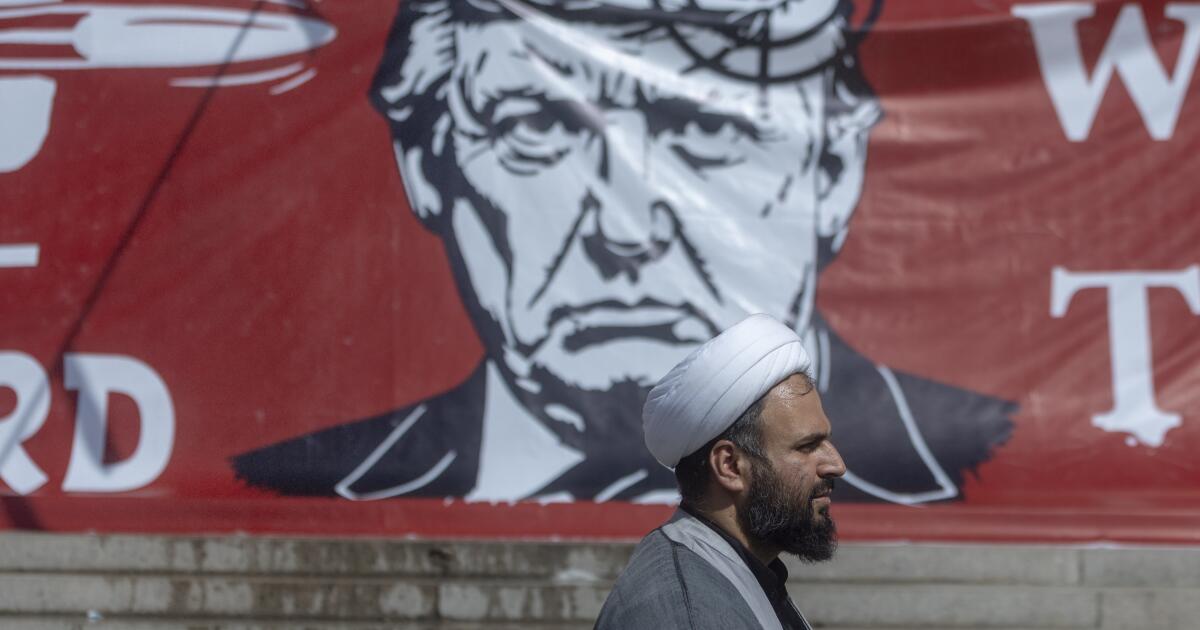
WASHINGTON — Shortly before President Trump ended a ceasefire with Iran this week, Israeli officials presented his team with intelligence indicating Tehran was hatching new plots to kill him.
It was not the first such warning. U.S. law enforcement and intelligence agencies have tracked evidence for years of Iranian efforts to target the president, with signals only increasing since the start of the war.
Their desire to target Trump and his top aides began six years ago, just outside Baghdad International Airport, when the president ordered a drone strike that killed Iran’s most powerful general. The assassination of Qassem Suleimani brought the two countries to the brink of war.
Yet even as full-scale war was averted, top Iranian officials vowed revenge for the strike, authorizing attempts on the lives not just of the president, but of his secretary of State and national security advisor, among others, even after they had left office.
Now, calls for revenge have reached a sharper pitch in Tehran, after a joint U.S.-Israeli operation killed Iran’s supreme leader, Ayatollah Ali Khamenei, at the start of the war in February.
At Khamenei’s funeral ceremonies this week, red flags of vengeance flew throughout the capital as protesters explicitly called on their government to “kill Trump.” His son, Mojtaba, the new supreme leader, was absent from the commemorations, fearing assassination himself.
Mourners hold an anti-President Trump banner at the Imam Khomeini Grand Mosque during mass funeral prayers for Iran’s late Supreme Leader Ayatollah Ali Khamenei and his family in Tehran on Sunday.
(Morteza Nikoubazl / NurPhoto via Getty Images)
The prospect of foreign assassination plots targeting U.S. leaders puts the United States in dangerous new territory, where its embrace of political killings could ultimately place its own officials at unprecedented risk. And experts fear the existential threat of assassination has pushed peace further out of reach: When both sides believe their survival is at stake, the trust required for diplomacy becomes far harder to achieve.
Israeli news organizations have reported that Israel’s prime minister, Benjamin Netanyahu, cited Iranian attempts to kill Trump in recent years as part of his case to go to war in the first place.
A U.S. official told The Times that a range of serious threats exist against the president, including from Iran, but that Israel’s intelligence pointed to a more specific plot. The official did not provide further details. Israeli officials did not respond to requests for comment.
Iran’s president, Masoud Pezeshkian, has said in recent months that the government sees vengeance against U.S. officials as “its legitimate duty and right,” and “will fulfill this great responsibility and duty with all its might.”
“The Suleimani killing accelerated a lifting of restraints on foreign assassinations — and the taboo on targeting and killing foreign leaders, with U.S. military assets, has been more or less lifted,” said Matt Dallek, a political professor at George Washington University.
“If the United States sets the example of how to conduct international relations, and it is using assassination of foreign leaders as a political weapon, it’s only logical that other countries will be more inclined to also engage in assassinations,” Dallek added. “It does seem likely that Trump will have a bigger target on his back.”
Returning from a NATO summit in Turkey on Wednesday, Trump was forced to switch back to an old model of Air Force One — equipped with specialized defensive technologies — from a new plane given as a gift by Qatar, after the Secret Service warned of potential threats to the aircraft from Iran.
“They want to take out the U.S. leader — me,” Trump told reporters aboard the plane. “I’m on whatever list. I saw this morning I’m on every single one of their lists. And so far, I guess I’ve been a bit lucky, but maybe that doesn’t last very long.”
The threat has remained on his mind in the days since. In an interview with the New York Post, Trump told the reporter, “I hope you’ll miss me,” adding that he has “been on their list for a long time.” And in a subsequent social media post Friday night, he warned of a catastrophic response he instructed the administration to pursue in the event Tehran succeeds.
“1000 Missiles are Locked and Loaded and aimed at the Islamic Republic of Iran,” he wrote, “with thousands of more to immediately follow, should the Iranian Government act on its threat, pronounced in many corners of the Globe, to assassinate, or attempt to assassinate, the sitting President of the United States of America, in this case, ME!”
The United States had a decades-old prohibition against assassinating foreign leaders before Trump’s presidency, codified in an executive order signed by President Ford in 1976 over concerns of a CIA plot to kill Fidel Castro.
The policy was only strengthened further by subsequent administrations, fearing a new international standard for targeted killings could result in unintended consequences in the halls of Washington.
Other administrations have been accused of targeting foreign leaders before. Under the Obama administration, an international coalition targeting the Libyan regime of Moammar Kadafi during the country’s 2011 civil war struck his fleeing convoy, leading to his capture and killing by rebel fighters.
But experts say Trump’s explicit targeting of Suleimani and Khamenei — and his public celebration of their deaths — marks a new paradigm.
“Through words and actions, President Trump has done more to normalize political violence than any other U.S. president, certainly in modern times,” said Robert Pape, a professor at the University of Chicago and author of “Our Own Worst Enemies: America in the Age of Violent Populism.”
“On the international front alone, the president routinely brags about killing Iranian leaders and seizing the leader of Venezuela, among others,” he added, “to the point that assassination is becoming the new normal in international politics.”
Politics
Trump takes unusual step, lets bipartisan housing bill become law unsigned amid SAVE pressure campaign

NEWYou can now listen to Fox News articles!
A bipartisan housing bill became law Saturday at midnight after President Donald Trump declined to sign it, capping a weeks-long saga over whether the president would veto the measure amid frustrations with Congress over his stalled agenda.
Trump refused to sign the 21st Century ROAD to Housing Act — legislation aimed at expanding the nation’s housing stock and lowering costs — in an attempt to pressure Congress to pass the SAVE America Act, despite the housing bill clearing both chambers with overwhelming majorities.
“I will not sign the Housing Bill, which has been fully approved by Congress and sent to the White House, in PROTEST over the fact that the United States Senate is not capable of passing THE SAVE AMERICA ACT, which is polling at 97% with the Republican Party, and very high with the non-politician Dumocrats,” he declared on Truth Social Friday morning.
The Trump-backed election measure, which would require proof of citizenship to vote in federal elections and impose voter ID requirements, has struggled to overcome the Senate’s 60-vote threshold.
Meanwhile, the House has not passed a version of the bill that includes the president’s proposed crackdown on mail-in voting and banning men from women’s sports.
President Donald Trump speaks in the Oval Office of the White House, Wednesday, June 3, 2026, in Washington. (Alex Brandon/AP)
HOUSE CONSERVATIVES DERAIL GOP AGENDA IN SAVE AMERICA ACT SHOWDOWN
Under the U.S. Constitution, Trump had 10 days, not including Sundays, to sign or veto the housing measure after the House formally transmitted the legislation to the White House in late June. The president ultimately chose neither option, allowing the measure to become law without his signature.
Though Trump declined to veto the legislation, he sharply criticized elements of the bill and argued it should not have been a legislative priority in recent weeks.
“It’s so unimportant … compared to the SAVE America Act,” Trump told reporters in the Oval Office in late June. “I think the SAVE America Act is exactly what it says. It’s saving America from crooked elections.”
Trump went on to call the housing bill “a yawn,” adding, “compared to the SAVE America Act, just about everything is a big yawn.”
It would have taken a two-thirds majority in both chambers to override a veto — a margin the House and Senate exceeded when they passed the legislation. However, it remains unclear whether so many Republicans would have defied the president had he vetoed the bill.
Trump also appeared to criticize the bill over a provision restricting Wall Street investors from purchasing single-family homes — a policy he first proposed during his January State of the Union address and later urged Congress to pass. Trump previously argued the investor ban would give individual homebuyers a leg up against private equity firms in the housing market.
“I don’t want to hurt people that own houses, too,” Trump later told reporters, appearing to reference the provision. “These people, for the first time in their lives, they have valuable houses. They’ve become rich. I don’t want to hurt them either. What you want to do is what’s good for everyone, get the interest rates down.”
The law also aims to boost housing supply by streamlining federal environmental reviews, loosening rules around the construction of factory-built homes, and incentivizing local governments to modify their zoning laws to allow more housing, among roughly 60 provisions.
Trump’s souring on the legislation created headaches for Republicans, who touted the bill as an affordability win as voters grapple with high housing costs.
“It’s irresponsible to postpone signing the Housing bill due to the SAVE Act,” Sen. Bill Cassidy, R-La., a retiring lawmaker who lost re-election to a Trump-backed challenger, wrote on social media. “We need to start delivering relief to people for the high cost of housing ASAP!!”
Construction workers stand on the roof of homes under construction at a new housing development on June 24, 2026, in Valencia, Calif. (Justin Sullivan/Getty Images)
WARREN TELLS TRUMP TO ‘SIGN THE DAMN BILL’ AS BIPARTISAN HOUSING PACKAGE REMAINS STALLED IN WASHINGTON
Trump abruptly canceled a signing ceremony for the legislation at the U.S. Capitol in June with GOP leaders. The stage had already been set, with at least one senior Republican arriving unaware the president had called off the event shortly before it was scheduled to begin.
The president then declared he would not sign the legislation until Congress passed the SAVE America Act, despite Senate GOP leaders insisting the votes do not exist to advance the measure.
Trump has also expressed frustration with the Republican-controlled Senate for declining to weaken the legislative filibuster, which requires 60 votes to advance most legislation in the upper chamber.
“GET SMART REPUBLICANS, IF YOU DON’T, YOU WON’T BE IN OFFICE FOR LONG!” Trump wrote in a Truth Social post on Sunday.
Before Trump came out against the bill, White House Press Secretary Karoline Leavitt called it “one of the most significant pieces of housing affordability legislation in American history” and said it included an array of policies “long championed” by Trump.
House Speaker Mike Johnson, a Republican from Louisiana, speaks during a news conference at the U.S. Capitol in Washington, D.C., on Oct. 15, 2025. (Eric Lee/Bloomberg via Getty Images)
Meanwhile, Trump political operative James Blair touted the legislation for including the president’s Wall Street investor ban, which he referred to as a “signature commitment.”
House Speaker Mike Johnson, R-La., has argued that Republicans will still promote the landmark housing bill ahead of November.
CLICK HERE TO DOWNLOAD THE FOX NEWS APP
“We’ll still celebrate it, but he’s trying to make a point, and I think he’s making it very effectively,” the speaker recently told reporters, referring to Trump. “And the fact that you all ask me every three steps down the hallway illustrates that he has achieved the desired objective, and that is to make SAVE America the number one thing, because if we don’t get that right, everybody’s concerned about what happens next.”

The Trump administration has signed off on a company’s plan to convert an oil and gas pipeline to pump groundwater from the Mojave Desert to thirsty California cities for the first time, a lucrative venture that critics say threatens natural springs and wildlife.
The federal Bureau of Land Management released documents Thursday saying that Cadiz Inc.’s plan to repurpose 162 miles of the pipeline to transport water “will not significantly affect” the environment.
“We’re excited to achieve this pivotal milestone. After many years of planning and environmental review, the project has now reached the construction stage,” said Susan Kennedy, chair and chief executive of Cadiz.
Environmental advocates and leaders of Native tribes, who have been fighting the project, criticized the decision.
“This groundwater mining proposal would drain the desert and rob the Mojave of its rare springs and wildlife habitat,” said Chance Wilcox, California desert associate director of the National Parks Conservation Assn. “It’s indefensible that the Trump administration would once again try to revive the pointless Cadiz project, by defying decades of scientific warnings and refusing to conduct an environmental review of the groundwater mining.”
The application for the federal authorization was filed by the Fenner Gap Mutual Water Co. The documents say the company plans to build seven pump stations, three of them located on federal land managed by the agency.
The 30-inch steel pipeline runs underground from Cadiz’s desert property, near the town of Amboy, northward to the town of Mojave.
The BLM said in its authorization that repurposing the pipeline for water “would comply with all applicable statutes and regulations.” The agency said it has “reasonably determined that the impacts of groundwater withdrawal associated with Cadiz’s groundwater extraction project are outside the scope of analysis.”
Cadiz’s attempts to export water from its property 200 miles east of Los Angeles have drawn controversy for decades.
In 2019, Gov. Gavin Newsom signed legislation that requires the project to undergo scientific study and gain approval from the State Lands Commission before it can take water from the Mojave and sell it to California cities.
Activists opposing the company’s plans include civil rights leader Dolores Huerta.
“Cadiz spells destruction for water, sacred lands, and the desert economy,” Huerta said in a statement. “It is exactly this type of greed and injustice that I have dedicated my life to oppose.”
Leaders of nearby tribes have also objected to Cadiz’s plans to pump from the desert aquifer near the Mojave Trails National Monument and Mojave National Preserve.
“It is the living heart of the desert,” said Daniel Leivas, chairman of the Chemehuevi Indian Tribe. “To drain it would be to drain the life out of the entire desert. No profit is worth such desecration.”
Chairman Timothy Williams of the Fort Mojave Indian Tribe said the company’s plan “to pump and sell 25 times more groundwater each year than the aquifer can replenish would desecrate our traditional territories.”
“Pumping more groundwater than is sustainably replenished is not only negligent, but dangerous to the American Desert Southwest,” he said in the joint statement with other opponents of the project.
For years, while pursuing its plan to sell water far away, the company has been using wells on its property to irrigate nearly 2,000 acres of farmland growing lemons, grapes and other crops. It has drilled more wells in anticipation of being able to export water once the government approved its pipeline.
The company intends to pipe water to communities in San Bernardino County and says it’s “expected to provide one of the lowest-cost sources of new water in the drought-plagued Southwest.” It says the federal permit “marks a key milestone as we finalize project financing with prospective investors.”
Cadiz bought the 220-mile pipeline from El Paso Natural Gas in 2020. Once construction is completed, the company says the pipeline will be able to transport up to 25,000 acre-feet of water per year — about 5% of what Los Angeles uses each year.
The Los Angeles-based corporation is also seeking to build a new pipeline along a railroad right-of-way to transport water to the south.
Environmental groups have repeatedly filed lawsuits challenging the project.
Ileene Anderson, a senior scientist at the Center for Biological Diversity, called the Trump administration’s decision “a green light for environmental destruction.”
She said six of the proposed pumping stations slated to be built are in the habitat of desert tortoises, a species in decline.
“We’ve successfully fended off this project before and we’ll continue to fight to stop this zombie from coming back,” Anderson said.
In 2021, the Biden administration reversed a Trump administration decision that had cleared the way for Cadiz to pipe water across public land. In 2022, a federal judge scrapped the pipeline permit that the Trump administration had issued.
But during President Trump’s second term, the company has again made headway on its plans. In February, Cadiz announced that the federal Environmental Protection Agency had invited it to submit an application for a $194-million low-interest loan for the northern pipeline project.
The company said in May that it reached an agreement with the federal Bureau of Reclamation to provide funding for a review of its potential role in “augmenting water supplies” along the shrinking Colorado River.
The company has also been lobbying the Trump administration. The group Public Citizen said in a recent report that Cadiz, through its nonprofit Fenner Gap Mutual Water Co., enlisted former Interior Secretary David Bernhardt’s new lobbying firm, the Bernhardt Group, and has spent at least $330,000 on lobbying in 2025 and 2026.
Records show lobbyist Luke Johnson has repeatedly accompanied Kennedy at meetings with Interior Department officials.
“The extensive influence of David Bernhardt’s boutique lobbying firm on the agency he formerly led highlights how insider firms staffed with former Trump officials have grown in recent years,” said Alan Zibel, a research director with Public Citizen. He said Bernhardt and his lobbyists “have learned how to master influence-peddling in the anything-goes era of Trump 2.0.”
Earlier this month, an Arizona water agency announced it signed an initial “memorandum of understanding” agreement to buy up to 10,000 acre-feet of water per year from Cadiz’s Mojave Groundwater Bank. The Central Arizona Irrigation and Drainage District provides water to farmlands in Pinal County, where growers are dealing with water cutbacks.
The company said that for this to happen, it would need to build pipelines and reach deals to exchange water across state lines.
Members of California’s congressional delegation have raised concerns. In a recent letter to Interior Secretary Doug Burgum, California Sens. Adam Schiff and Alex Padilla called for a thorough environmental review, saying that federal agencies and peer-reviewed scientific analyses have “warned of the significant and irreversible impacts that Cadiz’s project could have on federal lands and surrounding communities.”
Rep. Raul Ruiz (D-Indio) said in a letter to Burgum that he is concerned about the company’s long-standing effort to extract and export groundwater.
“The area I represent cannot afford to absorb the long-term costs of a commercially driven groundwater export scheme,” Ruiz said.
-
Politics6 minutes ago
Assassinations unleashed under Trump haunt Iran war endgame
-
 Sports14 minutes ago
Q&A: Partner, chance to play in Long Beach reignited AVP star Taylor Crabb’s Olympic fire
-

 World24 minutes ago
Moldova president nominates pro-European businessman Tofan for PM
-

 News51 minutes ago
US congressman says he was detained by armed Israeli settlers in occupied West Bank
-

 Los Angeles, Ca2 hours ago
New details emerge in fatal stabbing of boy in El Monte
-

 Detroit, MI3 hours ago
1 dead, 1 injured after two-vehicle crash at Collingwood and Belleterre in Detroit
-

 San Francisco, CA3 hours ago
4 arrested, 3 cited after brawl following Giants vs. Rockies game at Oracle Park
-

 Dallas, TX3 hours ago
Mark Cuban takes legal action against Dallas Mavericks ownership over potential new arena deal

