Politics
Litman: With Supreme Court reform ideas, Biden is playing the long game

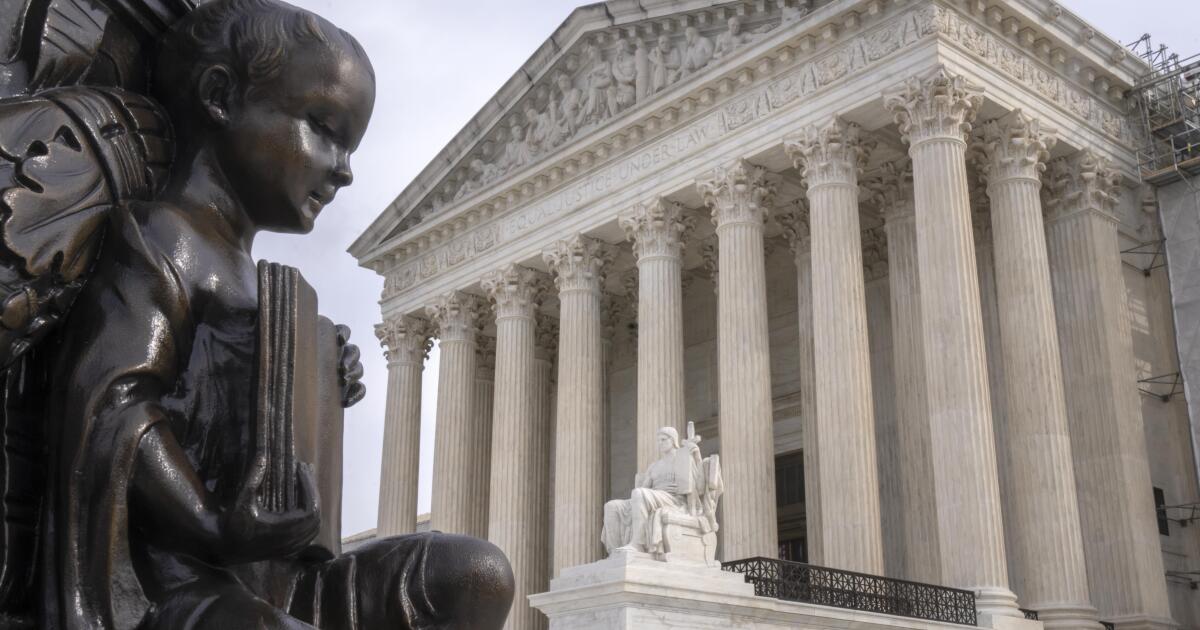
The first and easiest question to answer with respect to the package of Supreme Court reform measures that President Biden announced Monday is whether there is any hope of their passage or enactment by the current Congress.
There is not.
With Congress hopelessly polarized and the Supreme Court hopelessly politicized, there is no chance of action on Biden’s proposals in the coming months, and the administration well understands that point.
Indeed, before Biden even unveiled them in a speech at the LBJ Presidential Library in Texas, Republican House Speaker Mike Johnson pronounced them “dead on arrival.”
Why then choose now to introduce them? After all, Biden has steadfastly resisted pleas from progressives to try to reform the court — and he has been under pressure since he took office, because President Trump had just tilted the court to the right by appointing three justices.
The straightforward explanation for the timing is to make the Supreme Court, now quite possibly the most unpopular of all federal governmental institutions, a focus of the election, which would presumably nudge voters toward Vice President Kamala Harris.
It was no surprise (and presumably exactly what Biden and Harris wished) when Trump came out with a strident defense of the court.
But the proposals shouldn’t be dismissed as a mere political gesture. Biden and the Democrats are also playing the long game, looking in particular to make the court a campaign issue. Then if they win control of both chambers and the White House, they can portray their election as a mandate for substantial reforms.
Biden’s proposals are in three basic areas. First, ethics, responding to the series of scandals involving eyebrow-raising or nakedly partisan conduct by Justices Clarence Thomas and Samuel Alito. Second, time of service and method of appointment, which Biden proposes be changed to 18 years per justice and a fixed allotment of two new justices per presidential term. And third, the court’s recent, stunningly broad immunity opinion in the Jan. 6 Trump prosecution brought by the Justice Department.
Biden announced the reforms in a Washington Post op-ed that, interestingly, led with the immunity decision, which Biden wrote transgressed a bedrock principle of the nation: “No one is above the law.”
Indeed it does, but Biden and Harris, who was quick to endorse the proposals, obviously have calculated that of all the court’s recent unpopular moves, the immunity decision most offends the most American voters who might swing toward Harris.
Biden’s proposal recognizes that the decision can be overcome only by a constitutional amendment. I think that’s dubious; a careful reading of the Supreme Court’s sweeping immunity decision suggests it is ultimately anchored in perceived good government principles dressed up as constitutional law.
The problem here, as in one way or another with all the proposals, is the firmly entrenched principle that the Supreme Court has the last word. (One thinks of Justice Robert Jackson’s famous line “We are not final because we are infallible, but we are infallible only because we are final.”)
So that leaves the famously cumbersome process of a constitutional amendment, which requires either two-thirds of both houses or the states to request and three-quarters of the states to ratify.
The most recent constitutional amendment, the 27th, took more than 200 years to ratify. The Equal Rights Amendment, which was first proposed in 1923 to guarantee the rights of Americans regardless of their sex, still has not passed.
The ethics provision of the Biden package probably has the strongest chance of passing. It is conspicuous that the Supreme Court justices — alone among government officials — get to make and apply their own rules on issues such as whether they can take or must disclose gifts from parties who may have an agenda with the court. Although the court adopted ethics rules for itself last fall, they have no teeth. Justice Elena Kagan just last week called for the rules to be subject to an enforcement regime other than the justices themselves.
But in my view, the most important component of Biden’s package is his proposal to change Supreme Court terms from lifetime to 18 years, and, with the consistent rhythm of that span, guarantee each president precisely two appointments.
The design of the reform is to obviate the Armageddon quality of current confirmation battles. Lifetime appointments create very high stakes, leading to carefully curated fairly young nominees who can serve 40 years or more and have enormous, longstanding influence, as with the relatively young cadre of Trump appointees.
Term limits would prevent the imbalance that results if one president makes many appointments and others make few. Democrats are understandably frustrated at the bad luck — and GOP obstructionism — that allowed Republican presidents to choose six of the current nine justices, in a country in which more people identify as Democrats than as Republicans and in which Democratic presidential candidates have won the popular vote in seven of the last eight elections.
This proposal would do nothing to alleviate the current imbalance. Progressives had been pushing Biden to instead propose four additional seats on the court to undo the current uber-conservative hammerlock. The Constitution permits such an expansion, but the history of FDR’s court packing plan and similar efforts obviously persuaded Biden that the approach would freight the package with political controversy and long odds that would diminish the clean appeal of the rest of the provisions.
As for the court, today’s proposals only reinforce the grave loss of confidence it has brought on with its own overreaching. As a matter of raw power, it can continue on its path and remain oblivious to its many self-inflicted wounds. But Supreme Court history teaches that whatever its recognized authority in individual cases, it is untenable for it to operate indefinitely so against the grain of the American people.
As Alito said in an overheard comment, “one side or the other is going to win.”
Harry Litman is the host of the “Talking Feds” podcast and the “Talking San Diego” speaker series. @harrylitman


WASHINGTON — A spectacular economic upturn is on its way, President Trump promised Americans last week, galvanized in part by a deal brokered this month to end his war with Iran.
“Very soon you’ll be at $2.50 a gallon for gasoline,” Trump told a crowd Wednesday night on the National Mall. The next year, he said, “is set for an economic boom the likes of which no nation has ever seen before.”
Economists are skeptical. The effects of the war and other factors driving inflation are likely to stick around for months, experts say, presenting an ongoing challenge to American households — and to Trump’s party as it seeks to retain control of Congress in November’s midterm elections.
Yesenia De La Torre, 24, from Culver City pumps gas at the Chevron gas station on Sawtelle Boulevard and Culver Boulevard on June 15. Despite an agreement announced Sunday to end the Iran war and open the Strait of Hormuz, high oil, gasoline prices and energy supply problems won’t be solved overnight.
(Kayla Bartkowski / Los Angeles Times)
The war’s end will not create “a complete snap-back,” said Patrick Harker, professor at the University of Pennsylvania Wharton School and former president of the Federal Reserve Bank of Philadelphia.
“Markets are still cautious, and the infrastructure that’s been destroyed [in the Middle East] is going to take a while to re-create,” Harker said. “Inflation’s going to stay elevated for a while.”
Oil prices were dropping last week — falling to their prewar level Friday — and average gas prices fell by 7 cents per gallon over a week ago. But it will take significant time for oil shipping to ramp up through the Strait of Hormuz, infrastructure to be rebuilt and gas prices to drop, said Michael Negron, senior fellow for economic opportunity at the Center for American Progress.
“I would expect there to be a continued inching downward,” Negron said, but “we’re not going to just go back within weeks to $2.90 per gallon.”
That means the prices of gas and of other essentials aren’t likely to improve dramatically before the midterms, in which affordability has become a driving issue. It could heighten challenges for Republicans, who are defending their majorities in the U.S. House and Senate, as Democrats seek to leverage the issue to gain ground.
Positive messaging about the economy from Trump and other officials “doesn’t really resonate” with Americans who are struggling to make ends meet, said Gina Plata-Nino of the Food Research and Action Center, a national anti-hunger advocacy organization.
“When you’re still making the same amount of money but there’s less for you to be able to pay [for] your basic needs — gas is more expensive, food is more expensive — it doesn’t really add up,” she said.

A fruit stand on West 7th Street sells bananas for $2 per bunch.
(Carlin Stiehl / For The Times)
Americans question the costs
The Iran war has cost the average American household between $775 and $1,300 so far in fuel and taxpayer costs, according to an analysis by Roger Pielke, a senior fellow at the American Enterprise Institute.
The national average gas price sat at $3.90 on Friday, according to AAA, and California’s average was $5.48 per gallon, down 13 cents from a week earlier.
The increase in oil prices has also affected diesel and fertilizer prices, creating a ripple effect through several sectors, including agriculture. Consumer prices rose 4.1% in May from a year earlier, putting the inflation gauge at a three-year high.
Trump has leaned on a bullish message about the economy, but he has largely dismissed Americans’ worries about affordability, calling it a “fake word” and a “hoax.” Last week, he undermined the first major progress by Congress on the issue, refusing to sign a bipartisan housing affordability bill after both chambers passed it.

President Donald Trump closes his eyes as Dr. Ben Carson, left, speaks during an event with the White House Religious Liberty Commission in the Oval Office on Friday.
(Anna Moneymaker / Getty Images)
Meanwhile, the president’s approval rating on the economy dropped to 33% last week in an NPR/PBS News/Marist Poll — his lowest ever for that poll and 3 points below former President Biden’s worst reading on the question during his term.
Nearly four-fifths of respondents said that gas prices present some sort of strain, with 34% categorizing it as a major strain and 44% calling it a minor strain. Half of respondents who said they were not vacationing this summer said cost was the reason.
And only 23% of Americans say the war was worth the costs, according to a Reuters/Ipsos poll conducted days after the Trump administration announced the framework agreement to end the conflict earlier this month.
“People [are] just feeling like they’re getting left behind,” Harker said. “That’s a very real, palpable feeling when you go out and talk to people. They’re worried.”
The president and his party need a midterms message that “real economic change” is coming, said Brian Reisinger, a rural policy analyst in Wisconsin and a former GOP strategist.
“It has to be substance behind the sell,” Reisinger said.

Senate Majority Leader John Thune (R-S.D.) speaks to reporters after the weekly Senate policy luncheons at the U.S. Capitol on Tuesday in Washington, D.C. Thune spoke on a meeting with President Trump on the Iran deal.
(Kevin Dietsch / Getty Images)
U.S.-Iran talks on shaky ground
Trump’s boosters have hailed the Iran deal as a victory for the president. And Trump has justified the shock to gas prices as “worth it not to have a nuclear weapon” in Iran, though the war has not achieved the president’s stated aims, which included the elimination of its nuclear program.
“President Trump was clear all along that there would be short-term, temporary disruptions to energy markets, and that oil and gas prices will quickly fall as soon as the Iran situation is resolved,” White House spokesperson Taylor Rogers said Friday.
How rapidly the conflict will be resolved is not yet clear. The U.S.-Iran negotiations were on shaky ground by week’s end, with each country offering diametrically opposed messaging on the status of key points of negotiation.
Analysts say much of the increase in traffic through the strait has been driven by the return of Iranian oil to global markets. Trump agreed in the controversial deal with Iran to lift sanctions on Iranian oil, allowing Tehran to resume trading its most valuable export and breaking with decades of U.S. policy.
The unpredictability of the talks is another factor keeping energy companies, shippers and insurers cautious for now, Negron said.
“Everything is to be negotiated in the next nearly two months,” he said. “It is natural to expect there to be additional risk priced into each barrel of oil, into the insurance people are paying, just because of the volatility and uncertainty of where we are.”

NEWYou can now listen to Fox News articles!
He wasn’t on the ballot, but President Donald Trump was a winner in Louisiana’s GOP Senate runoff election.
That’s because Trump-backed Rep. Julia Letlow defeated state Treasurer John Fleming to capture the Republican nomination, The Associated Press reported on Saturday.
Six weeks after denying Trump-targeted GOP Sen. Bill Cassidy a third six-year term in the Senate, a majority of Republican voters in the solidly red Gulf Coast state backed Letlow. Her victory in the runoff is seen as another victory for Trump as he works to fill the halls of Congress with loyal lawmakers for his final two years in the White House. And it’s another sign of the power of a Trump endorsement in Republican primaries.
Five years after he voted to convict Trump in his second impeachment trial, Cassidy was sent packing.
WATCH: CASSIDY DETAILS NEW BEHIND CLOSED DOORS CLASH WITH TRUMP
Sen. Bill Cassidy of Louisiana fist bumps a supporter during a campaign stop at a gun retailer and firing range in Baton Rouge on May 15, 2026, the eve of the state’s Senate primary. (Paul Steinhauser/Fox News)
Trump reacted to Letlow’s victory in a Truth Social post, calling Saturday’s result “great news.”
“Julia Letlow WON in Louisiana, beating conclusively a very strong and smart opponent,” Trump wrote. “Congratulations to Julia. She will be a truly GREAT Senator!”
Letlow, who was backed by Trump even before she entered the race in January, finished first in the primary, double digits ahead of Fleming, with Cassidy in third place. Since no candidate cracked 50% of the vote, Letlow and Fleming advanced to the runoff for the Republican nomination and Cassidy became the first elected Republican senator to lose renomination since Sen. Richard Lugar of Indiana in 2012.
Trump, celebrating Cassidy’s defeat, said on social media that “it’s nice to see that his political career is OVER!”
Cassidy, in a speech to supporters after conceding, took a jab at Trump, saying, “When you participate in democracy, sometimes it doesn’t turn out the way you want it to. But you don’t pout, you don’t whine. You don’t claim the election was stolen… You don’t manufacture some excuse.”
President Donald Trump stands with Rep. Julia Letlow during the Congressional Ball at the White House Grand Foyer in Washington, D.C., on Dec. 11, 2025. (Alex Wong/Getty Images)
Letlow, who was backed by Louisiana Gov. Jeff Landry, a top Trump ally, won her congressional seat in 2021, after her husband, Luke Letlow, died five days before being sworn into the U.S. House after his 2020 election victory for the seat she now holds. She highlighted her support from Trump throughout her Senate campaign.
Fleming, who spent eight years in Congress before serving as a White House deputy chief of staff during Trump’s first term, argued he was the most conservative candidate in the GOP Senate primary.
DEMOCRACY ’26: STAY UP TO DATE WITH THE FOX NEWS ELECTION HUB
Letlow will be considered the clear frontrunner in the midterm election against either farmer Jamie Davis or Navy veteran Gary Crockett, who are facing off in the Democratic Party runoff.
The brute force of the president’s endorsement power has been on display in GOP primaries over the past two months, with his candidates ousting incumbents he targeted in showdowns in Indiana, Kentucky and Texas, as well as the Louisiana primary.
But Trump’s endorsement streak in statewide and congressional Republican primaries was snapped three weeks ago when his last-minute endorsement of Republican Rep. Randy Feenstra of Iowa in the race to succeed retiring GOP Gov. Kim Reynolds wasn’t enough to propel the three-term congressman to victory.
Feenstra was narrowly edged by Zach Lahn, a businessman, farmer and former political strategist who was backed by the political wings of MAHA — the acronym for the Make America Healthy Again movement aligned with Trump’s Health Secretary Robert F. Kennedy Jr. — and Turning Point USA, the powerful conservative organization co-founded by the late Charlie Kirk.
Zach Lahn raises his fist in celebration after defeating his primary opponent in Iowa’s GOP gubernatorial race on Tuesday, June 2, 2026. (Zach Lahn for Governor via Facebook)
The president rebounded three weeks ago in South Carolina, as Trump-backed Lt. Gov. Pam Evette finished first in the GOP gubernatorial primary and longtime Trump ally Sen. Lindsey Graham won a majority of the vote in the Republican Senate primary, and avoided a runoff.
Graham, who was endorsed by Trump, was facing primary challenges from five candidates, including conservative businessman Mark Lynch, who took aim at the senator over his support for the war in Iran. Lynch was backed by some MAGA leaders who have been critical of the president.
Two weeks ago, Trump-backed candidates won two of the three top races in Georgia and Alabama, with the one setback coming against a billionaire businessman who shelled out over $100 million of his own money to boost his campaign.
Rep. Barry Moore, a House Freedom Caucus member and longtime Trump supporter who was endorsed by the president, comfortably defeated rival Jared Hudson, a former Navy SEAL sniper who was supported by some top names on the right, in solidly red Alabama’s GOP Senate runoff.
In battleground Georgia’s Republican Senate runoff, an 11th-hour endorsement by Trump helped boost Rep. Mike Collins, a MAGA champion, to victory over former college football coach Derek Dooley, who was backed by popular conservative Gov. Brian Kemp.
TRUMP’S ENDORSEMENT FAILS TO SAVE MAGA CANDIDATE AS BILLIONAIRE ADVANCES IN KEY GOVERNOR RACE
Collins will face Democratic Sen. Jon Ossoff in the general election in a race that’s among a handful that will likely decide if the GOP holds its slim majority in the chamber in the midterms.
CLICK HERE TO DOWNLOAD THE FOX NEWS APP
But in Georgia’s GOP gubernatorial runoff, the candidate Trump backed, Lt. Gov. Burt Jones, who was also endorsed by Kemp this past weekend, was defeated by billionaire businessman Rick Jackson, who ran as an outsider.
On Tuesday, Trump-backed first-time candidate Anthony Constantino, a businessman and former boxer, defeated Robert Smullen, a retired Marine Corps colonel and New York Assembly member who had the backing of the state party, in the upstate New York race to succeed retiring GOP Rep. Elise Stefanik.
Meanwhile, in South Carolina’s Republican gubernatorial runoff, Trump couldn’t lose.
That’s because, besides backing Evette, he also gave a last-minute endorsement to state Attorney General Alan Wilson, who ended up winning the showdown in a landslide.

WASHINGTON — Asylum seekers may be turned away without a hearing at the southern border, the Supreme Court ruled Thursday in a historic retreat from the promise of relief for those who say they are fleeing persecution.
The justices split over whether this was a simple dispute over legal wording or a moral question involving desperate families.
Siding with the Trump administration, the court’s conservatives said the Refugee Act of 1980 offers a right to seek asylum to migrants who “arrive in the United States” but not those who are turned back when they approach a border crossing or a port of entry.
“This case presents a straightforward question” that turns on the word “in,” said Justice Samuel A. Alito Jr. “In ordinary speech, no one would say that a person ‘arrives in’ a place — for example, a house, a city, or a country — before the person enters that place.”
The liberal dissenters agreed with immigration rights lawyers who saw this as a nonsensical reading of the law.
Justice Sonia Sotomayor said the asylum law arose from the “international moral reckoning that followed the Holocaust and World War II.”
She cited the infamous voyage of the MS St. Louis in 1939. More than 900 Jewish refugees attempted to flee persecution in Nazi Germany by setting sail aboard the ship, which was turned away from Cuba and the United States.
Most of the passengers were returned to Europe, and several hundred died in the Holocaust, she said.
“Congress passed the Refugee Act in 1980 because it did not want this country to repeat the mistakes of its past. Yet if the refugees on the M.S. St. Louis were to walk up to a port of entry on our southern border today, the majority’s interpretation would allow immigration officers to refuse even to consider their asylum applications by physically blocking them from stepping foot onto U.S. soil,” Sotomayor wrote.
Justices Elena Kagan and Ketanji Brown Jackson agreed.
The decision upholds a turn-back policy that began in 2016 as an emergency response to a surge of Haitian immigrants at the San Ysidro border crossing.
The Department of Homeland Security said these asylum seekers must wait on the Mexican side of the border until they could return for a scheduled interview. The policy was extended to other border crossings, but it was challenged as illegal in federal court in San Diego.
Last year, a divided 9th Circuit Court of Appeals ruled that those restrictions were illegal if they prevented migrants from applying for asylum.
“To ‘arrive’ means ‘to reach a destination,’” wrote Judge Michelle Friedland. “A person who presents herself to an official at the border has ‘arrived.’”
She said the “government’s reading would reflect a radical reconstruction of the right to apply for asylum because it would give the executive branch vast discretion to prevent people from applying by blocking them at the border.”
The 2-1 decision upheld a federal judge’s ruling in San Diego for migrants who had filed a class-action suit and said they were wrongly denied an asylum hearing.
But Solicitor Gen. D. John Sauer urged the Supreme Court to review and reverse the appellate ruling, noting 15 judges of the 9th Circuit joined dissents that called the decision “radical” and “clearly wrong.”
The administration argued federal immigration law “does not grant aliens throughout the world a right to enter the United States so that they can seek asylum.”
From abroad, they may “seek admission as refugees,” Sauer said, but the government may enforce its laws by “blocking illegal immigrants from stepping on U.S. soil.”
Defenders of the asylum system denounced the decision.
“We believe that today’s ruling violates international law, as well as the express intent of Congress,” said Erika Pinheiro, executive director of the migrant support organization Al Otro Lado, which led the legal fight. “For decades, the United States has allowed individuals and families who are fleeing persecution, torture and death to ask for protection at U.S. borders.”
“Cruelty is not a substitute for real solutions. Blocking people from seeking asylum at official ports of entry will do nothing to fix our broken immigration system,” said Rebecca Cassler, senior litigation attorney at the American Immigration Council. “It only makes things more chaotic and dangerous for vulnerable families.”
The Federation for American Immigration Reform applauded the decision.
“Our immigration laws are written to be pro-enforcement, not anti-enforcement,” said Christopher J. Hajec, deputy general counsel of FAIR. “Because of this, courts that hamstring enforcement are often forced to violate basic logic, as the 9th Circuit did here. We are pleased the Supreme Court saw that the lower court’s reading would make immigration law incoherent, and reversed.”
-

 Health51 seconds ago
Could ‘humanmaxxing’ actually help you live longer? Here’s what experts say
-

 Sports4 minutes ago
WWE NXT The Great American Bash 2026 preview, predictions and more
-

 Technology9 minutes ago
FBI warns Microsoft users about passwordless scam
-
 Business16 minutes ago
Swipeless online dating? How AI is reshaping the search for love
-
 Entertainment19 minutes ago
Review: They’re finally too old for it in the middling clip reel ‘Jackass: Best and Last’
-
Politics31 minutes ago
Costs of Iran war will linger despite conflict’s end, experts say
-
 Sports39 minutes ago
Commentary: You’re up, Rob Pelinka. To avoid Ned Colletti’s fate, the Lakers’ GM has to deliver this offseason
-

 World49 minutes ago
Q&A: Why humanitarian aid is crucial to stopping the Ebola outbreak

