Politics
John Kirby dodges grilling over plea agreement for 9/11 terrorists: ‘Didn’t hear an answer’


White House National Security Council communications adviser John Kirby on Sunday dodged answering questions regarding the abrupt plea deal reversal provided to a trio of 9/11 terrorists last week.
“Is the president willing to let these terrorists escape the harshest penalty in the system of justice and let that be part of his legacy?” Fox News’ Jacqui Heinrich asked Kirby during an interview on “Fox News Sunday.”
“Again, this was a decision made by a convening authority in the military chain of command, an independent convening authority,” Kirby responded.
“He didn’t weigh in at all?” Heinrich pressed.
BIDEN-HARRIS ADMINISTRATION BACKTRACKS, REVOKES PLEA DEAL FOR 9/11 TERRORISTS
National Security Council spokesman John Kirby speaks during the daily briefing at the White House on Jan. 31, 2024. (Mandel Ngan/AFP via Getty Images)
“The secretary of defense has the authority to change the delegation of that – of that authority to the convening authority,” Kirby continued. “I know that sounds kind of complicated, but he has the authority to do that. He did this on his own.”
“But did the president weigh in?” Heinrich asked again.
“This was a decision made by the secretary of defense,” Kirby said, sparking Heinrich to say that she “didn’t hear an answer.”
The Department of Defense announced last week the Convening Authority for Military Commissions entered into pretrial agreements with Khalid Shaikh Mohammad, Walid Muhammad Salih Mubarak Bin ‘Attash, and Mustafa Ahmed Adam al Hawsawi. The agreement included taking the death penalty off of the table for the three 9/11 plotters.
9/11 MASTERMIND, 2 OTHERS STRIKE PLEA DEALS WHILE AWAITING TRIAL; FAMILIES OF VICTIMS ‘VERY DISAPPOINTED’
As outrage mounted over the agreement, the White House said Biden did not play a role in the deal.
President Biden arrives to board Air Force One at Joint Base Andrews in Maryland, on Aug. 15, 2023. (Andrew Caballero-Reynolds/AFP via Getty Images)
“The White House learned yesterday that the Convening Authority for Military Commissions entered into pretrial agreements, negotiated by military prosecutors, with KSM and other 9/11 defendants,” a White House National Security Council spokesperson told Fox News Digital. “The President and the White House played no role in this process. The President has directed his team to consult as appropriate with officials and lawyers at the Department of Defense on this matter.”
PLEA DEAL REVERSAL FOR 9/11 TERRORISTS WINS PRAISE AND DEMANDS FOR JUSTICE FROM VICTIMS GROUPS, REPUBLICANS
Biden has also rejected a proposal last year that would have spared the three suspects from the death penalty.
After the news broke, the Defense Department abruptly backtracked on the agreement on Friday. Secretary of Defense Lloyd Austin has now taken the lead on the case.
“Effective immediately, in the exercise of my authority, I hereby withdraw from the three pretrial agreements that you signed on July 31, 2024,” the letter from the secretary reads.
Secretary of Defense Lloyd Austin has now taken the lead on the case. (Anna Moneymaker/Getty Images)
No explanation was offered as to why the matter was not settled before the deals were concluded and publicly announced.
Heinrich pressed Kirby whether Biden asked Austin to rescind the deals to the trio of terrorists, to which the White House spokesman responded that Austin made an “independent decision.”
HARRIS SAYS ISRAEL HAS RIGHT TO DEFEND ITSELF AS IRAN, RUSSIA AND LEBANON CONDEMN IDF STRIKE ON HEZBOLLAH
“This was a decision made by the secretary of defense. It was an independent decision by him, certainly within his authorities, as in the chain of command at the Defense Department,” Kirby responded.
On Sunday, Kirby also addressed ongoing efforts to broker a cease-fire in Israel as war continues raging since Oct. 7, when Hamas launched an attack that killed more than 1,200 and led to the kidnapping of hundreds more.
Spokesman John Kirby speaks during a press briefing at the White House on Tuesday. (AP/Evan Vucci)
“Number one, we still believe a cease-fire deal is the best way to bring this war to an end. It’s also, we believe, very possible. We still believe the gaps are narrow enough to close,” Kirby said.
VANCE SLAMS 9/11 PLEA DEAL DURING RALLY: ‘NEED A PRESIDENT WHO KILLS TERRORISTS, NOT NEGOTIATES WITH THEM’
“The other thing that we’ve been doing since the 7th of October is making sure that not only Israel has what it needs to defend itself, but that this war doesn’t escalate to become something broader, a regional war, a regional conflict. And that’s what you’re seeing us do.”
Concern has grown, however, that Prime Minister Benjamin Netanyahu does not want a cease-fire. On CNN’s “State of the Union,” deputy national security adviser Jonathan Finer said he could not weigh in on Biden’s private discussions with Netanyahu about a cease-fire deal, while noting that the two world leaders have a candid and long-established relationship.
Deputy national security adviser Jon Finer appears on “Meet the Press” on April 24, 2022. (William B. Plowman/NBC/NBCU Photo Bank via Getty Images)
“I won’t speak to the private conversations that take place between the president and the prime minister. What I will say is these are two people who have a four-decade-plus relationship. One of the extraordinary assets in the US-Israel relationship is this personal relationship between these two leaders in which they can speak to each other directly and candidly. That’s been the case since President Biden came to office, it’s certainly been the case since Oct. 7,” Finer said when asked about Netanyahu potentially avoiding a cease-fire deal.
“The United States has been extremely clear, both publicly and privately, about how urgent we think it is that the cease-fire and hostage deal be established. Nothing that’s taken place over the last week or two has changed that sense of urgency, and if anything, part of why we believe this needs to happen as quickly as possible is because in the Middle East, at a time in which there are hostilities taking place, outside factors can infect and disrupt these talks. And so we don’t want to allow that to happen.”
Fox News Digital’s Stepheny Price contributed to this article.

Politics
Fetterman unleashes on ‘dirtbag’ wing of Dems after far-left victories: ‘Orgy of socialism’

NEWYou can now listen to Fox News articles!
Sen. John Fetterman, D-Pa., unloaded on his own party on Sunday evening, blasting a series of victories for progressives he called “anti-America.”
“Big night for the dirtbag left,” Fetterman said, referring to New York’s recent primaries, where two members of the Democratic Socialists of America (DSA) won primaries.
“I’ve said the party is becoming an orgy of socialism. Clearly anti-America, anti-Western Civilization,” Fetterman said.
Fetterman’s striking calls give a rare look at how some moderates may view the developments on their far-left flank that have dominated the party’s momentum in recent months, sparking concern that their high visibility is dragging the party further and further left.
FETTERMAN WARNS DEMOCRATS ‘DRIFTING FIRMLY INTO COMMUNISM’ AFTER SOCIALIST PRIMARY WINS
Sen. John Fetterman, D-Pa., speaks to reporters outside the Senate Chamber during votes on Nov. 10, 2025, on Capitol Hill in Washington, D.C. (Andrew Harnik/Getty Images)
His comments come on the heels of a handful of key progressive victories.
In Maine, Graham Platner, a controversial Democratic candidate for U.S. Senate, has attracted controversy for denying knowledge of the meaning behind a Nazi-linked tattoo, for off-color comments about race and calling himself a “communist” in a deleted Reddit post.
In New York, one DSA member, Claire Valdez, won a primary on a platform of abolishing ICE and a Green New Deal-style approach to climate change. Similarly, Darializa Avila-Chevalier, another DSA candidate, beat out incumbent Rep. Adriano Espillat, D-N.Y., a high-ranking Democrat and the chair of the Congressional Hispanic Caucus.
WINNERS AND LOSERS EMERGE AFTER SOCIALIST EARTHQUAKE ROCKS NYC PRIMARIES
Graham Platner, Democratic Senate candidate for Maine, speaks at a primary election night event at the Blue Hill YMCA in Blue Hill, Maine, on June 9, 2026. Platner won the party’s Senate primary after a campaign marked by accusations of past misbehavior and voter concerns. (Graeme Sloan/Bloomberg via Getty Images)
Both Chevalier and Valdez had the backing of New York Mayor Zohran Mamdani, himself a socialist.
The wins have captured national attention and drawn criticisms from Republicans who have pointed to their success as emblematic of the direction of the Democratic Party.
Fetterman, who has not shied away from confrontations, has been one of the few Democrats to express alarm about the kind of candidates carrying the party’s banner.
“I mean, you look at some of the things that people have said. Abolish prison, abolish the border, abolish ICE, I mean these crazy people — I have colleagues in my caucus that refuse to even call this out,” Fetterman said.
FETTERMAN REACTS TO MAMDANI’S REFUSAL TO ACCEPT SUPREME COURT’S IMMIGRATION RULING
U.S. Sen. John Fetterman, D-Pa., walks through the Senate Subway during the Senate War Powers vote on April 22, 2026, in Washington, D.C. (Heather Diehl/Getty Images)
CLICK HERE TO DOWNLOAD THE FOX NEWS APP
“Between P-hustle in Maine and some of the other winners in New York, they should form their own party and run on all the things that they’ve had to delete on social media,” Fetterman said, referring to Platner.
“That’s where our party has moved,” he added.
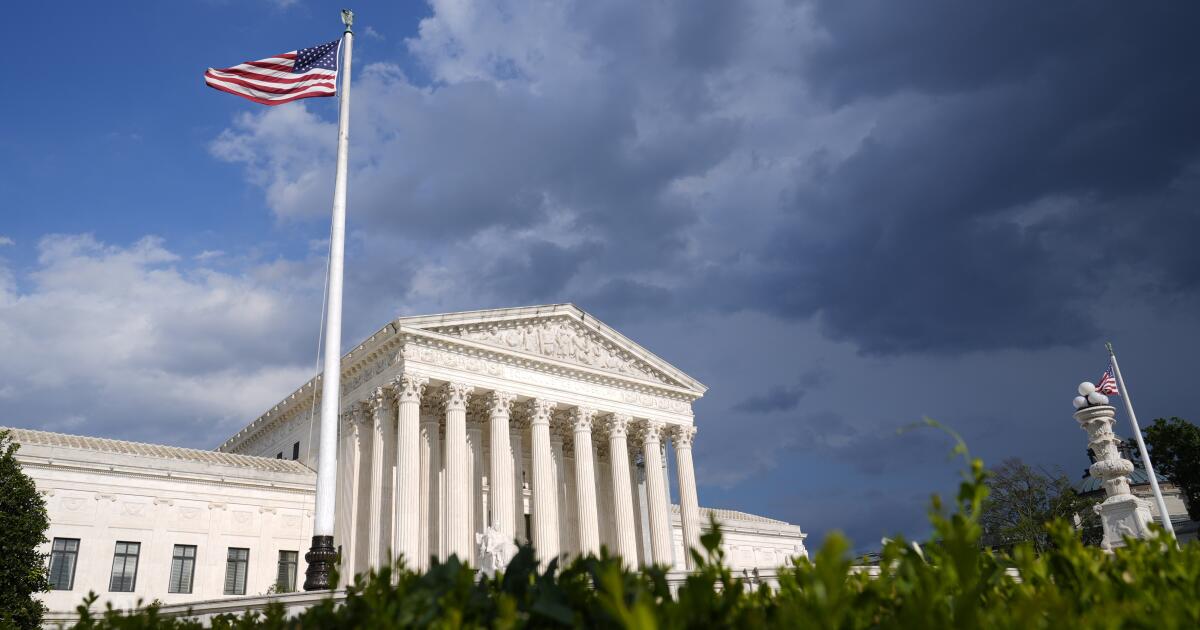
WASHINGTON — The Supreme Court cast doubt Monday on whether police may obtain cellphone data to find crime suspects.
In a 6-3 decision, the justices said this location information showing where a cellphone user has traveled is personal and private and subject to the protection of the 4th Amendment’s ban on unreasonable searches.
Justice Elena Kagan said these “records serve as a personal journal of a user’s movements.”
She said the information “resembles other private materials — think of emails, documents, photographs, or calendars—that even if stored on Google’s servers, a user reasonably views as his own…and reasonably expects to be shielded from the inquisitive eyes of the government.”
Because an “individual has a legitimate expectation of privacy in his cellphone location data,” she said police investigators need a valid search warrant from a magistrate.
The court stopped short of deciding the proper basis for a search warrant in such cases. Instead, the justices sent the case back to judges in Virginia.
But the outcome casts doubt on “geofence warrants.”
In recent years, police have gone to Google and cellphone companies seeking tracking data on cellphones that were at a crime scene. Sometimes, they have had a warrant from a magistrate.
Civil libertarians say the use of this tracking data raises the specter of mass surveillance on innocent people.
Police and government lawyers say no one has a reasonable right to privacy when they are walking on a sidewalk or driving down the street.
The case before the court arose from the armed robbery conviction of a Virginia man who stole $195,000 from a credit union in a small town near Richmond.
By the time police arrived, the robber had fled. But surveillance cameras showed he was carrying a gun and a cellphone.
Lacking other leads, detective Joshua Hilton asked a judge to issue a special type of warrant seeking information from Google.
Referred to as a “geofence warrant,” it seeks data from phones in a particular area at a particular time.
The detective sought data on phones that were within 150 yards of the credit union within one hour of the late afternoon robbery.
After examining and paring down the data, the detective asked for the phone records of Okello Chatrie. Then, with a search warrant of his home, investigators found two robbery-style demand notes, a semi-automatic pistol and about $100,000 in cash.
A judge refused to suppress the evidence from an allegedly unconstitutional search, and Chatrie entered a conditional guilty plea.
The full 4th Circuit Court of Appeals split evenly on the legality of the geofence warrant, and the Supreme Court agreed to decide the issue in Chatrie vs. U.S.
Usually investigators obtain warrants to search the home or vehicle of a known crime suspect.
The new and disputed geofence warrants seek to find a suspect by examining data on the cellphones that were at the scene of a crime.
The FBI used this cellphone data in 2021 to identify suspects who broke through police barricades on Jan. 6, 2021, and pushed their way into the Capitol to disrupt the official counting of electoral votes.
Chief Justice John G. Roberts Jr. and Justices Sonia Sotomayor, Neil M. Gorsuch, Brett M. Kavanaugh and Ketanji Brown Jackson agreed on the outcome in Chatrie vs. U.S.
In a 21-page dissent, Justice Samuel A. Alito Jr. said the court had “carefully set the stage for its planned performance: striking a pose as a great champion of privacy in the digital age. I cannot support this irresponsible escapade.”
Justice Clarence Thomas agreed.
Justice Amy Coney Barrett agreed in a one-paragraph dissent. “Chatrie had no reasonable expectation of privacy in data about his public movements that he voluntarily disclosed to Google,” she said.
The Supreme Court ruled 6-3 that President Trump could fire independent regulators for any reason. But the justices carved out an exception for the Federal Reserve, preventing the immediate removal of Lisa D. Cook, a Federal Reserve governor.
-

 Indianapolis, IN3 minutes ago
Caitlin Clark not practicing Tuesday, to do individual workout
-

 Pittsburg, PA8 minutes ago
Pittsburgh area’s low jobless rate beats state, U.S. rates
-

 Augusta, GA15 minutes ago
Salvation Army of Augusta collects heat relief supplies
-

 Washington, D.C18 minutes ago
Washington Spirit Announces Midseason Roster Update
-
 Cleveland, OH23 minutes ago
No idling: Why it’s against the law in Cleveland
-

 Austin, TX30 minutes ago
Home Automation Austin Brings Personalized, Full-Service Home Automation to Homeowners in Austin
-

 Alabama33 minutes ago
Former Alabama Inmate Arrested After Allegedly Flying Drone with Contraband Toward Prison
-

 Alaska38 minutes ago
As war stalls, Putin concedes he never cut a deal with Trump in Alaska

