Politics
It’s over, and other takeaways from Trump's defeat of Haley in New Hampshire

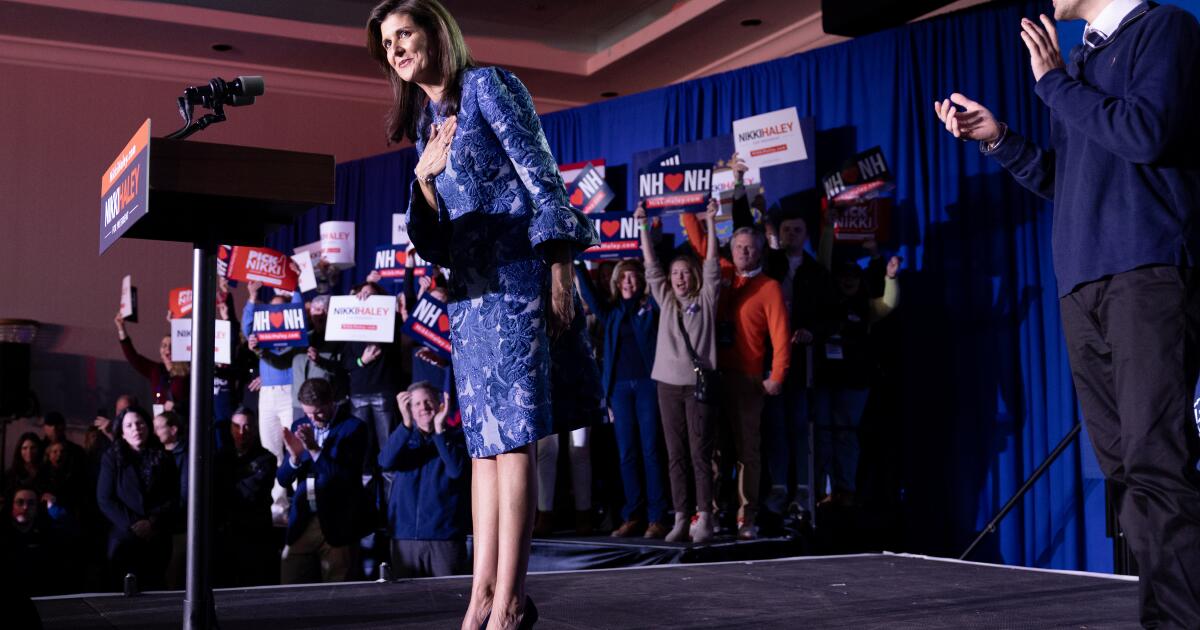
Former President Trump won the first Republican primary Tuesday in New Hampshire over his closest competitor, former South Carolina Gov. Nikki Haley, according to a projection by the Associated Press. Though the outcome was expected, it was significant.
Here are some takeaways.
It’s over
Yes, Haley remains in the race, for now. But Trump’s victory in the first primary state — which happens to have one of the more moderate and least Trump-friendly electorates in the GOP — all but seals hisparty’s nomination, setting up an expected rematch with President Biden.
The not-terribly-competitive nominating contest has underscored how much the GOP has become Trump’s party.
Trump left office with low approval ratings and two impeachments that followed an unprecedented attempt to overturn a lawful election. But he entered the nominating fight with many of the advantages of an incumbent, then scored wins in both Iowa and New Hampshire, a rare feat for a Republican presidential hopeful.
Endorsements tell part of that story. They don’t often matter, but two recent nods from former opponents demonstrate why Trump has been the default choice from the beginning. Florida Gov. Ron DeSantis and South Carolina Sen. Tim Scott both got behind Trump soon after they left the race.
Neither man had much personal reason to embrace Trump. The former president relentlessly targeted DeSantis, who entered the race with high approval ratings, calling him “Desanctimonious” and mocking his appearance, among other insults. But both men endorsed Trump for the same reason they held back from attacking his vulnerabilities during the race: GOP voters still adore him. The two believe that if they want to have a future in the party, at least in the near term, they need to stay with Trump.
Does Haley drop out with her home state looming?
Haley has said repeatedly that she will not depart the race after New Hampshire — as she did again Tuesday night after the race was called for Trump.
“New Hampshire is first in the nation, it is not last in the nation. This race is far from over,” she told supporters.
Most candidates make similar statements until the moment they leave the race. Haley’s underdog strategy depended on winning New Hampshire, which is filled with highly educated Republican and independent voters whom Haley has been seeking.
The race next heads to Nevada and the Virgin Islands, which hold Republican caucuses Feb. 8.
Polls show Haley down by nearly 40 percentage points to Trump in South Carolina, her home state, which holds its Republican primaryFeb. 24. A big loss there would be damaging to her prospects, though not fatal. Florida Sen. Marco Rubio drew only 27% against Trump in his home state in 2016; though he soon exited the presidential race, he won reelection easily to his Senate seat that fall.
But many candidates, including Kamala Harris when she was a California senator, choose to avoid the potential stain on their resume that would come from losing in their home state. They dropped out before any ballots were cast in the 2020 race. In Harris’ case, it paid off with a nomination for vice president, though Haley seems unlikely to get the nod from Trump.
Nikki Haley supporters listen as the candidate speaks after her primary defeat.
(Gina Ferazzi / Los Angeles Times)
Another historic moment for a twice-impeached president
Trump’s win Tuesday, coupled with last week’s caucuses victory in Iowa, marked another historic moment: It was the first time he faced voters since leaving office, still refusing to accept the election results while encouraging an angry mob that stormed theCapitol.
He’s facing 91 criminal charges and has threatened, among other things, to terminate the Constitution and give himself dictatorial powers for a day, while claiming that presidents enjoy absolute immunity from prosecution, even for acts that “cross the line.”
The question is a dividing line for many voters. In preliminary network exit polling, 85% of Haley’s voters said Trump, if convicted of a crime, is unfit to be president. Only 11% of Trump’s voters said that.
Democrats hope voters will start comparing Biden to ‘the alternative’
Biden for months has repeated the aphorism “Don’t compare me to the Almighty, compare me to the alternative.” He argues that his low approval rating — below 40% — will matter less once people zero in on the binary choice between him and Trump.
That process is likely to intensify as Trump gets closer to securing the nomination. The big question is whether the election, now forecast as close, will shift to Biden’s favor when voters take a closer look at Trump. Historically, Trump’s approval rating in polls has dropped as he gets more public exposure.
Turnout for a Trump-Biden rematch could fade
Voters showed up in huge numbers in 2018, 2020 and, in some states, 2022, in part because Trump inspires such strong positive and negative feelings. Abortion also played a large role in 2022, after the Supreme Court’s decision to overturn a constitutional right to the procedure.
Will that fervor persist in November, or are voters too fatigued and uninspired for a likely rematch that has turned off many? That’s one of the biggest questions and one that both parties will pursue now that the general election is taking shape.
Biden needs to shore up support from younger and Black voters, key groups for him in 2020 whose excitement has waned, polls show. Trump needs to minimize losses in the suburbs, where educated Republican women have defected.
What happens to third parties? Will they fade as usual or play spoiler?
Robert F. Kennedy Jr. has been drawing double digits in some polls as an independent candidate. A centrist group called No Labels has been floating a third-party ticket, though no one has signed up to run.
History shows that these candidacies tend to fade by the time voters cast ballots. But they have had an impact, including in 1992, when Ross Perot drew 19% of the vote. Debate continues over which of the two major candidates he hurt worse: Bill Clinton defeated George H.W. Bush with a mere 43% of the popular vote. In 2000, Ralph Nader may have tipped the balance for George W. Bush in his race against Al Gore.
Conventional wisdom holds that Biden will be hurt by a third-party candidate because Trump’s core base is so loyal. But that is unclear, especially in the case of Kennedy, whose conspiratorial views on vaccines and other topics align with those of many Trump supporters.



Politics
Carney casts himself as NATO defender amid Trump beef, despite Canada missing key benchmark for decades

NEWYou can now listen to Fox News articles!
Canadian Prime Minister Mark Carney defended his country’s NATO commitments after being pressed over alliance spending by President Donald Trump, insisting Ottawa meets the benchmark – even though Canada only reached the 2% defense target in 2025.
Speaking recently at a press conference in Monteregie, Quebec, Carney said Iran remains a “grave threat” to the Middle East and beyond and argued Canada is meeting its obligations to the alliance.
But Canada only reached NATO’s 2% defense spending benchmark in 2025, after spending years well below the target. Carney acknowledged Ottawa had not hit that mark since the Cold War, underscoring the vulnerability in his pushback to Trump.
“I’ll underscore that just a few weeks ago that we’ve met for the first time since the fall of the Berlin Wall our NATO commitments in terms of 2% defense spending,” Carney added.
ECONOMIST EDITOR SAYS EUROPEAN LEADERS NOW FEAR A TRUE NATO ‘DIVORCE’ AFTER TRUMP PULLOUT THREAT
Trump has blasted some NATO allies over what he sees as weak support during the Iran conflict, warning on Truth Social that the alliance “wasn’t there when we needed them and they won’t be there if we need them again.”
When a reporter pressed that Trump threatened to punish NATO, including conflict-averse members Germany and Spain, Carney boasted that Canada “meet[s] its NATO commitments.”
NATO’s 2014-2025 defense expenditure report estimated Canada’s defense spending at 1.01% of GDP in 2014, and below 1.5% through 2024 before reaching 2.01% in 2025.
NATO CHIEF SAYS WORLD IS ‘ABSOLUTELY’ SAFER UNDER TRUMP
Meanwhile, NATO Secretary-General Mark Rutte has praised Trump for pushing allies to meet the 2% benchmark, as several Eastern Bloc nations have noticeably increased their tithes.
Over the past decade, U.S. defense spending has averaged roughly 3.3% of GDP, compared with about 1.3% for Canada. The U.S. GDP is also a higher gross figure than all other NATO members in dollars.
MORE KEY US ALLIES BLOCK MILITARY FLIGHTS AS IRAN WAR RIFT WIDENS WITH TRUMP
Tensions between Canadian Prime Minister Mark Carney and U.S. President Donald Trump flared after the World Economic Forum in Davos, Switzerland. (Renaud Philippe/Bloomberg; Chip Somodevilla/Getty Images)
Greece and the U.K. have been the top two countries consistently contributing to NATO’s funding, while Canada, Spain, Belgium, the Czech Republic and Hungary all sit in the lower tier on average. The only outlier below them is Luxembourg, which contributes an average 0.6% of GDP to NATO, according to calculations made from the report’s figures.
TRUMP LASHES OUT AT ‘SICK’ IRANIAN LEADERS, CONFIRMS ESTIMATED TIMELINE FOR ENDING WAR
Rutte previously made waves for appearing to refer to Trump as “daddy,” but said this week the Dutch-to-English translation was flawed and that he meant to refer to the president as a strong disciplinarian-like figure at a time when Trump was angry at both Israel and Iran.
CLICK HERE TO DOWNLOAD THE FOX NEWS APP
“In Dutch, you would say the translation of your father is ‘daddy’ and I would say hey, yeah, some time, Daddy has to be angry, so I wasn’t going to say [he’s my] daddy,” he said of a meeting between the two men in The Hague last June.
Rutte issued the response after being pressed on whether he still viewed Trump as “Daddy” or an ally amid the president’s issues with some member-nations.

WASHINGTON — Last September, the Department of Homeland Security started advising unaccompanied immigrant children that they could either self-deport or expect to face long-term detention.
But a federal judge in Los Angeles on Monday ordered the government to stop using such “blatantly coercive” language, ruling that the new advisals, as they are known, violated a 40-year-old court order that bans immigration agents from pressuring unaccompanied children to give up asylum claims and leave the U.S.
According to court documents, the legal advisal was given to recently detained immigrant children. Unaccompanied children are those in the country without a parent or legal guardian.
The minors were told they had the option to return to their country, that doing so would result in no administrative consequences and that they still could apply for a visa in the future.
But the children also were told that if they chose to seek a hearing with an immigration judge or indicated that they were afraid to leave the U.S., they could expect to be held at a detention facility “for a prolonged period of time.”
Those who turned 18 while in custody would be turned over to Immigration and Customs Enforcement for deportation, they were told. The advisal, though generally passed on verbally, was written out in court documents by lawyers representing the immigrant children, which the government did not dispute.
“If your sponsor in the United States does not have legal immigration status, they will be subject to arrest and removal,” the advisals continued. “The sponsor may be subject to criminal prosecution for aiding your illegal entry.”
U.S. District Judge Michael W. Fitzgerald said that “such a threat disturbingly mirrors” the testimony of Jose Antonio Perez-Funez, a plaintiff in a 1980s class-action lawsuit challenging the tactics of immigration officers.
Perez-Funez, who was 16 when he was arrested near the Mexican border, testified in 1985 in Los Angeles federal court that he agreed to self-deport because federal officers said he would face lengthy detention if he didn’t return to El Salvador.
Perez-Funez’s case originally led the court to establish due process safeguards for immigrant children, giving them the right to speak with a relative or attorney before signing forms that waive their pursuit of legal protection.
“The Government was thus already on notice that such a statement delivered in this environment is precisely the kind of inappropriate persuasion the Injunction sought to prevent,” Fitzgerald wrote.
Fitzgerald, a judge in the Central District of California, also denied a request by the federal government to end the permanent court-mandated safeguards for immigrant children altogether.
In response to a request for comment, U.S. Customs and Border Protection provided a statement, attributed to a spokesperson who wasn’t named, that the agency is following the law and protecting children. The agency said the advisal document explains to unaccompanied children their options available under federal law.
“Many unaccompanied minors are brought to the border by smugglers and face real risks of exploitation, which is why providing a clear, lawful advisal is essential,” the statement said. “It ensures they understand their rights and options — and for many who were trafficked or coerced, returning home to their family is the safest path.”
Unaccompanied children are first held by Homeland Security before being turned over to the Office of Refugee Resettlement, which is within the Department of Health and Human Services, for long-term housing. Federal law requires ORR to provide them with a legal consultation within 10 days.
“It is difficult to imagine a scenario more coercive than the one faced by [unaccompanied immigrant children] in the 72 hours before they are transferred into ORR custody, particularly for noncitizen children who likely do not know whether they possess any rights at all,” Fitzgerald wrote in his order.
In declarations to the court, children wrote that they felt threatened by the government’s advisals. One minor, identified as D.A.T.M., said the threats to prosecute their parents and of long-term detention caused them to sign voluntary departure papers.
Mark Rosenbaum, an attorney at the pro bono law firm Public Counsel, helped secure the 1986 court order. He said his legal team discovered Homeland Security had changed the advisals only after a government attorney notified him in November that the agency was going to seek to end the court-mandated safeguards.
“I consider this a war on children — the most vulnerable population,” he said.
The government has until Thursday to decide whether it will appeal the judge’s ruling. Regardless, Rosenbaum said, his goal is to establish more aggressive monitoring of unaccompanied children’s cases to ensure their rights aren’t violated again.
Politics
Trump blasts Spanberger ahead of Virginia meetings, says state faces tax base exodus like New York, California

NEWYou can now listen to Fox News articles!
President Donald Trump slammed Virginia Gov. Abigail Spanberger ahead of meetings in the state Saturday, warning her policies are triggering a tax base exodus similar to New York and California.
Trump, in an early morning Truth Social post, said the Democratic governor had imposed a wave of taxes he argued were draining the state’s economic strength.
“She is adding so many Taxes, a Food and Beverage Tax, Digital Services Tax, Utilities Tax, and more,” Trump wrote. “It has lost its Energy, Vitality, and Strength. People are leaving that would never have even thought of doing so!”
Trump’s comments come as Republicans have criticized Democrats in the state legislature over a slate of tax and revenue proposals, warning the measures could hurt Virginia’s business climate, though the governor has not publicly supported or signed the measures referenced by Trump.
GLENN YOUNGKIN ACCUSES GOV SPANBERGER OF ‘ILLEGAL AND UNCONSTITUTIONAL’ GERRYMANDERING IN VIRGINIA MAP FIGHT
Virginia Gov. Abigail Spanberger and President Donald Trump (Marvin Joseph/Getty Images; Brendan Smilowski/AFP)
“New companies that signed to come into the Commonwealth under Governor Youngkin are now looking for ways to get out — Break their Deal,” he said.
The president, who said he was heading to Virginia for meetings at Trump National Golf Club, drew comparisons to high-tax states like New York and California, which he has frequently criticized.
“We have a similar situation in New York and, most of all, in California, where Rich, Job Producing people and companies are being forced to FLEE at levels never seen before,” Trump wrote.
He added that California’s tax base was “literally disappearing” as wealthy individuals and corporations relocate, warning Virginia could face a similar trajectory.
VA DEM REJECTS ‘POWER GRAB’ CLAIMS ON SPANBERGER REDISTRICTING AS GOP WARNS 10–1 MAP WOULD SPLIT RURAL VOTE
The Virginia State Capitol during the inauguration ceremony of Virginia Gov. Abigail Spanberger in Richmond Jan. 17, 2026. (Kendall Warner/The Virginian-Pilot/Getty Images)
“Remember, once people and companies leave, they are never coming back!” Trump said.
Spanberger pushed back on the criticism in a post on X, arguing Trump and his allies were mischaracterizing her policies.
“The president and his allies are talking about taxes that our state legislature never even voted on and I certainly didn’t sign,” she wrote. “Why? Because if they don’t flood the zone with fake news about fake taxes, people might hear about the bills I am signing to lower energy costs, strengthen our schools, make housing more affordable, and bring billions of dollars of business investment to Virginia.”
Spanberger has supported a broader set of revenue measures since taking office, including proposals targeting digital services and business activity, as part of an effort to fund priorities such as education and health care.
A spokesperson for Spanberger’s office also issued a statement criticizing Trump’s claims.
“Virginians are tired of Donald Trump’s lies,” the spokesperson told Fox News Digital. “Governor Spanberger has signed dozens of bipartisan bills to contend with high housing, healthcare and energy costs for Virginians — and not any of the taxes President Trump and his allies are lying about.”
CLICK HERE TO DOWNLOAD THE FOX NEWS APP
The spokesperson added that businesses have announced “more than $500 million in new investment in the commonwealth since Governor Spanberger took office in January,” while accusing Trump of focusing on politics instead of economic stability.
On Saturday, House Speaker Mike Johnson and former Virginia Gov. Glenn Youngkin also took aim at Spanberger as a state vote on redistricting approaches during a rally in Rockingham County opposing Democrats’ proposed 10-1 gerrymander ahead of the April 21 referendum election.
“She talks like a moderate, and she governs like a Marxist,” Johnson said. “I mean, this is serious stuff.”
Virginia Gov. Abigail Spanberger delivers the Democratic response to U.S. President Donald Trump’s State of the Union address on Feb. 24, 2026, in Williamsburg, Va. (Mike Kropf/Getty Images)
Johnson also warned that the outcome in Virginia could have national implications, citing the GOP’s narrow House majority.
Youngkin, meanwhile, accused Spanberger of weakening public safety policies in the state.
“She says she’s going to stand for public safety, and she makes Virginia a sanctuary state after one of the most successful federal-state collaborations in the entire country,” Youngkin said. “We arrested thousands of violent criminals who are here illegally, and she put a stop to it.”
Spanberger defeated Republican Lt. Gov. Winsome Earle-Sears in the 2025 gubernatorial race, securing a Democratic win. Youngkin was not eligible for re-election under state law.
Spanberger campaigned on issues including health care and abortion rights, while positioning herself as a more moderate alternative despite GOP criticism of her voting record.
Fox News Digital’s Preston Mizell contributed to this report.

Fellow Democrats urge Swalwell to quit California governor’s race and resign from Congress

Kevin McGonigle crushes 1st MLB home run for Detroit Tigers

President Trump terminates Presidio Trust

Running Back Remains a Sneaky Need For Dallas Cowboys in 2026 NFL Draft

Hawks sitting all usual starters against Miami

Florida High School Football Rankings: Top 25 teams – Oct. 21

How old is Bo Nix? What to know about Oregon quarterback ahead of 2024 NFL Draft

Cleary's 21 help Le Moyne down Central Connecticut State 69-64 in OT

99th annual Pony Swim held in Virginia

Indiana Members Credit Union announced as new anchor tenant at Bottleworks District
Fellow Democrats urge Swalwell to quit California governor’s race and resign from Congress

Carney casts himself as NATO defender amid Trump beef, despite Canada missing key benchmark for decades

‘Enough of war!’ says Pope Leo XIV who grows increasingly frustrated

Artemis II splashdown captures nationwide attention

Video: Police Fatally Shoot Man After Stabbings at Grand Central Subway Station
-

 Atlanta, GA1 week ago
1 teenage girl killed, another injured in shooting at Piedmont Park, police say
-

 Georgia5 days ago
Georgia House Special Runoff Election 2026 Live Results
-

 Pennsylvania6 days ago
Parents charged after toddler injured by wolf at Pennsylvania zoo
-

 Arkansas2 days ago
Arkansas TV meteorologist Melinda Mayo retires after nearly four decades on air
-
 Milwaukee, WI6 days ago
Potawatomi Casino Hotel evacuated after fire breaks out in rooftop HVAC system
-

 Indianapolis, IN1 week ago
Fighting Illini begin Final Four preparations in Indianapolis
-

 Technology1 week ago
Anthropic essentially bans OpenClaw from Claude by making subscribers pay extra
-

 Austin, TX5 days ago
ABC Kite Fest Returns to Austin for Annual Celebration – Austin Today