Politics
It’s over, and other takeaways from Trump's defeat of Haley in New Hampshire

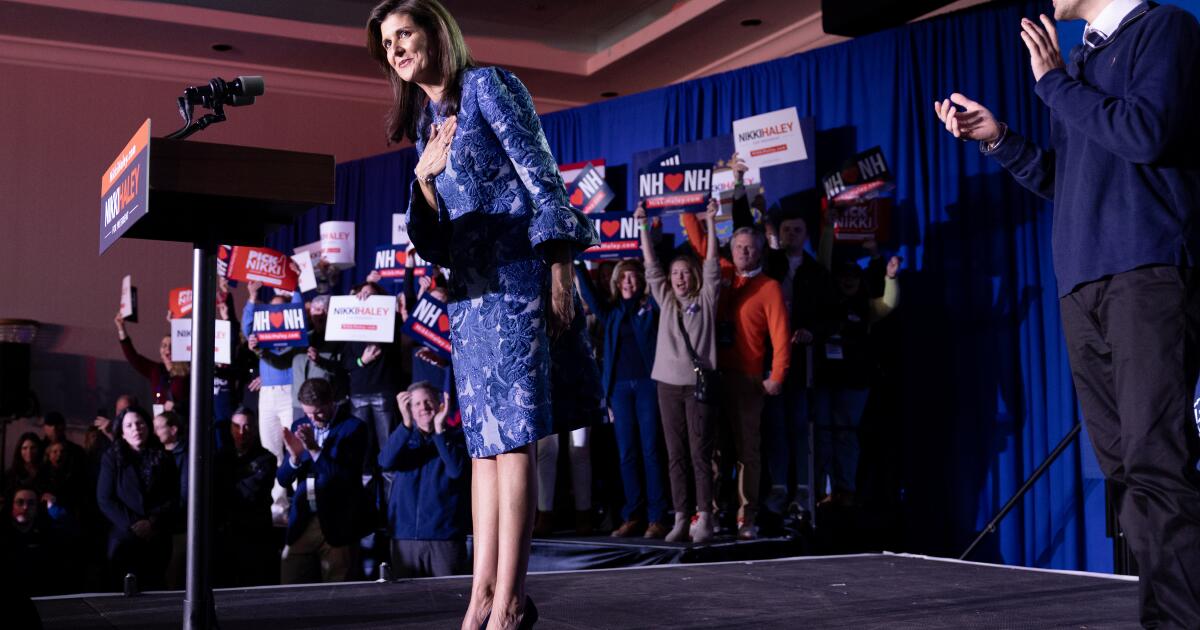
Former President Trump won the first Republican primary Tuesday in New Hampshire over his closest competitor, former South Carolina Gov. Nikki Haley, according to a projection by the Associated Press. Though the outcome was expected, it was significant.
Here are some takeaways.
It’s over
Yes, Haley remains in the race, for now. But Trump’s victory in the first primary state — which happens to have one of the more moderate and least Trump-friendly electorates in the GOP — all but seals hisparty’s nomination, setting up an expected rematch with President Biden.
The not-terribly-competitive nominating contest has underscored how much the GOP has become Trump’s party.
Trump left office with low approval ratings and two impeachments that followed an unprecedented attempt to overturn a lawful election. But he entered the nominating fight with many of the advantages of an incumbent, then scored wins in both Iowa and New Hampshire, a rare feat for a Republican presidential hopeful.
Endorsements tell part of that story. They don’t often matter, but two recent nods from former opponents demonstrate why Trump has been the default choice from the beginning. Florida Gov. Ron DeSantis and South Carolina Sen. Tim Scott both got behind Trump soon after they left the race.
Neither man had much personal reason to embrace Trump. The former president relentlessly targeted DeSantis, who entered the race with high approval ratings, calling him “Desanctimonious” and mocking his appearance, among other insults. But both men endorsed Trump for the same reason they held back from attacking his vulnerabilities during the race: GOP voters still adore him. The two believe that if they want to have a future in the party, at least in the near term, they need to stay with Trump.
Does Haley drop out with her home state looming?
Haley has said repeatedly that she will not depart the race after New Hampshire — as she did again Tuesday night after the race was called for Trump.
“New Hampshire is first in the nation, it is not last in the nation. This race is far from over,” she told supporters.
Most candidates make similar statements until the moment they leave the race. Haley’s underdog strategy depended on winning New Hampshire, which is filled with highly educated Republican and independent voters whom Haley has been seeking.
The race next heads to Nevada and the Virgin Islands, which hold Republican caucuses Feb. 8.
Polls show Haley down by nearly 40 percentage points to Trump in South Carolina, her home state, which holds its Republican primaryFeb. 24. A big loss there would be damaging to her prospects, though not fatal. Florida Sen. Marco Rubio drew only 27% against Trump in his home state in 2016; though he soon exited the presidential race, he won reelection easily to his Senate seat that fall.
But many candidates, including Kamala Harris when she was a California senator, choose to avoid the potential stain on their resume that would come from losing in their home state. They dropped out before any ballots were cast in the 2020 race. In Harris’ case, it paid off with a nomination for vice president, though Haley seems unlikely to get the nod from Trump.
Nikki Haley supporters listen as the candidate speaks after her primary defeat.
(Gina Ferazzi / Los Angeles Times)
Another historic moment for a twice-impeached president
Trump’s win Tuesday, coupled with last week’s caucuses victory in Iowa, marked another historic moment: It was the first time he faced voters since leaving office, still refusing to accept the election results while encouraging an angry mob that stormed theCapitol.
He’s facing 91 criminal charges and has threatened, among other things, to terminate the Constitution and give himself dictatorial powers for a day, while claiming that presidents enjoy absolute immunity from prosecution, even for acts that “cross the line.”
The question is a dividing line for many voters. In preliminary network exit polling, 85% of Haley’s voters said Trump, if convicted of a crime, is unfit to be president. Only 11% of Trump’s voters said that.
Democrats hope voters will start comparing Biden to ‘the alternative’
Biden for months has repeated the aphorism “Don’t compare me to the Almighty, compare me to the alternative.” He argues that his low approval rating — below 40% — will matter less once people zero in on the binary choice between him and Trump.
That process is likely to intensify as Trump gets closer to securing the nomination. The big question is whether the election, now forecast as close, will shift to Biden’s favor when voters take a closer look at Trump. Historically, Trump’s approval rating in polls has dropped as he gets more public exposure.
Turnout for a Trump-Biden rematch could fade
Voters showed up in huge numbers in 2018, 2020 and, in some states, 2022, in part because Trump inspires such strong positive and negative feelings. Abortion also played a large role in 2022, after the Supreme Court’s decision to overturn a constitutional right to the procedure.
Will that fervor persist in November, or are voters too fatigued and uninspired for a likely rematch that has turned off many? That’s one of the biggest questions and one that both parties will pursue now that the general election is taking shape.
Biden needs to shore up support from younger and Black voters, key groups for him in 2020 whose excitement has waned, polls show. Trump needs to minimize losses in the suburbs, where educated Republican women have defected.
What happens to third parties? Will they fade as usual or play spoiler?
Robert F. Kennedy Jr. has been drawing double digits in some polls as an independent candidate. A centrist group called No Labels has been floating a third-party ticket, though no one has signed up to run.
History shows that these candidacies tend to fade by the time voters cast ballots. But they have had an impact, including in 1992, when Ross Perot drew 19% of the vote. Debate continues over which of the two major candidates he hurt worse: Bill Clinton defeated George H.W. Bush with a mere 43% of the popular vote. In 2000, Ralph Nader may have tipped the balance for George W. Bush in his race against Al Gore.
Conventional wisdom holds that Biden will be hurt by a third-party candidate because Trump’s core base is so loyal. But that is unclear, especially in the case of Kennedy, whose conspiratorial views on vaccines and other topics align with those of many Trump supporters.


NEWYou can now listen to Fox News articles!
President Donald Trump said Tuesday he plans to lift U.S. sanctions on Turkey and signaled he is prepared to move forward with the long-stalled sale of F-35 stealth fighter jets, marking a dramatic reversal in U.S. policy toward the NATO ally years after Ankara was expelled from the program for its purchase of a Russian missile defense system.
Speaking alongside Turkish President Recep Tayyip Erdoğan during a bilateral meeting at the NATO summit in Ankara, Turkey, Tuesday, Trump said his administration would remove sanctions imposed on Turkey’s defense sector.
“I can tell you we’re going to be taking the sanctions off, OK?” Trump said. “I don’t want him to waste his time answering that question. It’s time. We don’t sanction friends.”
TRUMP BETS ON FORMER NATO TROUBLEMAKER AS TURKEY’S STRATEGIC VALUE SURGES
Turkish President Recep Tayyip Erdogan welcomes US President Donald Trump at Ankara Airport, who is paying an official visit to Turkey ahead of the 36th NATO Heads of State and Government Summit in Ankara, Turkey, on July 07, 2026. (Dogukan Keskinkilic/Pool via REUTERS)
Asked whether he would sell F-35 fighter jets to Turkey despite existing legal restrictions tied to Ankara’s purchase of the Russian-made S-400 air defense system, Trump indicated he was open to doing so.
“Many people, including the people sitting right here thinks why wouldn’t we do that?” Trump said. “Turkey has been in many ways much more loyal than other countries that we think would be loyal.”
Pressed on concerns about Turkey’s continued possession of the S-400, Trump dismissed them.
“I have no concerns about anything.”
The remarks represent Trump’s clearest indication yet that he intends to restore defense ties with Turkey, building on months of efforts to revive military cooperation with one of NATO’s largest armed forces after years of strained relations.
Turkey was removed from the multinational F-35 program in 2019 after taking delivery of the Russian-made S-400 air defense system, prompting Washington to argue that operating the Kremlin-built system alongside America’s most advanced stealth fighter could expose sensitive U.S. technology. Congress subsequently imposed sanctions under the Countering America’s Adversaries Through Sanctions Act, or CAATSA.
‘WRITTEN IN OUR DNA’: POLISH PILOTS WHO REMEMBER SOVIET RULE PREPARE FOR AMERICA’S MOST LETHAL FIGHTER JET
Congress long has been one of the biggest obstacles to restoring Turkey’s access to the F-35, with bipartisan lawmakers arguing that Ankara should not receive America’s most advanced fighter aircraft while it continues to possess the Russian-made S-400 air defense system and pursues policies they say run counter to U.S. interests.
A U.S. airmen watches an Air Force F-35 Lightning II joint strike fighter aircraft approach for the first time on July 14, 2011 at Eglin Air Force Base in Florida. (Samuel King Jr./U.S. Air Force)
Beyond political opposition, the Trump administration also faces legal hurdles.
While the president has authority over sanctions policy, Congress enacted additional restrictions after Turkey’s purchase of the S-400. Section 1245 of the fiscal year 2020 National Defense Authorization Act bars the transfer of F-35 aircraft to Turkey unless the executive branch certifies that Ankara has met statutory requirements related to the Russian missile system.
In recent days, a bipartisan group of House lawmakers urged Trump not to move forward with an F-35 sale, arguing that doing so without satisfying those legal requirements would violate U.S. law and undermine national security.
Lawmakers also have warned that Turkey’s continued possession of the S-400, support for Hamas and tensions with fellow NATO allies Greece and Cyprus raise broader concerns about restoring Ankara’s access to the stealth fighter.
Russian S-400 missile air defence systems are seen before the military parade to commemorate the 75th anniversary of the battle of Stalingrad in World War Two, in the city of Volgograd, Russia February 2, 2018. REUTERS/Tatyana Maleyeva – UP1EE220T3A2B
CLICK HERE TO DOWNLOAD THE FOX NEWS APP
The Pentagon has maintained that the S-400’s sophisticated radar could collect data on the F-35’s radar signature and electronic profile during routine operations, potentially allowing Russia to better detect and defeat the aircraft in a future conflict if that information were shared with Moscow.
When the Trump administration removed Turkey from the F-35 program in 2019, the White House said “the F-35 cannot coexist with a Russian intelligence collection platform that will be used to learn about its advanced capabilities.”
Pentagon acquisition chief Ellen Lord similarly warned at the time that allowing Turkey to operate both systems would jeopardize the long-term security of the F-35 program because “much of the F-35’s strength lies in its stealth capabilities.”
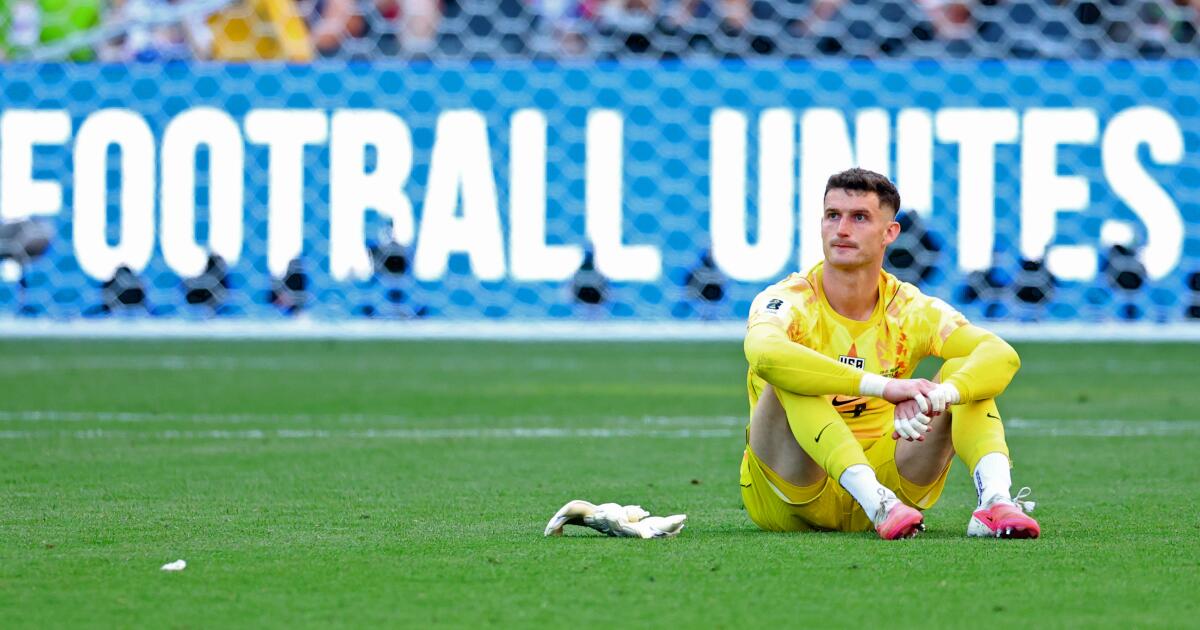
SEATTLE — Is everybody happy now? You good, Mr. President?
Put our boys in a blender, President Trump did, with those phone calls to FIFA President Gianni Infantino. Messed with their mojo by politicking to get American striker Folarin Balogun’s red card rescinded.
We’ll have to check VAR, but it might be the first time Trump succeeded at having a decision overturned.
Probably because this time what he sought to overturn — discipline stemming from Balogun’s accidental contact in the United States’ victory over Bosnia and Herzegovina — actually was unjust. Balogun should not have received a red card.
The problem is, having our President butt in here was a joke. Unfunny and out of bounds, offsides, an own goal — all of the things.
It put the U.S. team at the center of a geopolitical maelstrom, which is exactly what they did not need in the hours before the biggest match of their lives and the biggest match in the history of the U.S. men’s soccer program.
Some 40 or 50 million viewers were expected to tune in; how many of them watched for the first time? And what sort of impression did Monday’s 4-1 blunder-filled meltdown against Belgium make? That we stink at soccer — still?
If you were one of them, please, believe your soccer-fan friends when they tell you the Americans played much better in previous matches.
But so much for a magical run. On their home turf, the Americans pulled up lame before the finish line (aka, for the U.S. team’s purposes, its first quarterfinals since 2002).
To their credit, after the debacle, members of the U.S. team didn’t complain about anything being rigged. They didn’t use the distraction as an excuse. And they didn’t point fingers at anyone — anyone at all.
U.S. striker Folarin Balogun (20) walks to the locker room at halftime against Belgium in the World Cup on Monday at Lumen Field in Seattle.
(Allen J. Schaben / Los Angeles Times)
“We’re playing on home soil,” defender Chris Richards said. “So the only pressure we put on ourselves is to perform for our country, and ultimately didn’t feel the way we wanted to today. But I don’t think the antics of the last 24 hours had anything to do with it.”
No, they said the “debate,” or “outside noise” or “political manipulation” — as Tim Ream, Alex Freeman and coach Mauricio Pochettino described what others are calling “Balogate” — were not to blame for the gut-punch that answered the question: Why not us?
Because the U.S. is not yet good enough to beat the world’s great teams. Especially not when their pregame preparation includes having to try to block out an international uproar.
To have any hope against the Belgians in the round of 16 — a matchup between FIFA’s Nos. 9- and 17-ranked sides — the Americans needed to be going full-tilt, to be focused and ferocious and probably also a little bit lucky.
Instead, they looked shook, rattled. And they got rolled.
They were the worst version of themselves at the worst time, which was so weird from a team that had been on its front foot from the first whistle against Paraguay.
Not Monday. Against Belgium, they were on their heels from the outset. Heavy touches, slow afoot, playing like they had the weight of the World Cup on their shoulders.
And all that White House maddening meddling — for what?
Balogun started and played most of the match, but it could just as well have been reserve striker Ricardo Pepi. Or you or me, Balogun was that ineffective.
His play of the day came postmatch, when he approached Belgian coach Rudi Garcia and the two had a respectful exchange. A real diplomat, that Brooklyn-born, Britain-raised American by birthright.

This loss was a real team effort, of course. Christian Pulisic came off in the 59th minute after twisting his right ankle — leaving this World Cup without a goal in the four matches he appeared.
Matt Freese, the Harvard-educated starting goalkeeper, had a brain cramp of epic proportions when he stepped outside of the box and failed to corral a ball. Belgium’s Charles De Ketelaere kicked it loose and set up Hans Vanaken, whose shot traveled behind Ream for an easy score that made it 3-1 in the 57th minute.
There was a lot of poor decision-making with this match, on and off the pitch.
In the end, Trump’s appeal to Infantino did more harm than good. But what if some good could come from it?
Hey, FIFA, what about giving teams a process to appeal cards, like our American athletes in the NBA, NFL and MLB have?
Offering a suggestion box wouldn’t be opening Pandora’s box, not if it were a transparent and regular part of the game that would, hopefully, offer increasingly fair outcomes in a tournament where every match is so monumental — as our President recognized, much too enthusiastically.

U.S. coach Mauricio Pochettino waves to the crown after a 4-1 loss to Belgium at the World Cup on Monday.
(Allen J. Schaben / Los Angeles Times)
Prosecutors on Monday began laying out their case against the man accused of murdering Charlie Kirk. It was the first day of a weeklong preliminary hearing that will determine whether or not there is enough evidence against the accused killer to stand trial.
-

 Atlanta, GA3 minutes ago
Maryland kidnapping suspect taken into custody in Georgia
-

 Minneapolis, MN5 minutes ago
Man sentenced to federal prison for armed robberies of St. Paul bank, Minneapolis Walgreens
-

 Indianapolis, IN11 minutes ago
Advocates say new public camping ban criminalizes homelessness
-

 Pittsburg, PA18 minutes ago
Allegheny County park with 200-year-old trees joins network of
-

 Augusta, GA21 minutes ago
Local service members get more chances to expand their education
-

 Washington, D.C26 minutes ago
Greenberg Traurig Adds Former Commerce Official Joe Bartlett to Washington, D.C., Office
-

 Cleveland, OH33 minutes ago
GUARDIANS WILL SEND THREE TO MLB ALL-STAR GAME IN PHILADELPHIA
-

 Austin, TX36 minutes ago
Tesla leases 683K sf speculative industrial building amid Central Texas expansion spree

