Politics
Harris, Walz emphasize 'freedom,' 'joy' and press attacks on Trump, Vance in raucous first rally

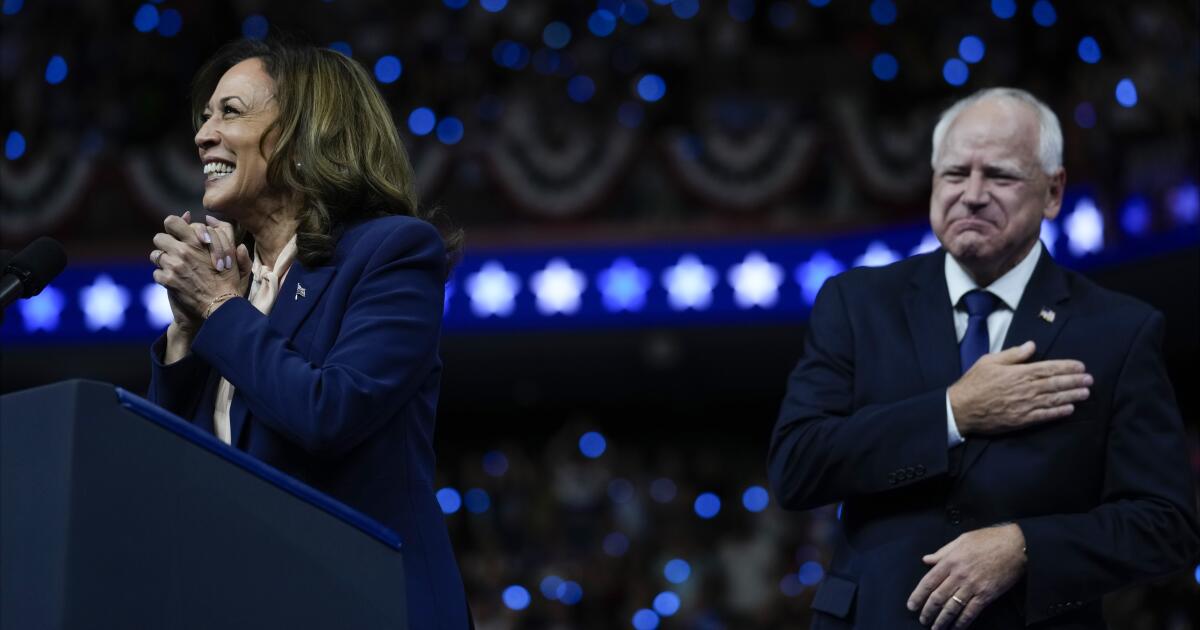
Democratic presidential nominee Kamala Harris introduced running mate Tim Walz at a rally Tuesday evening in Philadelphia, where the Democratic duo pledged to restore freedom and hope they contend would be stripped away if former President Trump wins a second term in the White House.
The Minnesota governor, little known nationally before his selection Tuesday as Harris’ No. 2, told a raucous partisan audience that he is the product of small-town America, who believes in old-fashioned values.
“I was born in West Point, Neb., and lived in Butte, a small town of 400 where community was a way of life,” said Walz, 60. “Growing up, I spent summers working on the family farm. My mom and dad taught us to show generosity toward your neighbors and to work for the common good.”
Walz said communal strength loomed large in Minnesota, the state where he has governed since 2019 and that he planned to bring that culture to the White House.
“Minnesota’s strength comes from our values,” Walz said, “our commitment to working together, to seeing past our differences, to lending a helping hand. “
In introducing Walz, Harris pictured her running mate as the kind, common sense alternative to Republican policies that she said had stripped away fundamental rights.
“We fight for a future where we defend our most fundamental freedoms,” Harris said. “We fight freedom to vote, freedom to be safe from gun violence, freedom to love who you love openly and with pride, and the freedom of a woman to make decisions about her own body, not having the government tell her what to do.”
Democratic vice presidential nominee Minnesota Gov. Tim Walz attends a campaign rally in Philadelphia.
(Matt Rourke / Associated Press)
Democrats have been buoyed by Harris’ entry into the race two weeks ago, after President Biden’s withdrawal. Polls have shown a narrowing of an already tight race. The candidate’s campaign reported that she had collected more than $300 million in campaign donations, with a spokesperson saying an additional $20 million poured in after Harris announced on social media Tuesday morning that Walz would join her on the ticket.
The Democratic duo plans to visit battleground states in the Midwest, before flying west to campaign in Arizona and Nevada. Those states are expected to hold the key to victory in the election along with the swing states of Pennsylvania, Wisconsin, Michigan and Georgia.
Harris, 59, whipped through the resume of her new political partner, depicting him as an everyman who understood the travails of regular Americans. She described his youth on a family farm in Nebraska, his two decades as a high school social studies teacher and work as an assistant coach for a state champion high school football team.
She noted that Walz simultaneously coached linebackers on the West Mankato High School football team and supported students who wanted to start a gay-straight alliance.
“At a time when acceptance was difficult to find for LGBTQ students, Tim knew the signal that it would send to have a football coach get involved,” Harris said. “So he signed up to be the group’s faculty adviser. Students have said he made the school a safe place for everybody.”
It was that supportive stance that led to students voting Walz as the most inspirational faculty member, Harris said.
“We both believe in lifting people up, not knocking them down,” Harris said. “When we look at folks, our fellow Americans, we see neighbors not enemies.”
Walz said more than once that Harris had brought “joy” back to America’s public arena, but the folksy politician showed he also wasn’t above throwing a punch.
He chided his vice presidential rival, noting that Republican JD Vance’s rural roots grew into a much different life than one he recognized from Middle America.
“Like all regular people I grew up with in the heartland, JD studied at Yale, had his career funded by Silicon Valley billionaires and then wrote a bestseller trashing that community,” Walz said, before throwing his arms wide and chiding: “Come on! That’s not what Middle-America is.”
Walz drew knowing laughter from the crowd at the Liacouras Center arena at Temple University when he reprised one of his first attacks on the Republican ticket, saying Trump and Vance “are creepy and, yes, just weird as hell.”
He found another punchline in the multiple criminal cases against Trump, saying of the former president: “He froze in the face of the COVID crisis. He drove our economy into the ground and make no mistake, violent crime was up under Donald Trump.” After a round of applause, Walz added: “That’s not even counting the crimes he committed.”
Saying he welcomed a chance to debate Vance, Walz then made a thinly veiled reference to a prurient, and unfounded, rumor about Vance’s purported fixation with living room furniture.
“I can’t wait to debate the guy — if he’s willing to get off the couch and show up!” Walz said.
Harris and Walz both suggested that a second Trump term would strike a crippling blow against progressive government programs. They said he would try to gut the Affordable Care Act, the law that brought health care coverage to millions of Americans; “gut” Social Security and Medicare; .and continue to crack down on abortion, a procedure that became much harder to obtain after Trump-appointed Supreme Court justices helped reverse the Roe v. Wade decision.
“Today in America, one out of three women live in a state with a Trump abortion ban,” Harris said. “Some of those bans go back to 1800s, before women had a right to vote. We have a message for Trump and those who want to turn back our freedoms: We’re not going back!”
That led to a prolonged chant from the crowd: “Not going back!”


NEWYou can now listen to Fox News articles!
An explosive meeting in the Senate turned into a win for President Donald Trump and his administration as key Republicans flipped on another bid to handcuff the administration’s authorities in Iran.
In its final act before leaving Washington, D.C., for an over two-week break, the Senate rejected Democrats’ attempt to rein in Trump’s war powers in Iran as talks continue between Iran and the U.S. to hammer out a long-term peace deal.
It was the same war powers resolution from Sen. Tim Kaine, D-Va., that passed over a month ago and stunned Republicans in the upper chamber.
‘HE NAMED NAMES’: TRUMP’S SENATE MEETING EXPLODES INTO SHOUTING MATCH OVER IRAN
Majority Leader John Thune, R-S.D., and Senate GOP leaders are pushing forward with budget reconciliation to fund the final piece of government that had been shut down by Senate Democrats’ opposition to President Donald Trump’s Immigration and Customs Enforcement actions. (Nathan Posner/Anadolu)
What seemed like a predetermined outcome just hours after Trump and Sen. Bill Cassidy, R-La., sparred over the Iran war, and the administration’s lack of forthcomingness with lawmakers, during a closed-door meeting to discuss the president’s marquee voter ID and citizenship verification legislation turned into a surprise late night win.
Trump argued to the GOP that the previous war powers resolution, which passed on Tuesday thanks in part to a pair of Republicans being absent, hurt the administration’s negotiating position with the Iranians.
Meetings with key holdouts at the White House helped change the minds of Cassidy and Sen. Rand Paul, R-Ky., who has routinely voted with Democrats on every war powers resolution brought forward, and provided the administration with a win as they work toward a deal beyond the 60-day memorandum of understanding with Iran.
IRATE REPUBLICANS ACCUSE TRUMP OF HANDING DEMOCRATS A WIN AFTER BLOWING UP HOUSING PACKAGE
“I want to thank Vice President [JD] Vance and Special Envoy [Steve] Witkoff for the thorough briefing this afternoon on Iran,” Cassidy said on X. “I appreciate the quick invitation to the White House to address many of my concerns.”
And Paul, who voted present, noted that his “opinion on the debate over war and executive power has not changed and I have voted that way several times.”
“But since hostilities seem to be over and the President asked me to give consideration to his negotiating position, I will do so,” Paul said on X. “My vote of present is a way to give the President more space and leverage to negotiate a lasting peace.”
Sen. Chris Murphy, D-Conn., who has been at the forefront among Democrats in pushing war powers resolutions in the upper chamber, acknowledged that “this is a different moment,” but cautioned that the ceasefire appeared to be “precarious right now.”
When asked if he believed Trump’s case to Republicans that the successful war powers vote just a day before was hurting the administration’s leverage, Murphy said, “The Iranians don’t — you know, all they have to do is read a poll and find out that people in this country don’t support the war. They didn’t support the war.”
TRUMP HEADS TO CAPITOL HILL FOR PIVOTAL MEETING AS SENATE GOP DIVISIONS DEEPEN
President Donald Trump boards Air Force One as he departs Reading Regional Airport in Reading, Pa., on Tuesday, June 23, 2026. (Evelyn Hockstein/Reuters)
Still, it marked a key win for Senate Majority Leader John Thune, R-S.D., and the Senate GOP’s whip operation, led by Senate Majority Whip John Barrasso, R-Wyo., to flip the skeptics into backers of the administration’s long game in Iran after several contentious weeks in the Senate spurred by Trump’s last-minute decisions that either derailed or torpedoed several of his key agenda items.
Thune and Barrasso, accompanied by Sens. Lindsey Graham, R-S.C., and Bernie Moreno, R-Ohio, huddled in the GOP leader’s office as the vote wound down late Wednesday to call Trump, and share the news of the vote.
“Wow! The Senate just changed its vote on Iran from 50-48 against, to 50-47 for,” Trump said on Truth Social. “Rand Paul and Bill Cassidy changed. Thank you to Leader John Thune, Lindsey Graham, Bernie Moreno, and all. This vote puts Iran on notice!”
It also comes at a time when speculation has swirled over the nature of Thune and Trump’s relationship as the president, accompanied by chatter online, have ramped up the pressure to pass the Safeguarding American Voter Eligibility (SAVE) America Act.
CLICK HERE TO DOWNLOAD THE FOX NEWS APP
Moreno made the case that the questions over their relationship, and Thune’s position as leader, was just noise, and that “there’s not a single solitary Senator running for office that says leader Thune should be replaced, not one, even non-incumbents.”
“What today showed is that President Trump has a kind of relationship with John Thune where he says, ‘Hey, let me talk to the guys,’ understand the situation,” Moreno said. “As much as Cassidy and Trump got into it, it was because they’re both passionate, they’re both smart people.”
“And now, we’ve most importantly sent the Iranians a message that President Trump has the full backing of the Congress, and that was an incredibly important day,” he continued. “That’s a huge victory for us.”

WASHINGTON — President Trump canceled his planned signing Wednesday of the landmark housing bill Congress passed this week, in a striking decision to jeopardize a rare bipartisan success in order to demand that lawmakers pass voter ID legislation.
The president’s reversal, as a stage and chairs for the signing ceremony were set up in the Capitol and stakeholders were arriving on the Hill, underscored his fixation on asserting some federal control over election processes.
And it displayed a remarkable willingness to threaten a bill that he and his party could have framed as a win on affordability ahead of the midterm elections, as Republicans fight to keep U.S. House control amid economic dissatisfaction among Americans.
Hours before the president torpedoed the bill signing, the White House had said the measure was an example of a “promise kept.”
“Today’s Housing News Conference and Signing is hereby cancelled until such time as we pass the desperately needed SAVE AMERICA ACT, which I consider to be a National Emergency,” Trump wrote Wednesday morning on his social media website.
It opened a new front in ongoing tension between Trump and Senate Republicans, which already had neared a breaking point this week over the proof-of-citizenship bill. Senate leaders have told the president that the bill, dubbed the SAVE America Act, does not have the votes to pass.
And it shocked lawmakers who had been celebrating the bipartisan accomplishment. Rep. Maxine Waters (D-Los Angeles), who had helped lead negotiations, said Trump was “slapping millions of families in the face” after having supported the bill.
“Trump is making his promise crystal clear: If you’re dealing with high housing costs, you’re on your own,” Waters told reporters at a Democratic news conference Wednesday afternoon.
The housing bill, which passed with overwhelming support in the House on Tuesday evening and the Senate on Monday, aims to boost housing supply. It is the most significant legislation Congress has passed on housing in more than 30 years, and it contains a host of provisions aimed at removing regulatory barriers, improving federal programs and incentivizing new home building.
As president, Trump has 10 days to sign or veto bills after they are presented. If he takes no action and Congress remains in session, a bill becomes law. Rep. Katherine Clark (D-Mass.), the House minority whip, said Republican leadership had not yet presented the bill to Trump.
House Speaker Mike Johnson (R-La.) indicated to reporters Wednesday that a signing could still be on the table, saying he had spoken to Trump about “delaying” the housing bill before the president announced the cancellation.
“He decided — I didn’t announce it, I wanted him to announce it — but we’re delaying this,” Johnson said. “He has a window of time before he has to sign a bill and he’s going to use a little bit more of that window of time and we’re gonna go through this together.”
Johnson said he had promised an effort to advance the SAVE America Act, saying election integrity “is the top priority.” The speaker accused Democrats of wanting “to allow for cheating and fraud in the elections because it is the only way Marxists can win.”
The White House did not respond when asked whether the president planned to veto the bill or sign it later.
Jim Tobin, president of the National Assn. of Home Builders, which advocated for the bill, said he was on his way to the ceremony, getting ready to walk through Capitol security, when Trump posted.
It was “very disappointing,” Tobin said, citing two years of bipartisan work among industry leaders, lawmakers and the White House, but he said he believed the bill may still ultimately become law.
“People, I believe, want to run — back home — on the affordability issue,” Tobin said. “This would be a great feather in a lot of Congress members’ hats, as well as the president’s, so I’m confident that we’ll get there.”
Last week, the NPR/PBS News/Marist Poll and Fox News poll found record dissatisfaction with the economy among Americans and Trump’s support slipping among key demographics. The president also lashed out about that on his social media website earlier Wednesday, writing without evidence: “MY REAL POLL NUMBERS ARE THE HIGHEST THEY HAVE EVER BEEN. THANK YOU!!!”
Before Trump announced the cancellation, he posted about the legislation, labeling it “the Elizabeth ‘Pocahontas’ Warren centric housing bill,” and railed about the SAVE America Act.
His push for the election overhaul bill could be a test of Senate Republicans’ willingness to counter him.
In recent months, they have revolted against several of his priorities, including security funding for a White House ballroom and a $1.8-billion fund to pay people who claim to have been politically persecuted by the federal government. On Tuesday, four Republican senators joined with Democrats to approve a war powers resolution seeking to block U.S. military action in Iran.
Trump, who for years has tried to sow doubt in American elections, has pressed Republicans to pass the SAVE America Act ahead of the midterm elections. He has said the bill would “guarantee” the midterms for Republicans.
Frustrated that the bill has fallen short of the 60-vote threshold needed to pass the Senate, Trump has repeatedly pressured Senate Majority Leader John Thune (R-S.D.) to eliminate the filibuster rule. Thune has refused.
“He is trying to put pressure on the Senate and on his own caucus to pass an unpopular bill as part of his effort to interfere in the elections,” said Wendy Weiser, democracy program director at the Brennan Center for Justice at New York University. “We need to take seriously the possibility that he’s really trying to blow up the Senate over this.”
Earlier this year, Trump said he would not sign any other legislation before the election overhaul measure was passed, arguing that it “supersedes everything else.” He has threatened to not renew a key U.S. surveillance law if it does not include the voting law. And at a rally in Pennsylvania on Tuesday, the president said the election bill was needed because states such as California were trying to rig the election.
“California is totally rigged. All mail-in ballots, it’s a disgrace,” the president told the crowd.
In Washington, the voting law has already passed the House three times. But it has stalled in the Senate. Sen. Thom Tillis (R-N.C.) told reporters Wednesday that it was an “unachievable goal” to try to get the bill passed.
The legislation would require voters to provide proof of citizenship when they register, require Americans show identification when casting a ballot and require states to send voter data to the Department of Homeland Security.
Voting rights advocates say it would create unnecessary barriers to voting for citizens. There are less disruptive ways to verify a voter’s citizenship status, and the bill would also create administrative challenges for election officials, said Wren Orey, elections project director at the Bipartisan Policy Center.
It serves Trump to continue pushing the bill even without support to pass it, said Eric Kashdan, director of federal advocacy at the Campaign Legal Center; if Republicans suffer losses in the midterms, Trump may use the narrative that elections are vulnerable to fraud.
“If they can say that without the SAVE Act these elections are not secure, that lays the groundwork for the administration to possibly interfere in the elections or just sow doubt,” Kashdan said.
Rep. Brad Sherman (D-Sherman Oaks) said Trump was holding the bill hostage in a bid “to control California’s elections.”
“The stage was set both physically and metaphorically for the president to sign a historic housing bill for the American people,” said Sherman, who contributed a provision to the housing bill that would help disabled veterans get rental assistance. “Trump must put his ego aside and put the American people first and sign this bill into law.”

Habitual marijuana users cannot be barred from owning guns, Supreme Court rules
Fox News host Sean Hannity reports the Supreme Court unanimously limits a federal gun law, ruling habitual marijuana users cannot be banned from owning guns. Legal Analyst Gregg Jarrett explains the 9-0 decision, distinguishing between recreational use and serious addiction, contrasting it with Hunter Biden’s crack cocaine and gun charges.
NEWYou can now listen to Fox News articles!
FIRST ON FOX: A powerful House committee is escalating its probe into the Biden administration for alleged collusion with gun control activists.
House Oversight Chairman James Comer, R-Ky., is demanding that the Bureau of Alcohol, Tobacco, Firearms and Explosives (ATF), the federal agency responsible for enforcing gun laws, hand over documents detailing Biden aides’ communications with Everytown for Gun Safety, an influential gun control group founded by billionaire Michael Bloomberg.
Comer’s panel has argued that a now-defunct Biden office may have collaborated with Everytown to help facilitate its lawsuit with the city of Chicago against the gunmaker Glock Inc.
“These records will inform the Committee as to whether the Biden Administration and Everytown colluded to attack private gun manufacturing companies through lawfare to circumvent Second Amendment rights,” Comer wrote in a letter Wednesday to the ATF that was reviewed by Fox News Digital.
Rep. James Comer arrives at the U.S. Capitol in Washington, D.C., on June 10, 2026. (Tom Brenner/Getty Images)
CITY OF CHICAGO SUES GLOCK INC. OVER ‘FACILITATING’ ILLEGAL GUN CONVERSIONS
Chicago’s lawsuit, listing Everytown’s legal arm as the plaintiff’s counsel, was filed in March 2024 and alleges Glock sold pistols that the firearms manufacturer knew could be easily modified to fire like machine guns.
“Glock knows that it takes little effort to convert its pistols into illegal machine guns and that criminals frequently do so,” the lawsuit alleged. “Glock also knows it could fix the problem, but has chosen not to, putting profits over public safety and violating the law.”
In the letter, Comer cited a 2023 meeting between the White House Office of Gun Violence Prevention (WHOGVP) and representatives from Glock, during which Biden officials pressed the gun manufacturer to modify its pistol designs.
When Chicago sued Glock three months later, John Feinblatt, president of Everytown, wrote on X, “Federal officials recently contacted Glock to discuss implementing new ways to modify Glock pistols to make it harder for Glock switches to be installed. Rather than help, Glock has falsely insisted there is nothing they can do.”
Comer argues Feinblatt “appears to have had insider information regarding the WHOGVP’s private meeting with Glock, which raises questions about whether the Biden Administration colluded with Everytown to initiate their lawsuit against Glock,” according to the letter.
The lawsuit is still moving through the court system, with a Cook County judge denying Glock’s motion to dismiss the case in September 2025.
Members of Everytown for Gun Safety rally outside the U.S. Capitol in Washington, D.C., on May 26, 2022. (Chip Somodevilla/Getty Images)
STATES’ TOP COPS GANG UP ON LETITIA JAMES IN CRUSADE WITH POTENTIAL NATIONWIDE CONSEQUENCES
The Kentucky lawmaker has also highlighted close ties between the Biden White House and Everytown. The letter notes that Biden aide Rob Wilcox worked at Everytown for eight years prior to his employment with the WHOGVP.
Biden also headlined Everytown action fund’s annual training conference, known as Gun Sense University, in June 2024, during which he reiterated his support for a nationwide ban on so-called assault weapons.
Wednesday’s letter comes after the GOP-led panel asked the National Archives and Records Administration (NARA) in April for communications between the Biden White House and Everytown.
House Oversight Republicans previously subpoenaed the Biden ATF and Everytown for all communications related to their “potential collaboration efforts,” but neither party complied with the request.
President Joe Biden speaks about gun safety at Everytown’s Gun Sense University at the Washington Hilton in Washington, D.C., on June 11, 2024. (Saul Loeb/AFP)
CLICK HERE TO DOWNLOAD THE FOX NEWS APP
Comer has also argued that the committee’s probe will help lawmakers evaluate whether new legislation is needed to combat officials violating recordkeeping requirements or using their roles to leak private information to politically aligned third parties.
A spokesperson for the ATF did not immediately respond to a request for comment.
-

 Movie Reviews7 minutes ago
Mark Jenkin’s ‘ROSE OF NEVADA’ – Movie Review – PopHorror
-

 World17 minutes ago
Mubi to Publish Lost ‘Faust’ Bible on Centenary of F.W. Murnau’s Silent Cinema Classic (EXCLUSIVE)
-
 Lifestyle59 minutes ago
Great movies you may have missed : Pop Culture Happy Hour
-

 Technology1 hour ago
The best Apple deals you can get during Prime Day
-

 World1 hour ago
Trump says Venezuela earthquakes left ‘devastating number of deaths’ as US readies aid
-

 Politics1 hour ago
Closed-door outburst turns into victory for Trump’s Iran negotiations
-

 Health1 hour ago
Former reality star opens up about new diagnosis after years-long health ordeal
-

 Sports1 hour ago
Terrion Arnold, Lions’ 2024 first-round pick, charged with kidnapping and armed robbery in Florida

