Politics
From Let's Go Brandon to Let's Go Brenda. Trump merch sellers say they'll be just fine after Biden exit

Vincent Scuzzese runs a store in New Jersey named Let’s Go Brandon.
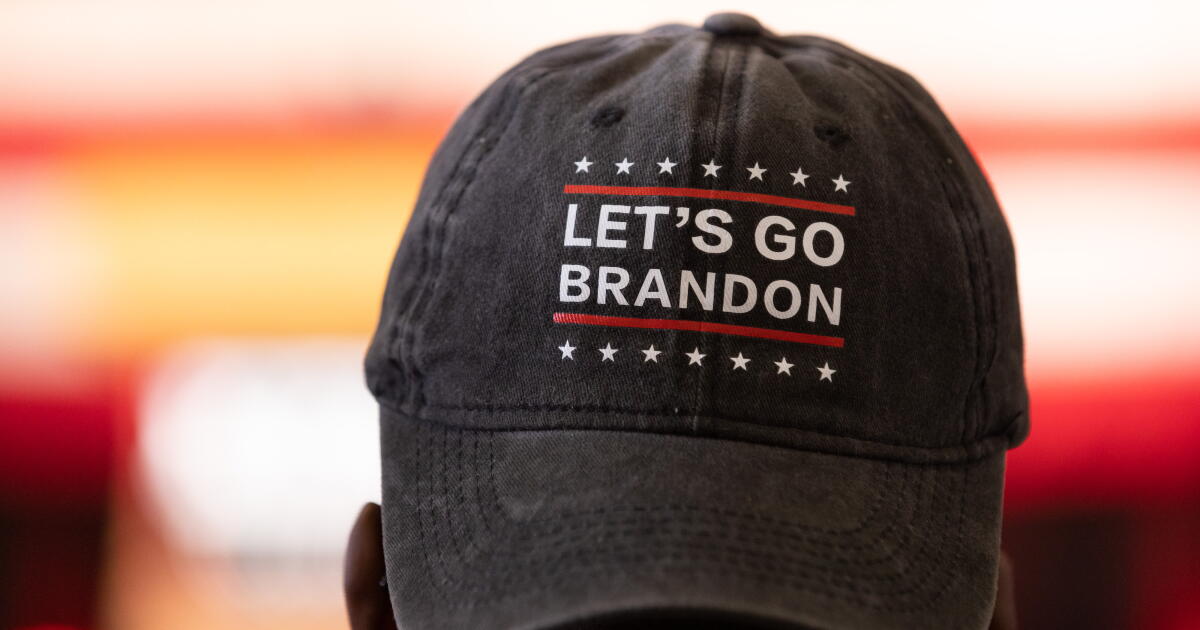
Yes, that Let’s Go Brandon, the pro-Trump mantra gracing Scuzzese’s merchandise — shirts, flags, mugs, makeup compacts and more. There’s a Let’s Go Brandon adult coloring book (subtitle: “The Story of the WORST President in U.S. History”). And for the athletic, a 32-inch Let’s Go Brandon skateboard.
So, what happens now that “Brandon” himself has dropped out of the presidential race and endorsed his second-in-command, Vice President Kamala Harris?
A rebrand.
Scuzzese’s shelves now offer merch with a new motto: Let’s Go Brenda.
“My sales are going nuts,” said Scuzzese, 59, who opened his store in a strip mall off Route 37 in Toms River, N.J., two years ago. “Biden dropped out, but Kamala has the same views — even worse views. She’s more socialist.”
After Biden quit the race Sunday, social media quickly filled with jokes about warehouses full of rotting, deeply discounted anti-Biden merch and Let’s Go Brandon flags flying at half-staff. One meme includes an altered photo of a marquee sign for a different Let’s Go Brandon store; the memester added a fake banner for Spirit Halloween, the seasonal retailer that pops up in empty stores.
But the folks selling anti-Biden swag say they will be just fine, thank you very much.
“Dear Liberal Snowflakes, We appreciate your fan emails and phone calls voicing your concerns in regards to our now ‘useless inventory’ since the Sleepy Joe dropout. We understand that liberals don’t have an IQ of even two digits and have no idea how printing businesses work,” the website for the Let’s Go Brandon Online Shop read on Thursday.
Even if Let’s Go Brenda — the female version of Brandon — catches on, the original slogan doesn’t appear to be going away anytime soon.
The crass catchphrase, which began as a sort-of-but-not-really inside joke among supporters of former President Trump, became so ubiquitous that the Republican National Committee sells its own Brandon-branded beverage koozies, bumper stickers and grilling irons.
“It was a way to signal to other MAGA people that they’re in the club and to signal to the liberals in the community that they’re not welcome,” said Tim Miller, a former RNC spokesman, who left the GOP in 2020 and is now a Trump critic.
“I’m sure there will be plenty of anti-Kamala slogans,” Miller said. But Brandon “might stick around,” he said, like Trump’s Make America Great Again slogan and MAGA acronym, as well as the red hats.
The Let’s Go Brandon jeer came from a viral video of NASCAR driver Brandon Brown being interviewed in October 2021 by an NBC reporter after winning his first Xfinity Series race at the Talladega Superspeedway in Alabama.
In the crowd, people chanted, “F— Joe Biden!” The reporter, apparently trying to cover up the obscenity, suggested they were yelling, “Let’s go, Brandon!”
Let’s Go Brandon is an anti-Biden slogan seen on countless flags, shirts and merchandise across the country.
(Anadolu Agency via Getty Images)
The taunt later inspired pro-Biden memes with a laser-eyed alter ego of the president called Dark Brandon. Although Biden embraced the image and his campaign sold its own Dark Brandon swag, the meme never came close to overtaking Let’s Go Brandon.
Or, for that matter, the vulgar acronym FJB — it means what you think it means — which adorns countless flags and bumper stickers across the country.
Outside the Thunder-Rode motorcyle accessories shop on Route 66 in Kingman, Ariz., owner Jack Alexander flies a flag with an anti-Biden expletive. He’s got some inside, too. They sell well, he said.
For now, he has no plans to get rid of them. Alexander said it does not make sense “to spend a lot of money” on new merch before the party’s nomination becomes official at the Democratic National Convention in Chicago next month.
“We don’t think Harris is going to make it past the convention,” Alexander said. “We feel there’s going to be a war within the Democratic Party because of the non-election process that put her where she is.”
In New Jersey, Scuzzese said sales at the Let’s Go Brandon store have been through the roof since the failed assassination attempt against Trump during a July 13 rally in Butler, Penn. That night, Scuzzese said, he was so busy that he kept his store open long past closing time.
“Before he got shot, people were afraid to wear his hat and put his flags on their house,” Scuzzese said. Afterward, “they were coming in and buying hats and saying, ‘I’m not taking this hat off. I’m wearing it proudly. I hid it for long enough.’”
Scuzzese quickly hawked shirts with the iconic photo of a bloodied Trump raising his fist in front of the American flag. And his Let’s Go Brenda shirts were on the shelves within two days of Biden quitting the race.
Despite Biden’s exit, Scuzzese has no plans, at least for now, to change the name of his business.
And the Let’s Go Brandon phrase itself?
“At least until the election,” Scuzzese said, “it ain’t going nowhere.”


Twenty-four days after the polls closed on election day, Los Angeles County officials have certified the results from the 2,227,461 ballots cast. Despite questions raised about the pace of the vote count, a Times analysis found ballots this June were tallied faster than in previous cycles.
California is known to have a slow vote count, partially because of the state’s grace period for mail-in ballots. This year, counties were required to report most of the ballots by June 15, with some exceptions, including for mail-in ballots received within seven days of election day and ballots requiring additional verification such as signature curing. The process has spurred baseless claims of fraud from President Trump and others, leading the U.S. Supreme Court to take up a case on whether mail-in ballots must be received by election day to count.
The state has reported 9.4 million processed ballots. Officials estimate about 5 ballots remain to be counted and 17,650 are waiting to cure a missing or mismatched signature.
Compared with the last time both governor and Los Angeles mayor were on the ballot, county election officials counted more ballots, and tallied them faster than in 2022, The Times found.
In Los Angeles County, turnout jumped from 28% of eligible voters in the 2022 primary to 38% this June, according to the county registrar. Meanwhile, the share of vote-by-mail ballots dropped about 3 percentage points to 82%, indicating a rise in in-person voting.
Statewide, early results show 41% of registered voters turned up for the June election, up from 33% in 2022, according to the secretary of state. County elections officials must report their final results by July 3, giving state officials a week to certify all election results.
The Los Angeles Times reports election results from the county clerk as well as from the Associated Press. The AP provides ballot counts, a calculation of the expected vote and race calls for statewide and national races.
The expected vote percentage, or EEVP, is an estimate of the total number of votes that will eventually be certified. That number can be adjusted based on new information over time.
“Before counting begins in California, our estimates are primarily informed by turnout in past similar elections plus pre-election data on ballot returns, with projections based on what percentage of ballots had already been received at the same point in past elections,” AP director of election analytics Emily Swanson said in an email.
In the gubernatorial and mayoral races, more than half of the votes were counted by the end of election day, EEVP data show.

Swanson’s team also observed a faster vote count this year than in the 2022 and 2024 primaries.
In January 2024, L.A. County consolidated its election operations into a new ballot processing center in the City of Industry. Dean Logan, head of the L.A. County registrar-recorder/county clerk’s office, told The Times earlier this month that the facility, which is open to observers, is designed for transparency, security and efficiency.
“It doesn’t take long to count. The counting process is very fast,” Logan said ahead of election day. “What extends the time period is those options that are provided under California law for voters — to allow everyone the opportunity to vote up until election day, and then allowing us the time to process those with the same level of security and integrity that we did the ballots that were received two weeks before the election.”
Despite the faster count, the Associated Press took longer to call winners, suggesting these races were more competitive. The AP makes such declarations by determining whether there is an opportunity for a trailing candidate to catch up to the race leader. It has been calling races for nearly 180 years.
Both the gubernatorial and Los Angeles mayoral race saw a 30% increase in votes from 2022. The governor’s race received more than 9.2 million votes compared with 7 million in 2022. The Los Angeles mayor’s race received more than 850,000 votes, an increase from nearly 650,000 in 2022.


The vote counting process for California, Washington, Oregon, Nevada and Alaska may change for the November midterm election, depending on which way the U.S. Supreme Court rules.
Data and graphics assistant editor Sean Greene contributed to this report.

NEWYou can now listen to Fox News articles!
The attorney who helped persuade the Supreme Court to strike down Hawaii’s private-property concealed-carry restriction on Thursday criticized the state’s reliance on a Reconstruction-era Black Code to defend the law.
In a 6-3 decision in Wolford v. Lopez, the Court held that Hawaii cannot require licensed gun owners to obtain express permission before carrying firearms onto private property open to the public. Gun-rights challengers dubbed the policy the “vampire rule” because lawful gun owners had to be “invited in” before entering businesses while armed.
“It is disgraceful that any state would rely on a law specifically aimed at taking away the Second Amendment rights or any constitutional right of Black Americans as it was at that time,” attorney Kevin O’Grady, who represented the plaintiffs, told Fox News Digital.
“And it’s not surprising, however, that Hawaii would rely on it as they are diametrically opposed to the Second Amendment. We fully expected that the Supreme Court would identify that as the kind of law that one absolutely should not look to determine whether or not something is constitutional because this is the perfect example of something which is not constitutional.”
SUPREME COURT HANDS SECOND AMENDMENT WIN TO CONCEALED CARRY HOLDERS IN BLUE STATE GUN CONTROL CASE
Justice Ketanji Brown Jackson speaks on stage during the “Ketanji Brown Jackson on Lovely One: A Memoir” panel at The Atlantic Festival in Washington, D.C., on Sept. 20, 2024. (Tasos Katopodis/Getty Images for The Atlantic)
A major flashpoint was Hawaii’s effort to justify the law under the Supreme Court’s 2022 decision in New York State Rifle & Pistol Association v. Bruen. Since Bruen, courts evaluating firearm regulations have generally asked whether modern gun restrictions are consistent with the nation’s historical tradition of firearm regulation.
Hawaii cited several historical laws, including an 1865 Louisiana statute enacted as part of the post-Civil War Black Codes. The law made it unlawful to carry firearms onto another person’s property without the owner’s consent.
Justice Samuel Alito, writing for the majority, rejected that argument outright, calling the Louisiana statute a “tainted artifact” that was enacted to disarm newly freed Black Americans and leave them defenseless after the Civil War. He concluded the law “cannot be taken seriously” as evidence of the Second Amendment’s original public meaning.
Justice Ketanji Brown Jackson, however, argued in her dissent the Court skipped an important constitutional question.
Jackson did not defend the Black Codes, which she acknowledged were racist and used to oppress newly freed Black Americans. But she argued the Court should have first decided whether the Louisiana law itself violated the Second Amendment, or whether the real constitutional problem was that it was enforced in a racially discriminatory way.
SUPREME COURT TAKES SECOND AMENDMENT CASE CHALLENGING HAWAII GUN LAW
Todd Settergren handles pistols inside his display case at Setterarms gun shop in Walnut Creek, Calif., on Jan. 13, 2017. (Michael Macor/The San Francisco Chronicle via Getty Images)
“It might well be that the Black Codes are invalid inputs for Bruen’s test,” Jackson wrote, “but only if they violated the Second Amendment — which may or may not be the case.”
Instead, she argued that under the Supreme Court’s Bruen framework, the Court could not simply dismiss those laws without first explaining why they should not count as historical evidence.
She outlined two possibilities: either the firearm restrictions in the Black Codes were constitutional but enforced in a racially discriminatory manner — making the constitutional defect an equal-protection problem — or the restrictions independently violated the Second Amendment. The Court, she argued, never resolved that question before excluding the Louisiana law from consideration.
US APPEALS COURT STRIKES DOWN CALIFORNIA’S OPEN-CARRY BAN IN MAJOR SECOND AMENDMENT RULING
“Either history does matter, and if so, all potentially relevant historical experiences must be thoroughly examined,” she wrote. “Or, it does not, and the Court should just admit that the test it has created is boundless.”
Her reasoning immediately drew pushback from critics, who argued the Fourteenth Amendment was passed in response to laws like the Black Codes that denied newly freed Black Americans their constitutional rights, like the right to bear arms.
Rain clouds roll over the United States Supreme Court building in Washington, D.C., on June 18, 2026. (Chip Somodevilla/Getty Images)
“I would simply point her to what Justice Alito pointed out in the majority ruling — it was in response to these types of laws that the Fourteenth Amendment was enacted in the first place,” Hannah Hill, vice president of the National Association of Gun Rights, told Fox News Digital.
US JUDGE TOSSES ILLINOIS’ BAN ON SEMIAUTOMATIC WEAPONS, GOVERNOR PLEDGES SWIFT APPEAL
“That right there is your answer,” Hill continued. “Yes, there was a historical tradition — they enacted a constitutional amendment to fix that deprivation of rights, and that is also in the Constitution now, so I think she should probably go back to law school.”
Tyler Yzaguirre, president of Second Amendment Institute, echoed O’Grady and Hill’s criticism.
“Those laws were not legitimate expressions of our Nation’s constitutional tradition; they were examples of government using its power to deprive Americans of a fundamental right,” Yzaguirre told Fox News Digital. “The Court was right to reject the notion that such laws could define the historical limits of the Second Amendment.”
CLICK HERE TO DOWNLOAD THE FOX NEWS APP
Businesses may still ban guns by posting or enforcing a “no firearms” policy. But what Hawaii can’t do, the Court said, is treat every business as off-limits to licensed gun owners unless the owner specifically says guns are allowed.

SACRAMENTO — Gov. Gavin Newsom reached an agreement Friday with legislative leaders on a $351.7-billion state budget in his final year as governor, a spending plan that uses a tax windfall to avoid major cuts and lessen California’s chronic deficit in the years ahead.
The deal provides nearly $2 billion in state revenue next year through tax hikes on corporations, new levies on software sales and a revamped tax on managed healthcare organizations. Lawmakers and the governor continue major investments in public schools, healthcare and agreed to increase spending on subsidized childcare and affordable housing.
“We want to leave the next governor not only a balanced budget, but a budget that is substantially structurally sound, and we’re going to accomplish that,” Newsom said in an interview Friday. “We were very cautious in terms of new spending,”
The agreement ends weeks of lobbying by outside interests and negotiations among lawmakers and the governor at the state Capitol about how to handle a surge of income tax collected on stock market gains related to artificial intelligence.
Early forecasts last June projected a $12.6-billion deficit in 2026-27, according to the California Department of Finance. Updated predictions now suggest the state will end the year with a surplus of $4.5 billion.
Democrats, following Newsom’s lead, are tucking away $6.4 billion for future years, which allows the governor to knock down a deficit previously projected through 2027-28 and assuage criticism about his spending habits.
But economists say the fix and revenue increase are likely only temporary.
Spending in California has generally exceeded revenue growth during Newsom’s tenure in the governor’s office, creating a chronic shortfall. Despite the extra funding, the budget continues a trend of relying on reserves, shifting funds, borrowing and suspending debt payments to balance state spending.
The Legislative Analyst’s Office, the nonpartisan fiscal advisor for lawmakers, has warned of a roughly $10-billion annual gap between the amount of money the state brings in and spends, which could grow dramatically worse if the stock market turns downward. The LAO has said the existence of any operating deficit during a revenue boom is a red flag and that the state is “ill-prepared” for even a modest decline.
Christopher Thornberg, an economist and founder of the consulting firm Beacon Economics, said it’s business as usual in Sacramento.
“They love increasing spending. But it seems politically impossible to go the other way,” Thornberg said. “We’ve seen this play out over and over again.”
Lawmakers and the governor offered a different take and asserted that their decision to put the $6.4 billion into a short-term reserve, called the Projected Surplus Temporary Holding Account, and ask voters to allow them to store more money in the rainy day fund are examples of prudent budgeting.
“You see us save more and you see us try to address the immediate needs of our community, but also the structural budget that potentially awaits us,” said Senate President Pro Tem Monique Limón (D-Goleta) in an interview. “We are forecasting a moment where we will need to address these issues and we want to start now to think about the future as well.”
Under a progressive tax structure, the state budget is dependent on income taxes paid by the ultra-rich on earnings largely from capital gains. The set up leaves California vulnerable to the unpredictable nature of the stock market, dramatic swings in revenue and, in recent years, reliant on poor projections.
Negotiations at the state Capitol included an agreement on a constitutional amendment that seeks to offset the revenue highs and lows.
If approved by voters on the statewide ballot in November, the amendment would raise a cap on mandatory deposits into the rainy day fund from 10% to 20% of general fund revenue. The measure would also allow lawmakers to exempt money they put into the rainy day fund and the temporary holding account from state spending limits.
Under an existing state appropriations restraint, also known as the Gann Limit, lawmakers cannot spend more than an amount determined by a formula that takes annual tax proceeds, changes to the population and cost of living into consideration. Tax revenue above the limit must be divided between schools and refunds to taxpayers.
With few exceptions, the limit applies to most appropriations of tax revenue, including when lawmakers put money away in the rainy day fund and other reserves.
Newsom said the change will leave the state in a much better position to weather the volatility. Though calls for tax reform remain in California, the governor said being able to place more money into the reserves could ultimately solve the state’s budget challenges.
“The one thing missing is the one thing that I think we finally landed, which is the change in the reserves,” Newsom said. “It changes the political dynamic, where now you’re not exchanging general fund priorities.”
Republicans criticized the proposed constitutional amendment, which passed in a budget trailer bill this week, for failing to require that excess revenue pays down the state’s $22 billion in unemployment insurance debt.
State Sen. Tony Strickland (R-Huntington Beach) called it a missed opportunity.
“It does not require debt payment to go to the UI debt,” Strickland said. “It facilitates more spending, exempting reserve deposits from the state spending limit.”
The proposed change to the state Constitution also jabs the president and asks voters to approve a 100% tax on payments any California taxpayers receive from the “Anti-Weaponization Fund” Trump established for allies who claim they were unjustly targeted by the federal government.
As part of the overall budget negotiations, lawmakers agreed to delay some healthcare cuts that would have required monthly premiums for immigrants and eliminated dental care. The deal adopts a Medi-Cal asset test of $21,000 on July 1, 2027, instead of $2,000.
The budget agreement includes a provision requiring California’s next governor to develop options to reduce taxpayer subsidies for corporations whose employees receive state-sponsored healthcare through Medi-Cal instead of the company’s health plan. The plan is aimed at raising revenue to offset federal cuts that are expected to leave millions of Californians without access to healthcare.
To generate $11.25 billion for affordable housing, Democrats approved a bond for the November ballot that would include down payment and mortgage assistance to veterans and low-income families. Democrats also approved $900 million in Homeless Housing, Assistance, and Prevention grants, marking a $400-million increase from Newsom’s budget proposal in May.
The California Department of Finance said state reserves are expected to total $28.8 billion under the 2026-27 budget.
-
 Business1 minute ago
Truck parking lot plans near Port of Los Angeles spark backlash among residents
-
 Entertainment6 minutes ago
Review: A mesmerizingly vulnerable Angelina Jolie fails to fully redeem ‘Couture’
-
 Lifestyle13 minutes ago
He turned his one-bedroom West Hollywood apartment into an entertainer’s paradise
-
Politics16 minutes ago
Quicker count, bigger turnout: L.A. County certifies 2026 primary election ballots
-
 Science21 minutes ago
Water from Boyle Heights warehouse fire carries foam into L.A. River, sparks testing
-
 Sports28 minutes ago
Cameron Carr on Lakers acquiring him draft night: ‘It didn’t feel real’
-

 World37 minutes ago
Why is Crimea critical to the Russia–Ukraine war?
-
 News1 hour ago
As Supreme Court expands Trump’s immigration power, experts warn of steeper U.S. population decline

