Politics
Column: Are Republicans who got pandemic debt relief hypocrites for complaining about student debt relief? Yes

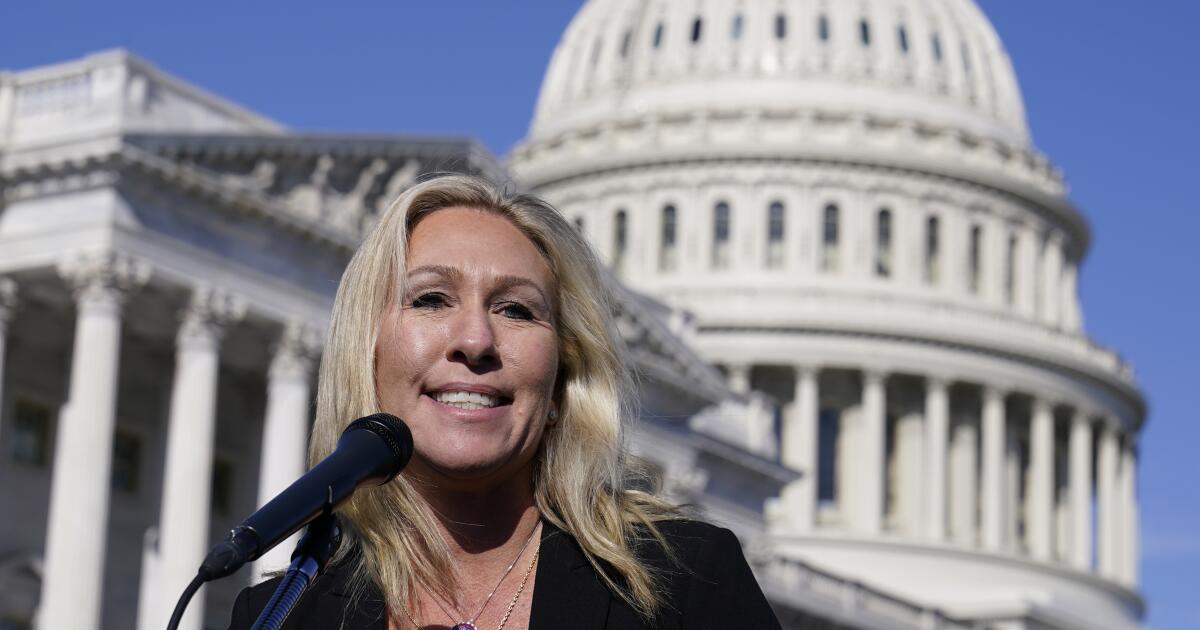
You may have noticed over the last few days that the political world is in an uproar over President Biden’s dispensing of student debt relief.
It’s not so much that Biden implemented the relief program at all; what got politicians and pundits in a tizzy was that he called out the GOP naysayers in the House by pointing out that many of them had received business loans via the pandemic-era Paycheck Protection Program, or PPP, that had never been paid back.
The White House tweeted out the forgiven PPP balances of 13 GOP House members critical of student loan relief, under the heading, “This you?”
The PPP helped people remain employed while the government literally shut down much of the economy,. Only an intellectual clown would compare that to what Biden is doing now with student loans.
— Rep. Ralph Norman, R-S.C., recipient of $616,241 in pandemic relief
That’s a really unfair comparison, the argument goes, because the PPP loans were never intended to be paid back. Under the program’s terms, the loans would be forgiven if the money was used to support the workers of a small business that had been forced to close or curtail operations because of pandemic restrictions.
In other words, it’s said, the PPP money was never expected to be repaid. By contrast, student loans were taken out in full expectation that they would be repaid — if not for the handouts being distributed by the White House.
“The PPP helped people remain employed while the government literally shut down much of the economy,” Rep. Ralph Norman (R-S.C.), tweeted back in 2022, the first time Biden made this purportedly invidious comparison. “Only an intellectual clown would compare that to what Biden is doing now with student loans.”
Norman received $616,241 from the PPP, according to the White House.
There’s something to be said for the distinction made by the PPP-pocketing student relief critics, but not nearly as much as they claim. More on that in a moment.
This is just another example of how our political press is incapable of telling the forest from the trees, or how it’s perennially distracted by a shiny object. (Insert your own pertinent metaphor here.)
In this case, the shiny object is the idea that it’s Biden who is the hypocrite for comparing the PPP loans to student debt. This misses the bigger picture of how America’s economy is structured to benefit corporations and the wealthy — that is, the patrons of the Republican political establishment — at the expense of average Americans. The pundits who are flaying the White House for making the connection are merely buying a GOP talking point.
Not only right-leaning commentators are committing this error. Not a few progressive-minded writers are complicit. Here, for instance, is Jordan Weissmann of Semaphor, usually a percipient analyst of economics and finance: “The thing about this talking point is that I know everybody in the White House, including the [communications] shop, is smart enough to know how disingenuous it is.”
Let’s take a closer — and a broader — look.
The comparison between student debt relief and the PPP loans first emerged in 2022, when Biden first announced his plan to forgive up to $20,000 in student debt for households with incomes of up to $125,000. The White House then issued a series of tweets targeting GOP critics of student debt relief whose PPP loans had been forgiven.
The Supreme Court invalidated Biden’s original proposal in 2023. Chief Justice John G. Roberts Jr. wrote for a 6-3 conservative majority that although the law gave the secretary of Education the authority to “waive or modify” the terms of student loans, the White House had gone too far.
After that, the administration implemented a new program, the SAVE plan, that limited monthly repayments on student debt for most borrowers to as little as 5% of their income and ended payments for borrowers living near or below the federal poverty standard. After as little as 10 years, the balance on loans originally totaling $12,000 or less will be permanently forgiven.
The White House issued this roster of GOP politicians who criticized Biden’s student debt relief program but got their pandemic relief loans forgiven
(White House)
The issue erupted again a few days ago when Biden announced new features of his student relief program. They included waiving some accrued interest for borrowers whose balances had grown higher than their original debt, generally because their payments hadn’t covered the accumulated interest — an issue that affects more than one-third of all student borrowers, and two-thirds of Black borrowers.
For the record:
12:22 p.m. April 17, 2024An earlier version of this column incorrectly identified Rep. Andrew S. Clyde (R-Ga.) as a Democrat.
Critics, again mostly Republicans, weighed in again with tendentious lectures on social media about the moral imperative of meeting one’s obligation to pay back a loan.
Rep. Andrew S. Clyde (R-Ga.), for instance, tweeted that Biden’s latest initiative, which will relieve student borrowers of about $7.4 billion in principal and interest, would “transfer millions more in student debt onto the backs of hardworking taxpayers.” Clyde called it “nothing more than a desperate attempt to buy votes with Americans’ hard-earned money.”
Clyde’s $156,597 PPP loan was forgiven.
That brings us back to the hypocrisy issue. It’s true that students who took out education loans are expected to repay them, and that businesses that took out PPP loans were led to believe that they would be forgiven — as long as they were used to support their payrolls through business closings and cutbacks.
But things are not so simple. Critics of Biden’s plan argue that the PPP loans were designed to address an acute economic disaster, which isn’t the case with student loans.
The student loan burden, however, has become an economic disaster. The total amount of outstanding student loans for higher education has ballooned over the last two decades to almost $1.8 trillion today, up from about $300 billion in 2000. Those loans are carried by about 43 million borrowers.
The burden has grown in part because the cost of higher education has exploded. That’s so even at public institutions: In 1970, the average tuition at public four-year universities was $358, or about $2,958 in today’s money. Since then, public university tuition and fees have grown to the point that working families can’t afford them without borrowing.
At UCLA and UC Berkeley, those annual costs come to $13,401 and $14,395 for state residents, respectively. It’s proper to note that the University of California was free to Californians until tuition charges were introduced under Gov. Ronald Reagan in the 1970s. Among the beneficiaries of the old system were former governor and U.S. Chief Justice Earl Warren, diplomat Ralph Bunche, L.A. Mayor Tom Bradley, and writer Maxine Hong Kingston, all children of low-income families.
Public university students today accumulate an average of $32,637 to receive a bachelor’s degree. The overall average of student debt reached $37,600 in 2022, more than double the average in 2007.
The economic implications of this burden are inescapable. Households burdened by high student debt often delay or forgo homeownership and face difficulties in starting a family or building up savings. The debt load also contradicts Americans’ cherished assumptions about the value of higher education.
“The whole premise of the main higher education industry is that a college degree pays off,” Marshall Steinbaum, an expert in higher education finance at the Jain Family Institute, told me in 2022. When some people are still paying off their student loans as they approach retirement, that premise loses some of its oomph.
As for the PPP, it was nothing like the unalloyed boon that its GOP defenders portray. The members of Congress who snarfed up loans by the six or seven figures (Rep. Brett Guthrie (R-Ky.) tops the list of those called out as hypocrites by Biden with $4.4 million in forgiven loans) are beneficiaries of a program they themselves voted for.
Of the 13 on Biden’s list, three (Marjorie Taylor Greene and Clyde of Georgia and Pat Fallon of Texas) hadn’t yet been elected when the PPP came up for a vote in April 2020; another, Mike Kelly of Pennsylvania, didn’t cast a vote. All the others on the White House roster voted in favor. The measure passed the House 388 to 5. Representatives and senators could have exempted themselves from the PPP benefits, but they didn’t. Then they lined up for the goods.
Were the PPP funds invariably used as they were supposed to? There’s reason to be skeptical. Greene, who received a $182,300 PPP loan in April 2020 for her family construction business, donated $250,000 to her own congressional campaign the following June and August. The government subsequently forgave $183,500, including interest.
Did any of those donations come from the PPP? We’ll never know, because days before Biden took office, the Small Business Administration deleted almost all the database red flags designating potentially questionable or fraudulent loans subject to further review. That’s according to the Project on Government Oversight, a watchdog group that based its findings on a government database.
As many as 2.3 million loans, including 54,000 loans of more than $1 million each, thus may have received a free pass. The red flags included signs that a recipient company had laid off workers or were ineligible to participate in the program.
The SBA’s inspector general’s office later disclosed that it had “substantiated an unprecedented level of fraud activity” in the PPP program, but said the mass closeout, as well as the SBA’s habit of forgiving loans before reviewing them for potential fraud, would hamper the agency’s ability “to recover funds for forgiven loans later determined to be ineligible.”
A larger problem in the haste by politicians and pundits to flay Biden for his defense of student loan relief is that their view is too narrow. As I reported in 2022, many of the politicians wringing their hands over how student loan relief burdens ordinary taxpayers received their higher education courtesy of ordinary taxpayers — by attending public institutions at a time when they were overwhelmingly tax-supported.
That’s not all. Republican fiscal policies are almost invariably aimed to benefit corporations and wealthier Americans. The 2017 tax cuts are a perfect example. The richest 20% of Americans received nearly 64% of the tax benefits. The top 1% received a reduction in their average federal tax rate of 1.5 percentage points, worth an average $32,650 a year; the lowest-income 20% got a tax rate reduction of 0.3 of a percentage point, worth $40 a year.
Student debt relief, however, overwhelmingly favors low-income borrowers. According to a 2022 study done for Sen. Elizabeth Warren (D-Mass.), $10,000 in student debt cancellation would reduce the share of people with debt by one-third among the lowest-income 20% and by one-fourth for households among the next 20%. But it would make almost no difference for the richest 10%.
Debt cancellation also would reduce racial gaps in household economics. A $10,000 debt reduction would zero out loan balances for 2 million Black families, the study said, reducing the share of Black individuals with student loans to 17% from 24%.
In other words, student debt relief is a boon for the most economically vulnerable American households. That can’t be said of the PPP program, and certainly not for the GOP tax cuts.
The debate over whether it’s “fair” to juxtapose student debt relief with the millions pocketed by GOP representatives and their patrons is, indeed, a story of hypocrisy. But the hypocrisy is not where our political press has claimed to find it. They should pay attention to what really drives conservatives to hate student debt relief so much.

The Supreme Court ruled 6-3 that President Trump could fire independent regulators for any reason. But the justices carved out an exception for the Federal Reserve, preventing the immediate removal of Lisa D. Cook, a Federal Reserve governor.
Politics
Emotion and feelings: How Democratic Socialists’ congressional insurgency could come back to bite them

NEWYou can now listen to Fox News articles!
Democratic Socialists of America are on the charge, running hot off their wins in the New York Democratic primaries last week. Their victories in multiple Congressional seats – felling both Reps. Adriano Espaillat, D-N.Y., and Dan Goldman, D-N.Y. – signals that the party is ready to move on from the same old, same old.
Espaillat chaired the Congressional Hispanic Caucus. Goldman was a key House staffer during the first impeachment of President Donald Trump.
“Even Dan Goldman’s not good enough for them,” said House Judiciary Committee Chairman Jim Jordan, R-Ohio, on Fox. “That is how radical it’s become.”
Some moderate Democrats are trying to distance themselves from the left.
MAMDANI-BACKED SOCIALISTS LOOK TO TAKE NEW YORK PLAYBOOK NATIONWIDE AFTER PRIMARY VICTORIES
The left flank of the Democratic Party has surged to the top of the nation’s most hotly-contested primaries. (Michael M. Santiago/Getty Images)
“That’s not the same brand of politics that we have. We’re not those type of Democrats,” said Rep. Tom Suozzi, D-N.Y., who represents a battleground district.
“There’s a new group of Democratic Socialists who are socialists who are not commonsense Democrats. Who are not interested in getting things done. They’re interested in throwing bombs. Not actually solving problems,” said Rep. Josh Gottheimer, D-N.J.
LURCHING LEFT: MAMDANI-BACKED CANDIDATES OUST ESTABLISHMENT DEMOCRATS
Some Democrats are worried how far left candidates command more attention than those in the middle. Rep. Kristen McDonald Rivet, D-Mich., worries that the outsized attention garnered by the left sends the wrong impression to voters.
“What they don’t want is divisiveness. They don’t want screaming and yelling,” said McDonald Rivet.
Mainstream Democrats feel trapped in the middle as the left – specifically the New York City left – wields an outsized media and political megaphone.
“Those candidates would not have won in Virginia where I live,” said Rep. Suhas Subramanyam, D-Va.
Rep. Tom Suozzi, D-N.Y., is among the moderate Democrats trying to distance themselves from the party’s insurgent wing. (Nathan Posner/Anadolu via Getty Images)
Republicans believe they are primed to nationalize the midterms. Republicans can do that by highlighting the extreme views of Democratic Socialists who captured primary victories in New York City. The GOP wants to portray their opponents as veering left.
“These are board-certified communists, right?” asked Sen. Roger Marshall, R-Kan. “They want no police. They want no private property.”
President Trump capitalized on the Democratic outcomes in his home city.
“The Democrat party is in big trouble because this isn’t stopping with New York,” he forecast.
VICTORIES BY MAMDANI-BACKED CONGRESSIONAL CANDIDATES SPOTLIGHTS GROWING RIFT IN DEMOCRATIC PARTY
This shakeup has progressive leaders demanding transformation at the top.
“You’re going to see, I think, people voting for new leadership and to change their representation,” said Rep. Alexandria Ocasio-Cortez, D-N.Y.
The Democratic Party tapped Sen. Elissa Slotkin, D-Mich., to deliver their official response to President Trump’s 2025 State of the Union speech. Slotkin is a moderate who won in a battleground race in 2024 – even as the President prevailed in the Wolverine State. But during an appearance on SiriusXM, Slotkin insists on a Democratic Party management switch.
“If people can’t understand that the game has fundamentally changed and they can’t adapt, then they need to let others,” said Slotkin. “The old models do not work for people.”
House Minority Leader Hakeem Jeffries, D-N.Y., is perceived by Republicans as vulnerable after his preferred candidates failed in their congressional primaries. (Roberto Schmidt/Getty Images)
Republicans believe House Minority Leader Hakeem Jeffries, D-N.Y., is vulnerable after the DSA elected their candidates over his preferred picks in New York City.
“I think Hakeem Jeffries’ friends and neighbors gave him a big middle finger,” said House Oversight Chairman James Comer, R-Ky. “If you lose three elections in your hometown, that’s a pretty big slap in the face.”
He added that Democrats “are going further and further to the left to the point where they are full-blown, card-carrying socialists.”
And then there is the anti-Israel, anti-Jewish, and in some cases, antisemitic take by some of these candidates. Rep. Greg Landsman, D-Ohio, is a moderate Democrat from a swing district. He’s Jewish and one of the most pro-Israel Democrats in the House.
“There are some on the left who use Israel the way that some on the right use immigrants or trans kids as a way to divide. And I think it’s terrible. It’s also just not what voters want us talking about,” said Landsman.
HOUSE DEMOCRAT LASHES OUT WHEN GRILLED ON WHETHER SOCIALIST VICTORIES WOULD THREATEN DEM UNITY
Yours truly tangled with Rep. John Larson, D-Conn. – who once chaired the House Democratic Caucus. I pressed him about what the party would do about some candidates “who are too far to the left.”
“What does that mean? That’s your statement. Did the people of New York vote?” queried Larson.
I assured him that they did.
“Is that democracy?” asked Larson.
“But if some of them are antisemitic,” I countered.
“Is that a democracy?” continued Larson.
“Will you stand by people if they have antisemitic views?” I followed up.
Larson finally addressed my inquiry. His answer crystallized the schism the Democratic Party now faces.
“I’m against antisemitism, if that’s your question,” Larson declared.
Rep. John Larson, D-Conn., got into a heated exchange with Fox News’ Chad Pergram over the views of some likely members of his party’s next freshman class. (Bill Clark/CQ-Roll Call, Inc via Getty Images)
The fact that Democrats are now facing this debate robs them of valuable time on economic issues.
Landsman argued that voters would prefer candidates to stick to groceries and the price of gas.
Gottheimer echoed Landsman on kitchen table subjects.
“We should be focused on ways to actually solve problems like that. Not coming in here and using tea party tactics and trying to divide up the country and pray to socialist ideals,” said Gottheimer.
So what is the party to do?
DEMOCRACY ’26: STAY UP TO DATE WITH THE FOX NEWS ELECTION HUB
“They’re our nominees. We’re going to support them. We’re going to welcome them. They’re going to be part of our caucus and we’re going to unite behind Leader Jeffries,” said Rep. Robert Garcia, D-Calif., the top Democrat on the Oversight panel.
But that doesn’t address the fissures. It doesn’t address how voters may perceive the party. And it doesn’t establish if these new Democratic nominees will work on behalf of the party to raise money and advocate for Democrats across the board. Or, will they become professional bomb throwers – ala what the right has endured for a while.
“It’s going to be a lot harder to get things done when you get more and more extreme candidates who are here because they’re interested in political celebrity. They are interested in fighting. They’re interested in making points,” asserted Rep. Dusty Johnson, R-S.D.
Republicans have had an abysmal week themselves – President Donald Trump and Sen. Bill Cassidy, R-La., for instance, got into a shouting match over Iran. (Chip Somodevilla/Getty Images; Tyler Kaufman/Getty Images)
Republicans suffered through an absolutely abysmal week. House GOP leaders had to yank multiple bills off the floor and send lawmakers home early because of internal disputes. President Trump and Sen. Bill Cassidy, R-La., got into a shouting match about Iran. And the president even threatened to veto a bipartisan housing bill. President Trump then refused to sign the bill at the Capitol, despite his aides touting the bill and House Republicans tricking out Statuary Hall for a signing ceremony.
The President characterized the housing bill as “a yawn.”
But the Democrats’ internal fractures may have superseded any internecine fighting among Republicans.
“While it’s not been a great week for Republicans, I think it’s been a much worse week for Democrats because of these primary elections,” observed Rep. Mario Diaz-Balart, R-Fla.
CLICK HERE TO DOWNLOAD THE FOX NEWS APP
Democrats will certainly run on economic issues and capitalize on statements by the President about basic issues like housing. But will a genuine policy debate outweigh fears about progressives nationwide?
Emotion and feelings rule in politics. And it could be a problem for Democrats if Republicans appropriate what happened in New York and Xerox it onto battleground districts across the country.

Anthropic teamed up with California to get more state workers to use its artificial intelligence assistant Claude as part of an effort to leverage technology to make the government more efficient.
Gov. Gavin Newsom, who announced the partnership on Monday, said state agencies will be able to access Claude at a 50% discount. Free training and other assistance will also be available to the workers. California’s local governments will also get the same discount under the agreement.
Government workers can use Claude to draft and summarize documents, analyze information and do other tasks.
Anthropic, an AI company based in San Francisco, has a version of its AI assistant for government clients that provides more security than what it provides other consumers.
The new partnership shows how AI is playing a bigger role at work as tech companies market their tools as ways to complete tasks more quickly. Last year, San Francisco made Microsoft 365 Copilot Chat, which is powered by OpenAI’s model, available to nearly 30,000 city employees.
Still, the rise of automation at work has heightened concerns that people will lose their jobs. There are also worries that there are not yet adequate guardrails in place to mitigate data privacy and security risks.
Anthropic and the governor said that they’re focused on the responsible use of AI.
“AI should not replace the human work of government; it should help our workers move faster, solve problems more effectively, and deliver better results for Californians,” Newsom said in a statement.
The remarks didn’t appear to comfort union leaders.
“Wow. Look local government, the Gov is giving you a 50% off coupon to give up your residents’ private data, outsource your jobs to big tech. Isn’t that cool? Because California basically invented AI slop!” said Lorena Gonzalez Fletcher, president of the California Federation of Labor Unions, AFL-CIO, in a post on X.
Anthropic has faced political hurdles as it pushes to get more companies and government agencies to use its products.
Most notable, it’s sparred publicly with the Trump administration, which ordered the company to cut off foreign access to its most powerful AI systems this month.
The Trump administration cited potential national security risks, but Anthropic disagreed with the findings. Last week, tensions decreased after the U.S. government gave Anthropic permission to restore access to its AI model Mythos to certain clients.
Valued at nearly $1 trillion, Anthropic has also signaled it plans to become a publicly traded company.
California has already started using Claude more in state government to develop tools to get the public to engage more in AI policy discussions and assist state workers, the governor’s office said in its news release.
State agencies, including the Department of Motor Vehicles, are also using AI to reduce wait times and improve customer service.
“As state employees, our goal is to provide our fellow Californians with the best possible service,” Government Operations Agency Secretary Nick Maduros said in a statement. “To do that, we need to make sure our teams have access to the best modern tools, including Claude and other emerging technologies.”
-

 Maine3 minutes ago
Maine driver to honor friend Kyle Busch during Celebration of America 300
-

 Maryland8 minutes ago
Maryland man sentenced for making online threats toward Black and Muslim communities
-

 Michigan15 minutes ago
Michigan Lottery Daily 3, Daily 4 results for June 29, 2026
-

 Massachusetts17 minutes ago
Millions of gallons of wastewater discharged into Merrimack River due to broken pipe
-

 Minnesota23 minutes ago
Driver in fatal crash near Belview, Minnesota, was fleeing law enforcement
-

 Mississippi30 minutes ago
Mississippi gas prices drop ahead of Fourth of July weekend
-

 Missouri32 minutes ago
Gas prices falling in Missouri despite U.S. conflict with Iran
-

 Montana38 minutes ago
June 29 recap: Missoula and Western Montana news you may have missed today

