Politics
At Supreme Court, steady wins for conservative states and Trump's claims of executive power

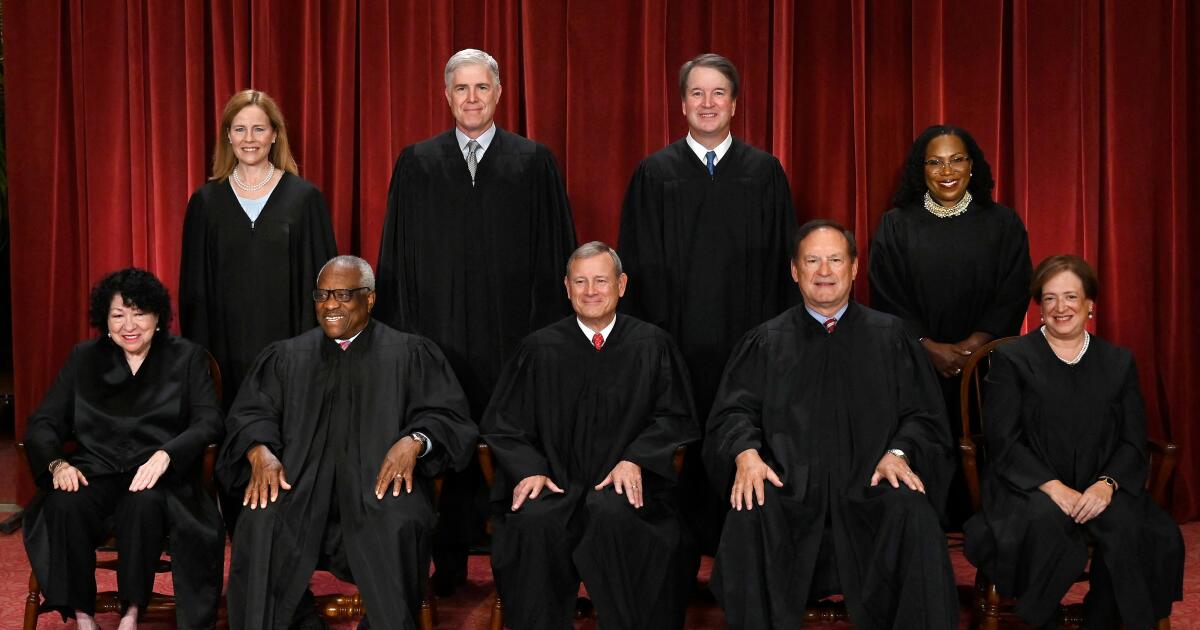
WASHINGTON — The Supreme Court term that ended Friday will not be remembered for blockbuster rulings like those recent years that struck down the right to abortion and college affirmative action.
The justices scaled back their docket this year and spent much of their energy focused on deciding fast-track appeals from President Trump. His administration’s lawyers complained too many judges were standing in the way of Trump’s agenda.
On Friday, the court’s conservatives agreed to rein in district judges, a procedural victory for Trump.
What’s been missing so far, however, is a clear ruling on whether the president has abided by the law or overstepped his authority under the U.S. Constitution.
On the final two days of the term, the court’s conservative majority provided big wins for Republican-leaning states, religious parents and Trump.
The justices gave states more authority to prohibit medical treatments for transgender teens, to deny Medicaid funds to Planned Parenthood clinics and to enforce age-verification laws for online porn sites.
Each came with the familiar 6-3 split, with the Republican appointees siding with the GOP-led states, while the Democratic appointees dissented.
These rulings, while significant, were something short of nationwide landmark decisions — celebrated victories for the Republican half of the nation but having no direct or immediate effect on Democratic-led states.
California lawmakers are not likely to pass measures to restrict gender-affirming care or to prohibit women on Medicaid from obtaining birth control, pregnancy testing or medical screenings at a Planned Parenthood clinic.
The new decisions echoed the Dobbs ruling three years ago that struck down Roe vs. Wade and the constitutional right to abortion.
As the conservative justices noted, the decision in Dobbs vs. Jackson Women’s Health did not outlaw abortion nationwide. However, it did allow conservative states to do so. Since then, 17 Republican-led states in the South and Midwest have adopted new laws to prohibit most or all abortions.
On this front, the court’s decisions reflect a “federalism,” or states-rights style of conservatism, that was dominant in decades past under President Reagan and two of the court’s conservative leaders, Chief Justice William Rehnquist and Justice Sandra Day O’Connor.
Both were Arizona Republicans (and in O’Connor’s case, a former state legislator) who came to the court with that view that Washington holds too much power and wields too much control over states and local governments.
With the nation sharply divided along partisan lines, today’s conservative court could be praised or defended for freeing states to make different choices on the “culture wars.”
The other big winner so far this year has been Trump and his broad claims of executive power.
Since returning to the White House in January, Trump has asserted he has total authority to run federal agencies, cut their spending and fire most of their employees, all without the approval of Congress, which created and funded the agencies.
He has also claimed the authority to impose tariffs of any amount on any country and also change his mind a few days later.
He has dispatched National Guard troops and Marines to Los Angeles against the wishes of the governor and the mayor.
He has asserted he can punish universities and law firms.
He has claimed he can revise by executive order the 14th Amendment and its birthright citizenship clause.
So far, the Supreme Court has not ruled squarely on Trump’s broad assertions of power. But the justices have granted a series of emergency appeals from Trump’s lawyers and set aside lower court orders that blocked his initiatives from taking effect.
The theme has been that judges are out of line, not the president.
Friday’s ruling limiting nationwide injunctions set out that view in a 26-page opinion. The conservatives agreed that some judges have overstepped their authority by ruling broadly based on a single lawsuit.
The justices have yet to rule on whether the president has overstepped his power.
Justice Amy Coney Barrett summed up the dispute in a revealing comment responding to a dissent from Justice Ketanji Brown Jackson. “Justice Jackson decries an imperial Executive while embracing an imperial Judiciary,” she wrote.
Missing from all this is the earlier strain of conservatism that opposed concentrated power in Washington — and in this instance, in one person.
Last year offered a hint of what was to come. A year ago, the court ended its term by declaring the president is immune from being prosecuted for his official acts while in the White House.
That decision, in Trump vs. United States, shielded the former and soon-to-be president from the criminal law.
The Constitution does not mention any such immunity for ex-presidents charged with crimes, but Chief Justice John G. Roberts Jr. said a shield of immunity was necessary to “enable the the President to carry out his constitutional duties without undue caution.”
Since returning to the White House, Trump has not been accused of exercising “undue caution.”
Instead, he appears to have viewed the court’s opinion as confirming his unchecked power as the nation’s chief executive. Trump advisors say that because the president was elected, he has a mandate and the authority to put his priorities and policies into effect.
But the Supreme Court’s conservatives did not take that view when President Biden took office promising to take action on climate change and to reduce the burden of student loan debt.
In both areas, the Roberts court ruled that the Biden administration had exceeded its authority under the laws passed by Congress.
Away from Washington, the most significant decision from this term may be Friday’s ruling empowering parents.
The six justices on the right ruled parents have a right to remove their children from certain public school classes that offend their religious beliefs. They objected to new storybooks and lessons for young children with LGBTQ+ themes.
In recent years, the court, led by Roberts, has championed the “free exercise” of religion that is protected by the 1st Amendment. In a series of decisions, the court has exempted Catholic schools and charities from laws or regulations on, for example, providing contraceptives to employees.
Friday’s ruling in a Maryland case extended that religious liberty right into the schools and ruled for Muslim and Catholic parents who objected to new LGBTQ+-themed storybooks.
At first, the school board said parents could have their young children “opt out” of those classes. But when too many parents took the offer, the school board rescinded it.
The clash between progressive educators and conservative parents reached the court when the Becket Fund for Religious Liberty appealed on behalf of the parents.
Justice Samuel A. Alito Jr. said the parents believed the books and stories offended their religious beliefs, and he ordered school authorities to “to notify them in advance whenever one of the books in question is to be used … and allow them to have their children excused from that instruction.”
This decision may have a broader impact than any from this term because it empowers parents nationwide. But it too has limits. It does not require the schools to change their curriculum and their lessons or remove any books from the shelves.
The conservatives fell one vote short in a case that could have brought about a far-reaching change in American schools. Split 4 to 4, the justices could not rule to uphold the nation’s first publicly funded, church-run charter school.
In the past, Roberts had voted to allow students to use state tuition grants in religious schools, but he appeared uncertain about using tax money to operate a church-run school.
But that question is almost certain to return to the court. Barrett stepped aside from the Oklahoma case heard in April because friends and former colleagues at the Notre Dame Law School had filed the appeal. But in a future case, she could participate and cast a deciding vote.




Politics
Sen Murphy warns ‘people are going to die’ as Congress punts on expiring Obamacare subsidies

NEWYou can now listen to Fox News articles!
A bipartisan Obamacare fix remains out of reach in the Senate, for now, and lawmakers can’t agree on who is at fault.
While many agree that the forthcoming healthcare cliff will cause financial pain, the partisan divide quickly devolved into pointing the finger across the aisle at who owns the looming healthcare premium spikes that Americans who use the healthcare exchange will face.
Part of the finger-pointing has yielded another surprising agreement: Lawmakers don’t see the fast-approaching expiration of the Biden-era enhanced Obamacare subsidies as Congress failing to act in time.
“Obviously, it’s not a failure of Congress to act,” Sen. Chris Murphy, D-Conn., told Fox News Digital. “It’s a failure of Republicans to act. Democrats are united and wanting to expand subsidies. Republicans want premium increases to go up.”
Partisan rancor over Obamacare has seeped into how lawmakers view the effect that expiring subsidies will have on their constituents. Sen. Chris Murphy, D-Conn., argued that it was a “life or death” situation, while Republicans contended that Democrats set up the very cliff they maligned. (Tom Williams/CQ-Roll Call, Inc. via Getty Images)
DEMOCRATS’ LAST-MINUTE MOVE TO BLOCK GOP FUNDING PLAN SENDS LAWMAKERS HOME EARLY
Senate Republicans and Democrats both tried, and failed, to advance their own partisan plans to replace or extend the subsidies earlier this month. And since then, no action has been taken to deal with the fast-approaching issue, guaranteeing that the subsidies will lapse at the end of the year.
A report published last month by Kaiser Family Foundation, a nonprofit healthcare think tank, found that Americans who use the credits will see an average increase of 114% in their premium costs.
The increase can vary depending on how high above the poverty level a person is. The original premium subsidies set a cap at 400% above the poverty level, while the enhanced subsidies, which were passed during the COVID-19 pandemic, torched the cap.
For example, a person 60 years or older making 401% of the poverty level, or about $62,000 per year, would on average see their premium prices double. That number can skyrocket depending on the state. Wyoming clocks in at the highest spike at 421%.
SENATE MULLS NEXT STEPS AFTER DUELING OBAMACARE FIXES GO UP IN FLAMES
Sen. Rick Scott, R-Fla., doesn’t want to blow up Obamacare or get rid of Obamacare subsidies, but he does want to provide Americans with more options for healthcare. (Andrew Harnik/Getty Images)
In Murphy’s home state of Connecticut, premiums under the same parameters would hike in price by 316%.
“When these do lapse, people are going to die,” Murphy said. “I mean, I was talking to a couple a few months ago who have two parents, both with chronic, potentially life-threatening illnesses, and they will only be able to afford insurance for one of them. So they’re talking about which parent is going to survive to raise their three kids. The stakes are life and death.”
Both sides hold opposing views on the solution. Senate Republicans argue that the credits effectively subsidize insurance companies, not patients, by funneling money directly to them, and that the program is rife with fraud.
Senate Democrats want to extend the subsidies as they are, and are willing to negotiate fixes down the line. But for the GOP, they want to see some immediate reforms, like income caps, anti-fraud measures and more stringent anti-abortion language tied to the subsidies.
Sen. Rick Scott, R-Fla., who produced his own healthcare plan that would convert subsidies into health savings accounts (HSAs), argued that congressional Democrats “set this up to expire.”
SENATE REPUBLICANS LAND ON OBAMACARE FIX, TEE UP DUELING VOTE WITH DEMS
Senate Majority Leader John Thune, R-S.D., panned Senate Democrats’ Obamacare subsidy proposal as “obviously designed to fail.” (Tom Williams/CQ-Roll Call, Inc. via Getty Images)
But he doesn’t share the view that the subsidies’ expected expiration is a life-or-death situation.
“I’m not taxing somebody who makes 20 bucks an hour to pay for healthcare for somebody who makes half a million dollars a year, that’s what they did,” he told Fox News Digital. “All they did was mask the increase in healthcare costs. That’s all they did with it.”
Sen. Jim Banks, R-Ind., similarly scoffed at the notion, and told Fox News Digital, “The Democrat plan to extend COVID-era Obamacare subsidies might help less than half a percent of the American population.”
“The Republican plan brings down healthcare costs for 100% of Americans,” he said. “More competition, expands health savings accounts. That needs to be the focus.”
Democrats are also not hiding their disdain for the partisan divide between their approaches to healthcare.
Sen. Brian Schatz, D-Hawaii, told Fox News Digital that the idea that this “is a congressional failure and not a Republican policy is preposterous.”
“They’ve hated the Affordable Care Act since its inception and tried to repeal it at every possible opportunity,” he said, referring to Obamacare. “The president hates ACA, speaker hates ACA, majority leader hates ACA, rank-and-file hate ACA. And so this is not some failure of bipartisanship.”
While the partisan rancor runs deep on the matter of Obamacare, there are Republicans and Democrats working together to build a new plan. Still, it wouldn’t deal with the rapidly approaching Dec. 31 deadline to extend the subsidies.
CLICK HERE TO DOWNLOAD THE FOX NEWS APP
Senate Majority Leader John Thune, R-S.D., predicted that the Senate would have a long road to travel before a bipartisan plan came together in the new year, but he didn’t rule it out.
“It’s the Christmas season. It would take a Christmas miracle to execute on actually getting something done there,” he said. “But, you know, I think there’s a potential path, but it’ll be heavy lift.”

Bill Clinton, Bill Gates, Noam Chomsky and Woody Allen were among the familiar faces in the latest batch of photographs released by Democrats on the House Oversight Committee in connection to the late Jeffrey Epstein. With the Justice Department preparing to make additional files public, the images underscore an uncomfortable truth for us all: The convicted sex offender moved comfortably among some of the most intelligent men in the world. Rhodes scholars, technology leaders and artists.
Also in the release was a photograph of a woman’s lower leg and foot on what appears to be a bed, with a paperback copy of Vladimir Nabokov’s “Lolita” visible in the background. The 1955 novel centers on a middle-aged man’s sexual obsession with a 12-year-old girl. Epstein, a serial sexual abuser, famously nicknamed one of his private planes “The Lolita Express.” And we are to believe that some of the globe’s brightest minds could not put the dots together?
Donald Trump, who once described himself as “a very stable genius,” included.
“I’ve known Jeff for 15 years. Terrific guy,” Trump told New York magazine in 2002. “He’s a lot of fun to be with. It is even said that he likes beautiful women as much as I do, and many of them are on the younger side.”
Later, the two had a public falling out, and Trump has repeatedly denied any wrongdoing. Great. But denial after the fact is only one side of this story. The other is harder to digest: Either the self-proclaimed “very stable genius” spent nearly two decades around Epstein without recognizing what was happening in plain sight — or he recognized it and chose silence. Neither explanation reflects on intelligence as much as it does on character. No wonder Trump’s defenders keep raising the most overused word in American politics today: hoax.
“Once again, House Democrats are selectively releasing cherry-picked photos with random redactions to try and create a false narrative,” said White House spokesperson Abigail Jackson. “Here’s the reality: Democrats like Stacey Plaskett and Hakeem Jeffries were soliciting money and meetings from Epstein after he was a convicted sex offender. The Democrat hoax against President Trump has been repeatedly debunked, and the Trump administration has done more for Epstein’s victims than Democrats ever have by repeatedly calling for transparency, releasing thousands of pages of documents and calling for further investigations into Epstein’s Democrat friends.”
Jackson has a point.
Democrats were cherry-picking which photos to release, even if many of the men pictured were aligned with progressives. That includes the president, who was a Democrat when he and Epstein were running together in New York in the 2000s. Trump didn’t register as a Republican until 2009. Now whether the choice of photos and timing was designed to shield political friends or weaponize against perceived enemies isn’t clear. What is clear is that it doesn’t take a genius to see that none of this is a hoax.
The victims are real. The flight logs are real. The millions that flowed into Epstein’s bank account have wire transfer confirmation numbers that can be traced. What Democrats are doing with the information is politics as usual. And you don’t want politics to dictate who gets justice and who gets vilified.
Whatever the politicians’ intentions, Americans can decide how to react to the disclosures. And what the men around Epstein did with the information they gathered on his jet or his island fits squarely at the heart of the national conversation about masculinity. What kind of men could allow such abuse to continue?
I’m not saying the intelligent men in Epstein’s ecosystem did something criminal, but the lack of whistleblowing before his arrest raises questions about their fortitude for right and wrong. And the Trump White House trying to characterize this conversation as a partisan witch hunt — a hoax — is an ineffective strategy because the pattern with their use of that word is so clear.
We saw what happened on Jan. 6, and Trump tells us the investigation is a hoax. We hear the recording of him pressuring Georgia officials to find votes, and he tells us the investigation is a hoax. Trump campaigned on affordability issues — the cost of bacon, no taxes on tips — but now that he’s in office such talk is a hoax by Democrats. As if we don’t know the price of groceries in real time. Ten years ago, Trump told us he had proof that President Obama wasn’t born in the U.S. We’re still waiting.
In his book, “Art of the Deal,” Trump framed his lies as “truthful hyperbole” but by now we should understand for him hyperbole matters more than truth — and his felony convictions confirm that some of his claims were indeed simply false.
So if there is a hoax, it is the notion that none of the brilliant men whom Epstein kept in his orbit had any idea what was going on.
YouTube: @LZGrandersonShow
Insights
L.A. Times Insights delivers AI-generated analysis on Voices content to offer all points of view. Insights does not appear on any news articles.
Viewpoint
Perspectives
The following AI-generated content is powered by Perplexity. The Los Angeles Times editorial staff does not create or edit the content.
Ideas expressed in the piece
-
The release of photographs and documents from the House Oversight Committee demonstrates that Epstein moved freely among some of the world’s most accomplished and intelligent individuals, including Rhodes scholars, technology leaders and artists.
-
Either these prominent men failed to recognize warning signs despite obvious indicators like Epstein’s “Lolita Express” nickname referencing a novel about child sexual abuse, or they recognized the reality and chose silence—neither explanation reflects well on their character.
-
Claims that this is a hoax lack credibility because the evidence is concrete: the victims are real[1], the flight logs are documented[1][3], and the millions flowing through Epstein’s bank accounts have verifiable wire transfer confirmation numbers.
-
The apparent lack of whistleblowing from the men in Epstein’s ecosystem before his 2019 arrest raises serious questions about their moral fortitude and willingness to stand against wrongdoing.
-
The Trump administration’s strategy of characterizing these disclosures as a partisan witch hunt is ineffective, given the pattern of applying the term “hoax” to numerous matters that subsequently proved to be substantiated, from investigations into January 6 to documented pressuring of Georgia officials.
-
Regardless of whether Democrats’ selection of which photographs to release was politically motivated, legitimate questions about masculinity and moral responsibility remain central to the national conversation.
Different views on the topic
-
Democrats selectively released cherry-picked photographs with random redactions designed to create a false narrative while attempting to shield their own political allies, including figures like Stacey Plaskett and Hakeem Jeffries who solicited money and meetings from Epstein after his conviction.
-
The timing and selection of photographs released by House Democrats appear strategically designed to weaponize the Epstein matter against political opponents while deflecting scrutiny from Democratic figures who also maintained connections to the convicted sex offender[2].
-
The Trump administration has demonstrated greater commitment to transparency on the Epstein matter through the release of thousands of pages of documents and calls for further investigations into Epstein’s connections to Democratic associates.
-
Characterizing this as purely a partisan response overlooks the fact that prominent figures across the political spectrum, including those who were Democrats when they associated with Epstein in the 2000s, had connections requiring examination[2].

NEWYou can now listen to Fox News articles!
The Department of Homeland Security (DHS) said Friday that more than 2.5 million illegal immigrants have left the United States since President Donald Trump returned to office this year, citing a sweeping immigration crackdown that it says led to the “most secure border in American history.”
In a year-end report highlighting the agency’s accomplishments, DHS claimed that illegal border crossings plunged 93% year-over-year, fentanyl trafficking was cut in half, and hundreds of thousands of criminal illegal immigrants were either arrested or deported, amounting to a dramatic shift from the Biden administration.
“In less than a year, President Trump has delivered some of the most historic and consequential achievements in presidential history—and this Administration is just getting started,” Homeland Security Secretary Kristi Noem said in a statement. “Under President Trump’s leadership, we are making America safe again and putting the American people first. In record-time we have secured the border, taken the fight to cartels, and arrested thousands upon thousands of criminal illegal aliens.”
EXCLUSIVE: MILLIONS OF ILLEGAL IMMIGRANTS LEAVE US IN RECORD-BREAKING YEAR UNDER TRUMP POLICIES, DHS SAYS
U.S. Secretary of Homeland Security Kristi Noem said Friday that President Donald Trump “has delivered some of the most historic and consequential achievements in presidential history” since he took office on Jan. 20. (Anna Moneymaker/Getty Images)
While Trump’s first year back in office was “historic,” the administration “won’t rest until the job is done,” Noem added.
Of the 2.5 million illegal immigrants that left the country since Trump took office on Jan. 20, an estimated 1.9 million self-deported and more than 622,000 were deported, according to DHS.
The Trump administration has encouraged anyone living in the United States illegally to return to their native countries using the Customs and Border Protection (CBP) Home Mobile App, which allows users to claim a complimentary plane ticket home and a $1,000 exit bonus upon their return.
BIDEN ADMIN MARKED ILLEGAL IMMIGRANT, ALLEGED MURDERER AS ‘NON-ENFORCEMENT PRIORITY,’ DHS REVEALS
United States Customs and Border Protection sent boats to the Chicago River amid “Operation Midway Blitz” on Thursday, Sept. 25, 2025. (Chicago Tribune/Getty Images)
CBP seized nearly 540,000 pounds of drugs this year, almost a 10% increase compared to the same time frame in 2024, DHS said, adding that the U.S. Coast Guard has retrieved roughly 470,000 pounds of cocaine, or enough to kill 177 million people.
Taxpayers have been saved more than $13 billion at DHS, the agency said, noting that several agencies, including the Federal Emergency Management Agency (FEMA), Cyber and Infrastructure Security Agency (CISA), and the Secret Service have returned “to their core missions.”
CLICK HERE TO DOWNLOAD THE FOX NEWS APP
Secretary of Homeland Security Kristi Noem touted the progress made during President Trump’s first year back in office. (Anna Moneymaker/Getty Images)
Secretary Noem awarded $10,000 bonuses earlier this year to TSA officers and personnel who displayed exemplary service, overcame hardships, and displayed the utmost patriotism during the 43-day government shutdown.
DHS touted the administration’s achievements, asserting that “countless lives have been saved” this year and “the American people have been put first again.”

Mayor Tim Keller defeats law-and-order challenger to secure third term as Albuquerque mayor

Suspect in second Charlotte light rail stabbing ID’d as twice deported illegal immigrant with criminal history

Lions place Kerby Joseph on IR, make 2 OL moves for Steelers game

Power outage affects 20,000 households in San Francisco

Suspect dead after officer involved shooting in Mesquite

Florida High School Football Rankings: Top 25 teams – Oct. 21

Cleary's 21 help Le Moyne down Central Connecticut State 69-64 in OT

How old is Bo Nix? What to know about Oregon quarterback ahead of 2024 NFL Draft

99th annual Pony Swim held in Virginia

Video: ‘It Didn’t Have to Happen This Way:’ U.Va. Faculty Call for Review of Police Response to Protests

Sen Murphy warns ‘people are going to die’ as Congress punts on expiring Obamacare subsidies

Ex-Pakistan PM Imran Khan, wife sentenced to 17 years in corruption case

U.S. launches strikes in Syria targeting Islamic State fighters after American deaths

Trump administration touts ‘most secure border in history’ as 2.5 million migrants exit US

How the reparations loan for Ukraine fell apart at the eleventh hour
-

 Iowa6 days ago
Addy Brown motivated to step up in Audi Crooks’ absence vs. UNI
-

 Iowa1 week ago
How much snow did Iowa get? See Iowa’s latest snowfall totals
-

 Maine4 days ago
Elementary-aged student killed in school bus crash in southern Maine
-

 Maryland6 days ago
Frigid temperatures to start the week in Maryland
-

 Technology1 week ago
The Game Awards are losing their luster
-

 South Dakota6 days ago
Nature: Snow in South Dakota
-

 New Mexico4 days ago
Family clarifies why they believe missing New Mexico man is dead
-

 Nebraska1 week ago
Nebraska lands commitment from DL Jayden Travers adding to early Top 5 recruiting class