Politics
After hostage killings, can the Israel-Hamas cease-fire talks be revived?

In the wake of the deaths of six Israeli hostages, including a California-born U.S. citizen, both the Israeli government and the Palestinian militant group Hamas are signaling hardened postures that pose a wrenching new challenge for the Biden administration.
For weeks, U.S. officials have said they were near a final agreement between Israel and Hamas that would halt fighting in the Gaza Strip, temporarily at least, and allow for the release of hostages from Hamas captivity. At the same time, it would bring freedom for some Palestinians held prisoner by Israel, and allow more aid, desperately needed, to reach Gazans.
But intractable holdups, over who and how many people should be released from each side and over a full withdrawal of Israeli troops from Gaza, prevented a deal — and that was before the latest hostage killings.
Now the U.S. is continuing work on negotiations — but not involving Israeli Prime Minister Benjamin Netanyahu, who President Biden said Monday was not doing enough to secure the hostages’ freedom.
Instead, the president said then, U.S. contacts are with “colleagues from Egypt and Qatar” — the two nations with direct contact with Hamas officials.
“We are working day and night to try to get an agreement over the line,” State Department spokesman Matthew Miller said Tuesday. He would not comment on Netanyahu’s apparent rejection of elements of the deal. “We obviously believe this is an urgent matter.”
The news Tuesday evening that the Justice Department had announced terrorism charges against the leaders of Hamas will probably bring even more uncertainty in talks. The leaders are facing charges, including conspiracy to murder U.S. nationals, in connection with the militant group’s cross-border incursion into Israel Oct. 7 that killed about 1,200 people.
With the war entering its 12th month, Gaza is in the grip of a full-blown humanitarian disaster. At least 41,000 Palestinians have been killed, according to the territory’s health officials, who do not differentiate between civilians and militants. Nearly all of the seaside enclave’s 2.3 million people are displaced, with entire cities bombed into mountains of rubble.
Early negotiating success — a U.S.-brokered accord last November that temporarily halted the fighting in Gaza and freed more than 100 hostages — is now a distant memory. Of the approximately 250 captives taken Oct. 7, Israel believes about 100 hostages remain in Gaza and at least a third are already dead.
The grieving families of the six slain hostages — who Israel says were shot in the head by their captors last week as troops operated nearby — voiced hopes that the violent deaths might prove the impetus for an accord that would free the remaining captives.
Jon Polin, father of Berkeley-born Hersh Goldberg-Polin, said Monday in a eulogy addressed to his 23-year-old son that over the months, the family had “sought the proverbial stone that we could turn over to save you.”
“Maybe, just maybe, your death is the stone” that could help bring the rest of the hostages home, he told the thousands of assembled mourners.
“I really hope that this is a turning point,” said Gil Dickmann, a cousin of Carmel Gat, another of the dead hostages, expressing similar hopes as he spoke to reporters hours before her funeral, also on Monday.
But amid a national spasm of grief, neither Netanyahu nor Hamas gave the slightest public hint that any movement was in the offing.
A big part of the problem, said Mara Rudman, a former special Middle East envoy for the State Department, is that neither Netanyahu nor Hamas chief Yahya Sinwar is motivated to halt the fighting.
“From the get-go, Netanyahu and Sinwar are the two in this equation whose interests do not align with getting to a cease-fire agreement,” she said in an interview.
Her analysis is chilling: Sinwar does not care about Palestinian deaths, since his goal is to stir international opprobrium against Israel and domestic turmoil within, and Netanyahu cares foremost about his political survival and avoiding prison, given criminal cases pending against him, which would be jeopardized if he agreed to a cease-fire deal that his far-right coalition partners object to.
At a Monday evening televised news conference, the Israeli leader signaled intransigence, declaring that Israel’s military control over a narrow strip of territory on the Gaza-Egypt border, known as the Philadelphi Corridor, was non-negotiable.
The nine-mile ribbon of land that Israel took control of in May, Netanyahu said, was “Hamas’ pipeline for oxygen and rearmament.”
“The axis of evil needs the Philadelphi Corridor,” he said. “We need to have it under our control.”
Hamas, for its part, sought to harshly dissuade Israel from any notion that hostages could be freed by military force, such as the Israeli raid that plucked four captives to safety in June from the crowded Nuseirat refugee camp. Palestinian officials said the Israeli raid killed scores of civilians, many of them women and children.
In a posting on the Telegram messaging app on Monday, the head of Hamas’ armed brigades appeared to suggest that an execution protocol had been put in place if Israeli troops were thought to be closing in.
“After the Nuseirat incident, new instructions were issued” to those guarding the captives, said the statement issued in the name of Abu Obeida, a nom de guerre.
Israeli officials interpreted the statement as a threat to kill hostages if Israeli troops were nearby, with the killings of the six as a gruesome illustration of that intent.
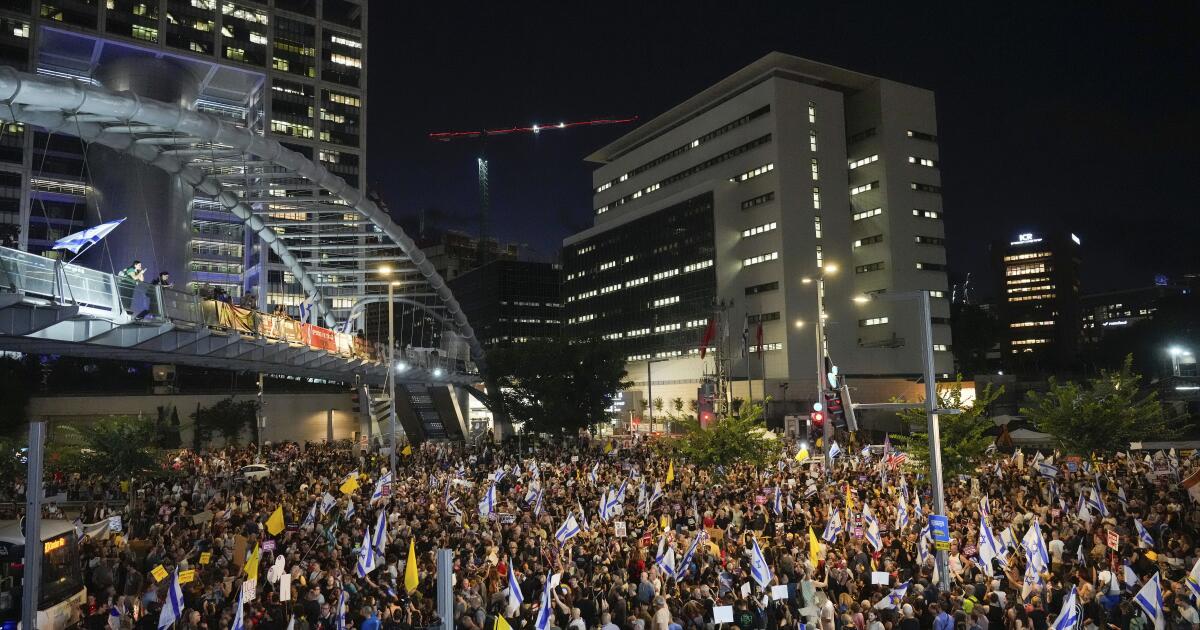
Netanyahu is under some of the strongest public pressure in months to strike a deal. Hundreds of thousands of Israelis flooded the streets of communities across Israel on Sunday, after the killings of the six were disclosed, and organizers have called for large demonstrations to continue nightly.
Protesting crowds chant slogans denouncing the prime minister as morally responsible for the hostage killings, and some wave signs depicting him with blood on his hands. But many among Netanyahu’s loyal base of supporters believe his commitment to an unrelenting military campaign is the best way to confront Hamas, ensure Israel’s safety and perhaps ultimately to free the hostages.
Illustrating the split over how to move forward, areas of the country where Netanyahu’s support is high largely declined to take part in a general strike called Monday by the country’s biggest labor federation.
While Netanyahu still has the fealty of most of his Cabinet, including the far-right figures who insist on continuing an all-out war, the country’s security establishment — notably his defense minister, Yoav Gallant — has publicly questioned his negotiating stance, accusing him in essence of searching for excuses to spurn a deal.
The prime minister’s latest show of defiance over the border strip also drew scorching editorial commentary.
“The Philadelphi route will wind up a highway paved with the hostages’ bodies,” analyst Zvi Bar’el wrote in the left-leaning Haaretz daily.
Netanyahu is well aware, though, that many Israelis derive a visceral satisfaction from the military hunting down the perpetrators of heinous acts in southern Israel on Oct. 7.
Almost everyone here remembers the militants’ killing of a father of two named Gil Taasa, in the community of Netiv Haasara, one of many Israeli villages attacked that day. An assailant tossed a grenade into a shelter, killing him as he tried to shield his two young sons.
Widely viewed video showed the aftermath: the two bloodied boys cowering in shock in their living room as the attacker casually took a bottle of cola from the family’s refrigerator.
On Tuesday, the army said the man in the video, identified as Ahmed Fozi Wadia, a Hamas commander, had been killed in an airstrike in Gaza City along with seven other militants.
A military decision on when to carry out such strikes commonly comes only at the last moment even when they are planned well in advance, and normally depends on many factors. But however coincidental, the reported timing struck some as symbolic: Saturday, the day the hostages’ bodies were discovered.
Times staff writers King and Wilkinson reported from Tel Aviv and Washington, respectively.


NEWYou can now listen to Fox News articles!
President Donald Trump marked the eve of America’s 250th anniversary with a sweeping patriotic address at Mount Rushmore on Friday, declaring the United States the “most exceptional nation ever to exist” and vowing that it would “never be a Communist country.”
Speaking beneath the granite likenesses of four of his predecessors — George Washington, Thomas Jefferson, Abraham Lincoln and Theodore Roosevelt — Trump touted American exceptionalism as festivities marking the nation’s 250th anniversary ramped up across the country.
“In all the chronicles of the ages, never before has any nation celebrated so magnificent a triumph as this one,” Trump told the crowd.
TRUMP KICKS OFF FOURTH OF JULY WEEKEND WITH SYMBOLIC SALUTE TO AMERICA’S LEGACY
President Donald Trump delivers remarks at Mount Rushmore on the eve of America’s 250th anniversary. (Chip Somodevilla/Getty Images)
“At 250 years, America is the oldest republic on earth,” he continued. “We are the freest people on earth. We have the most righteous and enduring Constitution on earth. We are the strongest and most powerful country on earth. And by the grace of God, the United States of America is the most successful, most accomplished, most exceptional nation ever to exist in human history.”
Trump praised the nation’s history and argued that no other country had achieved as much as the United States.
“The birth and survival of the American nation under God is, quite simply, the best and most incredible thing ever to happen on this planet by human hands, ever,” he said. “No other country has done more good for this world than the United States of America.”
AMERICA’S NEXT 250 YEARS DEPEND ON PASSING FAITH AND FREEDOM TO OUR CHILDREN
Fireworks explode after President Donald Trump spoke at Mount Rushmore National Memorial, Friday, July 3, 2026, near Keystone, South Dakota. (AP Photo/Matt Gade)
Before Trump took the stage, the new Air Force One flew over Mount Rushmore as spectators cheered. After his remarks, the president stayed to watch a fireworks display over the Black Hills.
Trump argued the country was facing what he described as a growing communist movement that sought to undermine America’s “exceptional character” and “alienate us from our history.”
The president said the movement had raised the question, “What does it mean to be an American?”
MAMDANI BLASTS ICE AGENTS, ELON MUSK AND ‘SUPREMACY’ IN AMERICA 250 SPEECH AHEAD OF JULY 4 WEEKEND
President Donald Trump speaks at Mount Rushmore National Memorial, Friday, July 3, 2026, near Keystone, South Dakota. (AP Photo/Matt Gade)
Trump described communism as “the greatest threat” facing the United States.
“It is the greatest threat to our country, including World War One, World War Two, Pearl Harbor, or even 9/11,” Trump said. “We’re not going to let this happen to us. Believe me, we’re not letting it happen, because communism is the enemy of free people.”
“Communism is the exact opposite of life, liberty, and the pursuit of happiness — it is death, tyranny and the pursuit of evil,” he continued.
“But we will not let them win,” he added. “They have no chance against us.”
Trump issued a clear directive: “You can be loyal to Karl Marx, or you can be loyal to America. You can be a communist, or you can be a patriot. You cannot be both.”
President Donald Trump speaks beneath Mount Rushmore during a celebration ahead of America’s 250th anniversary. (Chip Somodevilla/Getty Images)
As Americans face those choices, Trump pointed to the nation’s past sacrifices as a guide for its future.
“Our American ancestors did not shed their blood at Concord and Trenton, Gettysburg and Shiloh, Midway and Normandy, just so that a band of thieves, radicals and lunatics could come in and loot, pillage our nation,” he said.
Trump also highlighted the four presidents carved into the mountain behind him, saying they represented America’s founding ideals.
“They were men of action, men of ambition, men of daring, men of destiny, and men of truly great intelligence,” he said. “Above all, they were great men of history. Tonight, on the threshold of our 250th year, we stand beneath the monument of these heroes, a true group of unbelievable people. And we rededicate ourselves to being a nation as big, bold, noble, and as great as these American giants.”
CLICK HERE TO DOWNLOAD THE FOX NEWS APP
Trump is scheduled to deliver another speech Saturday on the National Mall in Washington, D.C. before a fireworks display celebrating the nation’s 250th anniversary.
“We know that this is not an ending,” Trump said. “This is only the beginning of the golden age of America.”

California’s effort to restrict sales of handguns that can be converted into fully-automatic machine guns drew an immediate federal challenge Wednesday, with the Trump administration suing the state over its new “Glock ban” law just hours after it took effect.
The U.S. Department of Justice is seeking a court order to block the controversial state law that limits where most Glock and Glock-style pistols can be sold. The lawsuit, filed in U.S. District Court for the Central District of California, also aims to invalidate key parts of the state’s handgun roster — a list that dictates the types of firearms that Californians may legally purchase. In a statement Wednesday, acting Atty. Gen. Todd Blanche said that both policies “trample” the rights of law-abiding Californians.
“The Second Amendment is a sacred right belonging to all Americans, even those in California,” Blanche said. “California cannot ban the most popular type of handgun in America.”
California’s Assembly Bill 1127 does not explicitly name the Glock brand, but instead targets any handgun with a specific mechanism that can easily be converted by a black market device. These simple “Glock switches” convert semiautomatic handguns into a weapon capable of firing 20 rounds per second with a single squeeze of the trigger.
Advances in 3D printing have made the conversion devices widely available and cheap to produce. Federal authorities reported recovering 11,088 of them from crime scenes between 2019 and 2023. Switches have been used in several mass shootings, including one in Sacramento that resulted in six deaths and 12 injuries in 2022.
The new law does not prohibit the possession of affected handguns already owned by Californians, and includes exemptions for gun dealers, as well as law enforcement and military agencies.
Gov. Gavin Newsom signed the bill in October, and has maintained that firearm laws are responsible for California’s declining crime rates and gun deaths.
“The Trump administration is once again trying to dismantle California’s commonsense gun safety laws,” Diana Crofts-Pelayo, a spokesperson for the governor, said in a statement. “Our response is simple — these laws save lives.”
The federal government argues in its complaint that California can’t ban legal semiautomatic handguns simply because they could be illegally altered, adding that state and federal law already prohibit such pistol converters. The U.S. compared California’s approach to banning ordinary shotguns because they can be illegally shortened.
The lawsuit also challenges California’s decades-old handgun roster, which requires new handgun models to pass certain safety tests before they can be approved for retail sale. A federal judge tentatively blocked portions of the roster requirements in a separate 2023 case, which is being appealed before the 9th Circuit. That lawsuit was filed by the California Rifle & Pistol Assn. and other gun rights supporters following a landmark 2022 decision by the U.S. Supreme Court that set new standards for evaluating firearm restrictions.
Under those new guidelines, the Trump administration wants a judge to find that California’s gun restrictions violate the 2nd Amendment, and is seeking an order to bar the state from enforcing them.
The Trump administration is relying on a federal civil rights law typically used against police departments accused of repeated constitutional violations, arguing that California Atty. Gen. Rob Bonta and state Justice Department agents qualify as peace officers and therefore violate gun owners’ rights whenever they enforce handgun restrictions.
Bonta, who is named in the suit, has a winning court record over the Trump administration, and has secured at least 12 final court rulings and more than 35 preliminary injunctions or emergency orders.
“California’s gun safety laws helped drive firearm death rates to record lows in our state and are a blueprint for reducing gun violence nationwide,” Bonta’s office said in a statement. “We will review the complaint and respond as appropriate in court.”
Politics
Mamdani blasts ICE agents, Elon Musk and ‘supremacy’ in America 250 speech ahead of July 4 weekend

NEWYou can now listen to Fox News articles!
New York City Mayor Zohran Mamdani took aim at U.S. Immigration and Customs Enforcement (ICE) agents, Elon Musk and what he described as the “arena of supremacy” in the United States during an immigration-themed America 250 speech on Friday ahead of Fourth of July weekend.
Flanked by eight recently naturalized U.S. citizens, Mamdani invoked the Statue of Liberty, Ellis Island and America’s history of immigration before turning his rhetoric on elements of today’s U.S. Mamdani also blasted the “world’s first trillionaire” — a milestone Musk achieved with the long-awaited Initial Public Offering (IPO) of SpaceX last month.
“We see the wealthiest country in the history of the world, one where children go to sleep hungry while the world’s first trillionaire hungers for more,” Mamdani said, without naming Musk. “We see monopolies that dominate every industry, and oligarchs who buy elections. We see masked agents terrorizing our streets, eating food cooked by our undocumented neighbors before spiriting them away in unmarked vans.”
“We see a nation whose immense wealth has been built by those with calloused, dirt-streaked hands, those who toil on factory floors and chisel into stone. And we see a nation that has allowed so much of that wealth to be held instead in the soft hands of a precious few,” he added.
Mamdani, who was sitting at George Washington’s desk during the remarks, also praised the legacy of immigrants, claiming that they have overcome riots “aimed at their very existence,” to create lives in New York.
FETTERMAN WARNS MAMDANI RISKS ‘CONSTITUTIONAL CRISIS’ BY VOWING TO DEFY SCOTUS IMMIGRATION RULING
New York City Mayor Zohran Mamdani delivers a speech to mark the 250th anniversary of the United States of America at City Hall on July 3, 2026. (Anna Connors/Pool via REUTERS)
“Over the years that followed, despite laws enacted by the federal government to bar their entry, despite sweatshop fires that killed hundreds of women, despite riots aimed at their very existence, immigrants made homes here in New York City, and they helped to make New York City,” the mayor said.
“That legacy of every generation of Americans insisting that the right to life, liberty and the pursuit of happiness extends to them, too, is no relic of the past. It carried millions of Black Americans north during the Great Migration. It drew hundreds of thousands of Puerto Ricans to New York City after the Second World War. It invited countless others from the West Indies and South Asia and West Africa and across the world. And it is what brought my family to this city when I was seven years old,” he continued.
ZOHRAN MAMDANI PRAISED FOR ‘FANTASTIC’ QUESTION-DODGING ON PRESIDENTIAL ELIGIBILITY
Mamdani did not mention his own family’s wealth in the speech. His father was an elite Harvard academic, and his mother and acclaimed film director.
“My family did not arrive by boat, although we saw the Statue of Liberty from the window of the plane. Even from the air, we could make out the promise of America, the promise of the beautiful patriotic work of rendering America, year after year, a little more faithful to its founding ideals,” he said.
The Statue of Liberty stands in the foreground as Lower Manhattan is viewed at dusk, Sept. 8, 2016, in New York City. (Drew Angerer/Getty Images)
In his speech, Mamdani blasted those with “power and influence,” who he lamented have written American history.
“There is a term so often used to describe our nation and those who have shaped it. American exceptionalism. American exceptionalism, the conventional wisdom tells us, makes our freedom a little more free. It is how we dug the Erie Canal and irrigated the West. Is why children in faraway lands grow up dreaming of one day moving here. And yet, the irony is that the story of America has so often been written by those who were told by others with power and influence and wealth, that they were anything but exceptional,” Mamdani said. “For generation after generation, we have been told that when the world has sent its people to our shores, it has not sent its best.”
“It sent Puritans and Sikhs and Quakers and Muslims and Jewish people who were banished for praying the wrong way, worshiping the wrong gods, angering the wrong people. It sent peasants and serfs from slums and shuttles, who were treated as less because they hardly owned clothes, let alone land. It sent immigrants from whom power was something someone else had,” he continued. “We are told that America is exceptional because we are richer, stronger, more powerful than everyone else. The truth, my friends, is that America is exceptional because here nothing is fixed into place.”
New York City Mayor Zohran Mamdani delivers a speech to mark the 250th anniversary of the United States of America at City Hall on July 3, 2026. (Anna Connors/Pool via REUTERS)
Mamdani referenced how he became a naturalized U.S. citizen in 2018. Mamdani was born in Uganda in 1991 and moved to New York when he was 7. The mayor is a dual U.S.-Ugandan citizen.
“Nearly a decade ago, I too felt what you feel the joy of no longer being just a New Yorker, but an American too. You each hold a special power. The power to determine what America means,” the mayor said, speaking to the recently naturalized citizens by his side.
“The powerful have always known their answer. America, in their view, is an arena of supremacy where only a select few are allowed freedom,” Mamdani said. “Where not all are created equal. America, if you ask them, becomes less the more people it welcomes. America, they will tell you, belongs only to those with the right accent or the right shade of skin. The rest of us, they insist, should be grateful for merely being allowed to visit. How small they are, how weak, how unoriginal. At every moment in our past, those who led through exclusion and isolation have tried to win power and enrich themselves by turning us against one another.”
New York City Mayor Zohran Mamdani delivers a speech to mark the 250th anniversary of the United States of America at City Hall in New York on July 3, 2026. (Anna Connors/Pool via REUTERS)
CLICK HERE TO DOWNLOAD THE FOX NEWS APP
Mamdani also claimed ICE were invading New York neighborhoods.
“We see America each time neighbors link arms with neighbors without asking how long they have lived here or what papers they have as ICE invades our neighborhoods,” he added. “We see America each time those young and old stand in the beating rain or the stifling heat to cast their ballots. We see America each time working people demand more not just for themselves, but for their fellow Americans.”
“There are some who respond to those who ask for more from America with a simple refrain. ‘Love it or leave it,’ they say. But patriotism has never been about pretending our nation is without flaws. Patriotism is every act of righteous dissent,” Mamdani said. “It is every March led under the heavy sun. It is every protest held a decade before its time. It is precisely because we love this nation that we will not leave it.”
Mamdani ended his speech with a rousing call to America’s greatness.
“What power each of us holds to bring America ever closer to the greatness so many have seen when they looked upon these shores. The greatness that for 250 years has been America. Thank you. God bless America. God bless New York City. And happy Fourth of July,” he concluded.
-

 Finance1 minute ago
Boyle Heights warehouse fire: Where neighbors, victims can seek financial assistance
-

 Fitness7 minutes ago
Personal Trainer Reveals the No. 1 Exercise to Do Daily for a Strong Deep Core
-

 Movie Reviews17 minutes ago
Movie Review: ‘Minions & Monsters’ is a very yellow mash note to Hollywood – Sentinel Colorado
-

 World32 minutes ago
Dear Americans, How Well Do You Know Canada?
-
 Lifestyle1 hour ago
After weeks of speculation, Taylor Swift, Travis Kelce wed in New York
-

 Technology1 hour ago
While you’re watching the World Cup, the feds may be watching you
-

 World1 hour ago
Conservative Keiko Fujimori officially declared winner of Peru’s presidential runoff election
-

 Politics2 hours ago
Trump hails America as ‘most exceptional nation ever to exist’ in Mount Rushmore speech

