Vermont
Vermont DMV launches program to assist autistic drivers

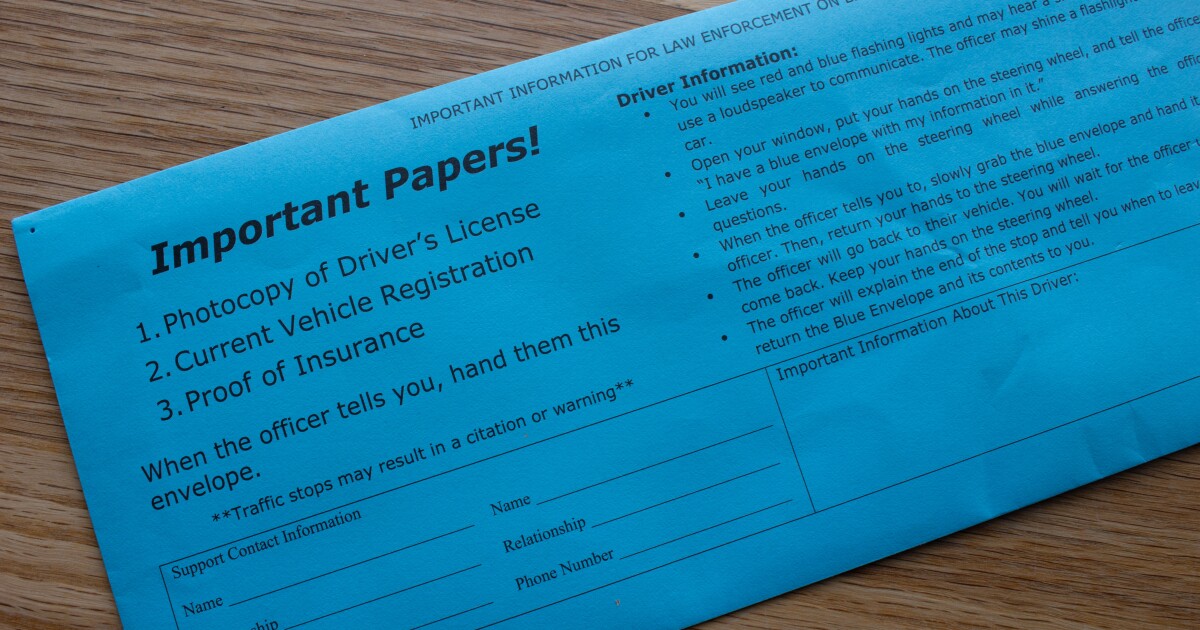
The Vermont Department of Motor Vehicles recently unveiled a new program aimed at easing challenges for autistic drivers and the law enforcement officers who engage them.
Some autistic people experience the senses more intensely than neurotypical people: flashing police lights, for example. And there can be differences in communication, which can lead to behaviors being misinterpreted.
The DMV’s Blue Envelope Program is designed to make routine traffic stops feel safer and less stressful.
Vermont Public’s Jenn Jarecki was recently joined in-studio by Vermont Department of Motor Vehicles Commissioner Wanda Minoli to learn more about the program. This interview was produced for the ear. We highly recommend listening to the audio. We’ve also provided a transcript, which has been edited for length and clarity.
Jenn Jarecki: So we described it briefly in the introduction, but broadly speaking, what is the state’s new Blue Envelope Program?
Nathaniel Wilson
/
Vermont Public
Wanda Minoli: The Blue Envelope Program is really simply about awareness for law enforcement when they do traffic stops, and it’s another form of communication for our residents. Our focus at DMV is customer service, and we’ve had to recognize that we deliver services to every resident at some point in time in the state of Vermont. And you have to be able to adjust and adapt in your communication with them.
Jenn Jarecki: Wanda, I’m curious about how the partnership between the DMV and the University of Vermont Autism Collaborative came about, and what role the Collaborative played in developing the DMV’s Blue Envelope Program.
Wanda Minoli: The Collaborative played the most significant role. They told us how it should be worded, how it should be designed, and what it looked like. And that’s based on their experience and how individuals — with an autistic spectrum of some type — communicate and how they communicate roadside. So they led us and we developed.
Jenn Jarecki: I understand that other states have similar programs, like neighbors in Connecticut and Massachusetts, to name just a couple. How much influence did that existing work have on what’s ultimately been rolled out here in Vermont?
Wanda Minoli: Well, for us, we used the other states’ model of the envelope and started there. Don’t reinvent the wheel. If there’s a successful program out there, then, you know, state to state, we try to model. And that’s really, really important because when you think about this program, and you think about our residents and our New England states, we don’t drive just in Vermont. We may take a vacation to Maine, we may be traveling to Massachusetts for something, and you possibly could be stopped roadside. And what we have now is consistent messaging for all law enforcement, and that applies for people driving into our state. So, when they hand the blue envelope over, all law enforcement is aware. They know exactly what they’re getting and what this document means, and that’s really important, too.
Jenn Jarecki: I want to press on that just a little bit, Wanda. You’ve said that you hope this program can, and I’m quoting you, “build bridges between law enforcement and the autism community.” Can you say even more about that?
Wanda Minoli: Building the bridges, again, is about awareness and communication. And when law enforcement is stopping someone — and we’re going to use a simple example for roadside — they are not aware. And every spectrum is different, you may not communicate with your eyes. Law enforcement is trained to communicate, you know, be looking at the individual, right, having that eye contact. And keeping it at that simple, simple level of, you know, this allows that officer to be able to do and be aware of the tasks that they have in front of them and the conversation. Because roadside stops are about conversations, generally, that’s where it starts. If you’re not aware at that point, the conversation can easily — for the passenger or the driver or the law enforcement — it can go a different way. And this is about a calming effect. This is about a tool to be able to communicate in a very comfortable manner.
Jenn Jarecki: What has the response from law enforcement been to the Blue Envelope Program?
Wanda Minoli: I have communicated with my team, and with the DMV enforcement team, and they’re very excited about it. Again, it’s awareness and it’s another tool. We sent out a law enforcement bulletin to all law enforcement entities in the state of Vermont: municipalities, Vermont State Police. I have not had any personal or direct conversations with them.
Jenn Jarecki: I’d like to talk about the blue envelope itself. Can you describe it for us, and what is written on the envelope and what its sort of purpose is?
Wanda Minoli: So the purpose is to put your necessary documents. If you think about it again, at a roadside traffic stop, a law enforcement officer is going to ask for your license, your registration and your proof of insurance. And so the document is something that you put in the envelope, you just place all of these documents in. But more importantly, too, it asks for an individual’s contact information in the event maybe communication is not, you know, going very well. It gives the law enforcement officer another avenue to help the conversation, and it’s as simple as that.
Jenn Jarecki: So, as we mentioned, the program rolled out earlier this month. Have you had any sign-ups yet?
Wanda Minoli: Oh my goodness, yes. I was so excited. I actually checked yesterday afternoon just to see how the requests were coming in and if we’re getting any online requests. And we had 175 as of noon yesterday [Aug. 21], which to me is remarkable. And in addition, we had two requests from other states. And so that alone tells me there’s awareness and individuals want access.
Jenn Jarecki: So for anyone listening, Wanda, who may be interested in getting a blue envelope, you know, what is the cost, and what might be the next steps?
Wanda Minoli: So, there’s no cost. There’s two simple ways to get the envelope. You can stop by any DMV branch office, you can walk in and we have available at the counter, and you can pick one up. Or you can go online, and you can just send us an email, there’s a direct link, and we will mail them to you.
Have questions, comments or tips? Send us a message.


Kevin Cassese has made his first big move as the head coach at Virginia, hiring Vermont head coach Chris Feifs as his defensive coordinator and top assistant. Inside Lacrosse first reported the news Wednesday, after which Vermont issued a formal announcement.
Feifs has previous experience in the ACC, having served as North Carolina’s defensive coordinator under Joe Breschi when the Tar Heels won the national championship in 2016. He left after that season to become the head coach at Vermont, where in 10 seasons he led the Catamounts to a 78-59 record and America East championships in 2021 and 2022.
“Chris poured his heart and soul into the program,” athletic director Jeff Schulman said.
Feifs was named the America East Coach of the Year in 2023 after leading Vermont to a regular season conference title.
“I will look back at the past 10 years as the single greatest growth period of my life,” he said.
Now he’ll play a key role in remodeling Virginia’s defense in his likeness. The Cavaliers ranked 39th in Division I last season allowing 11.12 goals per game. They do boast one of the best close defensemen in the country in John Schroter, who will be a redshirt senior next season. The goalie position is uncertain after Virginia turned to Air Force transfer Jake Marek as the starter this year and Kyle Morris entered the transfer portal.
Virginia has moved swiftly since making the surprise decision to part ways with Lars Tiffany on May 18 and issuing a terse press release announcing the departure of a head coach who led the Cavaliers to national championships in 2019 and 2021 and the ACC championship this year. Eight days later, they elevated Cassese — an offensive coordinator with extensive previous head coaching experience at Lehigh — to head coach.
Eight days after that, Cassese has his top lieutenant.

MONTPELIER, Vt. (WCAX) – The state of Vermont wants more flexibility in how it charges for access to state parks.
Right now, fees are determined by location, size, and type of camping.
However, leaders say parking at state parks and ponds is seeing more foot traffic, and costs of maintaining them have gone up.
The Department of Forest Parks and Recreation wants to be able to price campsites and day-use parks more dynamically.
There’s no proposal to raise fees now, but if approved, some state parks could see increased fees depending on their popularity, the date, and location.
“It is trying to find that balance of covering costs, providing the service parkgoers have come to expect and making sure we aren’t creating unintentional barriers for people who want to enjoy our fabulous state lakes,” said Julie Moore, Vermont Natural Resources Secretary.
She adds that last year’s Vermont ‘Parks Forever’ initiative, which allows for people who receive three squares benefits free entry to parks, meant an additional 30,000 visits last year.
Copyright 2026 WCAX. All rights reserved.
Vermont
Hundreds of housing units in the works at closely-watched project in Burlington’s South End – VTDigger

This story, by Report for America corps member Carly Berlin, was produced through a partnership between VTDigger and Vermont Public.
A long-awaited housing development that could bring hundreds of new apartments to a series of empty lots in Burlington’s South End neighborhood is beginning to come together.
The first phase of the major public-private deal, called the South End Coordinated Redevelopment Project, got official sign-off from the Burlington City Council last month. The project’s backers have also scored key funding commitments from Treasurer Mike Pieciak’s office and state housing funding agencies.
The project on Lakeside Avenue is the beginning of “a neighborhood being born out of a big parking lot,” Burlington Mayor Emma Mulvaney-Stanak told city councilors in May.
City officials and developers hope the project could eventually include over a thousand homes, making it one of the largest developments in Vermont – and putting a considerable dent in the Queen City’s housing shortage. Regional planners estimate that Burlington needs to add between 3,500 and 10,500 homes by 2050 to get the housing market to a healthy state.
The development is possible, in part, because of a 2023 zoning change in the formerly industrial area that allows for some of the densest housing development in the state, according to local planners.
 100vw, 1200px”/><figcaption class=) A rendering of the South End Coordinated Redevelopment Project, courtesy of Andrew Foley, development director at Jonathan Rose Companies. Credit: GOA Architecture.
A rendering of the South End Coordinated Redevelopment Project, courtesy of Andrew Foley, development director at Jonathan Rose Companies. Credit: GOA Architecture.
The South End project’s backers include Champlain College, Champlain Housing Trust and Ride Your Bike LLC, the investors behind the nearby Hula coworking campus. They have brought on Jonathan Rose Companies, an affordable housing developer with projects from New York to California, as the lead developer. The South End project is the company’s first in Vermont.
The development agreement signed by city councilors in May greenlights the South End project’s first 204 units, estimated to cost roughly $100 million.
Per Burlington’s inclusionary zoning policy and state rules, at least 20% of the first round of apartments will be set aside as affordable. But the developers hope to secure enough funding to allow them to earmark a third of the 204 apartments with income restrictions, said Andrew Foley, director of development at Jonathan Rose Companies, in an interview. The development agreement offers the developers reduced city fees if the affordable units are priced even more modestly than required.
The lion’s share of the new apartments will be studios and one-bedrooms, Foley said. The building would include common social spaces for neighbors to gather, he added.
Like any large-scale housing project, the developers of the South End apartments are piecing together financing from a wide array of sources. They recently scored an $8 million low-interest loan from Pieciak’s 10% for Vermont program, along with a $6.7 million award from the Vermont Housing and Conservation Board to support 67 affordable apartments – including 10 reserved for people experiencing homelessness.
To build out new roads – along with wastewater connections and stormwater infrastructure meant to cut down on sewer overflows into nearby Lake Champlain – city officials are going after funding from a new state program. The Community and Housing Infrastructure Program, a tax-increment financing tool created by the Legislature last year, would allow the city and the developers to borrow the funds needed to build out the infrastructure against the development’s future property tax revenue.
READ MORE

City officials and the developers are working together to submit an application for this CHIP financing. The South End development could be the first project in the state to utilize the program after its launch in January.
“I think a lot of other potential applicants are kind of saying, ‘I wonder how that South End project works out’ – for us to maybe go first,” Foley said.
With an eye toward lowering the project’s carbon footprint, the development will be all-electric, Foley said. The developers are looking to use mass-timber construction techniques, he added – essentially using large, prefabricated wood panels in place of steel or concrete. They also want to construct a rooftop solar array, employ a geothermal heating and cooling system and promote a “car-light” neighborhood in close proximity to bike paths and transit routes.
The developers hope to close on their construction financing by the end of the year.
“Everyone’s eager to see the construction start and housing built, so we’re trying to move as fast as we can,” Foley said.
-

 South-Carolina3 minutes ago
Here’s when, where you can vote in South Carolina 2026 primary election
-

 South Dakota10 minutes ago
Schedule, prediction for 2026 South Dakota softball state tournament
-

 Tennessee13 minutes ago
Tennessee AMC theater worker, 85, receives $146K from strangers for retirement after viral video
-

 Texas18 minutes ago
Peanuts, beans and more: Texas Roadhouse discontinued these menu items
-

 Utah25 minutes ago
Here’s what Utah football player Lance Holtzclaw told U.S. senators about student-athletes’ pay
-

 Vermont28 minutes ago
New UVA Coach Cassese Makes Splash, Hires Feifs as Top Assistant
-

 Virginia33 minutes ago
VSP issues senior alert for missing 63-year-old
-

 Washington40 minutes ago
Washington priest removed as exorcist after linking UFOs to work of demons

