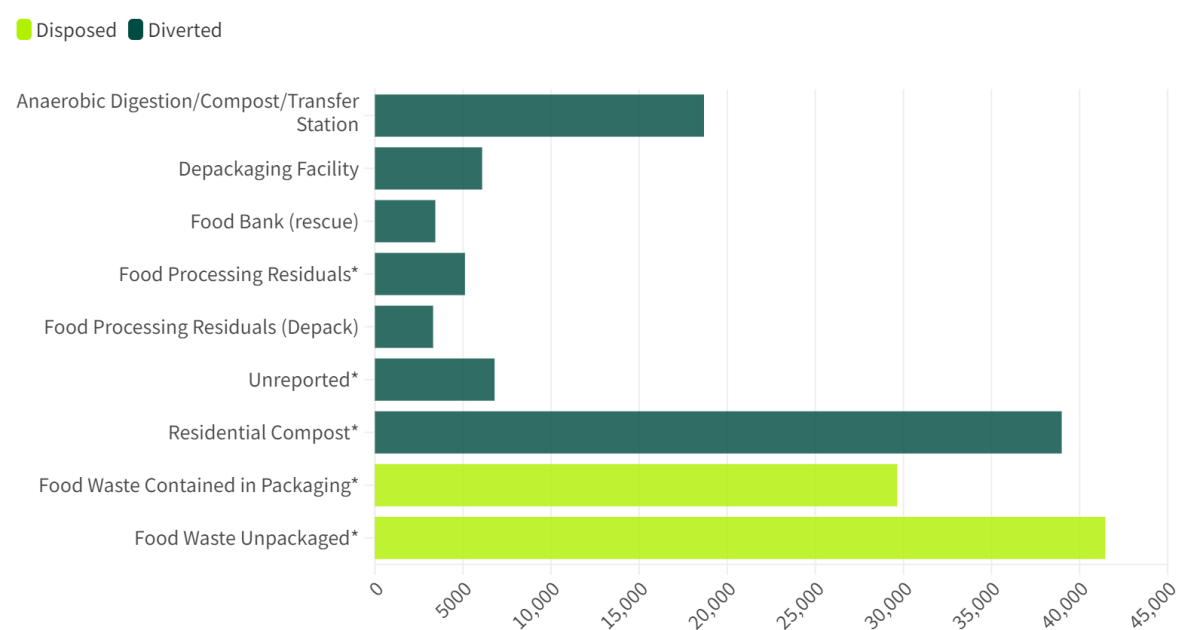
Food scrap waste has decreased slightly since a law banning it from landfills went into effect four years ago, according to a recently-released report from the state.
In terms of tonnage, food scrap waste in the landfill has decreased 13% since 2018. Food scraps make up about the same share of landfill waste as before because the amount of garbage overall has also decreased.
“It’s hard to say that there’s a significant difference, but it is demonstrating some progress,” said Josh Kelly, solid waste program manager at the Vermont Department of Environmental Conservation. “I would say, in short, there’s promising data and we have more work to do.”
Additionally, for the first time, the state has an estimate for the percentage of food waste kept out of the garbage: between 50.7% and 56.8%. That number is sum of the combined effort of residents, businesses, waste haulers, and manufacturers.
Advertisement
For households, the most common way to divert food waste, by far, is by composting, with 43% of households reporting they composted food waste, either at home or with municipal waste services.
Last year, a University of Vermont study showed a high level of support for the food scrap ban, not only from residents but businesses too, even though many businesses also said compliance was difficult and made them incur additional costs.
“I was really surprised and delighted with the incredibly high level of support and compliance I saw among those who worked in food service and food retail, even when we saw service providers often saying compliance wasn’t easy.” said Emily Belarmino, lead author of the study. “It was hard for them and they were still doing it.”
While composting is the most common method of disposing of food waste outside of regular garbage, it’s only one part of a broader system of food recycling in Vermont.
The food waste hierarchy
As with regular garbage, recycling food is not the preferred way to reduce waste. The state prioritizes getting food in people’s bellies before it goes bad over recycling it.
Advertisement
The first priority in the hierarchy is reducing the amount of food waste created by encouraging responsible buying and proper storage.
Courtesy
/
Vermont Department of Environmental Conservation
Advertisement
The Universal Recycling Law, passed in 2012, includes a hierarchy for managing food waste with composting considered the least-preferred method for keeping food out of landfills.
The next priority is feeding people with food before it goes bad. That could include sharing with friends and family, or with community fridges, Kelly said, but on a larger scale, it’s a role filled by organizations such as the Vermont Foodbank.
Millions of pounds of food are rescued
The Vermont Foodbank, which provides food to over 300 food shelves, senior centers, schools, hospitals and more, is an important piece of Vermont’s food waste puzzle. Jason Maring, chief operations officer at the food bank, said the organization receives two-and-a-half to three million pounds of food a year alone from retailers via its Fresh Rescue program.
“Oftentimes, it’ll have a packaging change, or it’s going to be discontinued, or it’s getting a little close to the [sell-by] date, and they’re just worried about it being able to be sold. So often, they’ll set it aside and donate it,” Maring said.
Currently, 158 stores across Vermont contribute to Fresh Rescue, Maring said, making up around 20% of the food bank’s overall distribution. That food is then distributed to the food bank’s community partners to provide for their customers. The program is expansive – at large retailers like Hannaford’s, pick-ups happen five to seven days a week. That’s in addition to other programs, like food donation, that also keep food out of the trash.
In total, the state reported 3,430 tons, or 6,860,000 pounds, of food waste was diverted from the landfill through Vermont Foodbank. That’s 2.2% of estimated food waste in the state and 4.2% of diverted food waste. And, Kelly said, it’s an underestimate: the state’s data only covers the food bank; local initiatives aren’t covered.
Advertisement
Food for animals is the next step of the hierarchy. In the state’s data, 12% of respondents said they disposed of food by feeding it to pets and 12% by feeding it to livestock.
How composting and anaerobic digestion work
When food is no longer edible, the best option when possible is to recycle it, and the two most common forms of food recycling are composting and anaerobic digestion.
Composting is the act of combining nitrogen rich “greens” like food waste, grass and other plants with carbon-rich “browns,” like wood chips, fall leaves, and shredded paper, in a container where organisms like earthworms, fungi, and aerobic bacteria gradually process the waste into a usable fertilizer.
Food in a landfill decays as well but uses anaerobic bacteria, due to a lack of oxygen. This process emits biogas, a mixture of mostly carbon dioxide and methane, a potent greenhouse gas. But methane can be trapped and burned for heat or used for electricity, which is where anaerobic digestion comes into play.
Anaerobic digestion uses the same process that would occur in a landfill, producing rich fertilizer just like with composting, but instead of emitting methane, it captures it. It can then be burned for heat or used to generate electricity with an internal combustion engine.
Advertisement
Goodrich Family Farm in Salisbury purifies and upgrades the gas before feeding it into the natural gas network. Methane generated from organic sources is a form of renewable energy – meaning it comes from a renewable source, not that it’s clean.
Both composting and anaerobic digestion release carbon dioxide, but unlike the burning of fossil fuels, it isn’t putting additional carbon dioxide into the atmosphere; the carbon dioxide released from the decomposition of organic matter is part of the carbon cycle, and would happen regardless.
Using biogas to generate electricity in an internal combustion engine does, however, emit other pollutants like hydrogen sulfide, carbon monoxide, and formaldehyde, if the proper pollution controls are not in place.
The food that gets composted and sent to anaerobic digestion not only comes from businesses and households, but also includes waste that is left over from the food manufacturing process, referred to as food processing residuals.
“It could be powdered whey from a mixing process where they make baby formula. It could be coffee grounds that Keurig Green Mountain had left over from a manufacturing process or just the blueberry coffee flavor didn’t take the way they wanted,” Kelly said. “It’s kind of a catch-all term.”
Advertisement
Depackaging meets a need but raises questions
Food waste held in packages needs to be removed, or depackaged.
Part of this is manufactured food that doesn’t meet specification, either due to quality or safety concerns. If the food is already packaged, like in ice cream tubs or yogurt containers, it would be absurdly labor-intensive to individually take apart each container, scoop out the food waste, and dispose of the two separately. Depackaging is the answer to this problem.
Depackaging machines separate food waste from packaging through a variety of means. The machines output packaging material and a food waste slurry separately, which can then be composted or anaerobically digested.
There’s currently one depackaging facility in Vermont, at the All Cycle Transfer Station in Williston, operated by Casella.
But it’s controversial. A bill passed in 2022 placed a moratorium on expanding depackaging facilities in the state until standards are adopted to limit microplastics and other pollutants which can fall through the screens along with food waste.
Advertisement
Have questions, comments or tips? Send us a message. Or contact the reporter directly at corey.dockser@vermontpublic.org.
A plan by Gov. Phil Scott’s administration to make all of the state’s lottery games, including scratch-off tickets, available on a person’s phone never got off the ground at the Statehouse this year.
Lottery Commissioner Wendy Knight told lawmakers in January that the plan was a way to modernize the lottery “because you need to keep pace with technology — you need to meet your players where they are.”
Fifteen states have created a “digital” lottery system, and many have discovered there’s a distinct market of people who don’t buy lottery tickets at retail outlets but will do so on their phones, according to Knight. “We’re trying to ensure the future of the Vermont Lottery, ” the commissioner said.
Advertisement
But state lawmakers have not been persuaded.
Vergennes Rep. Matt Birong, the Democratic chair of the House government operations committee, said members of the panel felt this year was not the time to move forward with this plan, especially given the recent legalization of sports betting.
“It is digitizing a current system and after moving forward with the sports wagering — people just wanted to take their time with it — so my committee decided to tap the brakes on further testimony.”
The administration estimated that the plan would have raised roughly $5 million a year for the state’s education fund after two years of implementation.
The prospect of that additional revenue is appealing to lawmakers, and Birong said they may reconsider the plan next year.
Records: UAlbany (10-5, 5-1 America East) | Vermont (8-6, 4-1 America East)
Short Story: UAlbany women’s lacrosse fell to the Vermont Catamounts on Saturday afternoon.
Advertisement
Key Stats
Grace Cincebox recorded a total of 14 saves with 13 goals allowed for a .565 save percentage.
Ravan Marsell led the Great Danes with two points on one goal and one assist.
Four different UAlbany players scored in the contest.
Reggie Williams was the team’s leader with three ground balls.
Delilah Mile caused a team high three turnovers.
How It Happened
The Catamounts came out of the gates hard and heavy, scoring all three goals between both sides in the first quarter.
Vermont would take an 8-0 lead in the second quarter before Amanda Williamson found the back of the net on a women-down goal to put the Great Danes on the board and make it 8-1.
The Great Danes would allow one more goal in the first half to trail 9-1 after 30-minutes of play.
Grace Cincebox would enter the half with 10 saves.
Riley Forthofer started the Great Danes off in the second half to make it a 9-2 game, before Vermont put up three more goals to take a 12-2 lead entering the final quarter of play.
Mya Carroll and Ravan Marsell both scored on back-to-back free-position goals to make it a 12-4 game.
The Catamounts finished the game with two more goals to take the win 14-4.
Up Next
The Great Danes will next have a bye week and wait to see the outcome of next week’s Vermont vs UMass Lowell game to see who will host the America East Tournament.
Social Central: Stay up to date with UAlbany women’s lacrosse by following the team on Instagram (@UAlbanyWLax), Facebook (UAlbany Women’s Lacrosse), and X (@UAlbanyWLax) for all of the latest news and highlights throughout the year.