Vermont
Four years into food scrap landfill ban, Vermonters are diverting just over half of food waste

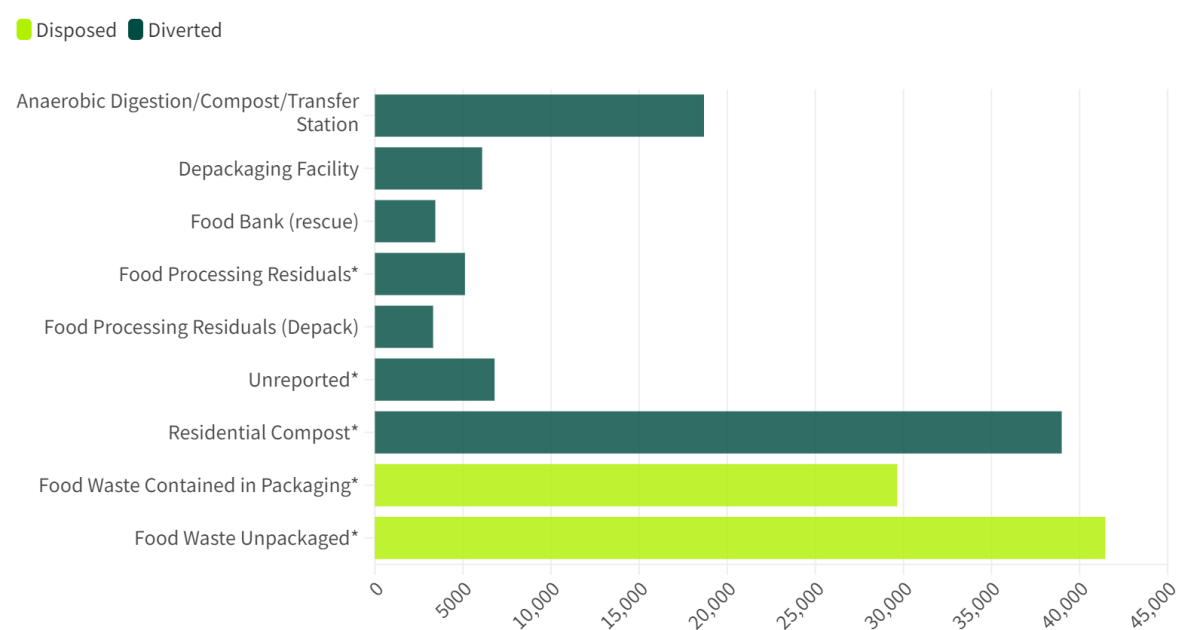
Food scrap waste has decreased slightly since a law banning it from landfills went into effect four years ago, according to a recently-released report from the state.
In terms of tonnage, food scrap waste in the landfill has decreased 13% since 2018. Food scraps make up about the same share of landfill waste as before because the amount of garbage overall has also decreased.
“It’s hard to say that there’s a significant difference, but it is demonstrating some progress,” said Josh Kelly, solid waste program manager at the Vermont Department of Environmental Conservation. “I would say, in short, there’s promising data and we have more work to do.”
Additionally, for the first time, the state has an estimate for the percentage of food waste kept out of the garbage: between 50.7% and 56.8%. That number is sum of the combined effort of residents, businesses, waste haulers, and manufacturers.
For households, the most common way to divert food waste, by far, is by composting, with 43% of households reporting they composted food waste, either at home or with municipal waste services.
Last year, a University of Vermont study showed a high level of support for the food scrap ban, not only from residents but businesses too, even though many businesses also said compliance was difficult and made them incur additional costs.
“I was really surprised and delighted with the incredibly high level of support and compliance I saw among those who worked in food service and food retail, even when we saw service providers often saying compliance wasn’t easy.” said Emily Belarmino, lead author of the study. “It was hard for them and they were still doing it.”
While composting is the most common method of disposing of food waste outside of regular garbage, it’s only one part of a broader system of food recycling in Vermont.
The food waste hierarchy
As with regular garbage, recycling food is not the preferred way to reduce waste. The state prioritizes getting food in people’s bellies before it goes bad over recycling it.
The first priority in the hierarchy is reducing the amount of food waste created by encouraging responsible buying and proper storage.
Courtesy
/
Vermont Department of Environmental Conservation
The next priority is feeding people with food before it goes bad. That could include sharing with friends and family, or with community fridges, Kelly said, but on a larger scale, it’s a role filled by organizations such as the Vermont Foodbank.
Millions of pounds of food are rescued
The Vermont Foodbank, which provides food to over 300 food shelves, senior centers, schools, hospitals and more, is an important piece of Vermont’s food waste puzzle. Jason Maring, chief operations officer at the food bank, said the organization receives two-and-a-half to three million pounds of food a year alone from retailers via its Fresh Rescue program.
“Oftentimes, it’ll have a packaging change, or it’s going to be discontinued, or it’s getting a little close to the [sell-by] date, and they’re just worried about it being able to be sold. So often, they’ll set it aside and donate it,” Maring said.
Currently, 158 stores across Vermont contribute to Fresh Rescue, Maring said, making up around 20% of the food bank’s overall distribution. That food is then distributed to the food bank’s community partners to provide for their customers. The program is expansive – at large retailers like Hannaford’s, pick-ups happen five to seven days a week. That’s in addition to other programs, like food donation, that also keep food out of the trash.
In total, the state reported 3,430 tons, or 6,860,000 pounds, of food waste was diverted from the landfill through Vermont Foodbank. That’s 2.2% of estimated food waste in the state and 4.2% of diverted food waste. And, Kelly said, it’s an underestimate: the state’s data only covers the food bank; local initiatives aren’t covered.
Food for animals is the next step of the hierarchy. In the state’s data, 12% of respondents said they disposed of food by feeding it to pets and 12% by feeding it to livestock.
How composting and anaerobic digestion work
When food is no longer edible, the best option when possible is to recycle it, and the two most common forms of food recycling are composting and anaerobic digestion.
Composting is the act of combining nitrogen rich “greens” like food waste, grass and other plants with carbon-rich “browns,” like wood chips, fall leaves, and shredded paper, in a container where organisms like earthworms, fungi, and aerobic bacteria gradually process the waste into a usable fertilizer.
Food in a landfill decays as well but uses anaerobic bacteria, due to a lack of oxygen. This process emits biogas, a mixture of mostly carbon dioxide and methane, a potent greenhouse gas. But methane can be trapped and burned for heat or used for electricity, which is where anaerobic digestion comes into play.
Anaerobic digestion uses the same process that would occur in a landfill, producing rich fertilizer just like with composting, but instead of emitting methane, it captures it. It can then be burned for heat or used to generate electricity with an internal combustion engine.
Goodrich Family Farm in Salisbury purifies and upgrades the gas before feeding it into the natural gas network. Methane generated from organic sources is a form of renewable energy – meaning it comes from a renewable source, not that it’s clean.
Both composting and anaerobic digestion release carbon dioxide, but unlike the burning of fossil fuels, it isn’t putting additional carbon dioxide into the atmosphere; the carbon dioxide released from the decomposition of organic matter is part of the carbon cycle, and would happen regardless.
Using biogas to generate electricity in an internal combustion engine does, however, emit other pollutants like hydrogen sulfide, carbon monoxide, and formaldehyde, if the proper pollution controls are not in place.
The food that gets composted and sent to anaerobic digestion not only comes from businesses and households, but also includes waste that is left over from the food manufacturing process, referred to as food processing residuals.
“It could be powdered whey from a mixing process where they make baby formula. It could be coffee grounds that Keurig Green Mountain had left over from a manufacturing process or just the blueberry coffee flavor didn’t take the way they wanted,” Kelly said. “It’s kind of a catch-all term.”
Depackaging meets a need but raises questions
Food waste held in packages needs to be removed, or depackaged.
Part of this is manufactured food that doesn’t meet specification, either due to quality or safety concerns. If the food is already packaged, like in ice cream tubs or yogurt containers, it would be absurdly labor-intensive to individually take apart each container, scoop out the food waste, and dispose of the two separately. Depackaging is the answer to this problem.
Depackaging machines separate food waste from packaging through a variety of means. The machines output packaging material and a food waste slurry separately, which can then be composted or anaerobically digested.
There’s currently one depackaging facility in Vermont, at the All Cycle Transfer Station in Williston, operated by Casella.
But it’s controversial. A bill passed in 2022 placed a moratorium on expanding depackaging facilities in the state until standards are adopted to limit microplastics and other pollutants which can fall through the screens along with food waste.
Have questions, comments or tips? Send us a message. Or contact the reporter directly at corey.dockser@vermontpublic.org.

Powerball, Mega Millions jackpots: What to know in case you win
Here’s what to know in case you win the Powerball or Mega Millions jackpot.
Just the FAQs, USA TODAY
The Vermont Lottery offers several draw games for those willing to make a bet to win big.
Those who want to play can enter the MegaBucks and Lucky for Life games as well as the national Powerball and Mega Millions games. Vermont also partners with New Hampshire and Maine for the Tri-State Lottery, which includes the Mega Bucks, Gimme 5 as well as the Pick 3 and Pick 4.
Drawings are held at regular days and times, check the end of this story to see the schedule.
Here’s a look at July 16, 2026, results for each game:
Winning Gimme 5 numbers from July 16 drawing
08-10-35-36-37
Check Gimme 5 payouts and previous drawings here.
Winning Pick 3 numbers from July 16 drawing
Day: 4-3-2
Evening: 3-4-4
Check Pick 3 payouts and previous drawings here.
Winning Pick 4 numbers from July 16 drawing
Day: 5-7-1-5
Evening: 6-6-9-0
Check Pick 4 payouts and previous drawings here.
Winning Millionaire for Life numbers from July 16 drawing
09-21-29-52-57, Bonus: 05
Check Millionaire for Life payouts and previous drawings here.
Feeling lucky? Explore the latest lottery news & results
Are you a winner? Here’s how to claim your lottery prize
For Vermont Lottery prizes up to $499, winners can claim their prize at any authorized Vermont Lottery retailer or at the Vermont Lottery Headquarters by presenting the signed winning ticket for validation. Prizes between $500 and $5,000 can be claimed at any M&T Bank location in Vermont during the Vermont Lottery Office’s business hours, which are 8a.m.-4p.m. Monday through Friday, except state holidays.
For prizes over $5,000, claims must be made in person at the Vermont Lottery headquarters. In addition to signing your ticket, you will need to bring a government-issued photo ID, and a completed claim form.
All prize claims must be submitted within one year of the drawing date. For more information on prize claims or to download a Vermont Lottery Claim Form, visit the Vermont Lottery’s FAQ page or contact their customer service line at (802) 479-5686.
Vermont Lottery Headquarters
1311 US Route 302, Suite 100
Barre, VT
05641
When are the Vermont Lottery drawings held?
- Powerball: 10:59 p.m. Monday, Wednesday, and Saturday.
- Mega Millions: 11 p.m. Tuesday and Friday.
- Gimme 5: 6:55 p.m. Monday through Friday.
- Lucky for Life: 10:38 p.m. daily.
- Pick 3 Day: 1:10 p.m. daily.
- Pick 4 Day: 1:10 p.m. daily.
- Pick 3 Evening: 6:55 p.m. daily.
- Pick 4 Evening: 6:55 p.m. daily.
- Megabucks: 7:59 p.m. Monday, Wednesday and Saturday.
- Millionaire for Life: 11:15 p.m. daily
What is Vermont Lottery Second Chance?
Vermont’s 2nd Chance lottery lets players enter eligible non-winning instant scratch tickets into a drawing to win cash and/or other prizes. Players must register through the state’s official Lottery website or app. The drawings are held quarterly or are part of an additional promotion, and are done at Pollard Banknote Limited in Winnipeg, MB, Canada.
This results page was generated automatically using information from TinBu and a template written and reviewed by a Vermont editor. You can send feedback using this form.

Sam Gabriels and Chrissy Bellmeyer were no strangers to living small. Before they met, Bellmeyer designed and lived in a tiny house on wheels and Gabriels spent four years living out of a van, looping the country to organize pop-up farm-to-table dinners alongside Michelin-starred chefs. So, when the couple bought a half-acre lot in Waitsfield, Vermont’s Mad River Valley in a development called the Waitsfield Ten, where neighbors help each other build, 800 square feet didn’t feel like a constraint.
Architectural designer and builder Andy White of Boreal Design started by creating a simple, 20-by-20-foot box that was drywalled, then painted, in a weekend. Inside it, White built the living spaces as independent, self-supporting platforms arranged at staggered heights. He describes the plan as a counter-clockwise spiral: Down one step from the entry into the living room, up two into the kitchen, up one more into the dining room.
The level variations define each space. “If built traditionally with two floor plates and 9-foot ceilings, the house would feel claustrophobic,” White says. “Here, you experience the full interior volume, with long sightlines from corner to corner.”
Without walls dividing the public spaces, rooms morph to fit current needs and individual elements do double or triple duty. For example, the open cubbies that store Gabriels’s vinyl collection are also perches for overflow dinner party guests in the dining room and extra seating in the living room. Initially, White worried — unnecessarily — that the living room was too small and lacked a wall for a television. The couple got a projector and screen, and noted that the deck expands the experience. The mechanicals and storage are under the floors.
Upstairs, the 8-by-12-foot space in front of the primary bedroom is both a closet/dressing area and mini lounge. In the morning, guests might wander over from the second bedroom to chat; during parties, it’s another spot to hang out. “We’re very open people, so it works for us,” Gabriels says. If things change, the couple could add standard-size French doors to hide their bed. The second bedroom, which already has a pocket door for privacy, could absorb the office nook beside it to become a larger bedroom.
The materials palette celebrates what’s commonly available: nothing is precious, everything is considered. Walls and ceilings throughout are CDX fir plywood — construction-grade sheathing that is normally hidden behind drywall. Structural fir posts, usually buried, are left exposed. The couple planed, sanded, and stained the posts and sanded all the plywood, removing lumberyard stamps. In place of galvanized joist hangers, White used inexpensive angle steel, spray-painted black. Running the length of the staircase and bracketing the bedroom thresholds, it’s the home’s signature accent. It matches the exterior siding — corrugated metal that is distinctive, inexpensive, easy to install, and low-maintenance.

Sustainability was non-negotiable. Fourteen-inch-thick, cellulose-filled walls push the dwelling past passive-house standards for insulation and airtightness. They also leave deep window sills that double as seating, plant shelves, and such. The utility bill for the all-electric home averages just over $100 per month (excluding internet).
Decor-wise, color does the talking. The bright yellow kitchen and pink-tiled bath are odes to homes that Gabriels admired in New Mexico, Oregon, and California. “We took a Pacifico beer bottle cap to Home Depot to find the right canary yellow for the kitchen cabinets,” Bellmeyer says.

White says his construction methods make it easy to add onto the home, although the couple has no plans to do so. Rather, they hope to build an ADU to offer housing to others in the community. “This is a mid-income development, making it cheaper than the median house price but not attainable for everyone,” Bellmeyer says.
Meanwhile, they’re grateful for White’s unconventional approach, fulfilling their wish list within the square footage their budget allowed.
White deflects the praise back onto the couple. “The home wouldn’t have come together the way that it did for anyone else; it’s very much theirs,” he says. “Chrissy and Sam’s vision, willingness to take risks and reimagine typical rooms, informed the design more than any specific space-saving or building strategy.”
Architectural designer and builder: Boreal Design, borealdesignvt.com
Cabinetmaker: Han Hewn, hanhewn.com

Marni Elyse Katz is a contributing editor to the Globe Magazine. Follow her on Instagram @StyleCarrot. Send comments to magazine@globe.com.
Vermont
Ben & Jerry’s Foundation says it will shut down amid legal dispute with parent company – VTDigger

The Ben & Jerry’s Foundation says it will shut down at the end of the year after its corporate parent cut off funding and evicted its three staffers Wednesday. The move leaves $600,000 a year in grants to Vermont organizations, and 40 years of the ice cream brand’s progressive mission, hanging on a judge’s future ruling.
“This is the other foot dropping in terms of the way Magnum is trying to destroy the social values of Ben & Jerry’s,” said Ben Cohen, co-founder of Ben & Jerry’s Homemade, in an interview Wednesday.
The Vermont-based iconic ice cream brand has been in a legal fight with its parent company, The Magnum Ice Cream Co. — an ice-cream spinoff of the larger corporation Unilever — since November 2024. Ben & Jerry’s alleges that the corporation overreached its control, pushing out the CEO and interfering with the brand’s political views. The question before a judge is whether the corporate parent had the authority to reshape governance and withhold funding from the foundation.
Amid the push-and-pull over governance, Unilever audited the foundation, which is the philanthropic arm of Ben & Jerry’s, in April 2025, finding conflicts of interest and a lack of governance and financial control.
Liz Bankowski, president of the foundation’s board of trustees, said in an interview that Unilever withheld the philanthropy’s funding late last year and ordered foundation staff to vacate its corporate office in South Burlington by July 15 because of governance issues the audit raised. This led the foundation’s leaders to join the ongoing lawsuit, fought by the ice cream brand’s independent board, in an effort to retain funding. The lawsuit is pending in the U.S. District Court for the Southern District of New York.
While the foundation’s leadership is framing the decision to cease operations as the only option after Unilever withheld funding, an unnamed spokesperson for Magnum wrote in a statement to VTDigger that the shuttering is “entirely down to the Trustees and their decision to ignore the findings of an independent audit and failure to put in place basic good governance; much to our dismay.”
Since the audit, the foundation has adopted a conflict of interest policy, but “the bottom line was that unless we changed our board, they were going to continue to withhold funding,” Bankowski said.
Cohen described the audit as “a bunch of trumped-up charges.”
“The foundation has been independently audited every year,” he said. “I think that Magnum was searching in vain for some illegal or unethical activities. I think they found none.”
Since Ben & Jerry’s sold the ice cream business to Unilever in 2000, the corporation has given $60 million to the foundation. The philanthropic arm has operated for 40 years, supporting the ice cream brand’s progressive mission by offering financial backing to social justice organizations across the country. The foundation does not have an endowment and is reliant on the funding its parent company gives annually, outlined in its merger contract.
A chunk of that funding, $600,000 a year, goes to Vermont organizations such as the immigrant farmworker rights organization Migrant Justice and the LGBTQ+ nonprofit Outright Vermont, according to foundation leaders.
“We fill a particular niche that not a lot of other funders fill,” said Rebecca Golden, the foundation’s director of programs, who has worked at the organization for 34 years.
Golden is one of three foundation staffers whose last day in the physical office is Wednesday, following orders from Magnum to vacate. Although Magnum did not directly address its vacate order in its statement to VTDigger, the spokesperson wrote that the foundation’s leaders recently “took the position that its staff are not Ben & Jerry’s employees, despite utilising Ben & Jerry’s offices and systems.”
Golden described the possible shutdown as an “enormous loss” that will not only affect the organizations that the foundation supports but also Ben & Jerry’s employees who “feel very proud of being a part of the foundation.”
“It’s been a really long year, so there’s been a lot of emotions — the whole gamut, as we like to say of the seven stages of grief. But I think at this point we’re sort of in the acceptance phase,” she said.
The Magnum spokesperson indicated that the work of the foundation will continue even if its leaders decide to cease operations at the end of the year, writing that the company is “firmly committed to funding a grant-giving foundation, supported by appropriate governance controls to ensure it is living by its values.”
But Cohen is not confident that Magnum will uphold the values of the Ben & Jerry’s Foundation in the corporation’s continued philanthropic efforts.
“What are they going to fund? I have no idea. My guess is that they would not be looking to fund entities that are opposed to the status quo,” Cohen said.
The foundation’s leaders have pointed to its support of Migrant Justice during a period when the farmworker organization was considering a boycott of Ben & Jerry’s as an example of their commitment to social justice. After immigrant farmworkers raised concerns about working conditions at farms supplying Ben & Jerry’s, the company joined a program that collaborates with farmworkers to strive for fair working conditions.
Political activism has been central to the Ben & Jerry’s brand since its founding. As a part of the ongoing lawsuit, Ben & Jerry’s alleged in a May filing that Magnum has been undercutting its social justice mission in order to “censor, intimidate and purge” the company’s independent board, which Cohen said was created to defend its progressive values.
Three of the board’s members, including one who has been an outspoken critic of Israel, were removed late last year after the parent corporation introduced a new set of governance practices. In its motion to dismiss the lawsuit, Magnum argues that it retains ultimate authority and the brand’s social mission must be nonpartisan.
As the lawsuit awaits a decision, Cohen, who is not a part of the suit, has created a campaign to “free Ben & Jerry’s,” amassing around 160,000 signers for its petition demanding that Magnum sell Ben & Jerry’s to a “group of values-aligned investors.”
“The very values-led business model that built Ben & Jerry’s into this amazing, phenomenal brand is the very thing that Magnum is currently destroying,” Cohen said.
-

 Idaho4 minutes ago
China Landslide
-

 Illinois10 minutes ago
Hillsboro grad, Springfield golfer Alex Eickhoff 2nd at state amateur
-
Indiana16 minutes ago
Where to watch Seattle Storm vs Indiana Fever on July 17: TV channel, start time and streaming
-

 Iowa22 minutes ago
US House Speaker campaigning in Iowa responds to President’s election fraud claims
-

 Kentucky35 minutes ago
June unemployment rate shows slight increase in Kentucky Center for Statistics latest report
-

 Louisiana40 minutes ago
How Louisiana football’s Lunch Winfield has embraced his QB1 role
-

 Maryland52 minutes ago
Great nature trails for hiking, beachcombing on Maryland’s Lower Shore
-

 Michigan58 minutes ago
Michigan’s upcoming Aug. 4 primary: What’s on my ballot?

