Rhode Island
‘Happy holidays’ for stores and retailers?


KINGSTON, R.I. – Nov. 26, 2025 – The rush to find the perfect gifts and gather with loved ones during the holiday season has commenced. How businesses both locally and nationally will fare this holiday season, though, is a bit murky.
According to S&P Global, holiday sales are expected to grow year over year, but price increases to offset tariffs will account for most of that growth. Also, S&P predicts that holiday retail consumer spending will remain relatively flat, which poses challenges for retailers.
In speaking with Rhody Today about the upcoming holiday shopping season, Nina Eichacker, associate professor in the University of Rhode Island’s Department of Economics, expects Rhode Islanders will be more selective in how much shopping they do this year and where. She also notes the rise of online shopping could impact seasonal employment locally.
Overall, do you feel the holiday economy is going to be strong this year, both locally and across the U.S.?
Spending always rises during the holiday season, compared to the months before and after. According to its consumer survey, the National Retail Federation is expecting close to 187 million people to shop from Thanksgiving Day through Cyber Monday this year, up from about 183 million in 2024. Nationally, sales are expected to rise approximately 4%. While projected spending is high, consumers expect to spend 1.3% less than they did last year ($890 per person compared to $902 per person).
I expect that these trends will be similar in Rhode Island. In 2024, Rhode Islanders spent 3% more than they had in 2023. Rhode Island is a small state, so its annual spending is usually in the bottom fifth of the United States. Rhode Islanders, particularly those in vulnerable or volatile industries, will likely think hard about how much holiday shopping they commit to in 2025, and also what goods they decide to buy.
What do you feel will be a major factor in the holiday economy flourishing in Rhode Island in 2025?
Rhode Islanders have been shifting more toward online shopping in recent years. Combined with higher prices on many goods due to tariffs, the rising cost of living, and economic uncertainty that has flowed from the government shutdown and the fact that we don’t know much about the state of the U.S. job market and other sources of economic uncertainty, I would expect that holiday shopping within Rhode Island is likely to be similar to national trends.
However, there is a great deal of community support for local shopping across the state. Households who care to shop locally will most likely continue to make that a priority.
Retailers are expected to hire fewer seasonal workers this year than last year. What do you feel is contributing to this decreased need, the growth of online shopping notwithstanding? And, does this negatively impact the overall holiday economy in some way?
Apart from the growth of online shopping, I think that this reflects broader economic uncertainty. In the context of rising costs of living and higher prices due to tariffs, retailers are demonstrating that they believe the volume of shopping may not be as great, and it doesn’t make sense to have so many staff on hand. The Rhode Island state economy, as of August, appeared to be in a holding pattern – falling private sector jobs and the only source of employment growth appearing in state government.
Because of the government shutdown, the U.S. Bureau of Labor Statistics has been unable to gather data on employment trends at the national and state levels, so we may see an amplification of those job trends when we finally have the data.
How will retailers respond to potential challenges to help ensure businesses will profit during the holidays?
Retailers will generally do their best to introduce more sales and bundles to get shoppers in the door, such as by offering Black Friday deals earlier and for longer, to entice more shoppers into stores or onto webpages.
Will spending on holiday travel remain steady, or do you expect that to scale back a bit?
NerdWallet expects that Americans are going to travel a lot this year and spend $311 million on flights and hotels—or $2,586 per person—which is up nearly $260 per person from last year. Given the federal government shutdown and the prolonged period of air travel delays, cancellations, and complications, the potential for more complications exists.
U.S. Transportation Secretary Sean Duffy argues that travel should proceed as normal. It’s worth noting that many Americans canceled or altered their plans in anticipation of a prolonged shutdown, which could mean lower-than-usual fares and potentially a bit more traffic on the roads.





Watch: advocate argues for minimum wage in Rhode Island’s going to $20
Affordable Rhode Island’s Michael Beauregard argues that the minimum wage should be $20 an hour, to get closer to what it actually costs to live.
PROVIDENCE – As lawmakers debate raising Rhode Island’s minimum wage, which would impact many grocery store workers, a bill to limit the number of self-checkout lanes at grocery stores is again stirring conversation.
Rep. Megan Cotter, D-Exeter, Hopkinton, Richmond, introduced a version of her initial bill, proposed in 2023, to reduce the number of self-checkout kiosks a grocery store can have open, and mandate the amount of labor required to operate them. Her bill, H 7290, has eight co-sponsors in the House, while Senate President Valarie Lawson, D-East Providence, introduced a companion bill in the Senate, S 2342.
When Cotter’s bill was first introduced, it included a mandate that grocers give a 10% discount to customers who used self-checkout for more than 10 items. The newest iteration scraps that language in favor of a more streamlined approach:
- Grocery stores can have no more than eight self-checkout kiosks operating at one time.
- One checkout line must be manned for every two self-checkout kiosks.
- One worker must be assigned to every two self-checkout stations.
Here’s how the math on the self-checkout proposal works:
For a store operating the maximum number of self-checkout kiosks, eight, this means the store would be running four lines with cashiers at a time. That same store would also need four people monitoring the self-checkout stations, for a total of eight workers across 12 cash registers, both manned and unmanned.
Limiting the number of self-checkout aisles a store can have is all about preserving jobs and hours worked, she previously said.
Why stores are using self-checkout
In 2023, Cotter said her original bill was partially a function of her frustration with using the Walmart self-checkout kiosks.
Problems with self-checkout kiosks abound as each industry, from groceries to pharmacies to hardware to big box stores like Walmart, sets different parameters and triggers on self-checkout machines.
Clements’ Marketplace Operations Director Charles Anthony IV wrote in testimony against Cotter’s bill that the grocery, with locations in Bristol and Portsmouth, installed the self-checkout kiosks to be their “fast lanes.”
“With smaller orders often causing backups across the Front End, the Fast Lanes have helped to maintain a steady pace and take care of our customers more efficiently,” Anthony wrote.
At Target, self-checkout was meant to be limited to people with 10 items or fewer.
Why limit self-checkout?
Cotter’s bill only targets grocery stores. That caught the attention of Rhode Island Food Dealers Association President Scott Bromberg, who submitted testimony against the proposal.
“This proposal is especially egregious because it specifically targets only grocery stores,” Bromberg wrote. “Big box retailers, along with hardware stores, pharmacies, dollar stores, fast food chains and more utilize self-checkout to allow them to deploy their staff where needed most.”
The bill mostly targets traditional grocery stores, but also hits pharmacies, like CVS and Walgreens, but might not include big box retailers like Walmart and Target.
It defines groceries as:
- Raw or processed food or drink
- Prescription and over-the-counter drugs
- Hygiene items when a store also sells food, drink and “miscellaneous household items” like laundry detergent and dishwasher soap.
A grocery store is defined as a business that gets most of its revenue from selling “groceries.”
Shaw’s and Star Market’s Jim O’Leary wrote that 60% to 65% of its transactions are done via self-checkout systems and 10% are done through its drive-up platform.
“Only approximately 25% of customers utilize traditional staffed registers. This distribution highlights the importance of maintaining adaptive service models to accommodate a broad spectrum of consumer preferences, thereby enhancing the overall shopping experience and most importantly convenience,” O’Leary wrote.
Which RI stores use self-checkout?
Stores in the state offer a wide variety of takes on self-checkout.
At many Five Below stores, self-checkout is the only option. Home Depot has replaced most checkout lanes at the front of many its stores with self-checkout lanes.
At the discount grocer Aldi, many stores have open self-checkout kiosks. Depending on how slow business is, it can sometimes take a few minutes for a cashier to return to a regular checkout lane, as employees do double duty as cashiers and stockers. Customers are also expected to do their own bagging.
Stop & Shops usually have a variety of self-checkout kiosks and cashiers, but the kiosks practically shout at customers and the scales, meant to prevent theft, often wrongly register item weights, forcing a worker to override the machine after an item is bagged too quickly, or not quickly enough.
Many CVS stores also have the self-checkout kiosks.
Self-checkouts have also moved into the world of fast food, for example at Taco Bell and McDonald’s, shifting workers away from being cashiers.
Is low-skill labor worth keeping?
The two-self checkout restriction bills are aimed at preserving jobs often classified as entry level or low skill.
The worth and value of those jobs is increasingly under fire by legislators and the business community, especially as the debate over minimum wage increases rages.
Rep. Stephen Casey, D-Woonsocket, made the case during a hearing on March 18 that it would be unfair for the minimum wage to be increased because public sector workers don’t make enough, making an argument that low-skilled labor deserves to be paid less.
“So the average fireman in Rhode Island makes $28.06 an hour, so you’re saying that the guy that’s flipping burgers should make $20 an hour?” Casey asked during the hearing.
That argument also appeared during the debate over a bill to give health care workers time-and-a-half on Sundays, as Woonsocket resident Jason Romblad said he was “amazed that people selling us a pack of gum will get time-and-a-half on these days, but a health care worker who takes care of us when we are sick and hurt do not get it.”
A separate bill to strip caterers and commissary workers of time-and-a-half on Sundays and holidays was lauded by businesses groups that called for ending the practice entirely. National Federation of Independent Businesses State Director Christopher Carlozzi wrote in support of ending the benefit, claiming that paying minimum wage workers $24 an hour on Sundays instead of the mandated $16 (a $64 pre-tax difference for an eight-hour shift) means the difference between opening a shop on Sundays or leaving it closed.
According to the state’s latest Occupational Employment And Wage Statistics, published in May 2025, cashiers, an estimated 9,710 of them in the state, make a mean average of $15.90 an hour. That climbs to $16.67 an hour for “experienced wage.” The entry wage was $14 an hour, the minimum wage in 2024.
In January, the minimum wage increased to $16 an hour and it increases to $17 an hour on Jan. 1, 2027.
Other large groups of similarly paid professions are fast food and counter workers, 12,650 of them; dining room and cafeteria attendants, 2,720 of them; and dishwashers, 2,830 of them.
The statistics count an estimated 493,800 employed, making cashiers 2% of the total employment in the state.

CHARLESTOWN, RI — The food website Mashed named Rhode Island’s best buffet restaurant.
Mashed went with The Nordic in Charlestown, despite its prices.
“The Nordic is one of the most expensive buffets in the country, so don’t expect a cheap meal when you sit down at the popular waterside eatery,” the Mashed story said. “The price for adults is $145 per person, $60 for children aged 8 to 12, and $35 for children aged 3 to 7. That sounds pretty steep, but considering that you can fill up on prime rib, a high-quality and costly cut of steak, it seems worth it for a special occasion.
“One of the main draws of dining at The Nordic is that you can chow down on prime rib,” according to Mashed, but there is much, much more, including lobster, snow crab legs, fried scallops, scallops wrapped in bacon and black angus filet mignon.
See the full Mashed story here.
Rhode Island
Lawmakers seek permanent funding for referral hotlines connecting families to mental health care


Michigan Basketball Roster Outlook After National Championship

Massachusetts food insecurity hits record, annual report finds

ATHENA Award Honors Lori Kloos For Decades Of Service To SCTCC And Local Charities

‘That’s been my trajectory’: Michael Watson confirms run for Mississippi lieutenant governor – SuperTalk Mississippi

Mizzou expands virtual fencing for cattle in Missouri and Nebraska

Florida High School Football Rankings: Top 25 teams – Oct. 21

How old is Bo Nix? What to know about Oregon quarterback ahead of 2024 NFL Draft

Cleary's 21 help Le Moyne down Central Connecticut State 69-64 in OT

99th annual Pony Swim held in Virginia

Indiana Members Credit Union announced as new anchor tenant at Bottleworks District

Ilhan Omar calls Trump an ‘unhinged lunatic,’ urges booting him out of office
Between Budapest and Brussels: Péter Magyar’s political tightrope
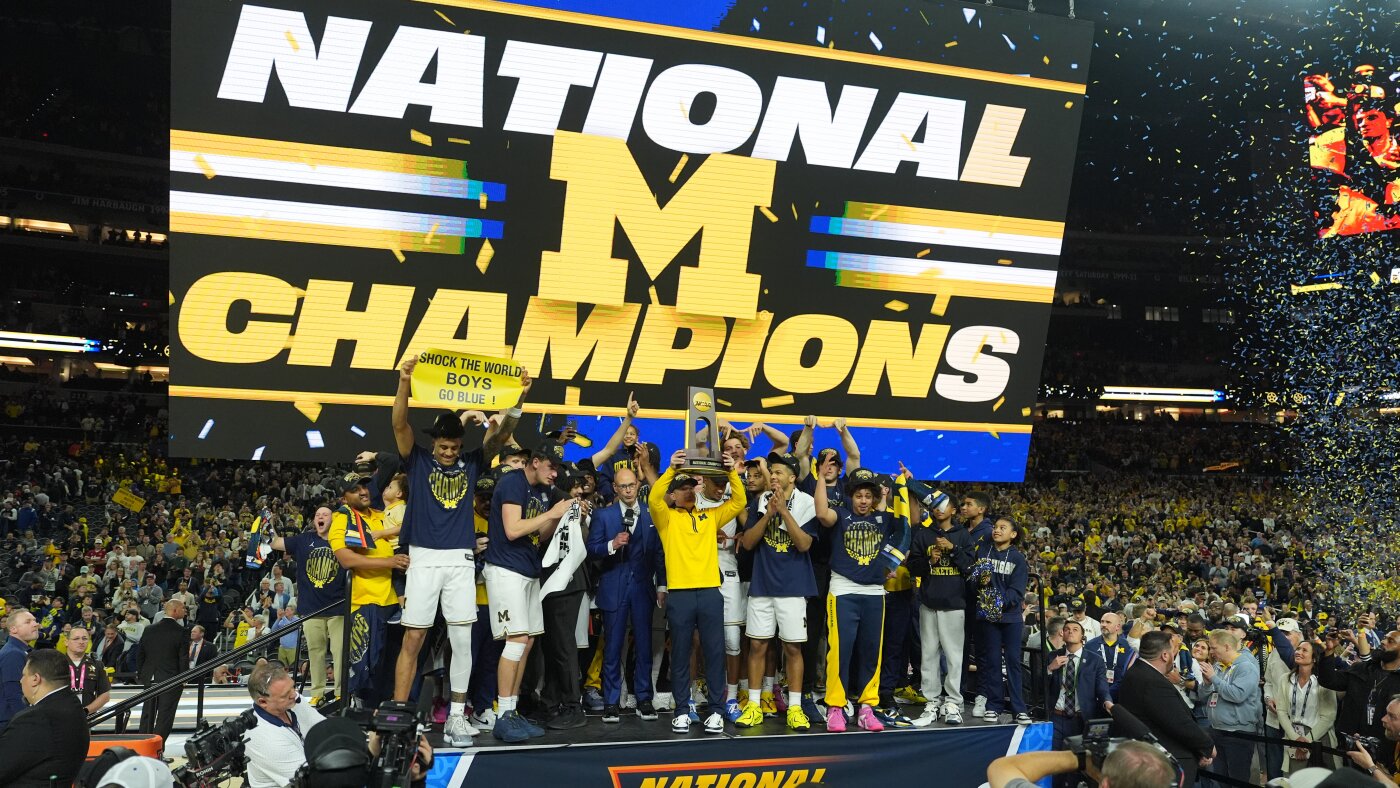
Michigan muscles its way to program’s 2nd NCAA basketball title, beating UConn

Map: Minor Earthquake Strikes Near San Diego

Trump claims he’d win as the president of Venezuela — just needs to ‘quickly’ learn Spanish
-

 Atlanta, GA2 days ago
1 teenage girl killed, another injured in shooting at Piedmont Park, police say
-

 South-Carolina1 week ago
South Carolina vs TCU predictions for Elite Eight game in March Madness
-

 Movie Reviews5 days ago
Vaazha 2 first half review: Hashir anchors a lively, chaos-filled teen tale
-

 Vermont1 week ago
Skier dies after fall at Sugarbush Resort
-

 Politics1 week ago
Trump’s Ballroom Design Has Barely Been Scrutinized
-

 Politics1 week ago
JD Vance says he was ‘obsessed’ with UFOs, believes aliens are actually ‘demons’
-

 Politics1 week ago
Jeffries declines to break with indicted Democrat after ethics panel’s guilty verdict
-
 Entertainment5 days ago
Inside Ye’s first comeback show at SoFi Stadium