Pennsylvania
Pennsylvania Must Count Provisional Votes From Those Who Submitted “Naked” Mail-in Ballots


The Pennsylvania Supreme Court ruled that counties must count provisional ballots cast in person by voters who mistakenly submitted “naked” mail-in ballots that lacked an inner secrecy envelope.
According to the consequential 4-3 opinion, a lower court “correctly discerned, the casting of a provisional ballot is specifically authorized in the Election Code.”
“Provisional ballots exist as a failsafe to preserve access to the right to vote…[and are] intended to alleviate potential disenfranchisement for eligible voters. Counting Electors’ provisional ballots, when their mail ballots are void for failing to use a Secrecy Envelope, is a statutory right,” the opinion continues.
The ruling stems from a lawsuit brought by two Butler County voters for whom the county board of elections refused to count their provisional ballots cast in the 2024 primary election. In a Sept. 5 ruling affirmed by today’s decision, the Commonwealth Court sided with the voters, concluding that the board erred when it disenfranchised the voters by disqualifying their provisional ballots.
The Republican National Committee (RNC) and state GOP promptly appealed the Commonwealth Court’s ruling to the Pennsylvania Supreme Court, which agreed to review the case last month.
The Republican appellants argued that allowing Butler County voters to cast provisional ballots would essentially force the county to implement cure procedures for those who submit naked ballots — a proposition rejected by the court in today’s ruling. Although Butler County currently allows voters to cure defective mail-in ballots with date or signature errors, it does not provide such a remedy for naked ballots.
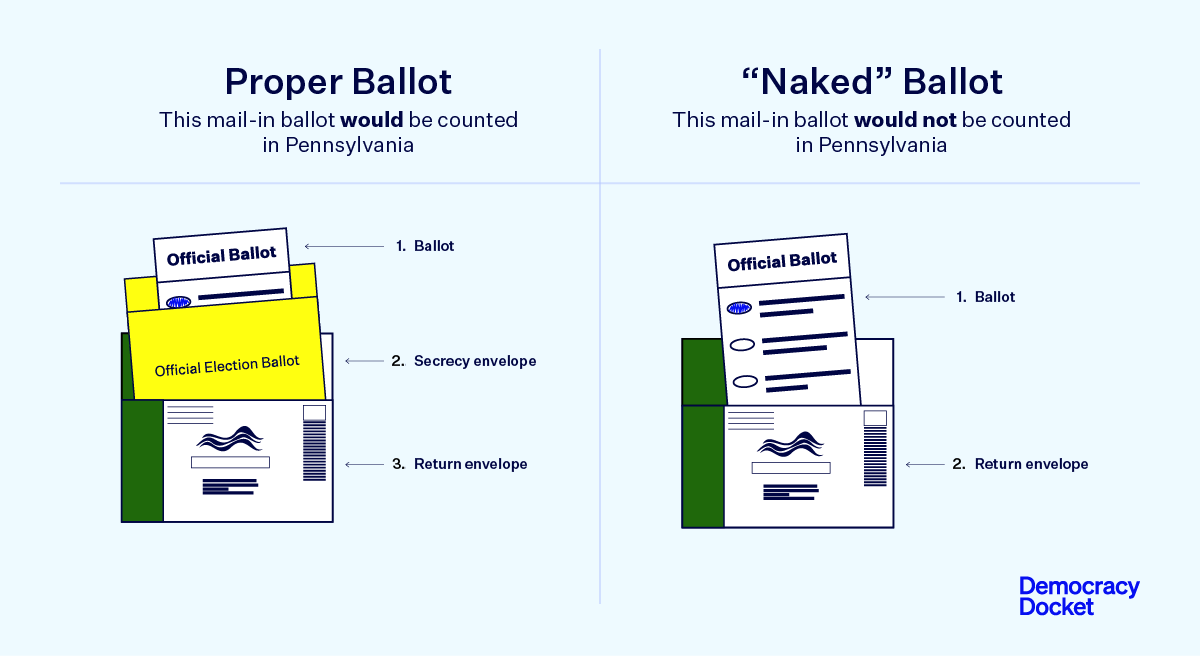
The RNC and state GOP had maintained that Pennsylvania law precludes the counting of a provisional ballot if the voter’s mail-in ballot is timely received — even in cases where the mail-in ballot is tossed out due to a disqualifying error.
Meanwhile, the voters — who inadvertently forgot to place their mail-in ballots in a secrecy envelope — alleged that the board’s rejection of their provisional ballots ran afoul of state election law and the Pennsylvania Constitution’s guarantee of “free and equal” elections.
The Democratic National Committee echoed that position and stated in a court filing that the RNC’s argument “serves no purpose but to disenfranchise mail voters.”
On appeal, the voters also emphasized that provisional voting is distinct from discretionary ballot curing, contending that the RNC “erroneously conflates ‘notice and cure’ programs with Pennsylvania’s longstanding statutory provisional ballot process.”
Under previous Pennsylvania Supreme Court precedent, counties are not legally obligated to offer notice-and-cure procedures, but many do so voluntarily. In a brief supporting the Butler County voters, Pennsylvania Secretary of the Commonwealth Al Schmidt (R) reiterated that provisional voting isn’t tantamount to curing.
Schmidt further acknowledged state law is somewhat ambiguous as to whether counties should count provisional ballots cast by voters who timely returned defective mail-in ballots. However, in line with the Commonwealth Court’s reasoning, he maintained that “arbitrarily denying provisional voting only to mail voters who timely return invalid mail ballots serves no election purpose and therefore unconstitutionally burdens the right to vote.”
A decision from the Pennsylvania Supreme Court remains pending in another case that could affect the upcoming election. In that lawsuit — stemming from Washington County — the RNC asserts that counties should not be required to notify voters if their mail-in ballots are rejected for technical errors.
Last month, the state Supreme Court rejected Republicans’ wholesale request to ban ballot curing statewide and secure a ruling to prohibit voters from voting provisionally as a means of rectifying their faulty mail-in ballots.
Read the ruling here.
Learn more about the case here.

Pennsylvania
Trump admin rule puts reproductive health care for 160K Pa. patients at risk, lawsuit says

Family planning and health organizations that serve tens of thousands of people across Pennsylvania could see federal funding delayed or denied by a new Trump administration policy, a new lawsuit alleges.
The suit, which includes the Cumberland County-based Family Health Council of Central Pennsylvania as a plaintiff, takes aim at a step added this year by the U.S. Department of Health and Human Services to applications for Title X grants, which provide local agencies with funds to aid low-income and uninsured patients with family planning and related health services.
That new process is detailed in the Title X 2027 Notice of Funding Opportunity published in April. It states that before applicants are assessed on their merits, a group of presidential appointees will conduct an “alignment review” to determine whether each application matches the agency’s “priorities.” The plan offers no opportunity to appeal the group’s decision.
To the plaintiffs in the suit, that sounded like code for evaluating applicants based on politics.
“The Trump administration’s attempt to condition Title X funding on political allegiance is a grave threat to public health,” Sara Rose, deputy legal director at ACLU of Pennsylvania and attorney on the case, said in a statement. “Grant decisions must be guided by objective standards to ensure that taxpayer money is spent fairly and efficiently without regard to the ideology of its recipients.”
Created during the Nixon administration to help low-income people prevent unwanted pregnancies, Title X funding has long drawn opposition from anti-abortion activists.
The Trump administration has also attempted to shift the focus of the program toward promoting more pregnancies. Officials tried and failed earlier this year to block Title X funding from reaching Planned Parenthood facilities.
The suit is filed in the federal Middle District of Pennsylvania. It names HHS, Secretary Robert F. Kennedy Jr., and other agency staff as defendants.
There are four Title X grantees in the commonwealth, each serving a specific region: The Family Health Council in central Pennsylvania, AccessMatters in Philadelphia, Adagio Health in the west, and Maternal and Family Health Services in the northeast.
Combined, they receive more than $12.6 million in Title X funds annually to serve more than 160,000 patients in Pennsylvania, according to their grant details listed on HHS’ website. (AccessMatters is by far the largest, working with more than 90,000 people.)
These organizations offer everything from fertility care and access to contraception to screenings for cancers and sexually transmitted infections.
Nationwide, the most recent data from HHS shows Title X grantees served nearly 2.8 million people.
Also at issue in the lawsuit is that HHS already has a set of regulations, put in place during President Joe Biden’s administration, that govern Title X applications — and many of them directly conflict with stated Trump administration priorities.
The suit highlights, for instance, that the HHS website currently states that ending “ideologically-laden concepts like health equity” is a priority, while Title X rules simultaneously require grantees to “advance health equity.”
Another alleged conflict stems from the Trump administration’s opposition to diversity, equity, and inclusion initiatives, especially for transgender people. Current Title X regulations mandate that grantees ensure transgender people have access to their programming.
Brigitte Amiri, deputy director at the ACLU’s Reproductive Freedom Project, told Spotlight PA that the Trump administration could overturn the Biden-era regulations by undertaking a public notice and comment rulemaking process.
“But you can’t just do it by a funding announcement,” she said.
The new review step “subverts the integrity” of the Title X grant application process, the lawsuit argues, and enables HHS “to hijack” the Title X program to fund organizations furthering the agency’s “political agenda.”
The lawsuit also notes that Title X funds are prohibited from being used for abortions.
Federal Judge Jennifer Wilson, who was nominated to the bench by Trump in 2019, will hear the case.
Spotlight PA sought a comment on the lawsuit from HHS, but did not receive a response.
The Family Health Council of Central Pennsylvania was selected to join the lawsuit because it has received Title X funding since the establishment of the program in 1970, and it serves a large area, the chief executive of the National Family Planning & Reproductive Health Association told Stateline.
Patricia Fonzi, president and CEO of the Family Health Council, said in a statement that her organization serves more than 31,000 people across a 24-county region.
“We welcome a competitive grant process and believe every applicant should be evaluated on its ability to effectively serve communities, responsibly steward federal resources, and demonstrate the experience and capacity necessary to carry out the Title X statute,” Fonzi said.
“At the end of the day, the success of Title X is measured by whether people can access the care they need in their own communities — and that depends on funding decisions grounded in experience, proven performance, and the ability to deliver comprehensive care where it is needed most.”
The plaintiffs are urging the court to vacate the Trump administration’s new Title X rule and declare it “unlawful.”
Title X funds are issued to agencies on a five-year basis, with annual renewal requirements. The new rule at issue was included in the process for grants under fiscal year 2027, which will begin a new five-year cycle.
___
This story was originally published by Spotlight PA and distributed through a partnership with The Associated Press.

(WHTM) — Pennsylvania is one of four states facing a lawsuit from the federal government over SNAP applicant data.
The U.S. Department of Justice filed suit against Pennsylvania, Kentucky, Michigan, and Minnesota. They are seeking the last five years of SNAP applicant data in the respective states.
The DOJ alleges that the four states refused to turn over data to the U.S. Department of Agriculture “so that USDA could ensure that states are properly administering and enforcing their determinations of residents’ eligibility.”
“The American people deserve a government that is transparent about how it spends their hard-earned tax dollars,” said Acting Attorney General Todd Blanche. “These four states are thwarting USDA’s efforts to ensure that the billions of dollars in SNAP benefits they distribute every year are not lost to fraud.”
“Stopping the rampant theft of taxpayer money demands a whole-of-government response, including strong participation at the state level,” said Assistant Attorney General Colin M. McDonald of the Justice Department’s National Fraud Enforcement Division. “These states are happy to take hundreds of millions of federal tax dollars—much of which is exploited by fraudsters—but want zero transparency over how those tax dollars are spent.”
The Department of Justice said 28 states promptly provided data and such indicated “there are billions of dollars per year in SNAP funds going to overpayments and fraud.”
The USDA has been seeking data for the past year or so, leading to a legal battle over concerns about how the data would be used.
Pennsylvania
House Republicans stall activity, Pennsylvania Rep. Meuser calls tactics ‘foolish’ | Fox Business Video

Maria Bartiromo reports on House Speaker Mike Johnson sending representatives home early as Republican hardliners stall floor activities, refusing votes without action on the SAVE America Act.
House Speaker Mike Johnson sent representatives home early as hardline Republicans stalled floor activities, demanding action on the SAVE America Act. President Donald Trump posted on Truth Social, urging House Republicans to unify and avoid giving power to Democrats. Rep. Dan Meuser (R-PA) labels the stalling tactics ‘foolish,’ emphasizing the need for legislative progress and appropriations.
-

 Idaho2 minutes ago
Idahoans left to deal with rat problem in the Treasure Valley for another year
-
 Illinois5 minutes ago
Illinois in the trenches again to protect fair housing
-

 Indiana10 minutes ago
How to watch Indiana Fever vs Los Angeles Sparks: Time, channel
-

 Iowa17 minutes ago
After two decades, Iowa Events Center could get a new operator
-

 Kansas20 minutes ago
Meet Mohammad Abualnadi: The Kansas City native making World Cup history with Jordan
-

 Kentucky25 minutes ago
Kentucky Arts Council's Celebrating the Black Experience Art Exhibit to visit NKY in November
-

 Louisiana32 minutes ago
Polls open for Louisiana runoff election | Everything you need to know
-
Maine35 minutes ago
Maine Marine Patrol launches newest, largest patrol vessel in its fleet

