Northeast
One-time GOP rising star reveals how she will work with Trump admin after victory in key race

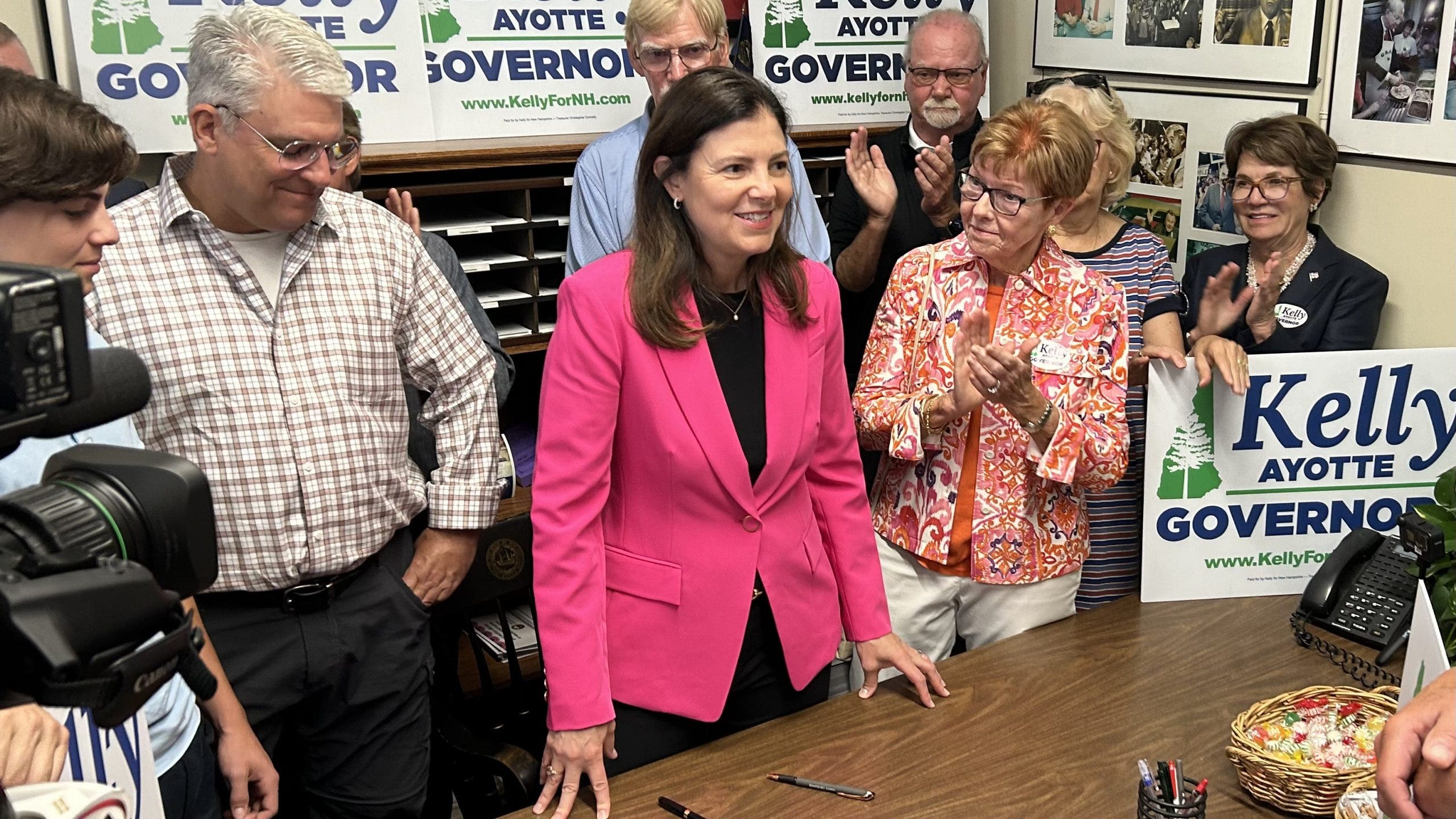
CONCORD, N.H. – Kelly Ayotte’s national profile is once again on the rise after a convincing gubernatorial election victory last week in New Hampshire, where she vows to be the “champion” for her constituents and will work with the incoming Trump administration on key issues.
“I see one role for me and that is every day, to wake up and to be the champion for the people of New Hampshire,” the governor-elect said in a Fox News Digital interview at her transition office this week in the state’s capital city.
And Ayotte, who last week defeated Democratic gubernatorial nominee and former Manchester, New Hampshire mayor Joyce Craig by an unexpected nearly 10-point margin, emphasized that she plans “to focus on the economic issues, education, mental health, and housing,” when she is inaugurated in early January.
REPUBLICANS HOLD ON TO THE MOST HIGHLY CONTEST GUBERNATORIAL SEAT THIS YEAR
Former Sen. Kelly Ayotte, the Republican gubernatorial nominee in New Hampshire, celebrates her Election Night victory for governor, on Nov. 5, 2024 (Kelly Ayotte campaign)
When it comes to former and future President Trump, Ayotte said “I look forward to working with the Trump administration on behalf of the people of New Hampshire, whether its roads, whether its bridges, whether its areas where we can strengthen our public safety. I think there are so many opportunities where we should be working together, and I’m going to advocate for the people of this state.”
Ayotte, a former state attorney general, was elected to the U.S. Senate in 2010 and was a rising star in the GOP and regarded as a leader on national security and foreign policy.
But Ayotte lost re-election in 2016 by a razor-thin margin of just over 1,000 votes at the hands of then-Democratic Gov. Maggie Hassan.
“It was a privilege to represent New Hampshire in the United States Senate, but I’ve been elected governor of the state of New Hampshire and everyday I’m just going to wake up and say ‘what can I do for New Hampshire today,’” Ayotte said when asked about any emerging new role as a leader in the GOP.
VANCE IN ‘CATBIRD SEAT,’ BUT THESE OTHER REPUBLICANS MAY ALSO RUN FOR PRESIDENT IN 2028
Ayotte launched her gubernatorial bid last year after popular Republican Gov. Chris Sununu announced that he wouldn’t seek re-election in 2024.
Sununu, a well-known figure in national politics, endorsed Ayotte in early August ahead of her easy victory in September’s GOP gubernatorial primary.
The governor often joined Ayotte on the campaign trail in the late summer and autumn, and Ayotte highlighted that she planned to continue the Sununu agenda.
Gov-elect Kelly Ayotte (left) and Gov. Chris Sununu (right) meet in the New Hampshire governor’s office, in the Statehouse in Concord, N.H., on Nov. 7, 2024 (Office of New Hampshire governor)
“I think Gov. Sununu has done an excellent job for the state of New Hampshire. We’re leading the nation in so many metrics,” she told Fox News.
But she added that “the thing that I love most about Gov. Sununu is the passion, the positive enthusiasm that he brings for this state. He loves this state. He’s so proud of New Hampshire. And I’m going to bring that same attitude as governor, really being a champion for the people of New Hampshire.”
“Obviously, we are different people, but I share his philosophy on the economic prosperity of the state and the emphasis on personal and economic freedom,” Ayotte emphasized.
HERE ARE THE DEMOCRATS WHO MAY RUN FOR THE WHITE HOUSE IN 2028
Ayotte said her years serving in Washington will come in handy as she takes over in the Granite State’s governor’s office.
Former Sen. Kelly Ayotte, a Republican candidate for governor, is surrounded by supporters as she files her candidacy at the Secretary of State’s office, on June 13, 2024, in Concord, N.H. (Fox News – Paul Steinhauser)
“Having the experience of having served in Washington, I certainly will fight hard for New Hampshire when it comes to interacting with the Trump administration,” she said. “Those federal dollars – making sure that they come to New Hampshire. But also, when Washington does things on the regulatory front, I want to make sure that New Hampshire’s voice is at that table.”
Ayotte famously broke with then-GOP presidential nominee Trump just ahead of the 2016 election. She withdrew her support for Trump over the “Access Hollywood” controversy, in which Trump, in a years-old video, made extremely crude comments about grabbing women without their consent.
“I cannot and will not support a candidate for president who brags about degrading and assaulting women,” Ayotte said at the time.
While they both lost in New Hampshire, Ayotte slightly outperformed Trump in the state as Democratic presidential nominee Hillary Clinton edged the White House winner by less than 3,000 votes.
Before heading back full time to New Hampshire, Ayotte stuck around Washington briefly after the end of her term, shepherding then-Supreme Court nominee Neil Gorsuch (Trump’s first high court nominee) through his successful Senate confirmation process.
As she ran for governor the past two years in a state where New Hampshire’s first-in-the-nation presidential primary repeatedly drew Trump and other GOP White House hopefuls, Ayotte kept her distance from the national political conversation.
She stayed neutral in New Hampshire’s presidential primary, but did endorse Trump after he locked up the nomination. She didn’t appear with Trump’s running mate – now Vice President-elect JD Vance – when the senator from Ohio made a last-minute stop in the Granite State a couple of days before Election Day.
But Ayotte told Fox News “I want to congratulate President Trump, obviously, on a very strong victory on Election Day.”
Republican presidential nominee, former President Donald Trump arrives to speak during an election night celebration at the Palm Beach Convention Center on November 6, 2024 in West Palm Beach, Florida. (Chip Somodevilla/Getty Images)
Asked about some of the president-elect’s controversial Cabinet nomination announcements this week, Ayotte said that “it’s important that he’s putting together a team that works for him.”
But the former senator emphasized that “this is really a decision for the United States Senate. They have an important role when it comes to advise and consent. I’m sure they’ll look carefully at President Trump’s nominees and make sure that they believe that they’re qualified.”
Ayotte, in the GOP gubernatorial primary, easily defeated former New Hampshire Senate president Chuck Morse, who touted his support for Trump and questioned Ayotte’s loyalty to the former president. Morse’s hope that he would land a Trump endorsement never materialized, as the former president stayed neutral.
Also helping Ayotte as she ran for governor – a helping hand from the Republican Governors Association, which dished out nearly $21 million in support of Ayotte. Most of the funding came in the final two months of the race, but the RGA did make a $2.75 million pre-primary investment.
The RGA – unlike the rival Democratic Governors Association – sent their resources directly to the Ayotte campaign from the start of their involvement in the race, rather than taking the traditional route of putting their funding in an independent expenditure committee.
Read the full article from Here


Along the Park
Dear Diary:
It was April Fools’ Day, and the weather kept changing from sunny to drizzle, as if the gusty wind was moving the sun back and forth behind a cloud.
I put my jacket on and off as I walked along Prospect Park. The trees were still bare, but spring was slowly awakening with yellow forsythias, and every child walking by stared at my new purple hair, hungry for color.
A guy in the bike lane yelled, “Hey!”
I turned to him.
“Sorry,” he said, pointing to someone else. “I’m talking to this guy.”
“But you actually look familiar,” I said.
“So do you,” he said, laughing.
I entered the park to hear pop music near the band shell. Two people with a portable speaker were dancing.
I wanted to join the party, but I realized that I hear the music, so I’m in the party. I danced along from a distance.
From high above, hundreds of blackbirds swooped down like falling peppercorn into the black-and-white woods ahead. As I got closer, I saw specks of tiny green buds emerging on each tree limb.
I left the park, passing three people who had converged because their dogs could not contain their joy. The people laughed like old friends, but within seconds they had walked off separate ways.
As I passed Seeley Street, I overheard a friend through the open window, cheering on a drum student.
I laughed. I should be getting home before the possible rain, I thought, but today, everywhere was home.
— Mare Berger
S. Klein’s Basement
Dear Diary:
It was around 1960, and my mother, my sister and I were in the bargain basement at the S. Klein department store on Union Square.
My sister, 13, was trying on winter coats in the aisle between the bins and discussing two final options with my mother when a woman riding the escalator up to the ground floor weighed in.
“Take the red!” she called out.
We took the red. I miss S. Klein’s.
— David Hammond
Brooklyn Warehouse
Dear Diary:
I woke up to my alarm at 2:45 on a Saturday morning, then maneuvered trains and city blocks through darkness to an unremarkable warehouse in Brooklyn.
Inside was a cathedral of music. Hips gyrated, and arms exalted rhythm. Fog embraced kissers, dancers, exhilaration, prayer, meditation, community.
I found my intention and connected with my spirit and the energy of bodies around me, alone and together, holding friends as family and strangers as friends.
I departed at 8:45 a.m. to a cold, golden morning, feeling lighter, freer, learned and loved.
A shopkeeper opening up for the day called out from behind me, his question nearly drowned out by the morning traffic.
“Hey, what’s happening over there?” he asked.
“Just a little dance party,” I replied. “Nothing crazy.”
— Carlie Cattelona
Helping Hand
Dear Diary:
I ride my bicycle 99 percent of the time. It’s just me and the city. I move fast enough to keep things interesting, but slowly enough to catch the weather changing or feel the mood of the people on the sidewalks.
Every so often, I have to take the train. On very rare occasions, it’s me, the train and my bike, a combination no one ever seems thrilled to encounter.
Because I know this, I try to shrink myself into an apologetic bicycle origami project once I’m on the train. I fold. I hover. I whisper “sorry” to people who haven’t even seen me yet.
On one such evening, I was trying to avoid anyone’s shins while hauling my bike up a flight of stairs after getting off the train, when I felt someone close behind me.
Terrified that I’d clipped someone, I whipped around to see a smiling woman who had one hand casually gripping the back of my bike.
“I got you,” she said, like we were old friends moving a couch.
I told her I had it under control.
“Two hands are better than one,” she said. “I got you.”
So we climbed the stairs together: me, my bike and a total stranger, moving in perfect, unspoken coordination. At the top, she let go, nodded and vanished into the crowd.
— Evan Abel
Central Park Zoo
Dear Diary:
Years ago, our nanny would take our son and daughter to the Central Park Zoo, where they could be set free from their stroller.
It was safe because the children loved the zoo and always stayed in the nanny’s sight and because the zoo’s walls meant there was no way they could leave.
One spring day when I was not working, I decided to accompany them all on a walk through the park, with the kids in their stroller.
As we passed the zoo, a guard at the entrance beckoned our nanny over and had a deep consultation with her.
She was laughing when she came back.
“He wanted to know who was that strange woman walking with me,” she said.
— Georgia Raysman
Read all recent entries and our submissions guidelines. Reach us via email diary@nytimes.com or follow @NYTMetro on Twitter.
Illustrations by Agnes Lee

Employees at the Institute of Contemporary Art / Boston are gearing up for contract negotiations with the Seaport museum after quietly opting to unionize last month.
Just over 90 employees, in roles ranging from visitor services to development to curation, are now being represented by the UAW Local 2110, a New York-based union, as they prepare to go to the bargaining table, seeking better pay and other job protections.
The ICA voluntarily recognized the union shortly after the workers went to museum leadership in early April, said Maida Rosenstein, UAW Local 2110’s director of organizing. That meant the employees could sidestep a formal election through the National Labor Relations Board and instead conduct a card-counting process.
“That all happened quite quickly,” said Rosenstein.
“Our experience with getting voluntary recognition was that the ICA was reasonable about the process,” she added. “So hopefully that will continue through the bargaining process.”
The next step, Rosenstein said, is for the workers to elect a bargaining committee from among their ranks, and then draw up some specific proposals. “We’re hopeful of being able to be negotiating this summer,” she said.
In a statement, the ICA’s director, Nora Burnett Abrams, who stepped into the top job last May, noted that “our exceptional staff are at the heart of what makes the museum so special.”
“We are voluntarily recognizing our employees’ choice to be represented by a union and view the decision to organize as an expression of their deep dedication to the institution,” Burnett Abrams said. “We look forward to working collaboratively and in good faith with Local UAW 2110 toward a collective agreement.”
The ICA is just the latest local institution to see labor action among its workforce. UAW Local 2110 also represents employees at the MFA Boston, who voted to unionize in 2020 and secured compensation increases and other benefit improvements when they ratified their first contract in 2022. Workers at MASS MoCa in North Adams, the Emily Dickinson Museum in Amherst, and the Portland Museum of Art in Maine are also represented by UAW Local 2110.
Carter Seggev, a 28-year-old events coordinator at the museum, said seeing the MFA go through its own unionization process served as something of a blueprint for the ICA workers.
“It has been a very helpful beginner example, to sort of be like, ‘Oh, yeah, they can do it,’ and especially that scale,” he said.
Rosenstein said a chief concern among workers is improving pay, which is currently “very slightly above minimum wage at the entry level,” she said. Other concerns include protections against layoffs and other “health and safety” provisions, such as adequate rest and seating for visitor-facing employees.
For Seggev, who earns $50,000 a year at the museum, better pay is only one piece of the puzzle. He wants more transparency from museum leadership into policy decisions — and a greater say in the institution’s future.
“I like the ICA a lot. It’s a fun workplace, and I would love to have more of a voice in making sure that everyone is being considered and everyone’s needs are being taken into account,” he said. “For me personally, that’s been the biggest driving force.”
He added that, since workers went public with their organizing efforts, he’s been happy with leadership’s willingness to talk with workers about their aims. He was also encouraged by the museum’s voluntary recognition of the union.
“I know that is a very rare thing, and so far, the communication has been very positive,” he said. “I think everyone’s sort of looking forward to working together to make the ICA better.”
The ICA, which has been housed in a gleaming glass building perched on the waterfront since 2006, had an operating surplus of about $800,000 in the fiscal year that ended in June 2025, according to its latest publicly released financial statements. That was up more than a quarter-million dollars from the previous year.
Dana Gerber can be reached at dana.gerber@globe.com. Follow her @danagerber6.

-

 New York1 hour ago
‘Every Child Walking by Stared at My New Purple Hair’
-

 Detroit, MI2 hours ago
Detroit school district to showcase student stars at Fox Theatre
-

 San Francisco, CA2 hours ago
Audit says San Francisco Zoo spent $12M without required approval
-

 Dallas, TX2 hours ago
FC Dallas vs New York Red Bulls: Highlights and stats
-

 Miami, FL2 hours ago
F1: How to Watch the 2026 Miami Grand Prix
-

 Boston, MA2 hours ago
Workers at the ICA in Boston opt to unionize – The Boston Globe
-
 Denver, CO2 hours ago
Hunter Lawrence wins Denver Supercross, heads to finale one point behind Ken Roczen
-

 Seattle, WA2 hours ago
Seattle Mariners’ Raleigh day-to-day with ‘general soreness’