Northeast
One-time GOP rising star reveals how she will work with Trump admin after victory in key race
CONCORD, N.H. – Kelly Ayotte’s national profile is once again on the rise after a convincing gubernatorial election victory last week in New Hampshire, where she vows to be the “champion” for her constituents and will work with the incoming Trump administration on key issues.
“I see one role for me and that is every day, to wake up and to be the champion for the people of New Hampshire,” the governor-elect said in a Fox News Digital interview at her transition office this week in the state’s capital city.
And Ayotte, who last week defeated Democratic gubernatorial nominee and former Manchester, New Hampshire mayor Joyce Craig by an unexpected nearly 10-point margin, emphasized that she plans “to focus on the economic issues, education, mental health, and housing,” when she is inaugurated in early January.
REPUBLICANS HOLD ON TO THE MOST HIGHLY CONTEST GUBERNATORIAL SEAT THIS YEAR
Former Sen. Kelly Ayotte, the Republican gubernatorial nominee in New Hampshire, celebrates her Election Night victory for governor, on Nov. 5, 2024 (Kelly Ayotte campaign)
When it comes to former and future President Trump, Ayotte said “I look forward to working with the Trump administration on behalf of the people of New Hampshire, whether its roads, whether its bridges, whether its areas where we can strengthen our public safety. I think there are so many opportunities where we should be working together, and I’m going to advocate for the people of this state.”
Ayotte, a former state attorney general, was elected to the U.S. Senate in 2010 and was a rising star in the GOP and regarded as a leader on national security and foreign policy.
But Ayotte lost re-election in 2016 by a razor-thin margin of just over 1,000 votes at the hands of then-Democratic Gov. Maggie Hassan.
“It was a privilege to represent New Hampshire in the United States Senate, but I’ve been elected governor of the state of New Hampshire and everyday I’m just going to wake up and say ‘what can I do for New Hampshire today,’” Ayotte said when asked about any emerging new role as a leader in the GOP.
VANCE IN ‘CATBIRD SEAT,’ BUT THESE OTHER REPUBLICANS MAY ALSO RUN FOR PRESIDENT IN 2028
Ayotte launched her gubernatorial bid last year after popular Republican Gov. Chris Sununu announced that he wouldn’t seek re-election in 2024.
Sununu, a well-known figure in national politics, endorsed Ayotte in early August ahead of her easy victory in September’s GOP gubernatorial primary.
The governor often joined Ayotte on the campaign trail in the late summer and autumn, and Ayotte highlighted that she planned to continue the Sununu agenda.
Gov-elect Kelly Ayotte (left) and Gov. Chris Sununu (right) meet in the New Hampshire governor’s office, in the Statehouse in Concord, N.H., on Nov. 7, 2024 (Office of New Hampshire governor)
“I think Gov. Sununu has done an excellent job for the state of New Hampshire. We’re leading the nation in so many metrics,” she told Fox News.
But she added that “the thing that I love most about Gov. Sununu is the passion, the positive enthusiasm that he brings for this state. He loves this state. He’s so proud of New Hampshire. And I’m going to bring that same attitude as governor, really being a champion for the people of New Hampshire.”
“Obviously, we are different people, but I share his philosophy on the economic prosperity of the state and the emphasis on personal and economic freedom,” Ayotte emphasized.
HERE ARE THE DEMOCRATS WHO MAY RUN FOR THE WHITE HOUSE IN 2028
Ayotte said her years serving in Washington will come in handy as she takes over in the Granite State’s governor’s office.
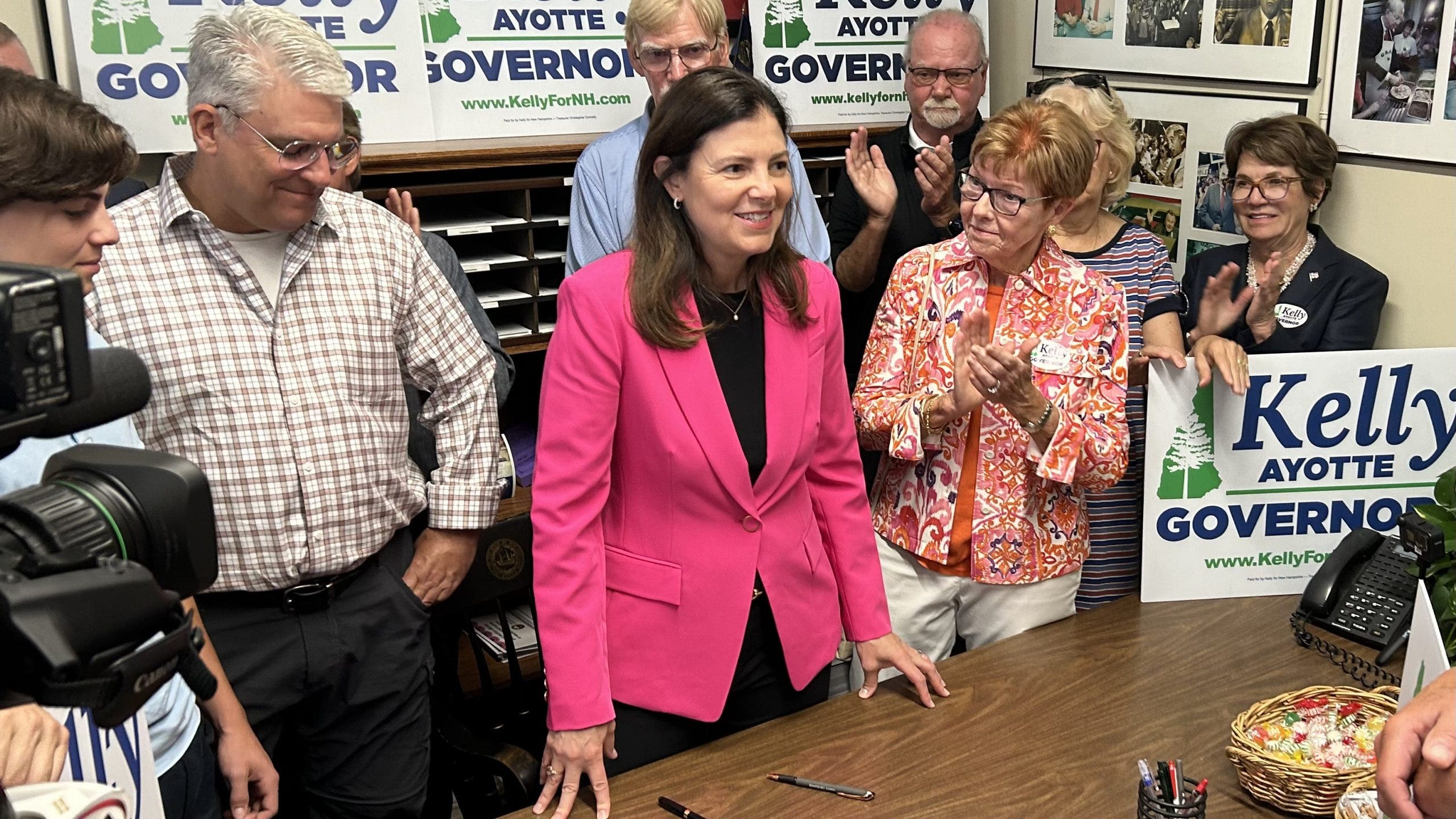
Former Sen. Kelly Ayotte, a Republican candidate for governor, is surrounded by supporters as she files her candidacy at the Secretary of State’s office, on June 13, 2024, in Concord, N.H. (Fox News – Paul Steinhauser)
“Having the experience of having served in Washington, I certainly will fight hard for New Hampshire when it comes to interacting with the Trump administration,” she said. “Those federal dollars – making sure that they come to New Hampshire. But also, when Washington does things on the regulatory front, I want to make sure that New Hampshire’s voice is at that table.”
Ayotte famously broke with then-GOP presidential nominee Trump just ahead of the 2016 election. She withdrew her support for Trump over the “Access Hollywood” controversy, in which Trump, in a years-old video, made extremely crude comments about grabbing women without their consent.
“I cannot and will not support a candidate for president who brags about degrading and assaulting women,” Ayotte said at the time.
While they both lost in New Hampshire, Ayotte slightly outperformed Trump in the state as Democratic presidential nominee Hillary Clinton edged the White House winner by less than 3,000 votes.
Before heading back full time to New Hampshire, Ayotte stuck around Washington briefly after the end of her term, shepherding then-Supreme Court nominee Neil Gorsuch (Trump’s first high court nominee) through his successful Senate confirmation process.
As she ran for governor the past two years in a state where New Hampshire’s first-in-the-nation presidential primary repeatedly drew Trump and other GOP White House hopefuls, Ayotte kept her distance from the national political conversation.
She stayed neutral in New Hampshire’s presidential primary, but did endorse Trump after he locked up the nomination. She didn’t appear with Trump’s running mate – now Vice President-elect JD Vance – when the senator from Ohio made a last-minute stop in the Granite State a couple of days before Election Day.
But Ayotte told Fox News “I want to congratulate President Trump, obviously, on a very strong victory on Election Day.”
Republican presidential nominee, former President Donald Trump arrives to speak during an election night celebration at the Palm Beach Convention Center on November 6, 2024 in West Palm Beach, Florida. (Chip Somodevilla/Getty Images)
Asked about some of the president-elect’s controversial Cabinet nomination announcements this week, Ayotte said that “it’s important that he’s putting together a team that works for him.”
But the former senator emphasized that “this is really a decision for the United States Senate. They have an important role when it comes to advise and consent. I’m sure they’ll look carefully at President Trump’s nominees and make sure that they believe that they’re qualified.”
Ayotte, in the GOP gubernatorial primary, easily defeated former New Hampshire Senate president Chuck Morse, who touted his support for Trump and questioned Ayotte’s loyalty to the former president. Morse’s hope that he would land a Trump endorsement never materialized, as the former president stayed neutral.
Also helping Ayotte as she ran for governor – a helping hand from the Republican Governors Association, which dished out nearly $21 million in support of Ayotte. Most of the funding came in the final two months of the race, but the RGA did make a $2.75 million pre-primary investment.
The RGA – unlike the rival Democratic Governors Association – sent their resources directly to the Ayotte campaign from the start of their involvement in the race, rather than taking the traditional route of putting their funding in an independent expenditure committee.
Read the full article from Here
Connecticut
PAID POST: Connecticut Expands AI Workforce Training Through Charter Oak Partnership
Connecticut is taking a major step to prepare its workforce for the growing influence of artificial intelligence, as Charter Oak State College announces a significant expansion of its AI Academy.
Through this initiative, developed in partnership with the Business-Higher Education Forum and Axim Collaborative, Charter Oak learners, job seekers, educators, and employees of small and mid-sized businesses will gain new pathways to in-demand careers using the Open edX platform.
Charter Oak, which is part of the Connecticut State Colleges & Universities (CSCU) system, is the state’s only public online college.
At a time when artificial intelligence is rapidly transforming industries ranging from healthcare to finance, the expansion reflects both urgency and opportunity. Employers are increasingly seeking workers who understand how to apply AI tools effectively, yet many job seekers and organizations lack access to affordable, relevant training. The AI Academy is intended to close that gap by aligning education directly with workforce needs.
This effort addresses a pressing economic challenge: ensuring that small and mid-sized businesses — which employ nearly half of Connecticut’s workforce — are not left behind as AI reshapes industries.
“Connecticut’s economic strength lies in its small and medium-sized businesses. The expansion of the AI Academy is a direct investment in those businesses, providing them with the high-level AI fluency typically reserved for large corporations. Furthermore, by bringing a tool-agnostic, mindset-first approach to our K-12 districts, we are helping educators move past the ‘hype’ and focus on the strategic deployment of AI. We aren’t just teaching people how to use AI; we are empowering Connecticut’s schools and businesses to lead with it,” said Dr. Dave Ferreira, Provost, Charter Oak State College.
The expanded AI Academy will offer stackable credentials over a three-year period, combining technical training with durable skills like communication, problem-solving, adaptability, and digital literacy. Learners will be able to progress at their own pace, building credentials that align with specific career pathways while remaining flexible enough to adapt to changing job market demands.
The program is designed with direct input from more than 100 leaders across business and higher education, including major employers in insurance, consulting, and technology. That collaboration ensures the curriculum reflects real-world needs, helping participants gain skills that are immediately applicable in the workplace.
A key component of the initiative is a new pathway for K-12 school districts. Rather than focusing on specific tools or platforms, the program emphasizes building an “AI mindset” — equipping educators and administrators with the knowledge to make informed, strategic decisions about how AI is used in classrooms and operations. This approach is intended to help school systems develop sustainable policies that can evolve alongside rapidly changing technology.
“The future of work demands a new kind of collaboration,” said Kristen Fox, CEO of the Business-Higher Education Forum. “When employers and institutions join forces to equip learners with AI skills and durable competencies, we create real pathways for people to unlock new opportunities, advance their careers, and thrive in an economy that is changing faster than any one sector can address alone. This is the model we need — and Connecticut is showing how it’s done.”
In addition to supporting businesses and schools, the initiative aims to expand access for individuals who have traditionally faced barriers to career advancement. By offering flexible online learning, the program is designed to reach underemployed workers, adult learners, and those seeking to transition into new fields.
The academy will begin with foundational AI coursework and expand into high-demand fields such as business, health technology, and cybersecurity — sectors where the need for skilled workers continues to grow. Over time, the program is expected to scale statewide before expanding nationally, with a goal of reaching 10,000 learners over the next five years.
“By partnering with employers to co-design AI-focused curricula, Charter Oak and BHEF are equipping learners with the skills and experiences they need to thrive in a changing economy while fueling regional economic development,” said Stephanie Khurana, CEO of Axim Collaborative.
The effort builds on Charter Oak’s existing CT AI Academy, launched in 2025, which has already served more than 3,500 residents with free AI training. That early success demonstrated strong demand for accessible AI education and helped lay the foundation for this expanded, more comprehensive model.
State higher education leaders say the initiative strengthens Connecticut’s long-term workforce pipeline while positioning the state as a model for others seeking to align education with economic development.
As artificial intelligence continues to reshape the workplace, Connecticut’s approach highlights how coordinated investment in education, business partnerships, and workforce development can help ensure that growth is both inclusive and sustainable — and that workers and employers alike are prepared for what comes next.
Maine
Keep Maine beautiful by protecting, investing in our public lands | Opinion
David Heidrich lives in Augusta.
From the cliffs of Acadia to the woods and waters of Katahdin’s national monument, Maine’s public lands are more than scenic, they are the backbone of our economy and way of life. Anyone who has spent any amount of time in these or other public places knows that they offer more than just natural beauty. They are central to our identity, drawing visitors from around the world, supporting small businesses and sustaining jobs in communities across the state.
As someone deeply invested in the success of Maine’s outdoor recreation and tourism industries, I know that investing in our public lands will support thriving communities for generations to come. But maintaining these places requires more than appreciation, it requires sustained investment and action.
In 2020, Congress recognized that many of our country’s national parks and other public lands were suffering from decades of deferred maintenance. Roads, bridges, water systems, historic structures and visitor facilities were aging faster than they could be repaired. In response, lawmakers passed the Great American Outdoors Act, which created the National Parks and Public Lands Legacy Restoration Fund (LRF).
This landmark legislation provided five years of dedicated funding to address long-overdue repairs on federal lands. Here in Maine, the LRF delivered $54 million for critical repairs to our public lands. These investments supported projects at places like Acadia National Park — improving trails, restoring historic carriage roads and upgrading essential infrastructure — as well as work on national forests and wildlife refuges across the state. These projects have served to protect natural resources, improve safety and enhance visitor experiences while supporting local economies.
Now, with that funding having expired, Congress is considering the America the Beautiful Act, introduced by Sen. Steve Daines of Montana and Maine’s own Sen. Angus King. The bill has received strong bipartisan support, and I want to thank Sen. King and Sen. Collins for their leadership in advocating for this important legislation.
The America the Beautiful Act rises above politics and reflects a shared commitment to conservation and safeguarding the places that help define both Maine and our nation. By continuing to invest in our public lands, we ensure they sustain local economies while preserving natural resources for residents, visitors and future generations alike.
Outdoor recreation is a cornerstone of Maine’s economy. Each year, millions of visitors come to experience our parks, trails, waterways and working forests — supporting roughly 32,000 jobs and generating $3.9 billion in economic activity. That is approximately 5% of Maine’s workforce and 4% of its GDP, respectively. Communities throughout Maine depend on these visitors, and the continued health of our public lands is essential to their continued success.
While important progress has been made, maintenance backlogs on our federal lands persist and require reliable, long-term funding. Congress should pass the America the Beautiful Act because it would provide $2 billion per year for eight additional years to address ongoing maintenance needs across national parks and public lands — without raising taxes.
This is accomplished by: 1) dedicating lease and royalty payments from energy producers operating on federal lands and waters to conservation, 2) requiring federal agencies to identify and dispose of unneeded assets, and 3) leveraging private funding by introducing a preference for projects with a 15% financial match from private stakeholders or nonprofit organizations.
By passing this legislation, Congress can ensure that Maine’s treasured public lands remain safe, accessible and vibrant. If we want future generations to experience Maine as we know it today, we need to invest in it now.
Massachusetts
Pols & Politics: Hundreds more layoffs announced by Massachusetts businesses
Four Massachusetts companies have announced hundreds of layoffs as residents and businesses flee the state due to what critics describe as soaring energy costs, high taxes, and costly climate mandates.
According to the state’s Worker’s Adjustment and Retraining Notification (WARN) tracker, a total of 283 Massachusetts workers are set to lose their jobs by the end of the fiscal year.
That includes 70 planned layoffs at Innovative Care Partners, which has locations in Northampton, West Springfield and Pittsfield, by June 30; 78 layoffs at Community Health Link at its Webster, Worcester and Lincoln locations, also by June 30; 83 layoffs at Compass Group USA in Boston by July 1; and 52 layoffs at Community Counseling of Bristol County at locations in Attleboro, Brockton, Fall River, New Bedford and Taunton between June 30 and July 13.
These latest notices come as several businesses have been moving out of Massachusetts over the past several months, including some that had been staples of the state’s economy.
In January, the reigning Massachusetts “Manufacturer of the Year,” Curia Global, shut down operations at its Burlington facility. Other notable departures include Thermo Fisher Scientific, Panera Bread, Cape Cod Potato Chips, Zipcar, SynQor, Analogic Corp. and more. Most recently, in April, Takeda Pharmaceuticals announced the elimination of 247 jobs from its Cambridge location.
The Massachusetts Fiscal Alliance told the Herald upon Curia Global’s exit that the Bay State has become an increasingly inhospitable business environment.
“The taxes here are high, the climate regulations are pretty extensive and we also have people in positions of power who don’t seem that interested in growing business here,” Executive Director Paul Craney said.
Healey denounces President Trump’s cap on student loans for health care and social workers
Gov. Maura Healey is responding to the Trump administration implementing a rule limiting access to federal student loans for graduate degrees in the nursing, physical therapy, physician assistants, occupational therapy, education and social work fields.
“At a time when people are already struggling with costs, President Trump is making higher education more expensive and harder to access. This rule is going to push students into more expensive private loans, and it blocks pathways into critical careers in the health care and education spaces,” Healey said in a written statement. “As the daughter of a school nurse, I know firsthand how important these jobs are to our communities.”
Healey spoke in opposition to this new rule back in March and continues to warn that it will increase costs and limit career opportunities. She launched a $15 million state loan repayment program for early education and care professionals along with loan repayments for health and human service workers through the MA Repay Program.
The new rule, implemented by the U.S. Department of Education, caps federal graduate student loan borrowing at $20,500 per year for the listed programs the administration deems not “professional.” The Healey-Driscoll Administration estimates that approximately 13,000 Massachusetts graduate students will be impacted.
Meanwhile, the Trump administration calls it a “common sense” regulation that will help control the ever-increasing costs for higher education.
-
Cleveland, OH43 seconds agoMan in critical condition after shooting on Cleveland’s East Side: EMS
-
Austin, TX7 minutes ago
William Brian Moriarty Obituary
-
Alabama13 minutes agoA quick history of the University of Alabama for commencement weekend
-
Alaska19 minutes agoBook review: ‘The North Face of Summer’ offers a compassionate look at an Alaska conflict
-
Arizona25 minutes agoArizona Lottery Powerball, The Pick results for May 2, 2026
-
Arkansas31 minutes agoArkansas Derby winner Renegade finishes 2nd in Kentucky Derby
-
California37 minutes ago
Commentary: Not too early, not too late. Here’s the sweet spot for voting in California
-
Colorado43 minutes agoBraves 9, Rockies 1: Just one wing at Coors Field tonight