Connect with us

New Jersey

Mail stolen from 6 USPS mailboxes across Fort Lee, N.J. Map shows where residents need to be wary

Published

on

Mail stolen from 6 USPS mailboxes across Fort Lee, N.J. Map shows where residents need to be wary


Police are investigating after mail was stolen from half a dozen United States Postal Service mailboxes in Fort Lee, New Jersey, over the weekend.

It comes amid recent reports of mail security issues across the Tri-State Area.

Advertisement

Fort Lee Police issue warning for residents who used blue mailboxes

Fort Lee Police say Sunday morning, a resident contacted the authorities after noticing a blue USPS mailbox was unsecured, open and empty.

“They did a little canvassing of some other mailboxes in the area, in the borough, and realized there was probably about a half dozen other mailboxes in the same situation, where the door was open and all the mail was removed,” Fort Lee Police Chief Matthew Hintze said.

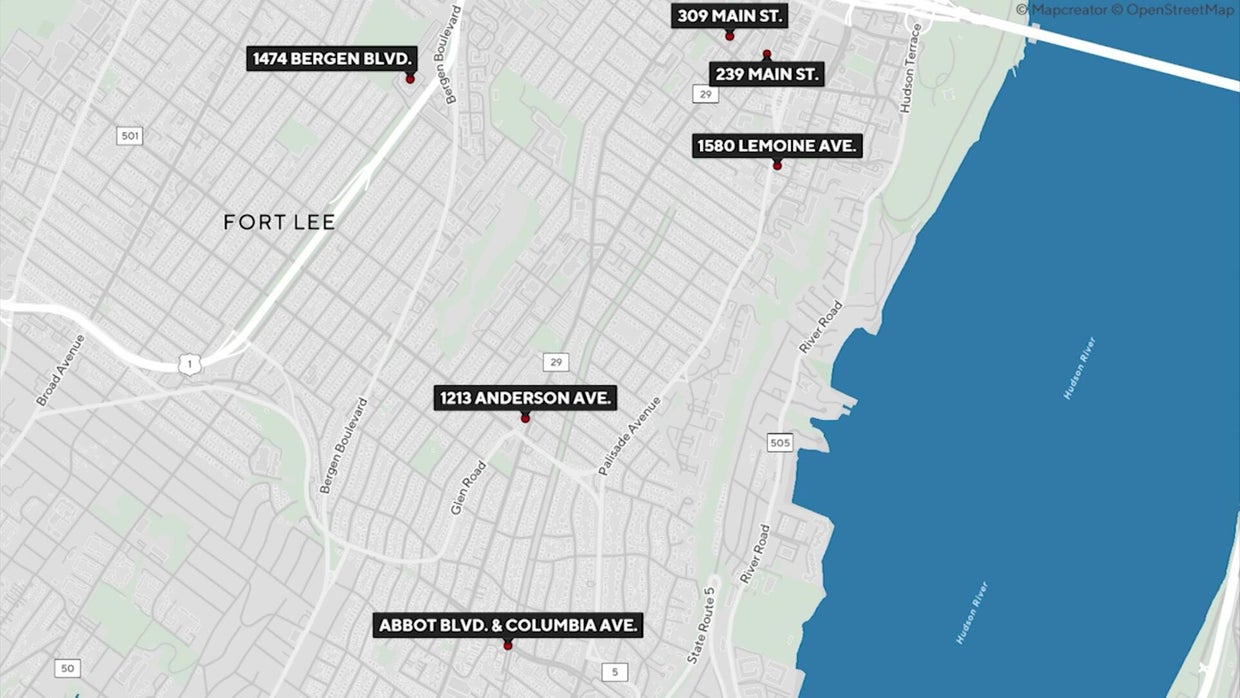
Hintze said Fort Lee Police launched a joint investigation with USPS inspectors and discovered six mailboxes were targeted across Fort Lee. The boxes were located at:

  • 1580 Lemoine Ave.
  • 231 Main St.
  • 309 Main St.
  • 1213 Anderson Ave.
  • 1475 Bergen Blvd.
  • Abbott Boulevard/Columbia Avenue

Map showing where mail was stolen from USPS mailboxes across Fort Lee, New JErsey

Fort Lee Police said mail was stolen from these six blue USPS mailboxes across the borough sometime after 3 p.m. on Sept. 20, 2025.

CBS News New York

Advertisement


Investigators believe the master key or locks on the mailboxes were somehow compromised. They also believe the thief or thieves were likely looking for personal information to commit fraud.

Police say anyone who dropped mail containing sensitive information in any of the impacted mailboxes after 3 p.m. on Sept. 20 should be on the lookout for suspicious activity.

“Please monitor all your financial accounts, check your bank accounts. If you really want to do due diligence, conduct a credit report, maybe a credit freeze,” Hintze said. “If you see anything suspicious or fraudulent, please come in to the Fort Lee Police Department and make that report.”

The investigation is ongoing.  

Mail-related crime across New York and New Jersey

This is just the latest mail-related crime reported in the Tri-State Area in recent weeks.

Advertisement

Earlier this month, two Long Island business owners said they lost nearly $3,000 after someone apparently fished checks they had mailed out of a mailbox, washed off the ink, and rewrote the checks.

“I went to the post office to file a complaint, and they said this is an everyday occurrence. It’s constantly happening,” business owner Rich Miller said at the time.

They were later reimbursed, but they weren’t the only recent victims of check washing. Another Long Island resident said she lost $20,000 after three checks she wrote were stolen and cashed by a thief.

“What the Postal Police had showed me is that they literally took Wite-Out and they erased the payable to,” Jean Gioglio-Goehring said.

Experts advise paying bills electronically to avoid falling victim to crimes like these.

Advertisement

Police say another way to keep your mail safe is to bring it inside the post office instead of just dropping it one of the blue mailboxes, even if the boxes are right outside the building.

“The only way you’re going to be safe is to take the mail actually into the post office during business hours and then you know your mail is safe. Because if you deposit it in a mailbox after hours, then you’re certainly at risk,” Tenafly resident Neil Taylor said.

Advertisement


Source link

New Jersey

Police investigate fatal stabbing in Mercer County

Published

on

Police investigate fatal stabbing in Mercer County


EWING TWP., N.J. (WPVI) — Police are searching for a suspect who fatally stabbed a man in Mercer County, New Jersey.

It happened around 5:20 p.m. Thursday on the unit block of New Hillcrest Avenue in Ewing Township.

When police arrived, they found a 40-year-old man lying in the street with several stab wounds to the torso.

He was transported to Capital Health Regional Medical Center, where he later died.

Advertisement

The victim has been identified as Jimmy Chase from Philadelphia.

So far, no arrests have been made.

Anyone who has any information on this case is asked to call Mercer County detectives at 609-989-6406.

You can also submit an anonymous tip online at MercerCountyProsecutor.com.

Copyright © 2026 WPVI-TV. All Rights Reserved.

Advertisement


Source link

Continue Reading

New Jersey

The arrest of New Jersey’s royal governor changed the colony forever

Published

on

The arrest of New Jersey’s royal governor changed the colony forever


4-minute read

play

  • The 1st New Jersey Regiment, made up of local tradesmen and farmers, placed Franklin under house arrest after he refused to yield authority.
  • Franklin later led Loyalist operations from Manhattan, using knowledge of New Jersey to target rebel homes and disrupt Patriot efforts.

On a bitter January morning in 1776, Patriot militia from the 1st New Jersey Regiment slogged through slush to the Proprietary House in Perth Amboy. Their target was William Franklin, the Crown’s highest-ranking civilian official between New York and Philadelphia.

Franklin was not a visiting British officer or a passing bureaucrat. He was the royal governor of New Jersey, and his arrest was a milestone that destroyed the bridge back to reconciliation.

His father, Benjamin Franklin, was already a figure of international renown. Printer, scientist, inventor and diplomat, he moved easily between Philadelphia and London. William had grown up in that orbit, trained in law and politics.

Unlike his father, who increasingly sympathized with the colonial cause, William sided with the Crown. He saw loyalty to Britain as vital to protect law, order and property.

Story continues below photo gallery.

Advertisement

In the months before militiamen arrived at his door, Franklin steadfastly refused to yield authority as governor. While local Committees of Observation enforced boycotts and intercepted mail, Franklin continued issuing proclamations, corresponding with British officials and loyalists and asserting that the government was still under control of the Crown.

By early January, patience had ended among members of the state’s revolutionary committees. Allowing Franklin to operate inside New Jersey was no longer seen as tolerable.

Shoemakers, tanners and farmers

The men sent to detain him were not professional soldiers in the British sense. In the 1872 “Official Register of the Officers and Men of New Jersey in the Revolutionary War,” historian William Stryker wrote that the 1st New Jersey Regiment was drawn largely from Essex, Bergen and Elizabethtown.

Advertisement

Stryker noted that shoemakers and tanners from Newark, men who had watched their businesses tighten under British currency and customs policies, made up a significant portion of the early volunteers.

Alongside them were Dutch-descended farmers from the Hackensack Valley, many of whom viewed Franklin’s land agents and surveyors as a threat to their claims, historian Adrian Leiby wrote in the 1962 work “The Revolutionary War in the Hackensack Valley.”

It also had members of the Elizabeth-Town Rifles, whose officers lived within sight of the British fleet in New York Harbor.

The group included men who had previously served during British campaigns during the French and Indian War, when Franklin held a captain’s commission. In her 1990 biography “William Franklin: Son of a Patriot, Servant of a King,” historian Sheila Skemp wrote that some had trained with him, while others had marched beside him.

Advertisement

Mission led by Lord Stirling from Basking Ridge

Primary source journals from the regiment describe the uncomfortable silence of the Jan. 8 mission, led by William Alexander, an aristocrat from Basking Ridge known as Lord Stirling. In the 1847 volume “The Life of William Alexander,” William Alexander Duer wrote that before the war, Stirling and Franklin had shared wine, discussed land deals and attended the same elite galas.

The group did not storm the Proprietary House. Contemporary journals describe a solemn encirclement. Guards were placed at the gates. According to the “New Jersey Archives” published in 1886, Franklin was informed by Stirling rather plainly that he “received orders… (and) to prevent your quitting the Province… I have therefore ordered a guard to be placed at your gates.”

Franklin objected immediately, calling the arrest a “high insult” and illegal.

The 1886 “New Jersey Archives” record that he argued that nobody in New Jersey possessed the right to restrain the king’s appointed governor, but it was no use. Authority had shifted.

Advertisement

Franklin signed a parole agreement restricting his movement. Within weeks, it nonetheless became clear that he had no intention of complying.

Seized and transported to Connecticut

He continued corresponding with loyalist figures and acting as governor in all but name. The Provincial Congress responded by ordering his removal from New Jersey. In June 1776, Franklin was seized again and transported under guard to Connecticut.

While Franklin remained imprisoned, events in New Jersey continued. Royal government collapsed. A new governor, William Livingston, assumed office. New Jersey moved formally into rebellion.

Franklin was released in a 1778 prisoner exchange and sent to British-occupied New York City. He did not return to New Jersey. Instead, he took up a new role as president of the Board of Associated Loyalists, an organization tasked with coordinating loyalist refugees and retaliatory actions against Patriot strongholds.

In research for the Online Institute for Advanced Loyalist Studies, Todd Braisted wrote that this organization operated as a paramilitary arm of the Loyalist cause.

Advertisement

From Manhattan, Franklin drew on his detailed knowledge of New Jersey’s geography and leadership. Raids authorized under the board targeted farms, barns and ironworks. Loyalist parties crossed the Hudson at night, seizing property and prisoners in Bergen and Essex counties.

Leiby documented that survivors later testified that attackers called out names as they approached, which provided evidence of the advanced knowledge Franklin had gathered as governor.

Franklin’s actions during these years ensured that he could never return. When the war ended, he relocated permanently to Britain, where he died in 1813.


Source link

Advertisement
Continue Reading

New Jersey

Soaking rain, gusty winds looming in N.J. this weekend before cold air sweeps in

Published

on

Soaking rain, gusty winds looming in N.J. this weekend before cold air sweeps in


New Jersey residents can expect quiet conditions Thursday night before a warm front lifts northward, bringing increasing clouds and a chance of rain showers by Friday afternoon.

Temperatures are forecast to rise 10 to 15 degrees above normal, reaching the mid-50s, as a precursor to a wet start to the weekend.

The first round of precipitation is expected to arrive late Friday afternoon into the early evening hours. While rainfall is generally expected to be light during this initial phase, there could be an isolated rumble of thunder, according to forecasters from the National Weather Service.

A cold front will pass through the region overnight, likely creating a lull in the rain showers before the next system arrives.

Advertisement

More widespread rainfall is forecast to return Saturday afternoon and evening as low pressure tracks across the area. During this time, rain could become heavy at times.

Rainfall totals between a half inch and 1.5 inches are predicted across New Jersey through Saturday night. Despite the anticipated volume of water, forecasters say flooding risks should be minimal to none.

Due to the recent stretch of mild temperatures, there is no concern regarding ice jams or river ice hindering runoff.

Temperatures will remain warm for January in New Jersey through the weekend, but heavy rain is expected Friday night into Saturday.National Weather Service

There is some uncertainty in the forecast regarding specific temperatures and wind speeds for Saturday, the weather service said.

Conditions will change significantly on Sunday as a secondary cold front moves through the region, forecasters said. As the rain clears, strong cold air advection will result in a breezy day, with west to northwest wind gusts peaking in the 30 to 40 mph range.

Advertisement

Temperatures will drop throughout the day, falling into the 20s for most of the area by Sunday night.

Looking ahead to the start of the work week, high pressure will build over the region, bringing dry conditions. Monday and Tuesday are expected to feature clear skies and temperatures near normal for January.

By Tuesday and Wednesday, return flow will develop as high pressure moves off the coast, helping temperatures moderate to about 5 degrees above normal.

No significant weather impacts are expected from Monday through next Thursday.

Current weather radar


Source link

Advertisement
Continue Reading

Trending