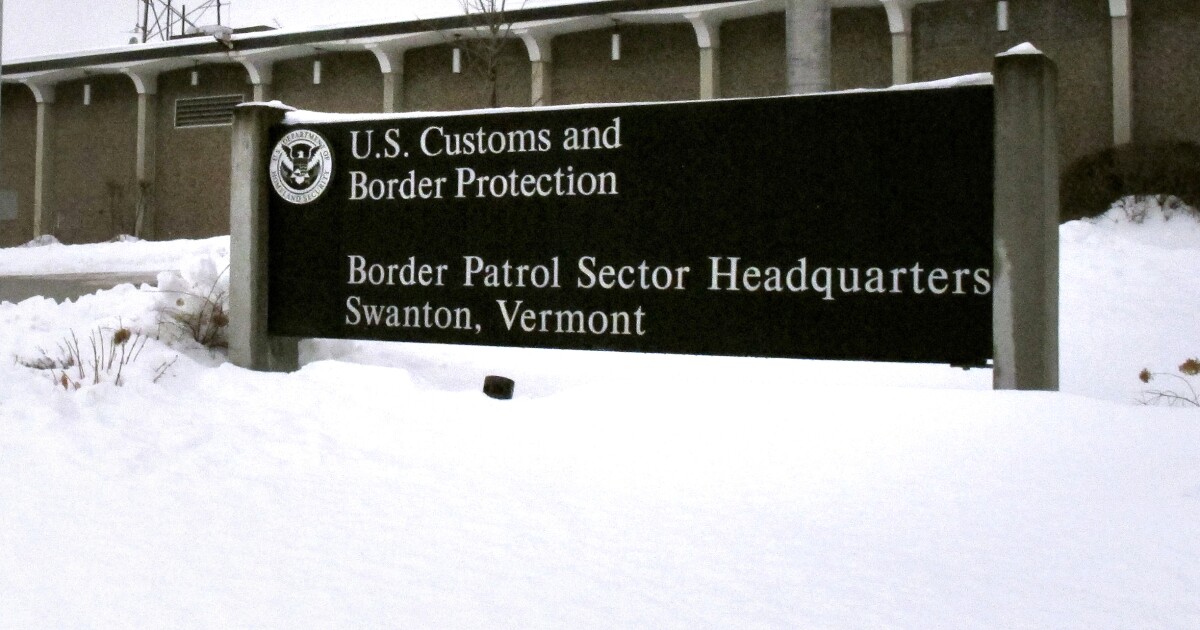
For half a century, New Hampshire’s “current use” law has been a widely used and rarely controversial policy that lets landowners pay less in taxes in exchange for preserving open space, and in some cases, allowing the public to use their land for recreational uses.
But a little noticed proposed change to the statute pushed by the top Senate Republican this year would turn the current use statute into a new, untested immigration enforcement tool.
The bill, sponsored by Senate President Jeb Bradley, would permit landowners — including those who live along the state’s northern border with Canada — to post “no trespassing” signs with exceptions for recreational use. That would clear the way for suspected undocumented migrants to be potentially arrested by local law enforcement — rather than federal border patrol agents — for criminal trespassing.
The legislation was requested by Gov. Chris Sununu and Attorney General John Formella, according to Bradley. And while the proposed change would apply to more than a million acres of land in the state, it was prompted by the concerns of a small handful of residents in the town of Pittsburg who say they have seen migrants illegally entering New Hampshire by crossing a stream that serves as the border between the U.S. and Canada.
Advertisement
This effort to reshape immigration enforcement using a relatively obscure section of land taxation law comes at a time when questions are being raised about the extent of immigration pressures along New Hampshire’s international border. Civil liberties groups have obtained data showing scant interactionsbetween border agents and suspected migrants in New Hampshire in recent months. But State House Republicans have argued the problem is far larger than the numbers suggest, and that it is time for the state to step up its own enforcement efforts.
“In New Hampshire and in 49 other states, we have seen the results of open border policies, not only human trafficking, but the import of illegal substances, in particular fentanyl, flowing across our southern and our northern border,” said Bradley during a recent public hearing on the bill.
Sen. Jeanne Shaheen met with U.S. Border Patrol officials and local law enforcement in Pittsburg in September to ask about immigration enforcement challenges.
The measure would make a technical change to the state’s 50-year old current use law, which allows residents to put 10 or more acres of undeveloped land — including open fields, forest, and agricultural properties — into a special category for assessing property taxes. The program saves landowners money, but also encourages the preservation of open space.
Under the existing program, landowners can receive an additional tax deduction if they allow recreational use on the property by the public.
Advertisement
The bill now in the State House would apply to those landowners who grant the public access to their land: It would permit them to post a sign that reads “No Trespassing except for skiing, snowshoeing, fishing, hunting, hiking or nature observation” without jeopardizing their tax break.
Under that change, suspected migrants who cross the international border onto residential land marked with the new signs could be arrested for criminal trespassing, although it isn’t clear what would distinguish a migrant carrying a backpack and wearing boots from any other hiker who is permitted to walk on the land.
“I believe — and I hope that you, as members of the committee, believe — that protecting our northern border to prevent drug smuggling, human trafficking, and illegal entry into our state is important,” Bradley told members of the Senate Judiciary committee.
Some activists, however, are concerned the measure could lead to racial profiling.
“I look brown,” said Bruno D’Britto, an immigration attorney who leads the New Hampshire Brazilian Council and opposes the bill. “Someone sees me on their property with a backpack, they are going to think I’m crossing the border.”
Advertisement
D’Britto also noted that courts have generally ruled that immigration enforcement is the jurisdiction of the federal government and not the states.
“The states do have their sovereignty under the 10th Amendment, but this goes way beyond what the states can do,” he said. “Immigration has been allocated to the federal government.”
Gov. Chris Sununu along with Attorney General John Formella announce details of the Northern Border Task Force Alliance last year.
That hasn’t stopped some states, including Texas, from implementing its own immigration policies. There is currently a legal fight between officials in that state and the Biden Administration over the use of razor wire to ward off migrants.
Bradley, in an interview with NHPR, acknowledged the measure could face legal challenges if it becomes law.
Advertisement
“I think it’s the best public policy, and if it’s legally challenged, it’s legally challenged,” he said, adding “the Attorney General’s office will be able to defend it.”
Bradley noted that a lack of perceived action by the federal government gives states like New Hampshire “a legitimate issue in terms of protecting their own sovereignty and the public safety.”
Earlier this month, the head of the regional Border Patrol office in Vermont, Chief Patrol Agent Robert Garcia, said his agents had apprehended 3,310 migrants from 55 different countries since October, more than the previous four fiscal years combined. Those figures, however, were not broken down by state.
While Republicans in New Hampshire frequently describe a migrant “crisis” along the state’s approximately 58-mile border with Canada — a heavily forested and remote stretch of land with relatively few crossing points — data obtained by the ACLU of New Hampshire last month through a lawsuit against U.S. Customs and Border Protection showed just 21 suspected migrants were detained by federal agents in the state in the 15-month period between October 2022 and December 2023.
Residents of a remote road that runs alongside the international boundary in the town of Pittsburg have raised concerns to NHPR about migrants crossing their property. Top officials in the state, including Sununu and U.S. Senator Jeanne Shaheen, visited the area last year to meet with Border Patrol officials and local law enforcement, pledging more resources.
Advertisement
There were two high-profile arrests of suspected migrants in New Hampshire last summer, though it wasn’t clear in court paperwork precisely where the individuals crossed the international boundary. In both cases, the drivers of vehicles transporting the migrants were arrested and charged with human smuggling. No narcotics or guns were seized, according to court paperwork.
Those cases, along with earlier data released by a regional Border Patrol outpost showing a surge in encounters with migrants across parts of upstate New York and Vermont, prompted the state to divert $1.4 million to increased patrols in the region. That money was allocated in the state budget despite concerns from immigration activists that the stepped up law enforcement would inevitably lead to racial profiling. The new effort, called the Northern Border Alliance Task Force, was launched last October. It has yet to release initial data on the program, despite a Dec. 31 deadline to do so.
This isn’t the first time the question of using New Hampshire’s criminal trespassing laws to arrest and detain undocumented people has arisen. In 2005, the Monadnock-region town of New Ipswich found itself in national headlines after local police pursued criminal trespassingcharges against an undocumented construction worker. The man was initially arrested and charged with operating a motor vehicle without a license. But when ICE agents contacted by the town declined to take him into custody, New Ipswich Police Chief Garrett Chamberlain charged Jorge Mora Ramirez with a misdemeanor under New Hampshire’s trespassing law, even though Ramirez was not accused of wrongfully entering private property.
A district court judge ultimately dismissed the case, ruling local law enforcement had overstepped its authority by attempting to enforce federal immigration laws through other means.
Today, more than 3 million acres of land are currently enrolled in current use status, or 52% of the entire land area of the state. Of those protected lands, approximately half of that acreage is also open to the public for recreational use, according to data on the Department of Revenue Administration’s website.
Advertisement
Most of New Hampshire’s border with Canada is controlled by a single entity, Aurora Sustainable Lands, which has a conservation easement in place that prohibits placing ‘No Trespassing’ signs, according to Charles Levesque, president of the Statewide Program of Action to Conserve Our Environment, or SPACE, a group dedicated to protecting open lands through the current use law.
Another large stretch of borderland is controlled and managed by New Hampshire Fish and Game. Along an approximately 70-mile stretch of road in the western corner of the international boundary, where New Hampshire, Vermont and Canada meet, there are numerous parcels owned by private individuals, with some of those lands in current use with the recreational tax enhancement.
Levesque’s group is in favor of the proposed legislation, though not for its potential impact on those specific landowners or on illegal immigration. Rather, he said all landowners statewide who utilize the recreational bonus under current use need clarity on what type of signs they may be able to post, “because now the statute’s rather silent on that.”
But given the wildness of the terrain along the vast majority of the New Hampshire-Canada border, and the challenge in determining who is a legally permitted hiker or birdwatcher on private lands — versus who may be hiking but without proper paperwork to be in the country — it isn’t clear what impact the proposed legislation may ultimately have.
Levesque said he is doubtful the legislation will accomplish what lawmakers are hoping.
Advertisement
“They’re looking for ways to give local law enforcement the authority here,” he said. “And this is what they came up with. I don’t think it will be effective.”
Schultz said she “highly respects” Aspell, too, but there was a “dissonance between reality” when eyeing what the public and city employees were earning.
Ward 6 City Council Aislinn Kalob, too, would not be voting for the increase, saying it had been “heavily on my mind since we’ve had our nonpublic sessions,” which lasted about six hours of work. She appreciated Kretovic clearly outlining the job of city manager. But people were frustrated with the city manager, and she saw that in the comments in online forums.
“I do feel, after really digging into this, and learning about his job,” she said, “and thinking toward the future when, eventually, at some point, somebody new will be sitting in that seat, we are the ones who direct policy and he is the one that implements it… there is anger out there that should be directed more toward us.”
Kalob said, too, a room full of firefighters, upset about their contract, also made voting for the wage increase something she could not consider.
Advertisement
Michele Horne of Ward 2 echoed similar concerns to Schultz, saying there was significant “wage disparity” between the public and staff and the city manager. She also agreed with Kalob’s point that previous councils created this contract.
Sunflowers are my absolute FAVORITE flowers. I truly feel like they have magical uplifting abilities. Hence, why I’ve always kept fresh sunflowers in my house, brightening up my kitchen table or even my TV stand.
Obviously, it was a dream of mine to have my maternity photos taken in a sunflower field. They reflect sunshine and exude happiness.
Not to mention, one of my favorite quotes is about sunflowers! “Keep your face to the sunshine and you cannot see the shadow. It’s what sunflowers do.” Helen Keller
A beautiful reminder to keep an optimistic outlook on life and not dwell on the negative.
Advertisement
So, you can imagine the joy I felt when I learned that New Hampshire had its very own Sunflower Festival at Coppal House Farm in Lee!
Coppal House Farm via FacebookCoppal House Farm via Facebook
About the Sunflower Festival:
During the summer, the farm transforms into a sea of golden blooms, giving visitors the chance to wander through thousands of sunflowers, snap photos, enjoy local food vendors, artisan crafts, listen to live music, and experience one of New Hampshire’s most beautiful summer traditions.
Other unique activities on the itinerary? Sip-n-snip! Guests can enjoy a cocktail or mocktail of their choice and cut their own fresh bouquet of flowers.
Coppal House Farm via FacebookCoppal House Farm via Facebook
Or maybe you’re a yoga fan? You can join a 60-minute sweat session from Lee, New Hampshire yoga instructors right in the heart of the flower field.
And because the farm grows oilseed sunflowers for culinary oil (which they harvest in the fall months), the flowers only stay at their peak for a brief window, making the festival a limited-time experience, according to the festival organizers…
Advertisement
What makes this event even more special is the reason behind it. The festival started as a way to share the beauty of the sunflower fields, but it has grown into something much bigger. Organizers say the event has raised more than $90,000 for Make-A-Wish New Hampshire over the years and now shares a portion of its proceeds with several local nonprofit organizations serving the Seacoast community.
Anyone who knows me knows that paying it forward is something that’s incredibly important to me. It’s right up there with my love of sunflowers because both fill my cup in the best way. So, when I found out this festival celebrates my favorite flower and gives back to the community, I knew I had to share it.
Sunflower Festival Details:
This festival only runs from Saturday, July 25th until Sunday, August 2nd. You can get the full list of activities and more on the Coppal Farm website.
Daily Field Hours
Advertisement
10:00 AM – 6:30 PM (last admission at 6PM because fields close at 6:30) Weekend Tickets (prepurchased online – day before) $12 per person ages 13 & older $10 per person ages 5-12 $10 per person Seniors (65+) & Military 4 yrs & under are always free Weekend Tickets (purchased day of – online or at farm): $16 per person ages 13 & older $14 per person ages 5-12 $14 per person Seniors (65+) & Military 4 yrs & under are always free includes: access to sunflower fields, craft fair, food vending area, tented shade area, picnic area, farm animals, & live music
Weekday Tickets (prepurchased online – day before) $8 per person ages 13 & older $6 per person ages 5-12 $6 per person Seniors (65+) & Military 4 yrs & under are always free
Weekday Tickets (purchased day of – online or at farm) $12 per person ages 13 & older $10 per person ages 5-12 $10 per person Seniors (65+) & Military 4 yrs & under are always free
What tickets include: Access to sunflower fields, food vending area, tented shade area, picnic area, and farm animals
READ MORE: A Classic Fairy Tale Comes To Life At Portsmouth’s Prescott Park This Summer
Advertisement
This festival might just leave you smiling long after you leave the fields!
What Flowers Thrive in New England
See what flowers thrive in New England weather: Maine, Massachusetts, and New Hampshire.
Gallery Credit: Logan
14 of the Best New Hampshire Farms Offering Locally Grown Strawberries
14 of the Best New Hampshire Farms Offering PYO Strawberries
Ed. Note: If this was you and you are interested, please email [email protected] so I can put you in touch with OP.
“Dear PoPville,
I was biking home from a doctor appointment a little before noon on Friday, and stopped at a red light on New Hampshire & L st nw. There was a woman across the street who was looking fine in her dark blue (I think they were) scrubs. I might be crazy, but it felt like we kept checking each other out. By the third time,
if we were in a romcom, one of us would have waved. Sorry I didn’t, but if you are reading this and date men, reach out to the Prince if you are interested in that man on the bike. Have a great weekend!”
Ed. Note: If this is you, please email [email protected] so I can put you in touch with OP. PoPville is not affiliated with either party, please proceed with any potential connection at your own risk using caution as you would any online encounter. For those curious about past missed connections, many have been made and when possible I’ll try to update when/if more are made.