Connect with us

New Hampshire

In Their Own Words with George Brown – New Hampshire Magazine

Published

on

In Their Own Words with George Brown – New Hampshire Magazine


There’s a sign high on the wall inside George Brown’s woodshop at Pinkham Notch Visitor Center that reads “grand juction.” 

After 10 years and roughly 600 signs, the missing “n”  is simply a reminder for Brown, a member of the Appalachian Mountain Club and official “Sign Maker,” to take his time when carving out the newest directional signs that line New Hampshire’s trails and which keep hikers on the right track. 

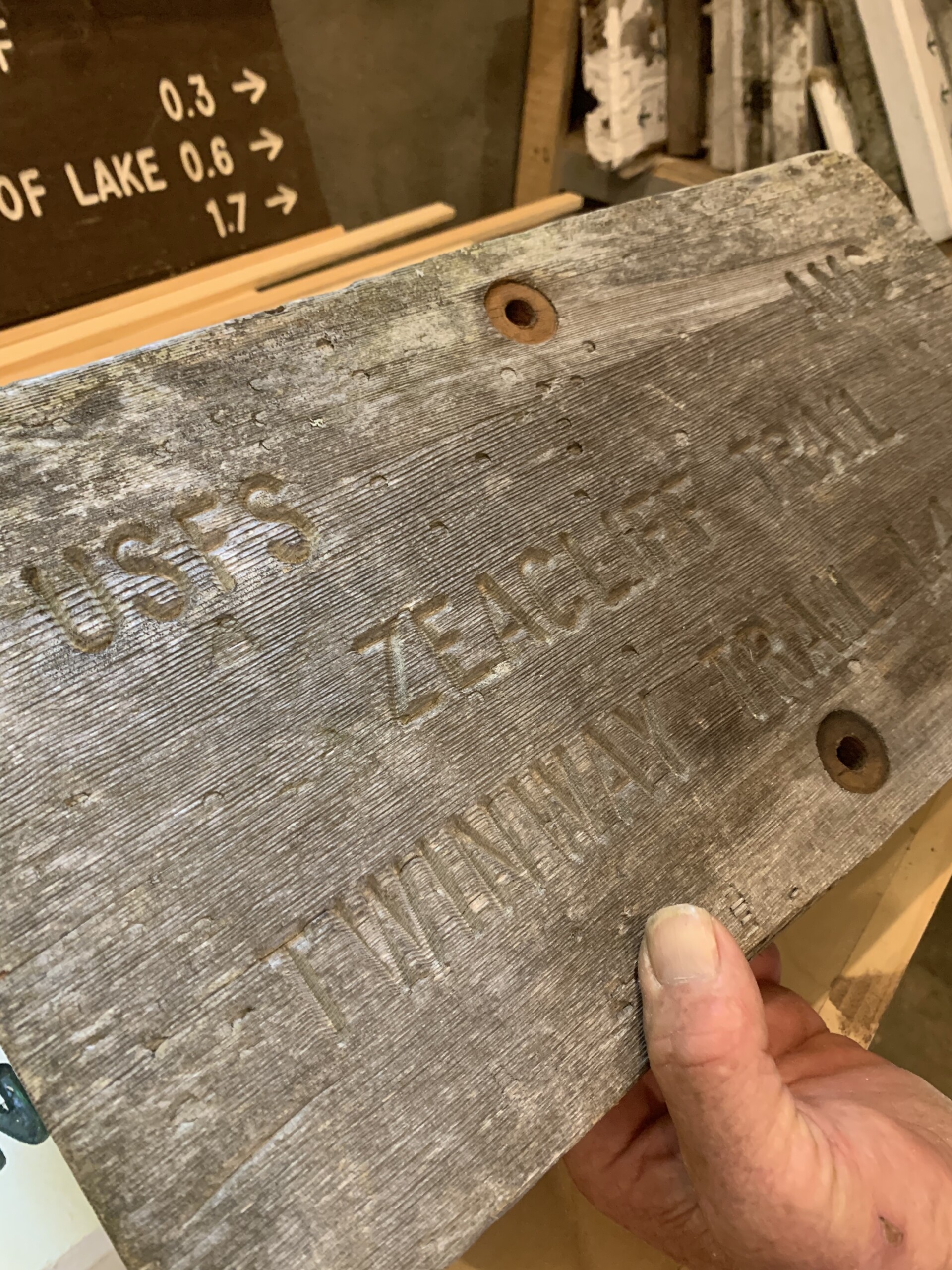
Brown, along with AMC staff and volunteers, helps maintain about 440 miles of trails in White Mountain National Forest — about 750 trail signs in all. When current signs wear out their welcome, become difficult to read, splinter or get chewed by bears or porcupines, staff and volunteers will note its ID number on its reverse and add it to a continuously updated database. That’s where Brown comes in.

Using a premeasured, pretreated white pine board sourced locally, Brown uses a “signmaking machine” — “I’m sure there’s a fancier name,” he says (it’s a Marlin 3-D Carving Machine) — to make a tiny mark in the wood for character placement. Then the machine helps him carve each character using standardized letters in plastic molds.

Advertisement

After chiseling the message, he squeezes a bit of ordinary house paint — chrome green to be exact — into the grooves, then uses the handle end of a small paintbrush to spread the paint and fill in the carved letters. The rest of the sign receives house paint in white.

Retired signs are returned to the woodshop; each year a few are auctioned off, some for a handsome price. 

Here’s an inside look at Brown’s craft.


  New Hampshire Magazine: I think it’s always a relief to see one of your signs — then you know you’re in the right place.

George Brown: I look at it like it’s an adventure. And it’s like a discovery as you hike along. And I think when people come to a junction with a sign, it kind of confirms “Oh, yeah, we’re in the right place, at the right time, we hope.”   

Advertisement

George Brown examines a damaged, splitting sign that has spent years enduring harsh elements.

NHM: I didn’t realize each sign is numbered.  

GB: That’s the actual sign number in the database. There are so many things about trail work that people take for granted — signs being one of them. There’s just a lot of cleaning drainage, building rock walls, brushing the trail and blazing it. A lot of people just don’t know. I can’t fault them.

NHM: How long does it take to make one sign from start to finish for you?

GB: Well, of course, it depends on the number of lines but on average, I would say between an hour and a half to two hours, and that includes layout, which is quite time-consuming. But then you got to spend time putting it together. Sanding it, painting it. And painting the letters, as you can see, is the most time-consuming, because it’s so fine.

Advertisement

NHM: How many coats of paint do they get?

GB: The white is three (coats). One prime, two finish. And the green is just one coat. We always buy top-quality paint, because we don’t want to do those letters twice. Once is enough. 

NHM: These signs seem very consistent. Who came up with this style?

George Brown 7

This wooden sign that was stationed on the Zeacliff Trail has a layer of patina from its time outdoors.

GB: These standards come from the owner of the White Mountain National Forest, which is the United States Forest Service. Most of the time making a sign is spent laying it out to make sure the trail name gets centered and that the text is all the way to the left and right like it’s supposed to be.

Advertisement

NHM: Do the distances on the signs ever need to be adjusted?  

GB: Whenever I make a sign, I refer to the White Mountain Guide. You’ve seen that big thick volume? It tells me exactly where this sign is. I’ll look in the guide and make sure the distance is correct. Chances are, in fact, if you see any sign that is this thickness — five-quarter inch — it was one that I made. 

NHM: How often are the signs replaced? 

GB: I’m guessing 10 years, maximum 15. Ones that are in a somewhat sheltered location — this one is right around Lincoln Woods — this one will probably last 12 to 15 years, I bet. 

NHM: What happens to the old, wornout signs?

Advertisement

GB: Every year, the AMC Trails Department will auction these off. It’s kind of fun to watch it. Someone paid like $1,800 last year (for one). I bet this one will get close to, if not more than, $1,800, because it was in the alpine zone. Anything that is above treeline and gets exposed to that kind of weather, which can be horrific, (is more valuable). 

NHM: How long will you continue to do this?    

George Brown 3

Brown uses locally sourced, treated white pine as he measures the proper distances between characters.

GB: As long as I can, as long as they want me to. I really enjoy it. It’s a great job. There’s always a challenge, but you do have to think through laying things out and spacing and checking the text to make sure it’s accurate.

NHM: Do you ever get bored with this job?   

Advertisement

GB: No, it’s a fun gig. I get to work here at Pinkham. … And it’s a great community here of staff that you get to know pretty well. I’ve got two golden retrievers, and they’ve got many friends here that come in and say hi.

NHM: I came across a picture of you hiking, and you had a new sign in your backpack. Do you always replace them? 

GB: No, I used to put some up. But my knees really started bothering me lately. It’s just real hard for me to get there, and I miss it horribly. There’s a seasonal staff person who puts signs up, but he also has a team of volunteers that puts signs up and also help with the inventory and assess trail conditions.

NHM: Do you still go hiking?    

GB: I do. I maintain the trail over in Evans Notch. I call it the undiscovered gem of the White Mountain National Forest. I look after the lower part of Royce Trail — the first mile follows a cold river stream. And of course, the dogs love it.

Advertisement
George Brown 8

A new sign with chrome green paint in the letters awaits its marching orders.

NHM: That trail’s not too difficult?  

GB: I was done by the end of the day. Because there’s a 2,000-foot elevation gain. So yeah, I still get out there, but I can’t do the 4,000-footers. I was on Emerald Bluff, a 2.4 mile hike along Israel Ridge Trail and Emerald Trail, a couple years ago, and I came to this beautiful outlook of Castle Ravine. And I had this real deep sense of remorse that I can’t do this anymore. And yet, right after that I said, “You know what, I feel just great that I was able to, that I can say that I did that.”




Source link

Advertisement

New Hampshire

Boston MedFlight expands into NH

Published

on

Boston MedFlight expands into NH


Boston MedFlight often touches down at the scene of some of the worst tragedies in New England – where minutes can mean life or death for a victim. The critical care transport operation is now expanding with a new base in New Hampshire.

The organization is hosting an open house at the new Manchester location on Thursday.

Boston MedFlight flies a critical care transport paramedic and nurse on every flight. Jaik Hanley-McCarthy says their helicopters and ground vehicles are equipped to handle just about any emergency medical procedure.

“Anything that can be done in the ICU,” explained Hanley-McCarthy. “We have a mobile lab so we can draw blood and run labs in real time.”

Advertisement

Boston MedFlight now has five bases across the region.

“Having a base in Manchester just expands this Boston-level care even further north to the more remote areas of the state,” said Hanley-McCarthy.

Boston MedFlight operates as a network of bases and some of the locations are staffed 24 hours.

Chief Executive Officer Maura Hughes says the nonprofit operation survives on public and private donations.

“We provide about $7 million in free care every year to patients,” said Hughes. “Not every hospital can be everything to every patient. We’re really the glue that keeps the health care system together.”

Advertisement

Heather Young says her daughter, Teighan, is still alive because she was flown for a critical assessment and procedure after falling off a truck and hitting her head.

“She should not be driving and walking and talking and all the things she’s doing as quickly as she is,” said Young.

Teighan just turned 18 and plans to go to college to study the medical field.

“I want to be a nurse and help other people,” she said.

It’s stories like this that keep the men and women who work Boston MedFlight focused on their mission.

Advertisement

“I think we just go call by call and try to do the best we can,” said Hanley-McCarthy. “I think when we stop and truly think about it, I think that weight is pretty heavy.”

Boston MedFlight also has a yearly reunion where patients and the team get together here in Bedford to meet and check in on their progress. It really shows you how connected they are to the people they help.


Source link

Advertisement
Continue Reading

New Hampshire

Hiker who set out in warm spring weather found dead after snowstorm in New Hampshire mountains

Published

on

Hiker who set out in warm spring weather found dead after snowstorm in New Hampshire mountains


NEWYou can now listen to Fox News articles!

A Massachusetts hiker who set out in warm spring weather was found dead deep in New Hampshire’s White Mountains after a snowstorm dumped several inches of snow in the area, authorities said.

Kent Wood, 61, of West Roxbury, was discovered Tuesday evening on a remote section of the Kinsman Pond Trail in Franconia Notch, about 5.5 miles from his vehicle, according to New Hampshire Fish and Game.

Wood had driven to Franconia Notch on April 17 for a weekend camping and hiking trip, and set out on a hike the next morning in warm, clear weather, officials said. Family and friends last heard from him Saturday afternoon.

Advertisement

When he failed to return or make contact for two days, officials said relatives reported him missing Tuesday morning, prompting a large-scale search.

HIKER IDENTIFIED, POPULAR TRAIL CLOSED AFTER DEADLY FALL A UTAH’S ZION NATIONAL PARK

An aerial view of Franconia Notch State Park in New Hampshire, where a hiker was found dead on Tuesday. (Joseph Sohm/Universal Images Group, File)

Rescuers quickly learned Wood had packed for mild conditions, not the three to five inches of snow that fell in the area between Sunday and Monday.

Fog hovers over a narrow road through Franconia Notch in the White Mountain National Forest in New Hampshire on Dec. 27, 2021. (Andrew Lichtenstein/Corbis)

Advertisement

Search teams from Fish and Game, PEMI Valley Search and Rescue, and the Army National Guard launched a coordinated effort, focusing on the Lonesome Lake and Kinsman Pond areas.

FAMILY’S SPRING BREAK HIKE TURNS INTO LIFE-OR-DEATH RESCUE AFTER PARENT FALLS 70 FEET OFF UTAH CLIFF

Conservation officers located Wood’s body around 7:41 p.m. Tuesday. Crews carried him out overnight, reaching the trailhead shortly after 1 a.m. Wednesday.

Franconia Notch and the Appalachian Trail are seen in New Hampshire on Sept. 21. (Carol M. Highsmith/Buyenlarge/Getty Images)

CLICK HERE TO DOWNLOAD THE FOX NEWS APP

Advertisement

Since Friday, six hikers from Massachusetts have been rescued in the White Mountains, Fish and Game said.

Officials are reminding hikers that winter conditions still grip the mountains, with snow, freezing temperatures and rapidly changing weather.


Source link

Continue Reading

New Hampshire

Death of Laconia, N.H. man ruled a homicide – The Boston Globe

Published

on

Death of Laconia, N.H. man ruled a homicide – The Boston Globe


Authorities ruled the death of a 62-year-old man who was found stabbed at his home in Laconia, N.H. last week a homicide, prosecutors said Tuesday.

An autopsy by the state medical examiner’s office found that John Anderson died from stab wounds to the neck, the office of Attorney General John M. Formella said in a statement.

Police went to Anderson’s apartment at 217 South Main St. the morning of April 14 for a welfare check when officers discovered his body, Formella’s office said in a previous statement.

No arrests were reported.

Advertisement

State Police detectives asked the public for information about Anderson’s movements or activity at his home from April 12 to April 14.

Anderson’s death was the first of two homicides in Laconia on April 14.

Linda Dionne, 58, was found dead at 52 Old Prescott Hill Road around 1:40 p.m., Formella’s office said. An autopsy showed she died of strangulation.

Dionne’s son Christopher Garon, 32, was at the scene and shortly arrested and charged with second-degree murder, officials said.


Chloe Pisani can be reached at chloe.pisani@globe.com.

Advertisement


Source link

Continue Reading
Advertisement

Trending
