
Northeast
Local officials attack New York City plan to house migrants in Staten Island church: 'Hurting this community'
Staten Island officials had harsh words for New York City’s latest plan to open a migrant shelter in a local church.
Staten Island Borough President Vito Fossella, alongside Councilwoman Kamillah Hanks and Councilman David Carr, held a last-minute press conference on Monday attacking a proposal to place 15 cots in the Faith United Methodist Church for single adult men.
“Out of the blue, in the dark of the night, we were just told last week that ‘guess what, despite all your best efforts, we’re going to open up a migrant shelter…which is wrong. We come here united,” Fossella, a Republican, said, according to the New York Post.
The bipartisan group of community leaders agreed that opening a migrant shelter would be “hurting this community and the people.”
FURIOUS STATEN ISLAND RESIDENT VOWS COMMUNITY WILL STOP MIGRANT SHELTER IN ITS TRACKS: ‘THIS IS GROUND ZERO’
Staten Island Borough president Vito Fossella said that the city only gave him a few days’ notice before insisting that a local church would open a migrant shelter. (Photo by Helen H. Richardson/MediaNews Group/The Denver Post via Getty Images)
“Some people in this community wake up every day trying to figure out, ‘How do we make Portland Richmond better? How do we make the North Shore better?’” Fossella said.
He added, “And then along comes the agencies, [which] say, ‘Guess what? Here’s a way we can make it better: We’re gonna’ dump a migrant shelter right in the middle of your neighborhood.’”
“How is that any degree of common sense? It’s not,” he said. “We have to stand and fight back.”
Hanks, a Democratic councilwoman, agreed with Fossella and criticized the city for giving them such short notice, the New York Post reported.
“The residents of this district are tired — they’re tired of constantly waking up one day to find that an institution they trusted has made the decision that they feel will have a negative impact on their community and their safety,” Hanks continued.
She added, “We deserve a reasonable expectation that communities will be provided with adequate notice and will not intentionally keep us in the dark while decisions are made.”
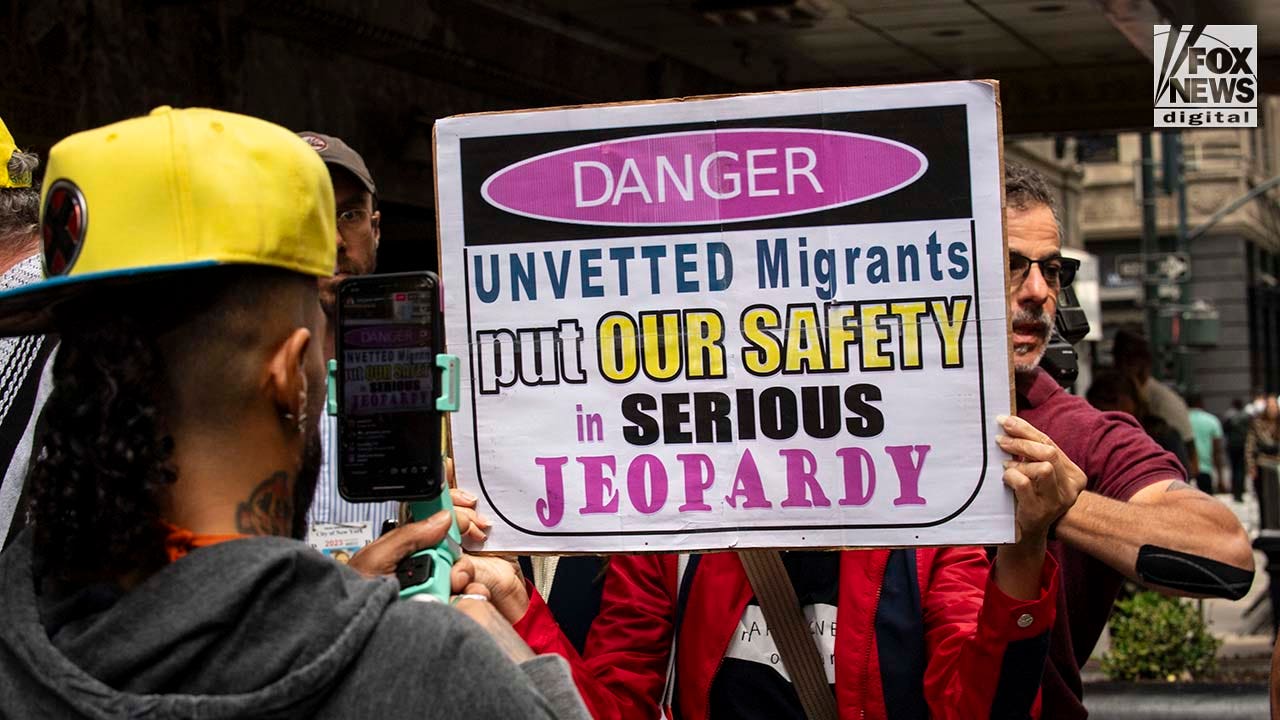
Staten Island residents and local leaders have attacked New York City’s attempts to shelter migrants in their neighborhoods. (Julia Bonavita/Fox News Digital)
Carr, a Republican, noted that it was unlikely the church could even be equipped to be converted into a shelter, insisting that Staten Island is not under any obligation to provide shelter for migrants.
“We should be talking about closing shelters, winding them down, not opening up new ones like the one that they intend to put behind us,” he said, indicating the church behind them.
“I’m not just against migrant shelters in my backyard,” Carr continued. “I’m against migrant shelters in everyone’s backyard.”
NYC RESIDENTS PROTEST ON STATEN ISLAND AS MIGRANT CRISIS WORSENS, CLAIM THEY ARE ‘NOT BEING VETTED’: REPORT
Speaking with Fox News Digital, Fossella said that Staten Island has frequently pushed back against some of New York City’s efforts to open more migrant shelters in their borough. For example, in September, a Staten Island judge ruled that a school being used to house migrants had to be vacated.
“From day one, we’ve been pretty clear that we feel that this policy is unsustainable. And clearly, it’s been unsustainable,” he said.
Fossella attacked New York City’s “right to shelter” mindset when it comes to welcoming migrants.
He further attacked the way New York City has been handling the migrant crisis over the past few years.
“Every day, people from all over the world come, and they roll the dice and once they cross the border, they are sent to wherever they want to go. And the unfortunate situation in New York City is the belief that’s wrong, that there’s this so-called ‘right to shelter’ that the city has an obligation to accommodate them, to put them up in hotels, to feed them, to give them mopeds, to give them iPhones. It’s wrong. It’s just not true,” Fossella said.
As of Monday night, Fossella stated that he had not yet heard back from the city.
Fox News Digital reached out to the New York City mayor’s office for a comment.
Read the full article from Here
Boston, MA
Poor Clares’ monastery a case study in why Boston is short on housing – The Boston Globe
But the story of the Poor Clares’ monastery — or as it’s known on the books of the Boston Planning Department, 920 Centre Street — is, at least for now, a case study on how housing doesn’t get built in this city.
It’s a story about how one midsized project with everything going for it — a world-class architect, a brilliant landscape designer, and a developer willing to make one compromise after another to the size and layout of the plan — still can’t move the needle in the face of one powerful opponent.
Well, make that one powerful opponent who has the ear of City Hall.
Faced with dwindling numbers in their order (they were down to 10 in 2022) and a Vatican mandate to consolidate, the sisters decided to sell their 2.8-acre parcel and the aging monastery building to developer John Holland. The building, which they had occupied since 1934, was expensive to heat and in need of extensive repairs.
They relocated to Westwood in 2023, hoping to expand those quarters to accommodate another 10 nuns from around the country as soon as the sale of the Jamaica Plain property became final, contingent on the approval of its redevelopment.
They’re still waiting.
The former monastery is neighbor to the Arnold Arboretum, land owned by the city but under a renewable 1,000-year lease to Harvard University. And no question, the 281-acre parcel is a tree-filled treasure for researchers and picnickers alike. Just try getting near the place on Lilac Sunday.
But the Arboretum, or rather its director, William Friedman, a Harvard evolutionary biology professor, has emerged as a powerful foe.
“The development has been part of the city’s planning process for nearly five years and has undergone several revisions,” Sr. Mary Veronica McGuff, the order’s abbess, wrote in a letter to Mayor Michelle Wu in January and shared with the editorial board. “We are very disappointed to learn that the main obstacle is … the Arnold Arboretum.”
She revealed that the order had earlier offered to sell the property to the Arboretum, but was rebuffed.
“It’s upsetting that our progress is now being hindered by an institution that declined the opportunity to take stewardship of the land and is now making unreasonable demands for its redevelopment,” she said in the letter.
In fact, its market rate condo component, once slated to be five stories high, has been reduced to four stories. Those 38 senior rental units planned for the monastery building will include 25 affordable units.
Project architect David Hacin, winner of the Boston Preservation Alliance’s 2022 President’s Award for Excellence, is equally bewildered.
“I don’t understand how a project that is so good on so many levels is being held up for years, literally, over asks that seem, to me, completely unreasonable,” Hacin told Globe business reporter Catherine Carlock. “If we can’t build five-story buildings, how are we going to solve the housing crisis?”
How indeed.
The developers have done shadow studies, a sunlight analysis, and tree root studies to convince Arboretum officials that the planned housing would do no damage to the magnolia tree roots on the perimeter of Harvard’s grounds, which seem to be their main bone of contention.
The project’s landscape architect Mikyoung Kim has surely not acquired her international reputation for “ecological restoration” by murdering magnolia trees.
Friedman has met with Boston’s planning chief, Kairos Shen, but as of Thursday the sisters have not yet been granted a similar opportunity. Nor have they heard from either Wu or Shen (who was copied in on the Jan. 12 letter) since they made their appeal for help “in finding a solution that allows this project to move forward and for our community to finally settle into our new home.”
In a statement to the Globe editorial board, Wu said, “Large properties like 920 Centre Street are significant housing sites for Boston, and we are working actively with all parties to advance a plan that would deliver homes our city needs.”
For the past year, experts have been warning that the slumping number of building permits in Greater Boston — down 44 percent last year from four years ago — do not bode well for an increase in the future housing supply. That dearth in supply is driving up prices and rents.
And while the Wu administration is quick to blame President Trump’s tariffs and rising costs for the construction slump, it fails to look in the mirror. Enabling the kind of Not In My Back Yard obstructionism that is keeping a good project on the drawing boards for years will never get Boston the kind of housing it needs to keep pace with demand and allow this city to thrive.
Editorials represent the views of the Boston Globe Editorial Board. Follow us @GlobeOpinion.
Pittsburg, PA
Plum Borough parents charged with supplying alcohol for underage drinking party
Two parents are facing charges after police say more than 60 teenagers were drinking at a large party in their Plum Borough home.
According to court paperwork, Ian and Corrine Dryburgh have been charged with endangering the welfare of children, corruption of minors, and furnishing liquor to minors stemming from the incident that happened at a home in Plum Borough late last month.
Police said that officers went to the home after receiving a tip about a large party involving high school aged children.
When officers arrived at the home, they found numerous teenagers, empty beer cans and empty seltzer cans, and multiple bottles of vodka.
The parents told police that a birthday party for their 17-year-old daughter got out of hand and that some kids has been kicked out, but more came and they didn’t know what to do.
According to the criminal complaint, officers said they had been called to the home two previous times for similar reasons.
Police said a total of 66 underage kids were at the home.
Court records show that both parents have been cited via summons and preliminary hearings are scheduled for mid-April.
Connecticut
Connecticut to receive $154 million for rural health
Connecticut is set to receive more than $154 million aimed at improving health care in rural communities.
The funding comes from the Centers for Medicare & Medicaid Services’ Rural Health Transformation Program, according to a community announcement.
The Connecticut Department of Social Services will lead the initiative, partnering with other state agencies to implement projects across four core areas: population health outcomes, workforce, data and technology, and care transformation and stability, according to the announcement.
The program will include several innovative projects, such as a mobile clinic pilot with four primary care and four dental vans, a health workforce pipeline through the Area Health Education Center and UConn Health Center, and community health navigators.
“Rural Connecticut has unique challenges, and its residents deserve the same access to high-quality care and support as anyone who lives anywhere else,” Lamont said. “This investment allows us to tackle those challenges head-on – from expanding mental health services and building a stronger health care workforce to modernizing our technology infrastructure and connecting residents to the services they need. This is about making sure every corner of Connecticut has the opportunity to thrive.”
The program was developed through extensive public engagement, including more than 250 written comments, meetings with health care providers, local government officials and community organizations, as well as in-person and virtual listening sessions held across the state, according to the announcement.
Andrea Barton Reeves, commissioner of the state Department of Social Services, highlighted the program’s long-term vision.
“This program reflects our commitment to building systems that work for rural residents over the long term,” she said in the release. “We are excited and grateful to CMS for this opportunity to make sure that our investments are coordinated, impactful, and built to last.”
The program aims to bring health care closer to rural residents while supporting the workforce that provides care, said Dr. Manisha Juthani, commissioner of the state Department of Public Health.
“Every person in rural Connecticut deserves good health care close to home, and the people who provide that care deserve real support too,” Juthani said. “This funding helps us bring care to where people are and build the healthcare workforce our communities need. When we invest in both, we give everyone a better chance at staying healthy.”
Additional information about the Rural Health Transformation Program, including opportunities for public engagement, will be made available as implementation proceeds.
For more information, visit the Connecticut Department of Social Services website at ct.gov/dss.
This story was created with the assistance of Artificial Intelligence (AI). Journalists were involved in every step of the information gathering, review, editing and publishing process. Learn more at cm.usatoday.com/ethical-conduct.
-
World1 week agoExclusive: DeepSeek withholds latest AI model from US chipmakers including Nvidia, sources say
-
Wisconsin4 days agoSetting sail on iceboats across a frozen lake in Wisconsin
-
Massachusetts3 days agoMassachusetts man awaits word from family in Iran after attacks
-
Massachusetts1 week agoMother and daughter injured in Taunton house explosion
-
Maryland5 days agoAM showers Sunday in Maryland
-
Florida5 days agoFlorida man rescued after being stuck in shoulder-deep mud for days
-
Denver, CO1 week ago10 acres charred, 5 injured in Thornton grass fire, evacuation orders lifted
-
Oregon7 days ago2026 OSAA Oregon Wrestling State Championship Results And Brackets – FloWrestling
