Northeast
Fetterman calls for bipartisan cooperation as he continues working across party lines on key issues

NEWYou can now listen to Fox News articles!
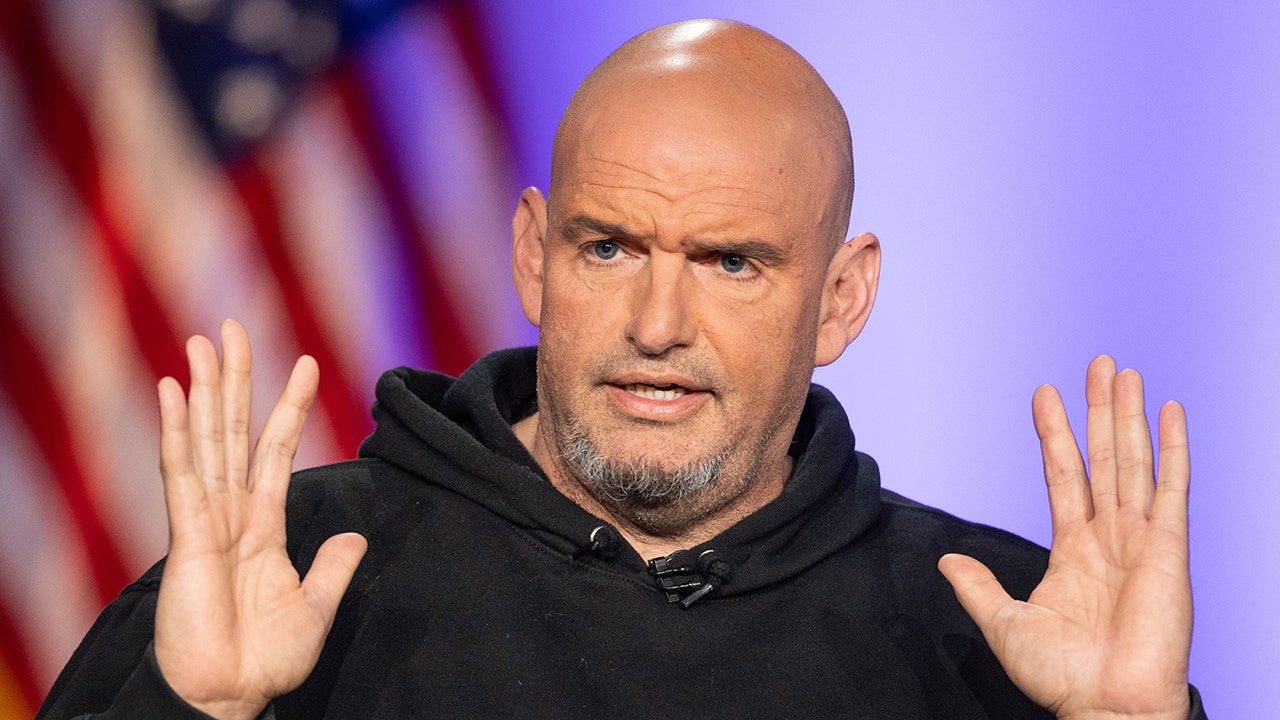
Sen. John Fetterman, D-Pa., joined Lara Trump to discuss why he believes it is so important to have conversations with both sides of the political divide in a Saturday interview on “My View.”
Lately, the Pennsylvania senator has broken ranks with his party over issues including U.S. Attorney General Pam Bondi’s confirmation, support for the Laken Riley Act for Border Security and U.S. strikes on Iranian nuclear sites.
Now, it’s his position on the government shutdown that is drawing attention.
“Whether it’s Republican or Democrat, whatever is driving the shutdown, that’s always wrong,” Fetterman said. “You may have a noble goal, but that is the wrong tactic.”
FETTERMAN APOLOGIZES FOR DEMOCRATS NOT GETTING THEIR ‘S— TOGETHER’ AND OPENING GOVERNMENT
He said his drive is to bridge the deepening political divide to the “purple” state he represents.
“I’m not just representing Democrats,” Fetterman said. “I’m representing 13 million Pennsylvanians.”
He also emphasized the importance of working on legislation with his Republican colleagues. Following the murder of Georgia nursing student Laken Riley, he partnered with Sen. Katie Britt, R-Ala., on the Laken Riley Act.
“She reached out saying, ‘Hey, would you be willing to co-sponsor?’”
“I’m very, very pro-immigration, always have been,” he said. But he acknowledged that his party has “done a bad job” securing the border.
Fetterman and Britt also introduced the Stop the Scroll Act, which would require social media companies to include mental-health warning labels on their platforms.
REPUBLICANS DUB FETTERMAN ‘VOICE OF REASON’ AFTER HE ACCUSES HIS OWN PARTY OF ‘PLAYING CHICKEN’
Sen. John Fetterman speaks to reporters in the Senate subway during a series of confirmation votes for President Donald Trump’s Cabinet nominees at the Capitol on Feb. 12, 2025, in Washington, D.C. (Anna Moneymaker/Getty Images)
Regarding strikes in Iran, Fetterman takes pride in supporting them.
“How can we allow Iran to acquire a nuclear weapon?” Fetterman thought. “That would transform the Middle East for the worst.”
The strikes also were heralded as creating conditions for a ceasefire between Israel and Hamas. Fetterman praised it as a geopolitical success for President Donald Trump, one that he thinks his own party has been too hesitant to celebrate.
FETTERMAN SAYS HE KNOWS AND LOVES TRUMP VOTERS: ‘I’M THE ONLY DEMOCRAT IN MY FAMILY’
The Pennsylvania senator also discussed his January dinner with the president, describing a positive conversation where they found common ground.
“It’s not about bending the knee,” he said.
Fetterman said labeling political opponents as “Nazis” or “fascists” only deepens division because it “implies that the people who vote for them must be the same too.”
CLICK HERE TO DOWNLOAD THE FOX NEWS APP
He warned that harsh rhetoric has worsened in the wake of Charlie Kirk’s assassination.
“I refuse to believe the very worst things about the other side, because I just know that’s not true,” Fetterman said.
“We are forgetting that we [Republicans and Democrats] need each other,” he added.
Read the full article from Here



Trump blames Democrats for shutdown and defends ICE in airports
President Trump blamed Democrats for the ongoing partial government shutdown and defended his choice to put ICE in airports.
Democrats are gaining ground ahead of the 2026 midterms, a new poll from Saint Anselm College Survey Center revealed.
The poll, released March 23, found Democrats lead the generic ballot 49% to 41%, up four points from November. That increase is likely due to concerns over the economy and foreign policy: 59% of voters surveyed oppose the recent military action in Iran, and a slight plurality now trust Democrats over Republicans on economic and affordability issues.
“War and economic uncertainty are creating headwinds for Republicans in New Hampshire, putting Congressman Chris Pappas in a stronger position than in our previous survey,” said Neil Levesque, the executive director of the New Hampshire Institute of Politics, in a statement.
The poll found Pappas leads both of his potential Republican challengers, former New Hampshire Sen. John Sununu and former Massachusetts Sen. Scott Brown, in hypothetical matchups for Senate. Rep. Maggie Goodlander, D-NH, also “restored her lead” against 2024 Republican nominee Lily Tang Williams.
Democrats also have more enthusiasm: 96% are “extremely likely” to vote in the midterm elections, compared to 88% of Republicans.
Despite the rise in support for Democrats, Gov. Kelly Ayotte still has a slight positive approval rating and beats her potential opponents in hypothetical head-to-head matchups. And President Donald Trump’s approval rating has remained largely unchanged.
The poll surveyed 1,491 New Hampshire registered voters online from March 16 to 18. The margin of error is +/-2.5%.
What is Kelly Ayotte’s approval rating?
The poll found Ayotte’s approval rating was 49%, with 47% disapproval. Her net approval is slightly down from November, when she was at 49% to 43%.
However, she still polls ahead of her two Democratic challengers for governor. Ayotte leads former executive councilor Cinde Warmington 46% to 39% and former Newmarket restaurant owner Jon Kiper 45% to 31%.
In the Democratic primary, Warmington leads Kiper 40% to 13%.
What is Donald Trump’s approval rating?
Forty-two percent of New Hampshire voters approve of Trump’s performance, the poll found, while 58% disapprove.
The same split is found on his favorability: 42% find Trump favorable, while 58% find him unfavorable.
This is largely unchanged from November, when he was at 57% disapproval and 57% unfavorable.
Buttigieg overtakes Newsom, Rubio gains support in 2028 primary polls
As presidential hopefuls continue to visit the early primary state, the Saint Anselm poll found some shakeups in an early look at the 2028 presidential primaries.
Former Transportation Secretary Pete Buttigeig, who finished second in the state in 2020, is an early favorite with 29% support from Democratic voters. At 15%, California Gov. Gavin Newsom has fallen back, the poll says, and he is followed by Rep. Alexandria Ocasio-Cortez (10%) and former Vice President Kamala Harris (6%).
While Vice President J.D. Vance remains the top choice on the Republican side with 46%, his support has fallen from 57% in November while Secretary of State Marco Rubio has risen in the ranks.
“Rubio has tripled his support from 9% to 27%, and must now be considered a significant potential challenger to Vance,” the poll says.

New Jersey Gov. Mikie Sherrill is ordering big changes in transit, aiming to give commuters a cleaner, safer and more reliable ride.
On Tuesday at Secaucus Junction, she signed an executive order that pushes NJ Transit to improve the rider experience. That includes everything from station cleanliness to overhauling the app.
“And making sure that people have real-time data. You should be able to look at your app and know if your train’s running on time,” Sherrill said.
The order requires state transportation leaders to deliver a full improvement plan within 45 days.
NJ Transit will hold public listening sessions and launch a new rider survey.
The agency’s CEO, Kris Kolluri, said the order provides him with a clear roadmap.
“That basically will tell the commuters what we and the governor are going to do to implement some of these things that the commuters have been asking for,” Kolluri said. “I think that is the kind of road map that has not existed before.”
Once the plan is submitted, NJ Transit will have another 45 days to fast-track the top priorities.

HARRISBURG, Pa. (WHP) — The Pennsylvania House of Representatives passed a bill Tuesday that would raise the minimum wage statewide.
The bill would raise Pennsylvania’s minimum wage from $7.25 per hour to $11 per hour starting Jan. 1, 2027. The minimum wage would then increase to $13 per hour in 2028 and finally $15 per hour in 2029.
Representatives voted 104-95 to pass House Bill 2189, which is sponsored by Rep. Jason Dawkins, the House Democratic Communications Office announced Tuesday.
If the bill passes, counties would have the option to implement the $15 per hour minimum wage sooner than 2029. The bill would also set the minimum wage for tipped employees at 60% of the statewide minimum wage.
Pennsylvania’s minimum wage was last raised in 2009 when the federal minimum wage was increased to $7.25, House Democrats wrote in a press release.
The bill now moves to the state Senate for consideration.
BE THE FIRST TO COMMENT
“Research shows that increasing the minimum wage does not lead to job losses or business closures,” Dawkins said. “What it does lead to is financial security and better life outcomes for families relying on minimum wage work. To my colleagues in the Senate, I implore you to take up this bill and finally raise the wage in Pennsylvania.”

Missouri Senate committee hears bill on private school bathroom policies for transgender students

‘Hannah Montana’ fans question Starbucks drink. ‘She hates raspberry’.

More than 300 attend Concordia Nebraska church work student luncheon

Jeff Choate evaluates spring camp following Nevada’s first padded scrimmage

Democrats gain ground in NH, new St. Anselm poll shows

Florida High School Football Rankings: Top 25 teams – Oct. 21

How old is Bo Nix? What to know about Oregon quarterback ahead of 2024 NFL Draft

Cleary's 21 help Le Moyne down Central Connecticut State 69-64 in OT

99th annual Pony Swim held in Virginia

Indiana Members Credit Union announced as new anchor tenant at Bottleworks District

Video: Passengers Wait in Long Security Lines at LaGuardia After Deadly Crash

King Charles to address Congress in historic first state visit to Washington

Iran names successor to security chief killed in US-Israeli attack

See How the LaGuardia Plane Crash Unfolded

Mullin confirmed as DHS chief as lawmakers near solution on shutdown standoff
-

 Detroit, MI6 days ago
Drummer Brian Pastoria, longtime Detroit music advocate, dies at 68
-

 Georgia1 week ago
How ICE plans for a detention warehouse pushed a Georgia town to fight back | CNN Politics
-

 Movie Reviews6 days ago
‘Youth’ Twitter review: Ken Karunaas impresses audiences; Suraj Venjaramoodu adds charm; music wins praise | – The Times of India
-

 Alaska1 week ago
Police looking for man considered ‘armed and dangerous’
-

 Education1 week ago
Video: Turning Point USA Clubs Expand to High Schools Across America
-
 Science1 week ago
Long COVID leaves thousands of L.A. county residents sick, broke and ignored
-

 Sports3 days ago
IOC addresses execution of 19-year-old Iranian wrestler Saleh Mohammadi
-
 Science1 week ago
Industrial chemicals have reached the middle of the oceans, new study shows