Northeast
Daniel Penny trial: Key witness in Marine vet chokehold case admits he lied

The subway rider seen on video helping Marine vet Daniel Penny hold down Jordan Neely after an outburst on a Manhattan train took the witness stand and revealed he lied to District Attorney Alvin Bragg’s office when investigators first interviewed him.
Eric Gonzales, a 39-year-old father of two, gave testimony during Penny’s trial Tuesday after prosecutors agreed not to charge him in exchange for testifying in Penny’s manslaughter trial, telling the court he said aloud that the former serviceman was not squeezing “tight enough” during the altercation.
“He’s their main witness, and his credibility was shot after being confronted with this,” said David Gelman, a Philadelphia-area defense attorney and former prosecutor who has been closely following the case.
Although he initially gave detectives a different story, he arrived after Penny had already taken Neely down.
DANIEL PENNY THOUGHT HE WAS PROTECTING A DIVERSE SUBWAY CAR, BUT PROSECUTORS HIGHLIGHT RACIAL UNDERTONES
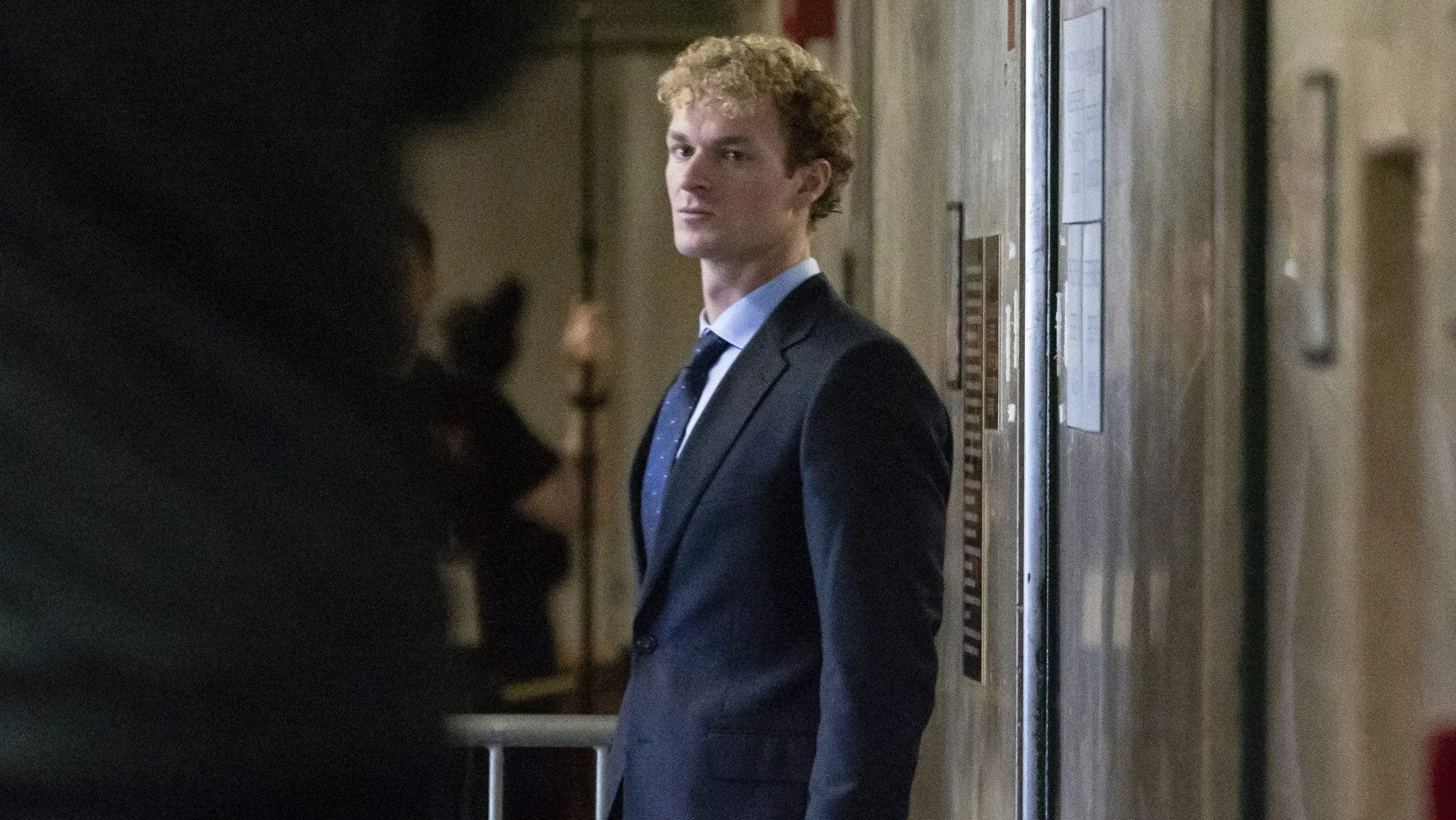
Daniel Penny arrives at the court after a break in New York City on Tuesday, Nov. 12, 2024. (AP Photo/Yuki Iwamura)
“Everybody was frantic and saying, call the cops, call the cops,’” Gonzales said. “I see those two individuals on the floor, so I assumed one was trying to restrain the other until the cops came.”
Gonzales’ evolving story could be fodder for the defense, according to experts.
“Any witness that lies, at any time during the case, loses credibility and a good defense attorney will exploit that,” said Louis Gelormino, a Staten Island defense lawyer who has tried two cases in front of Judge Maxwell Wiley, who is overseeing the Penny trial.
Neely barged onto the train, threw his jacket on the floor, raised his fists and started making death threats, according to witnesses.
Gonzales said that when he arrived on the scene, he waved his hand in front of Penny’s face to let him know he was jumping in to help and then grabbed Neely’s arms and held them.
Screenshot from bystander video showing Jordan Neely on the ground after Daniel Penny and Eric Gonzales let go of him on a New York City subway car. (Luces de Nueva York/Juan Alberto Vazquez via Storyful)
“I said I was gonna grab his hands so you can let go, giving him a different option to restrain him until police came,” he testified. “If I held his arms down he could let go of his neck. I didn’t think anything of it at the moment, I was just giving him an alternative.”
Neely continued to struggle, but the two continued to hold him down, waiting for the police. Gonzales said he did urge Penny to loosen his grip but later told him to grab tighter.
JUDGE DENIES MARINE VET DANIEL PENNY’S MOTION FOR MISTRIAL IN SUBWAY CHOKE HOLD CASE DESPITE ‘BIAS’
“Jordan Neely tapped on another individual who was kneeling by Penny’s head saying to let him go, he wanted to be released,” Gonzales said. “I told him, ‘We’re not gonna let you go.’”
Bystander video that prosecutors played in court shows Gonzales telling Neely, “We’re not gonna let you go until the cops arrive.”
As the three struggled on the floor, Gonzales said another rider was delivering commentary on a FaceTime call.
WATCH: Defense attorney breaks down Marine vet’s motion for a mistrial in subway chokehold death
“We were struggling at the time, and I see an individual who was FaceTiming with his wife saying something along the lines of if he has a poop stain on him that means he’s gonna die or pass out,” Gonzales testified.
DANIEL PENNY TRIAL: SUBWAY MADMAN RAISED FISTS BEFORE MARINE VET’S DEADLY CHOKEHOLD, WITNESS TESTIFIES
Other witnesses previously described how Neely “smelled like soiled sweatpants” when he barged into the train and started making threats. Gonazles said he acknowledged a brown stain on his pants – but “it was old.”
“It was a dry stain he had on his pants,” he said.
He said he was frustrated with the FaceTimer because he was talking but not helping.
“I was doing everything possible to basically shut him up,” he said. “At one point he was telling Daniel Penny not to hold too tight or said he was holding too tight. To try to dismiss him and shut him up, I said that Penny wasn’t holding on tight enough.”
This image from body camera video provided by New York City Police Department, Daniel Penny, left, looks on in a New York City subway car as officers attempt to revive Jordan Neely on May 5, 2023. (New York City Police Department via AP)
Under cross-examination, Gonzales said he originally told prosecutors that when he said Penny was not squeezing hard enough, he saw a gap between his arm and Neely’s chin, and Penny’s arm was on his chest, not around his throat.
He said part of the concern as the two held Neely down was that he might “fight or escape” before police arrived. He remembered telling detectives that Penny was restraining but not choking Neely, but on the stand backtracked and said he had only made “an assumption” and that Penny’s arm was “against his neck.”
At some point, Neely went limp, and he let go. Penny let go shortly thereafter, Gonzales testified. He said he checked for a pulse and found one before stepping away.
TEEN WITNESS TO JORDAN NEELY CHOKE HOLD TESTIFIES SHE WAS ‘SCARED’ BY HIS SHOUTING, WANTED TO ‘GET AWAY’
This undated photo, provided by Mills and Edwards, LLP, in New York, Friday, May 12, 2023, shows Jordan Neely with Carolyn Neely, an aunt. (Courtesy Mills & Edwards, LLP via AP)
He left and continued his workday and learned of Neely’s death in a newspaper the following morning, when a coworker showed him he was in a photo at the scene.
“I took all my vacation time – I went into hiding in other words,” Gonzales said.
Police found him about a week after the incident, and he then met with an assistant district attorney (ADA). He testified that he remembered being scared about “getting pinned for a murder charge.”
Then, he said, he lied to prosecutors, telling them he arrived at the altercation earlier than he really did and that Neely hit him first.
PROTESTERS ACCUSE MARINE VET OF WHITE SUPREMACY AS JURY SELECTION BEGINS IN SUBWAY VIGILANTE CASE
Screenshot from bystander video showing Jordan Neely being held in a chokehold on the New York City subway. As Neely struggled against the headlock, witness Eric Gonzales held Neely’s hands away. (Luces de Nueva York/Juan Alberto Vazquez via Storyful)
“I fabricated a story to the ADA – I lied to the ADA,” he said. “I told the ADA that as things were transpiring, [that] I was there on-site when everything went down. I told the ADA that Neely had struck me first, and then everything went down.”
However, prosecutors already had photos of him at a turnstile at the time Penny first grabbed Neely.
“I saw a still photo of me just finishing swiping my Metro card at the time,” he said.
During this interview, he also told prosecutors that he asked Neely if he was OK after letting go, and Neely said yes.
Prosecutors later offered him immunity in exchange for testifying against Penny, he said.
The defense asked the court about investigators’ notes during the Gonzales interview, saying only a few had been provided in discovery. Prosecutors claimed they had turned over everything they had.
Gonzales also said he’s still scared about testifying despite the prosecution’s immunity offer – saying he believes he or his family could be harmed if he testifies in favor of Penny.
“The DA is making this a race case,” Gelman said. “So they are thinking, OK we know there are issues here including weak witnesses and others who are contradicting the DA narrative, but the person who died is Black because of a White man. We will roll the dice.”
Penny faces up to 19 years in prison if convicted of manslaughter and criminally negligent homicide.
He is not accused of murder or a hate crime – but his defense team repeatedly objected to the prosecution’s attempts to highlight racial undertones in the case last week, moving to declare a mistrial and asking the judge to strike testimony from a “biased” witness.
Read the full article from Here


Connecticut is taking a major step to prepare its workforce for the growing influence of artificial intelligence, as Charter Oak State College announces a significant expansion of its AI Academy.
Through this initiative, developed in partnership with the Business-Higher Education Forum and Axim Collaborative, Charter Oak learners, job seekers, educators, and employees of small and mid-sized businesses will gain new pathways to in-demand careers using the Open edX platform.
Charter Oak, which is part of the Connecticut State Colleges & Universities (CSCU) system, is the state’s only public online college.
At a time when artificial intelligence is rapidly transforming industries ranging from healthcare to finance, the expansion reflects both urgency and opportunity. Employers are increasingly seeking workers who understand how to apply AI tools effectively, yet many job seekers and organizations lack access to affordable, relevant training. The AI Academy is intended to close that gap by aligning education directly with workforce needs.
This effort addresses a pressing economic challenge: ensuring that small and mid-sized businesses — which employ nearly half of Connecticut’s workforce — are not left behind as AI reshapes industries.
“Connecticut’s economic strength lies in its small and medium-sized businesses. The expansion of the AI Academy is a direct investment in those businesses, providing them with the high-level AI fluency typically reserved for large corporations. Furthermore, by bringing a tool-agnostic, mindset-first approach to our K-12 districts, we are helping educators move past the ‘hype’ and focus on the strategic deployment of AI. We aren’t just teaching people how to use AI; we are empowering Connecticut’s schools and businesses to lead with it,” said Dr. Dave Ferreira, Provost, Charter Oak State College.
The expanded AI Academy will offer stackable credentials over a three-year period, combining technical training with durable skills like communication, problem-solving, adaptability, and digital literacy. Learners will be able to progress at their own pace, building credentials that align with specific career pathways while remaining flexible enough to adapt to changing job market demands.
The program is designed with direct input from more than 100 leaders across business and higher education, including major employers in insurance, consulting, and technology. That collaboration ensures the curriculum reflects real-world needs, helping participants gain skills that are immediately applicable in the workplace.
A key component of the initiative is a new pathway for K-12 school districts. Rather than focusing on specific tools or platforms, the program emphasizes building an “AI mindset” — equipping educators and administrators with the knowledge to make informed, strategic decisions about how AI is used in classrooms and operations. This approach is intended to help school systems develop sustainable policies that can evolve alongside rapidly changing technology.
“The future of work demands a new kind of collaboration,” said Kristen Fox, CEO of the Business-Higher Education Forum. “When employers and institutions join forces to equip learners with AI skills and durable competencies, we create real pathways for people to unlock new opportunities, advance their careers, and thrive in an economy that is changing faster than any one sector can address alone. This is the model we need — and Connecticut is showing how it’s done.”
In addition to supporting businesses and schools, the initiative aims to expand access for individuals who have traditionally faced barriers to career advancement. By offering flexible online learning, the program is designed to reach underemployed workers, adult learners, and those seeking to transition into new fields.
The academy will begin with foundational AI coursework and expand into high-demand fields such as business, health technology, and cybersecurity — sectors where the need for skilled workers continues to grow. Over time, the program is expected to scale statewide before expanding nationally, with a goal of reaching 10,000 learners over the next five years.
“By partnering with employers to co-design AI-focused curricula, Charter Oak and BHEF are equipping learners with the skills and experiences they need to thrive in a changing economy while fueling regional economic development,” said Stephanie Khurana, CEO of Axim Collaborative.
The effort builds on Charter Oak’s existing CT AI Academy, launched in 2025, which has already served more than 3,500 residents with free AI training. That early success demonstrated strong demand for accessible AI education and helped lay the foundation for this expanded, more comprehensive model.
State higher education leaders say the initiative strengthens Connecticut’s long-term workforce pipeline while positioning the state as a model for others seeking to align education with economic development.
As artificial intelligence continues to reshape the workplace, Connecticut’s approach highlights how coordinated investment in education, business partnerships, and workforce development can help ensure that growth is both inclusive and sustainable — and that workers and employers alike are prepared for what comes next.

David Heidrich lives in Augusta.
From the cliffs of Acadia to the woods and waters of Katahdin’s national monument, Maine’s public lands are more than scenic, they are the backbone of our economy and way of life. Anyone who has spent any amount of time in these or other public places knows that they offer more than just natural beauty. They are central to our identity, drawing visitors from around the world, supporting small businesses and sustaining jobs in communities across the state.
As someone deeply invested in the success of Maine’s outdoor recreation and tourism industries, I know that investing in our public lands will support thriving communities for generations to come. But maintaining these places requires more than appreciation, it requires sustained investment and action.
In 2020, Congress recognized that many of our country’s national parks and other public lands were suffering from decades of deferred maintenance. Roads, bridges, water systems, historic structures and visitor facilities were aging faster than they could be repaired. In response, lawmakers passed the Great American Outdoors Act, which created the National Parks and Public Lands Legacy Restoration Fund (LRF).
This landmark legislation provided five years of dedicated funding to address long-overdue repairs on federal lands. Here in Maine, the LRF delivered $54 million for critical repairs to our public lands. These investments supported projects at places like Acadia National Park — improving trails, restoring historic carriage roads and upgrading essential infrastructure — as well as work on national forests and wildlife refuges across the state. These projects have served to protect natural resources, improve safety and enhance visitor experiences while supporting local economies.
Now, with that funding having expired, Congress is considering the America the Beautiful Act, introduced by Sen. Steve Daines of Montana and Maine’s own Sen. Angus King. The bill has received strong bipartisan support, and I want to thank Sen. King and Sen. Collins for their leadership in advocating for this important legislation.
The America the Beautiful Act rises above politics and reflects a shared commitment to conservation and safeguarding the places that help define both Maine and our nation. By continuing to invest in our public lands, we ensure they sustain local economies while preserving natural resources for residents, visitors and future generations alike.
Outdoor recreation is a cornerstone of Maine’s economy. Each year, millions of visitors come to experience our parks, trails, waterways and working forests — supporting roughly 32,000 jobs and generating $3.9 billion in economic activity. That is approximately 5% of Maine’s workforce and 4% of its GDP, respectively. Communities throughout Maine depend on these visitors, and the continued health of our public lands is essential to their continued success.
While important progress has been made, maintenance backlogs on our federal lands persist and require reliable, long-term funding. Congress should pass the America the Beautiful Act because it would provide $2 billion per year for eight additional years to address ongoing maintenance needs across national parks and public lands — without raising taxes.
This is accomplished by: 1) dedicating lease and royalty payments from energy producers operating on federal lands and waters to conservation, 2) requiring federal agencies to identify and dispose of unneeded assets, and 3) leveraging private funding by introducing a preference for projects with a 15% financial match from private stakeholders or nonprofit organizations.
By passing this legislation, Congress can ensure that Maine’s treasured public lands remain safe, accessible and vibrant. If we want future generations to experience Maine as we know it today, we need to invest in it now.

Four Massachusetts companies have announced hundreds of layoffs as residents and businesses flee the state due to what critics describe as soaring energy costs, high taxes, and costly climate mandates.
According to the state’s Worker’s Adjustment and Retraining Notification (WARN) tracker, a total of 283 Massachusetts workers are set to lose their jobs by the end of the fiscal year.
That includes 70 planned layoffs at Innovative Care Partners, which has locations in Northampton, West Springfield and Pittsfield, by June 30; 78 layoffs at Community Health Link at its Webster, Worcester and Lincoln locations, also by June 30; 83 layoffs at Compass Group USA in Boston by July 1; and 52 layoffs at Community Counseling of Bristol County at locations in Attleboro, Brockton, Fall River, New Bedford and Taunton between June 30 and July 13.
These latest notices come as several businesses have been moving out of Massachusetts over the past several months, including some that had been staples of the state’s economy.
In January, the reigning Massachusetts “Manufacturer of the Year,” Curia Global, shut down operations at its Burlington facility. Other notable departures include Thermo Fisher Scientific, Panera Bread, Cape Cod Potato Chips, Zipcar, SynQor, Analogic Corp. and more. Most recently, in April, Takeda Pharmaceuticals announced the elimination of 247 jobs from its Cambridge location.
The Massachusetts Fiscal Alliance told the Herald upon Curia Global’s exit that the Bay State has become an increasingly inhospitable business environment.
“The taxes here are high, the climate regulations are pretty extensive and we also have people in positions of power who don’t seem that interested in growing business here,” Executive Director Paul Craney said.
Healey denounces President Trump’s cap on student loans for health care and social workers
Gov. Maura Healey is responding to the Trump administration implementing a rule limiting access to federal student loans for graduate degrees in the nursing, physical therapy, physician assistants, occupational therapy, education and social work fields.
“At a time when people are already struggling with costs, President Trump is making higher education more expensive and harder to access. This rule is going to push students into more expensive private loans, and it blocks pathways into critical careers in the health care and education spaces,” Healey said in a written statement. “As the daughter of a school nurse, I know firsthand how important these jobs are to our communities.”
Healey spoke in opposition to this new rule back in March and continues to warn that it will increase costs and limit career opportunities. She launched a $15 million state loan repayment program for early education and care professionals along with loan repayments for health and human service workers through the MA Repay Program.
The new rule, implemented by the U.S. Department of Education, caps federal graduate student loan borrowing at $20,500 per year for the listed programs the administration deems not “professional.” The Healey-Driscoll Administration estimates that approximately 13,000 Massachusetts graduate students will be impacted.
Meanwhile, the Trump administration calls it a “common sense” regulation that will help control the ever-increasing costs for higher education.
-

 Augusta, GA3 minutes ago
West Augusta festival celebrates Cinco de Mayo with Latin cuisine
-

 Washington, D.C9 minutes ago
DC Weather: Sunny and pleasantly cool start to May
-

 Cleveland, OH15 minutes ago
Man in critical condition after shooting on Cleveland’s East Side: EMS
-
Austin, TX21 minutes ago
William Brian Moriarty Obituary
-

 Alabama27 minutes ago
A quick history of the University of Alabama for commencement weekend
-

 Alaska33 minutes ago
Book review: ‘The North Face of Summer’ offers a compassionate look at an Alaska conflict
-

 Arizona39 minutes ago
Arizona Lottery Powerball, The Pick results for May 2, 2026
-

 Arkansas45 minutes ago
Arkansas Derby winner Renegade finishes 2nd in Kentucky Derby

